
Imagine trying to change one word in a printed book that has been copied and distributed to ten thousand people. You’d have to find every single copy and update it before anyone noticed the discrepancy. That is essentially what happens when someone tries to tamper with a blockchain block. It’s not just a file; it’s a sealed capsule of data locked into place by math. If you’ve ever wondered why crypto transactions feel permanent or why hacking a ledger is nearly impossible, the answer lies inside the structure of these blocks.
Most people hear "blockchain" and think of Bitcoin prices or NFTs. But strip away the hype, and you’re left with a very specific engineering solution for trust. The core unit here isn’t the coin; it’s the block. Understanding how a block is built helps you grasp why this technology matters beyond finance. Let’s break down the anatomy of a block, piece by piece, without getting lost in jargon.
The Three Pillars of Every Block
Every block in a chain, whether it’s on Bitcoin, Ethereum, or a private enterprise ledger, shares a common DNA. Think of it as a three-layer cake. You can’t remove one layer without the whole thing collapsing.
First, there’s the Data. This is the meat of the sandwich. In a financial blockchain, this means transaction details: who sent money, who received it, and how much. In other networks, it could be medical records, supply chain logs, or smart contract code. The data itself doesn’t care about the order yet; it’s just raw information waiting to be organized.
Second, there’s the Hash. This is the unique digital fingerprint of the block. We’ll get into the math later, but for now, know this: the hash is generated from the block’s contents. If you change even one comma in the data section, the hash changes completely. It’s like a barcode that updates instantly if the product label shifts.
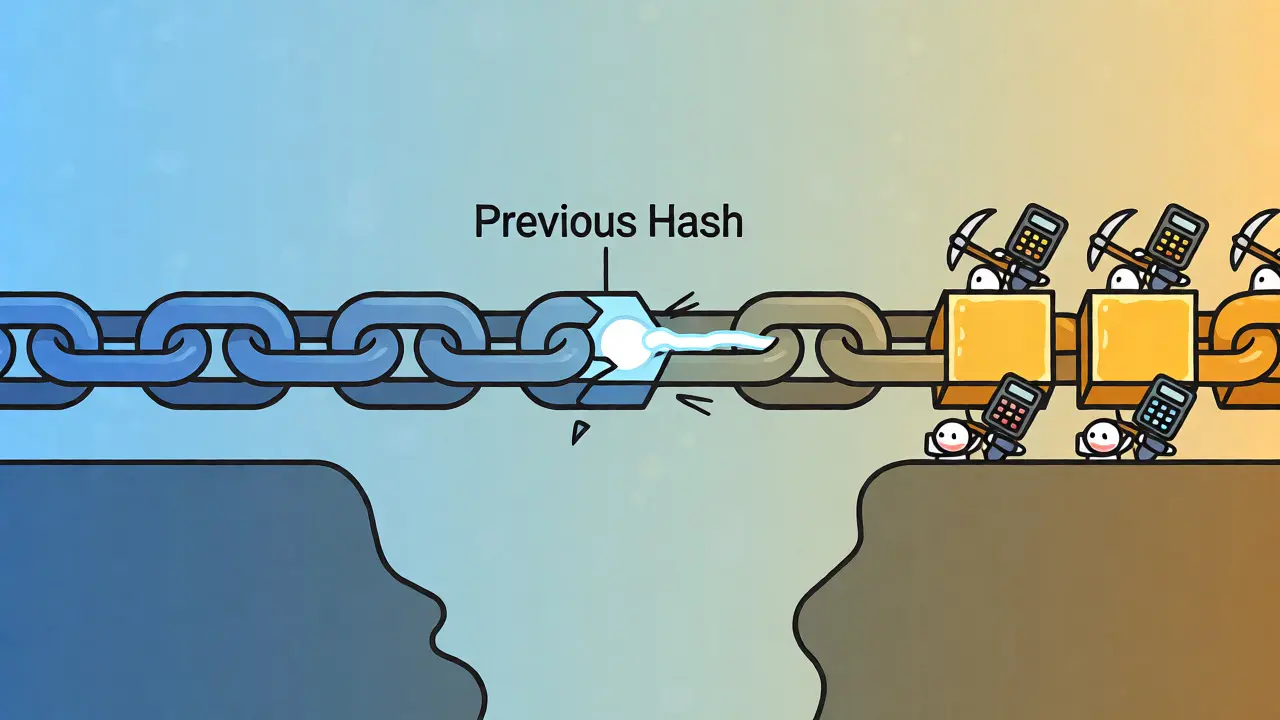
Third, and most crucially, is the Previous Hash. This field contains the hash of the block that came immediately before it. This is the glue. It creates the "chain" in blockchain. By including the previous block’s ID, each new block points backward, creating an unbreakable link. If you try to swap out Block A for a fake version, Block B won’t recognize its parent anymore, and the entire network rejects the chain.
Inside the Block Header: The Metadata Matters
You might assume all the important stuff is in the data section. Actually, the heavy lifting happens in the Block Header. This is the metadata container that keeps the network honest. It’s smaller than the data section but far more critical for security.
The header typically includes four key fields:
- Version: Indicates which set of rules (protocol) the block follows. Software updates happen, so the version number tells nodes how to interpret the rest of the block.
- Timestamp: Records exactly when the block was created. This ensures chronological order. You can’t add a Tuesday block after a Wednesday block unless the timestamp reflects reality.
- Merkle Root: This is a clever compression trick. Instead of hashing every single transaction individually against the header, the network groups them into pairs, hashes those pairs, and repeats the process until one single hash remains. This is the Merkle Root. It allows nodes to verify that a specific transaction exists in the block without downloading the entire history.
- Nonce and Difficulty Target: These are the tools miners use to secure the network. More on that in a moment.
Why does the header matter? Because it’s immutable. Once a block is added, you can’t tweak the timestamp or the Merkle Root without breaking the hash. This prevents sneaky edits where someone might try to backdate a transaction to manipulate interest rates or ownership claims.
The Magic of Cryptographic Hashes
Let’s talk about the hash. Most public blockchains, including Bitcoin, use an algorithm called SHA-256 (Secure Hash Algorithm 256-bit). It takes any amount of input-whether it’s a single letter or a gigabyte of video-and spits out a fixed-length string of 64 characters. Always 64. No exceptions.
Here’s the cool part: SHA-256 is deterministic but unpredictable. If you feed it the same data twice, you get the exact same output. But if you change one pixel in an image or one cent in a transaction, the output looks totally random. There’s no way to guess the new hash without running the calculation again.
| Input Data | Resulting SHA-256 Hash (Simplified) | Status |
|---|---|---|
| "Hello World" | a591a6d... | Valid |
| "Hello world" (lowercase w) | b3a8c1f... | Different Hash |
| "Hello World!" (added exclamation) | c7d2e9a... | Different Hash |
This sensitivity is the backbone of integrity. If a hacker intercepts a block and changes "Alice sends $10" to "Alice sends $100," the hash recalculates instantly. The new hash no longer matches the one stored in the next block’s "Previous Hash" field. The mismatch screams "tampering detected" to every node in the network.

Proof of Work: The Nonce Puzzle
If hashing were free, spamming the network would be easy. Anyone could generate millions of blocks per second. To prevent this, networks require work. In Proof-of-Work systems like Bitcoin, miners compete to solve a mathematical puzzle before their block gets accepted.
The puzzle involves the Nonce (number used once). Miners take the block header, add a random nonce, and run the SHA-256 hash. They check if the resulting hash starts with a certain number of zeros (the difficulty target). If it doesn’t match, they change the nonce and try again. And again. And again.
For Bitcoin, this requires trillions of guesses. It burns real energy because it’s computationally expensive. This cost serves two purposes: it slows down block creation to a predictable pace (every 10 minutes for Bitcoin), and it makes attacking the network prohibitively expensive. To rewrite history, you wouldn’t just need to re-hash one block; you’d need to re-do the proof-of-work for that block and every subsequent block, faster than the rest of the network can build new ones.
Linking Blocks: Creating the Chain
Now, let’s visualize the connection. Imagine Block #100 has a hash of XYZ. When miners create Block #101, they must include XYZ in its header under the "Previous Hash" field. This creates a dependency. Block #101 cannot exist validly unless Block #100 is exactly as it was when XYZ was generated.
What happens if someone tries to alter Block #99? Let’s say they change a transaction amount. The hash of Block #99 changes from ABC to DEF. Now, look at Block #100. Its header still says the previous hash is ABC. But the actual previous block is now DEF. Mismatch. The chain breaks at Block #100. Every block after #100 also becomes invalid because their references are now wrong relative to the altered history.
To fix this, the attacker must recalculate the proof-of-work for Block #99, then #100, then #101, all the way up to the current tip of the chain. Meanwhile, the honest network is adding new blocks every few minutes. Unless the attacker controls more than 50% of the network’s computing power (a "51% attack"), they will never catch up. This is why older blocks are considered "final." The deeper a block is in the chain, the more computational effort is required to undo it.
Beyond Bitcoin: Variations in Structure
While the basic anatomy holds true across most blockchains, implementation details vary. Not every chain uses SHA-256 or Proof-of-Work.
Ethereum, for example, switched to Proof-of-Stake in 2022. Its blocks don’t rely on nonces and energy-intensive mining. Instead, validators stake ETH to propose blocks. The structure still includes a parent hash and state root (similar to Merkle Root), but the validation mechanism differs. Other chains like Solana focus on speed, using different hashing algorithms and shorter block times, which changes how quickly the "chain" grows but not the fundamental logic of linking blocks via hashes.
Enterprise blockchains often skip the open competition entirely. In a permissioned network like Hyperledger Fabric, a trusted consortium decides who validates blocks. The anatomy remains similar-data, hash, previous reference-but the trust model shifts from "mathematical certainty" to "legal agreement." This trade-off offers higher throughput but less decentralization.
Why This Anatomy Ensures Trust
So, why should you care about headers and nonces? Because this structure replaces intermediaries. Banks trust themselves to keep ledgers straight. Governments trust their archives. Blockchain trusts math.
The combination of cryptographic hashing and chained references creates a system where truth is self-evident. You don’t need to ask a central authority, "Did this transaction really happen?" You can look at the block, verify the hash, and see that it links correctly to the past. If the numbers add up, the event occurred. If they don’t, something is wrong.
This transparency reduces fraud. In traditional databases, an admin can quietly edit a row. In a blockchain, editing a row triggers a cascade of errors visible to everyone. It turns data integrity from a policy issue into a technical impossibility.
Frequently Asked Questions
Can I change data in a blockchain block?
Technically, yes, you can change the bits on your hard drive. But the network will reject it. Changing the data alters the block's hash. Since the next block references the old hash, the link breaks. To make the change stick, you'd have to re-mine that block and every subsequent block faster than the rest of the network, which is practically impossible for established chains.
What is a Merkle Root?
A Merkle Root is a single hash that summarizes all transactions in a block. It's created by pairing transactions, hashing them, and repeating the process until one hash remains. This allows light clients (like mobile wallets) to verify a specific transaction exists without downloading the entire blockchain, saving massive amounts of bandwidth.
Do all blockchains use the same block size?
No. Bitcoin limits blocks to roughly 1MB to ensure decentralization and ease of verification. Ethereum's gas limit determines block capacity dynamically based on computational complexity. Other chains like Solana allow larger blocks to support high-frequency trading applications. Block size is a trade-off between scalability and decentralization.
What happens if two blocks are mined at the same time?
This is called a fork. For a brief moment, the network splits into two competing chains. Nodes may temporarily follow different tips. Usually, within a few blocks, one chain accumulates more proof-of-work (or stake) and becomes the canonical chain. The orphaned block's transactions are either included in future blocks or discarded, depending on the protocol rules.
Is the block data encrypted?
Not necessarily. On public blockchains like Bitcoin, transaction data is pseudonymous but transparent. Anyone can see addresses and amounts. Privacy-focused coins like Monero use advanced cryptography (ring signatures) to hide sender, receiver, and amount. However, the structural integrity (hashes) relies on visibility, not secrecy.
Next Steps for Learners
Now that you understand the anatomy, you can start exploring how these blocks interact. Look into Consensus Mechanisms to see how nodes agree on which chain is valid. Or dive into Smart Contracts to see how executable code lives inside these data containers. The block is just the vessel; the applications built on top are where the innovation happens.
Leave a comments