
Trading with borrowed money feels like walking a tightrope. One wrong step, and your entire account vanishes in seconds. That is the reality of crypto margin trading. It offers the chance to multiply your gains, but it also multiplies your losses just as fast. You need more than just luck; you need a platform that doesn’t crash when volatility spikes and doesn’t hide fees in fine print.
In 2026, the landscape has shifted. Regulations are tighter, and users are smarter about security. The "wild west" era of unregulated exchanges is fading. Today, you have choices ranging from massive centralized giants to decentralized protocols that keep your keys in your pocket. But which one actually fits your style? Let’s break down the top contenders based on what matters most: leverage limits, fee structures, security, and whether they even let you trade from where you live.
Understanding the Risks Before You Click "Buy"
Before comparing platforms, we need to be clear about what you are signing up for. Margin trading isn't just buying Bitcoin and hoping it goes up. It involves borrowing funds from the exchange or other traders to increase your position size. This is called leverage.
If you use 10x leverage, a 1% move in price equals a 10% change in your equity. A 10% move against you wipes out your entire collateral. This event is called liquidation. Different platforms handle this differently. Some offer cross-margin mode, where all your funds in the account act as collateral. Others use isolated margin, limiting loss to just the funds allocated to that specific trade. Understanding these mechanics is non-negotiable. No platform can save you if you don't understand how liquidation works.
The Heavyweights: Binance and OKX
When people talk about crypto trading volume, two names always come up first: Binance is the world's largest cryptocurrency exchange by trading volume, offering extensive market depth and a wide variety of trading pairs. For many, it remains the default choice. Why? Liquidity. When you trade on Binance, you are likely getting the best possible price because there are so many buyers and sellers. They offer up to 125x leverage on futures contracts. Their maker fees are incredibly low at 0.02%, and taker fees sit at 0.04%.
However, Binance comes with baggage. Regulatory scrutiny has led to restrictions in several countries, including the United States. If you are a US resident, you cannot use Binance.com. Even outside the US, fiat deposit options can be limited depending on your location. It is powerful, yes, but it requires you to navigate a complex web of compliance rules.
OKX is a leading global cryptocurrency exchange known for its advanced trading tools, Web3 wallet integration, and comprehensive derivatives offerings. Launched in 2017, OKX has carved out a niche for serious traders. With over 50 million users, it offers up to 100x leverage on futures. What sets OKX apart is its flexibility. It supports both cross-margin and isolated margin modes seamlessly. Security is a major selling point here; they use multi-signature wallets and cold storage for the majority of user funds. If you want a professional-grade dashboard without the regulatory headaches of Binance in certain regions, OKX is a strong contender.
High Leverage Hunters: MEXC and Bybit
Some traders crave higher leverage. If 100x isn't enough for you, you might look toward MEXC is a cryptocurrency exchange established in 2018 that specializes in high-leverage trading and listing a vast number of altcoins. MEXC pushes the envelope with up to 200x maximum leverage. That is extreme risk, but the option exists. More importantly for active traders, their fees are aggressive. Spot maker fees can be 0.0000%, and futures maker fees are just 0.010%. They list over 2,700 spot markets, meaning you can find obscure altcoins to trade on margin that aren't available elsewhere.
But there is a catch. Customer service response times can lag during peak hours, and while the asset selection is huge, liquidity on those smaller pairs can be thin. Slippage becomes a real enemy here. You might get filled at a worse price than expected if the order book is shallow.
Then there is Bybit is a popular derivatives-focused crypto exchange known for its user-friendly interface, educational resources, and high uptime reliability. Bybit serves over 75 million users and also offers up to 200x leverage. Unlike MEXC, Bybit focuses heavily on user experience. Their interface is clean, intuitive, and less cluttered. They have invested significantly in educational resources, making them a better starting point for beginners who want to dip their toes into margin trading. They also introduced USDC options trading recently, adding another layer of sophistication. However, like Binance, Bybit restricts access for US residents due to regulatory pressures.
| Platform | Max Leverage | Futures Maker Fee | US Access | Key Strength |
|---|---|---|---|---|
| Binance | 125x | 0.02% | No | Largest Liquidity |
| MEXC | 200x | 0.01% | Yes (Limited) | Lowest Fees & Altcoin Variety |
| Bybit | 200x | Varies by Tier | No | User Experience & Education |
| OKX | 100x | 0.02% | Yes (Restricted) | Advanced Tools & Security |
| dYdX | 20x | 0.02% | Yes | Non-Custodial/Decentralized |
The Decentralized Alternative: dYdX
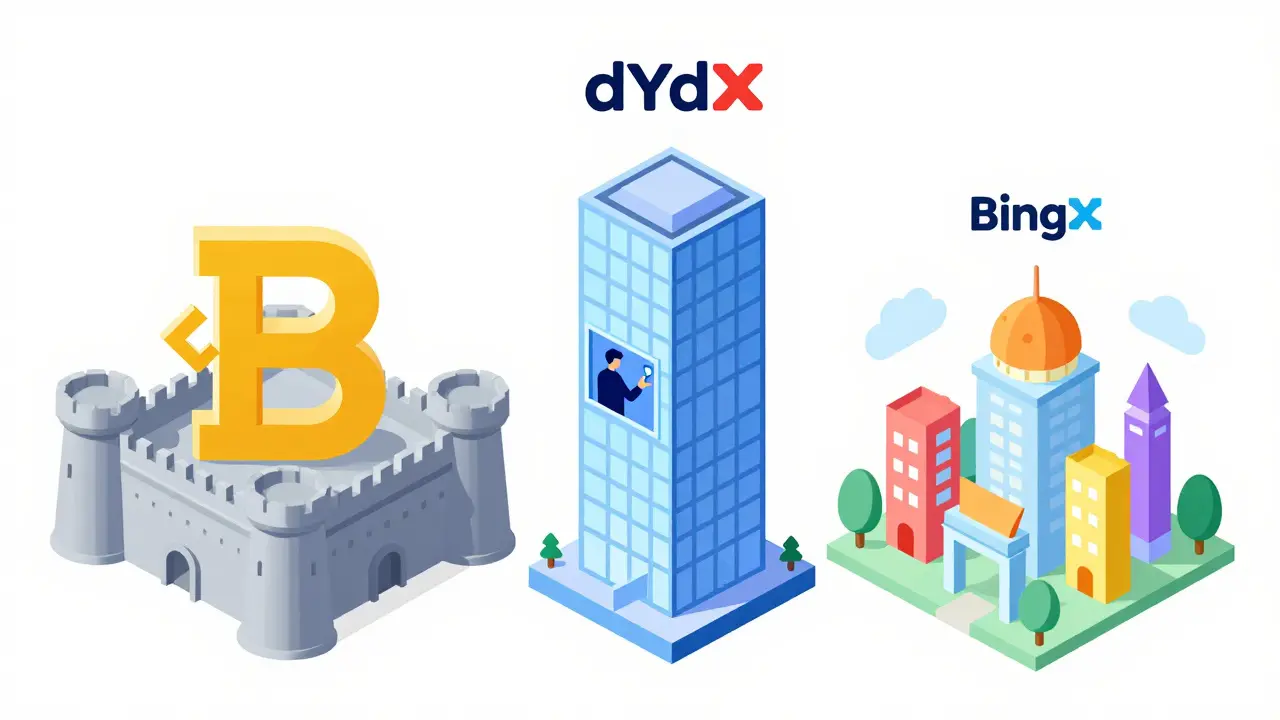
What if you don't trust an exchange to hold your money? Enter dYdX is a decentralized exchange (DEX) built on Ethereum and StarkNet that allows users to trade perpetual contracts without surrendering custody of their assets. dYdX operates differently. It is non-custodial. You connect your own wallet (like MetaMask), and you never send your funds to a central server. This eliminates the risk of the exchange going bankrupt or being hacked in the traditional sense. Your funds stay in your control until you execute a trade.
The trade-off? Convenience and leverage. dYdX caps leverage at 20x. For some, this is a safety feature; for others, it's a limitation. Fees are slightly higher, with maker fees at 0.02% and taker fees at 0.05%. Also, since it is decentralized, you need to already own cryptocurrency in an external wallet to start. There are no credit card on-ramps directly on the platform. Liquidity can also be an issue for less popular pairs. But for traders who prioritize sovereignty and security over maximum leverage, dYdX is unmatched. Its reported 99.9% uptime is impressive for a DeFi protocol.
Regulated and Beginner-Friendly: Coinbase and BingX
Not everyone wants to deal with complex interfaces or offshore entities. Coinbase is a publicly traded, highly regulated cryptocurrency exchange based in the United States, known for its simplicity and compliance with local laws. If you are in the US or prefer strict regulatory oversight, Coinbase is your go-to. They limit leverage to a modest 2.5x. This sounds low, but it drastically reduces the risk of instant liquidation. They offer tokenized shares alongside crypto derivatives, providing a unique hybrid experience. The interface is polished and easy to use, though the fees are higher compared to competitors like Bybit or MEXC. You pay for peace of mind and regulatory compliance.
BingX is a social trading platform that combines spot and margin trading with copy-trading features, catering to retail investors seeking guided strategies. BingX supports up to 20x leverage and stands out for its customer support and quick registration process. It is particularly popular among beginners who want to follow successful traders via copy-trading features. While it lacks the deep liquidity of Binance, it provides a safer learning environment with robust support services.
How to Choose the Right Platform for You
There is no single "best" platform. The right choice depends entirely on your profile.
- For High-Frequency Traders: Look at MEXC or Binance. Low fees matter when you make dozens of trades a day. The 0.01% maker fee on MEXC adds up quickly in your favor.
- For Beginners: Start with Bybit or BingX. The educational resources and cleaner interfaces reduce the cognitive load while you learn the ropes.
- For Security-Paranoid Users: Use dYdX. Keeping custody of your assets is the ultimate hedge against exchange insolvency.
- For US Residents: Stick to Coinbase or Kraken (which offers up to 10x leverage). Avoid platforms that explicitly ban US IP addresses to prevent account freezes.
Always check the current regulatory status in your country before depositing funds. Laws change rapidly. A platform available today might be restricted tomorrow. Diversifying across exchanges can also mitigate risk, but ensure each platform meets your security standards.
Common Pitfalls to Avoid
New margin traders often fall into the same traps. First, chasing high leverage. Just because a platform offers 200x doesn't mean you should use it. Most professionals rarely exceed 5x or 10x. Second, ignoring funding rates. In perpetual futures, you pay or receive a fee every 8 hours to keep the contract price aligned with the spot price. If you hold a large position, these fees can eat into your profits significantly. Third, neglecting stop-losses. Always set automatic exit points. Emotions run high during crashes, and manual intervention is often too slow.
Is crypto margin trading legal in the US?
Yes, but only through regulated exchanges like Coinbase, Kraken, or Bitfinex (with restrictions). Many international platforms like Binance and Bybit do not serve US residents due to CFTC and SEC regulations. Always verify the current legal status in your specific state, as some states have additional bans on derivatives.
What is the difference between cross-margin and isolated margin?
In isolated margin, only the funds allocated to a specific trade are at risk. If you get liquidated, you lose only that amount. In cross-margin, your entire account balance acts as collateral. This reduces the chance of liquidation but risks wiping out your whole account if the market moves sharply against you.
Which platform has the lowest fees for margin trading?
MEXC currently offers some of the lowest fees, with 0.01% maker fees on futures and zero maker fees on spot trading. Binance and dYdX follow closely with 0.02% maker fees. However, always consider withdrawal fees and potential slippage, which can offset low trading fees.
Can I use dYdX if I am new to crypto?
It is challenging. dYdX requires you to manage your own private keys and connect a Web3 wallet like MetaMask. There is no password recovery if you lose your seed phrase. Beginners might prefer centralized exchanges like Bybit or Coinbase first to understand trading mechanics before moving to decentralized platforms.
What happens if my margin position gets liquidated?
The exchange automatically closes your position at the current market price to repay the borrowed funds. You lose the collateral you put up. On some platforms, you may also owe additional funds if the liquidation price falls below your collateral value, though most modern platforms use auto-deleveraging to prevent negative balances.
Leave a comments