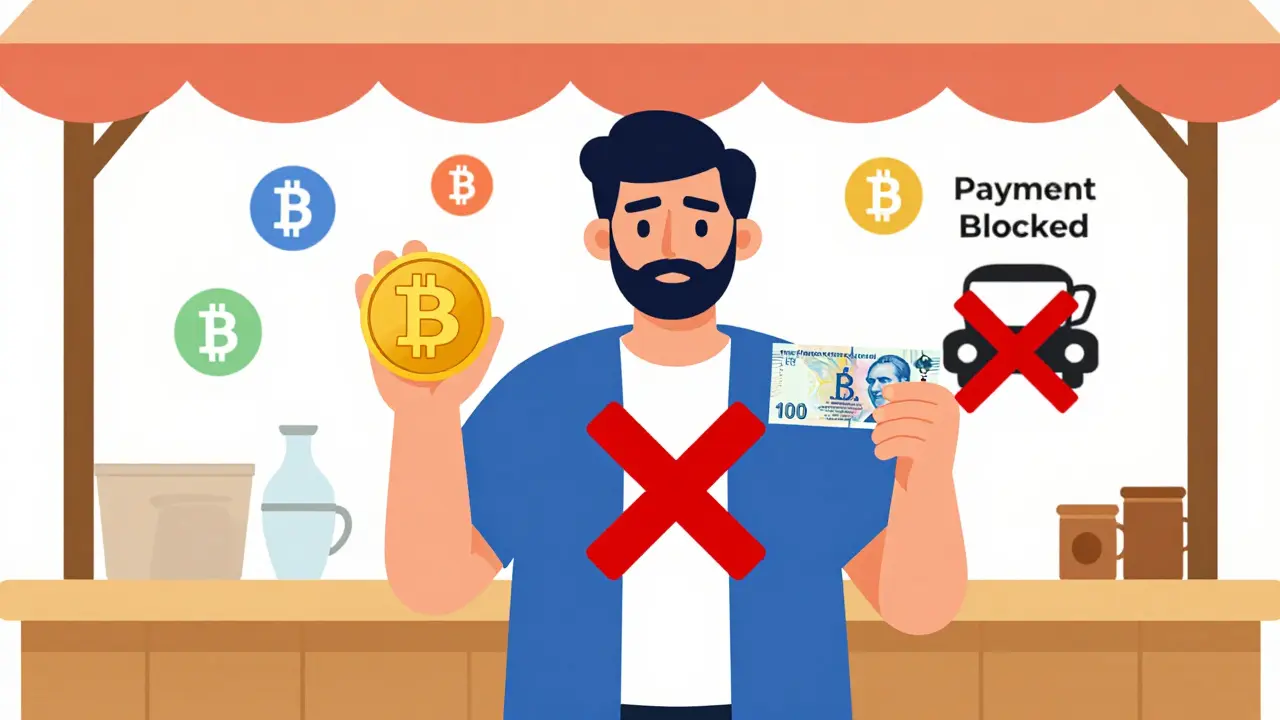
If you live in Turkey or send money there, you’ve probably heard that crypto isn’t allowed for payments. But here’s the twist: you can still buy, sell, and hold Bitcoin, Ethereum, and other coins without breaking the law. The Central Bank of Turkey doesn’t ban crypto - it just won’t let you use it to buy coffee, pay rent, or buy a car. And that’s the whole point.
This isn’t about stopping innovation. It’s about control. Turkey’s inflation hit 85% in 2022, and millions of people turned to crypto to protect their savings. The Central Bank of the Republic of Turkey (CBRT) didn’t want to lose control over the Turkish Lira. So instead of fighting crypto head-on, they drew a line: you can trade it, but you can’t spend it.
What Exactly Is Banned?
Since April 2021, Turkish law has forbidden using cryptocurrencies to pay for goods or services. That means no one can accept Bitcoin for your phone bill, Ethereum for your rent, or Dogecoin for your groceries. Even real estate deals - once a popular way to move large sums - now require fiat currency. You can’t use crypto to buy a house, even if the seller agrees.
The rule is simple: any transaction involving goods or services must go through the Turkish Lira. If you want to pay with crypto, you first have to convert it to lira on a licensed exchange. That’s not a suggestion - it’s the law.
And it’s not just about payments. Derivatives like crypto futures, options, and leveraged trading are also banned. That cuts out high-risk bets that could destabilize the financial system. But here’s where it gets interesting: initial coin offerings (ICOs) are still allowed - as long as they’re reviewed and approved by the Capital Markets Board (CMB).
Who’s in Charge?
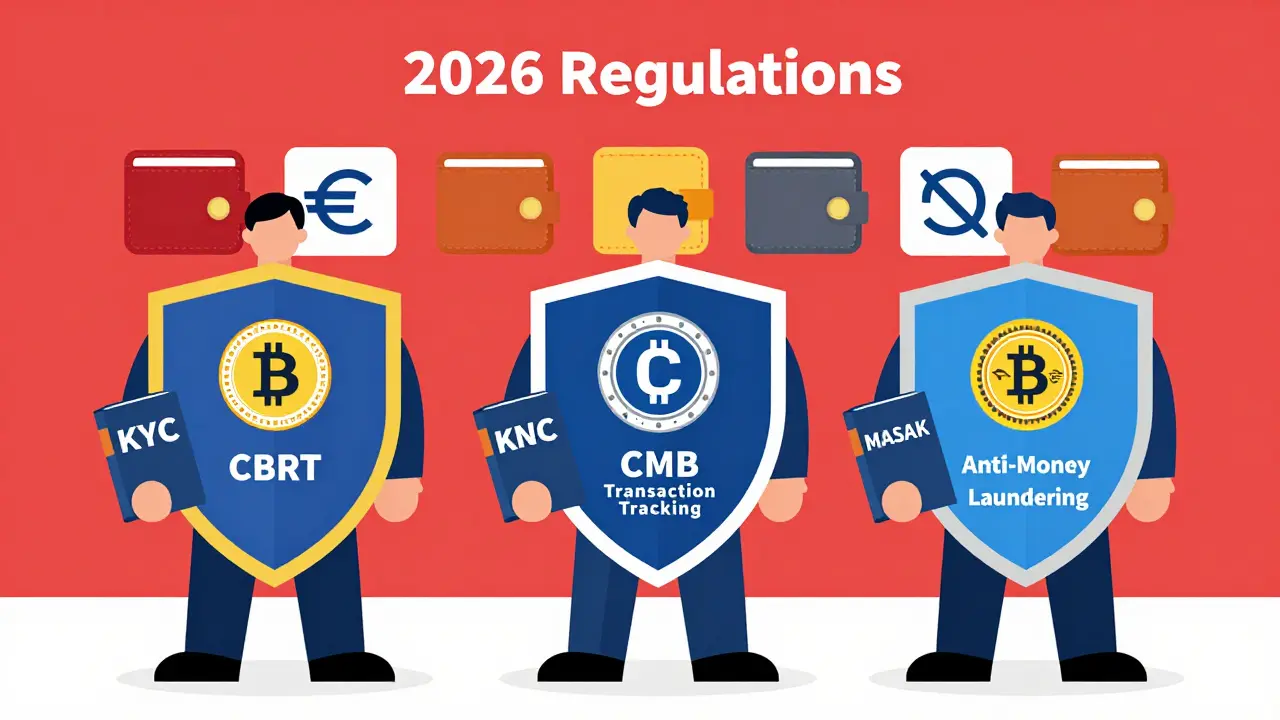
The CBRT doesn’t act alone. It works with three other agencies to keep crypto in check:
- Capital Markets Board (CMB) - The main regulator. All crypto exchanges and custodians must get a license from them.
- Financial Crimes Investigation Board (MASAK) - They hunt down money laundering. If you’re moving large amounts of crypto without ID, they’ll find you.
- TÜBİTAK - The science council. They set the technical standards for how crypto platforms must store data and secure systems.
In March 2025, four new communiqués were published in the Official Gazette. These weren’t minor updates. They overhauled the entire system. By June 30, 2025, every crypto business operating in Turkey had to meet new rules - or shut down.
The Licensing Rules (It’s Not Easy)
Want to run a crypto exchange in Turkey? Here’s what you need:
- Be a joint-stock company registered in Turkey.
- Have shares issued in cash - no anonymous ownership.
- Minimum capital: 150 million Turkish Lira (about $4.1 million) for exchanges.
- Minimum capital: 500 million Turkish Lira (about $13.7 million) for custodians.
- Prove your founders have clean legal records and no history of financial fraud.
- Implement full KYC: every user must be ID-verified.
- Track every transaction - even canceled ones.
- Report any transaction over 15,000 Turkish Lira (around $425) to MASAK.
That’s not just compliance. That’s a full-time operation. Many small platforms couldn’t meet the cost. Some shut down. Others moved offshore.
Binance TR got hit hard. In 2024, MASAK fined them 8 million Turkish Lira ($750,000) for failing to properly verify users and monitor suspicious activity. It was the maximum fine allowed. The message was clear: no exceptions.
Why Do People Still Use Crypto in Turkey?
If you can’t spend it, why do over 20 million Turks own crypto?
Because the Turkish Lira is unstable. Inflation keeps rising. The lira lost over 90% of its value against the dollar between 2020 and 2025. People aren’t using crypto to pay for pizza. They’re using it to save their life savings.
Bitcoin and USDT became digital piggy banks. People bought them on foreign exchanges like Binance, Kraken, or Bybit - where they can trade without Turkish rules. Then they held them, waiting for the lira to drop again.
It’s not a loophole. It’s survival.
And the government knows it. That’s why they’re not trying to ban ownership. They’re trying to control the flow. They want to know who’s buying, how much, and where it’s going.
What About Foreign Exchanges?
Foreign crypto platforms - like Coinbase or KuCoin - can’t advertise in Turkey. They can’t set up offices here. They can’t even use Turkish-language websites unless they’re licensed. But millions still use them.
How? People use VPNs. They pay with credit cards. They withdraw to local bank accounts. The system works - but it’s messy. And the regulators are catching on.
Starting in 2026, MASAK will gain the power to freeze both bank accounts and crypto wallets. They’re also cracking down on “rented accounts” - where someone lets another person use their ID to open a wallet. That’s a common trick to bypass KYC. Now, it’s a crime.

The Digital Lira Is Coming
While crypto can’t be used for payments, the CBRT is building its own digital currency: the Digital Lira. It’s not Bitcoin. It’s not Ethereum. It’s the Turkish Lira - but on a blockchain.
The goal? Control the future of money. With the Digital Lira, the government can track every transaction, set spending limits, and even program expiration dates on money (think stimulus payments that vanish if not spent in 30 days).
It’s not about replacing cash. It’s about replacing crypto’s role as a store of value. If the government can offer a stable, digital version of the lira - with full legal backing - why would anyone need Bitcoin?
What’s Next?
The CBRT isn’t done. By 2027, they plan to expand regulations to cover real-world asset tokenization - meaning you could tokenize gold, real estate, or even agricultural products on blockchain. But here’s the catch: only licensed Turkish entities can do it. Foreign platforms? Out.
So what’s the real goal? Not to kill crypto. Not to ban it. But to make sure that when Turkey moves into the digital future, it’s the government - not Silicon Valley - that controls the rules.
For now, crypto in Turkey is legal to own. Legal to trade. Illegal to spend. And that’s exactly how the Central Bank wants it.
What Happens If You Try to Pay With Crypto?
If you try to pay a shopkeeper with Bitcoin in Istanbul, they’ll turn you down - not because they’re afraid, but because they could be fined. The law says they must refuse.
But if you buy crypto on a foreign exchange, hold it, and later sell it for lira to buy a car? That’s perfectly legal. The system is designed to let you profit from crypto - just not use it as money.
It’s a strange balance. But it’s working. Turkey still has one of the highest crypto adoption rates in the world. And the lira? It’s still the only money that counts.
Can I still buy Bitcoin in Turkey in 2026?
Yes. You can legally buy, sell, and hold Bitcoin and other cryptocurrencies in Turkey. The ban only applies to using them as payment. Exchanges like Paribu, Bitexen, and Uygulama are licensed and operate legally. You can also use foreign exchanges like Binance or Kraken - though they can’t advertise in Turkey.
Can I use crypto to pay for rent or utilities?
No. Since April 2021, Turkish law explicitly prohibits using cryptocurrencies to pay for goods or services - including rent, electricity, or internet bills. Any service provider who accepts crypto for payment risks fines and legal action. You must convert crypto to Turkish Lira first.
Are crypto transactions taxed in Turkey?
Yes. Capital gains from crypto trading are taxable. If you sell Bitcoin for lira and make a profit, you must declare it on your income tax return. The tax authority (GİB) now receives transaction data from licensed exchanges, so undeclared gains are easily detected. Failure to report can lead to penalties.
Why can’t I use crypto to buy a house?
Real estate transactions must be conducted in Turkish Lira. Even if both buyer and seller agree to use crypto, the law requires the payment to go through a licensed bank in lira. This prevents money laundering and ensures property records remain tied to the official financial system. You can use crypto to fund the purchase - but only after converting it to lira.
What happens if I use a VPN to access foreign exchanges?
Using a VPN to access foreign exchanges isn’t illegal - but it does make you harder to track. The government doesn’t ban VPNs, but MASAK is cracking down on users who try to bypass KYC rules. If you’re caught using fake IDs or rented accounts to trade, you could face fines or account freezes. The system is getting smarter - anonymity is fading.
Is the Digital Lira the same as crypto?
No. The Digital Lira is a central bank digital currency (CBDC) issued by the Central Bank of Turkey. It’s not decentralized. It’s not blockchain-based like Bitcoin. It’s the Turkish Lira digitized - with full government control. It’s meant to replace cash, not compete with crypto. Its goal is to give the state more control over money, not less.
Can I withdraw crypto profits to my Turkish bank account?
Yes - but only through licensed Turkish exchanges. If you sell crypto on a foreign exchange and send lira to your bank, your bank may flag the transfer if it’s over $50,000. You’ll need to prove the source is legitimate. Licensed Turkish exchanges handle this automatically - they report everything to MASAK.
Sharon Tuck
8 03 26 / 11:00 AMSo cool to see how Turkey’s handling this - not banning crypto, just keeping it out of daily spending. It’s like they’re saying, ‘You can save in Bitcoin, just don’t use it to buy my baklava.’ Smart move, honestly. People need a hedge against inflation, and forcing them into lira-only systems just pushes them to use VPNs and offshore apps.
I love that they’re not trying to crush innovation, just control the flow. Makes me wonder if other countries should take notes instead of panic-banning everything.
Jennifer Pilot
9 03 26 / 12:57 PMOh, how quaint… the Central Bank of Turkey, in its infinite wisdom, has decided that citizens must be… *protected*… from the chaotic allure of decentralized finance. How dare individuals attempt to circumvent the state’s monetary stranglehold?
One must admire the elegance of their approach: allow ownership, forbid utility. A masterclass in authoritarian subtlety. The Digital Lira, with its programmable expiration dates, is not merely a currency - it is a psychological instrument. A digital leash, if you will.
And yet… how ironic that the very people who seek refuge from hyperinflation are now being surveilled under the guise of ‘anti-money laundering.’ The hypocrisy is… almost poetic.
Sherry Kirkham
11 03 26 / 00:00 AMThey’re not stopping crypto. They’re redirecting it. And that’s the real genius.
If you ban it outright, people go underground. If you let them trade but not spend, you turn crypto into a savings tool - not a threat. That’s not control. That’s strategy.
The Digital Lira? It’s not about replacing cash. It’s about replacing Bitcoin’s role. The state wants to be the only one who can give you a stable digital asset. And they’re winning.
People aren’t using crypto to buy coffee. They’re using it to survive. That’s not a loophole. That’s a symptom.
Melissa Ritz
12 03 26 / 19:08 PMOkay but like… why even bother? If you can’t spend it, what’s the point? It’s like owning a gold bar you can’t melt down or trade. Just… sit on it? Boring.
Also, why is everyone still using Binance? I thought Turkey blocked it? I guess people just… ignore laws? Wild.
Cerissa Kimball
13 03 26 / 22:40 PMThe regulatory framework in Turkey is remarkably structured. Licensing requirements for exchanges are stringent but necessary. Capital thresholds ensure institutional stability. KYC enforcement reduces illicit flows. MASAK’s oversight is critical. Transaction reporting thresholds align with global AML standards. The Digital Lira initiative represents a logical evolution toward sovereign digital currency. Foreign platforms operating without compliance are non-compliant by definition. This is not suppression. It is governance.
Basil Bacor
14 03 26 / 21:37 PMSo they let you buy btc but not spend it? That’s like letting you own a Ferrari but only drive it in your driveway. Classic government move. Overcomplicate everything. People just want to buy stuff with their crypto. Why make it a 10-step dance?
Also, ‘rented accounts’? That’s just people helping each other out. Not a crime. Jeez.
Ethan Grace
15 03 26 / 13:54 PMThere’s a quiet tragedy here.
People aren’t using crypto to get rich. They’re using it to stay alive.
The lira isn’t money anymore. It’s a rumor. A ghost of value. And the Central Bank? It’s not fighting crypto. It’s fighting despair.
They didn’t ban Bitcoin because they’re scared of it. They banned spending because they’re scared of what happens when people stop believing in the lira.
This isn’t policy. It’s grief.
Brian T
15 03 26 / 19:27 PMEveryone’s acting like this is some radical move. Nah. This is standard. Every government that doesn’t want to lose control does this. Let people hoard. Don’t let them spend. Keeps the system intact.
And the Digital Lira? That’s the endgame. They’re building a version of crypto… that they own. So you can’t own it. You just get to use what they let you use.
It’s not about inflation. It’s about power.
And yeah, I get it. People are using it to survive. But that doesn’t make the system fair. It just makes it predictable.
Nash Tree Service
16 03 26 / 04:07 AMIt’s fascinating how the Turkish government has weaponized bureaucracy to contain decentralization. The capital requirements alone - 150 million lira for exchanges? That’s not regulation. That’s exclusion.
Smaller platforms don’t stand a chance. Only institutions with deep pockets survive. So now crypto is being funneled into a handful of state-approved gatekeepers.
The Digital Lira isn’t innovation. It’s a trap. A beautifully engineered trap with compliance forms and KYC checkpoints.
And yet… people still use foreign exchanges. With VPNs. With fake IDs. With rented accounts.
The system is designed to be unbreakable. But humans? They’re still breaking it.
Julie Potter
18 03 26 / 00:20 AMY’all are acting like this is some deep philosophical move. It’s not. It’s panic. The lira’s collapsing. People are fleeing to crypto. So instead of fixing the economy, they’re trying to control the escape route.
‘You can own Bitcoin, but you can’t spend it.’ That’s not policy. That’s emotional blackmail.
And now they’re gonna freeze wallets? Like we’re criminals for trying to save our money? Give me a break.
Meanwhile, the Digital Lira is just a blockchain-powered surveillance tool. They don’t want to replace cash. They want to replace freedom.
And they’re gonna lose. Because people are smarter than this.
nalini jeyapalan
18 03 26 / 19:41 PMLet’s be real: Turkey’s crypto policy is one of the most rational approaches in the world. No ban. No chaos. Just clear rules: trade, hold, convert. That’s it.
The Digital Lira isn’t evil. It’s inevitable. If you want a digital currency that doesn’t crash 90% in 5 years, you need state backing. Crypto doesn’t offer that. The lira does.
And yes, people are using foreign exchanges. So what? They’re still reporting taxes. They’re still doing KYC. The system’s working.
Stop romanticizing anonymity. Stability matters more than ideology.
Sharon Tuck
20 03 26 / 19:38 PMLove how the government didn’t ban crypto - they just made it boring. No spending. No drama. Just savings. That’s actually genius.
People aren’t using it to buy pizza. They’re using it to buy time. Time until the lira stabilizes. Time until they can leave. Time until they can breathe.
And the Digital Lira? It’s not the enemy. It’s the answer they’re trying to sell. But people already bought a different one.