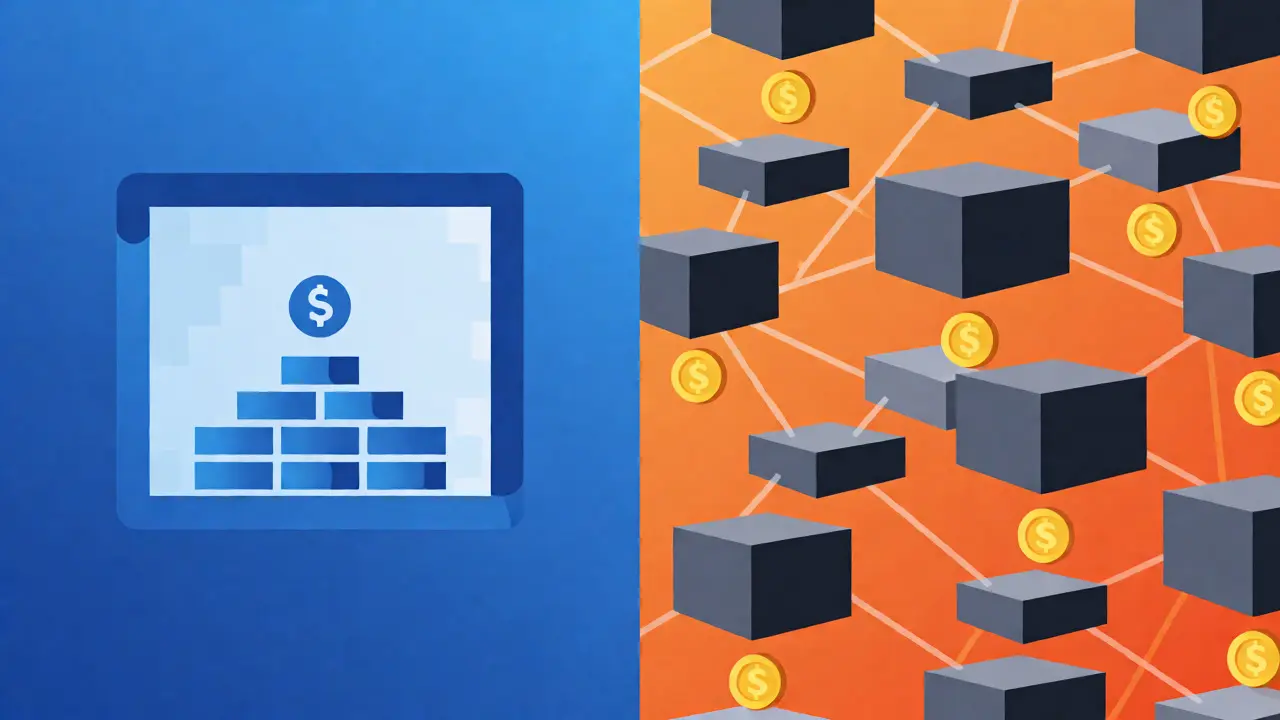
You think you know the cost of a trade until you calculate the real number. On paper, a decentralized exchange (DEX) swap looks cheap at 0.30%. But add Ethereum gas during a network spike, and that same $1,000 trade can cost you over 5% in total fees. Meanwhile, centralized exchanges (CEXs) are playing hardball, with some slashing spot fees to near zero. So, which is actually cheaper? The answer isn't fixed; it depends entirely on your trade size, timing, and network choice.
Key Takeaways
- CEXs offer predictability: Fees are fixed percentages (often 0.10%-0.60%), but hidden costs like fiat deposits and withdrawals can inflate the total bill.
- DEXs offer variable savings: Protocol fees are low (0.05%-0.30%), but gas fees dominate the cost structure, making small trades expensive on congested networks.
- Network matters more than protocol: Trading on Layer-2s (Arbitrum, Optimism) or Solana reduces DEX costs by up to 95% compared to Ethereum mainnet.
- Trade size dictates the winner: CEXs win for large institutional volumes due to tiered discounts. DEXs win for smaller trades on low-gas chains where protocol fees remain the primary cost.
- The fee war is heating up: Aggressive CEX pricing (e.g., Binance.US at 0.02% taker) forces DEX users to optimize routes carefully to stay competitive.
How Centralized Exchanges Charge You
Centralized exchanges operate like traditional stock brokers. They hold your funds, match orders off-chain, and settle on-chain only when you move money out. This architecture allows them to charge simple, predictable maker/taker fees. For most retail traders, the headline number is the trading fee. Platforms like Binance a leading global cryptocurrency exchange known for its high liquidity and diverse trading pairs typically start at 0.10% for standard users. If you pay fees using their native token (like BNB), this drops to 0.075%.
But here’s the catch: the trading fee is just one layer. When you deposit fiat currency via credit card, you might face charges between 0.50% and 4.99%. Withdrawal fees also vary wildly by asset and network. For example, withdrawing USDT on the Tron network might cost $1, while other networks could charge significantly more. High-volume traders benefit from VIP tiers. On Binance, if your 30-day volume exceeds $1 million, your maker fees drop to 0.09%. However, reaching these tiers requires significant capital. For the average user, the effective cost often hovers around 0.10% to 0.60%, depending on the platform's aggressiveness and your payment methods.
Recent moves show CEXs fighting for market share. In April 2026, Binance.US the United States-based subsidiary of Binance offering localized regulatory compliance cut spot trading fees to 0.00% for makers and 0.02% for takers. This undercuts competitors like Coinbase, whose retail taker fees sit around 0.60%. If you trade $10,000, that’s a difference of $58 per trade. These aggressive cuts make CEXs incredibly attractive for active traders who value speed and certainty over self-custody.

The True Cost of Decentralized Swaps
Decentralized exchanges flip the model. Instead of a company taking a cut, fees go directly to liquidity providers (LPs). Most major AMMs (Automated Market Makers) use a standard fee tier of 0.30% for volatile assets and 0.05% for stablecoin pairs. At first glance, 0.30% seems comparable to mid-tier CEX fees. But on a DEX, you aren’t just paying the protocol fee. You’re paying gas fees to execute the smart contract transaction on the blockchain.
This is where things get tricky. On Ethereum a decentralized platform running smart contracts and hosting thousands of tokens, gas prices fluctuate based on network congestion. During peak times, a single swap can cost over $50 in gas. If you’re swapping $500 worth of tokens, that $50 gas fee alone represents a 10% cost-far exceeding the 0.30% protocol fee. Suddenly, your "cheap" DEX trade becomes the most expensive option available.
However, not all blockchains are created equal. On high-throughput chains like Solana a high-performance blockchain supporting fast and low-cost transactions, gas fees are negligible, often less than $0.01. Here, the protocol fee dominates the cost. A $1,000 swap on a Solana DEX costs roughly $3.00 (0.30%). This makes DEXs highly competitive with CEXs for small-to-medium trades, provided you avoid congested networks. Layer-2 solutions like Arbitrum an optimistic rollup scaling solution for Ethereum reducing transaction costs and Optimism another optimistic rollup providing faster and cheaper Ethereum transactions also reduce gas by about 95%, bringing typical transaction costs down to $0.50-$2.00. On these networks, DEX fees become predictable and low.
Direct Fee Comparison: CEX vs DEX
To see how these models stack up, let’s look at concrete scenarios. We’ll compare a $1,000 spot trade across different platforms and conditions. Note that DEX costs include both the protocol swap fee and estimated gas fees.
| Platform / Network | Trading/Protocol Fee | Gas/Network Fee | Total Cost ($) | Effective Fee (%) |
|---|---|---|---|---|
| Binance Global (Standard) | $1.00 (0.10%) | N/A (Off-chain) | $1.00 | 0.10% |
| Binance.US (New Tier) | $0.20 (0.02%) | N/A (Off-chain) | $0.20 | 0.02% |
| Coinbase (Retail) | $6.00 (0.60%) | N/A (Off-chain) | $6.00 | 0.60% |
| Uniswap v3 (Ethereum Mainnet) | $3.00 (0.30%) | $50.00 (Congested) | $53.00 | 5.30% |
| Uniswap v3 (Arbitrum L2) | $3.00 (0.30%) | $1.00 | $4.00 | 0.40% |
| Solana DEX (e.g., Jupiter) | $3.00 (0.30%) | $0.01 | $3.01 | 0.30% |
The data tells a clear story. For large trades on optimized CEXs, fees are minimal. Binance.US’s 0.02% rate is unbeatable for pure cost efficiency. However, if you prioritize self-custody and use a low-gas chain like Solana or Arbitrum, DEX fees are competitive with mid-tier CEXs. The danger zone is clearly Ethereum mainnet during congestion, where gas fees obliterate any savings from lower protocol rates.

Hidden Costs and Strategic Pitfalls
Don’t just look at the percentage. Consider the friction. On CEXs, the biggest hidden cost is often fiat on-ramping. If you buy crypto with a debit card, you might pay a 3.5% spread plus a fixed fee. That instantly wipes out any advantage of low trading fees. To mitigate this, use bank transfers (ACH/SEPA) which are usually free or very cheap, though they take longer. Also, watch out for withdrawal fees. Moving assets off a CEX to a hardware wallet incurs a network fee set by the exchange, which may be higher than the actual on-chain cost.
On DEXs, the pitfall is slippage and failed transactions. If you set your slippage tolerance too low, your transaction might fail, costing you the gas fee anyway. Conversely, setting it too high means you accept a worse price. Liquidity depth matters here. A thin pool on a new DEX might have a 0.30% fee, but poor liquidity could cause 2% slippage on a large order. Always check the pool’s TVL (Total Value Locked) before executing large swaps. Additionally, MEV (Maximal Extractable Value) bots can front-run your transactions on public mempools, slightly increasing your effective cost. Using private RPC endpoints or aggregators like Jupiter a multi-chain aggregator finding the best swap routes across DEXs can help minimize this impact.
Which Should You Choose?
Your choice depends on your profile. Are you a day trader executing dozens of small orders? CEXs are likely better. The predictability, speed, and lack of gas management save time and mental energy. Plus, with fee wars driving prices down, you can trade almost for free on platforms like Binance.US. Just ensure you use limit orders (maker) to avoid taker fees if possible.
If you’re an investor holding long-term positions or engaging in DeFi yield farming, DEXs make more sense. Self-custody eliminates counterparty risk-you own your keys, you own your coins. While the fees might be slightly higher than a subsidized CEX campaign, the security and composability with protocols like Aave or Compound outweigh the cost. Use Layer-2s or Solana to keep those fees low. Avoid Ethereum mainnet unless you’re moving substantial sums where the fixed gas cost becomes a negligible percentage of the trade.
For hybrid strategies, consider keeping funds on a CEX for active trading and moving profits to a DEX-compatible wallet for long-term storage and DeFi interaction. This balances cost efficiency with security. Remember, the landscape changes fast. Uniswap v4 introduces dynamic fees that adjust based on volatility, potentially lowering costs further in stable markets. Keep an eye on gas trackers and exchange announcements-they’re your best tools for staying ahead of the curve.
Are DEX fees always lower than CEX fees?
No. While DEX protocol fees are often lower (0.05%-0.30%), gas fees on networks like Ethereum can make the total cost significantly higher than CEX fees, especially for small trades or during network congestion. On low-gas chains like Solana or Arbitrum, DEX fees can be competitive or cheaper.
Do I pay fees to withdraw crypto from a CEX?
Yes. Centralized exchanges charge a withdrawal fee for each asset sent to an external wallet. This fee varies by coin and network (e.g., ERC-20 vs. TRC-20) and is designed to cover the on-chain gas cost plus a margin for the exchange.
What is a 'taker' fee versus a 'maker' fee?
A 'maker' fee applies when you place a limit order that adds liquidity to the order book (it sits there waiting to be filled). A 'taker' fee applies when you place a market order or a limit order that immediately matches an existing order, removing liquidity. Maker fees are typically lower or zero to incentivize adding liquidity.
Can I avoid gas fees on DEXs?
You cannot completely avoid gas fees on most DEXs because every transaction must be processed by the blockchain. However, you can minimize them by trading on Layer-2 networks (like Arbitrum or Optimism) or high-throughput chains (like Solana or Polygon), where gas costs are fractions of a cent.
Why do some CEXs offer 0% trading fees?
CEXs often use 0% or low trading fees as a marketing strategy to attract volume and market share. They may recoup revenue through other services like staking, lending, listing fees, or by earning interest on customer deposits. It’s a loss-leader tactic common in competitive markets.
Leave a comments