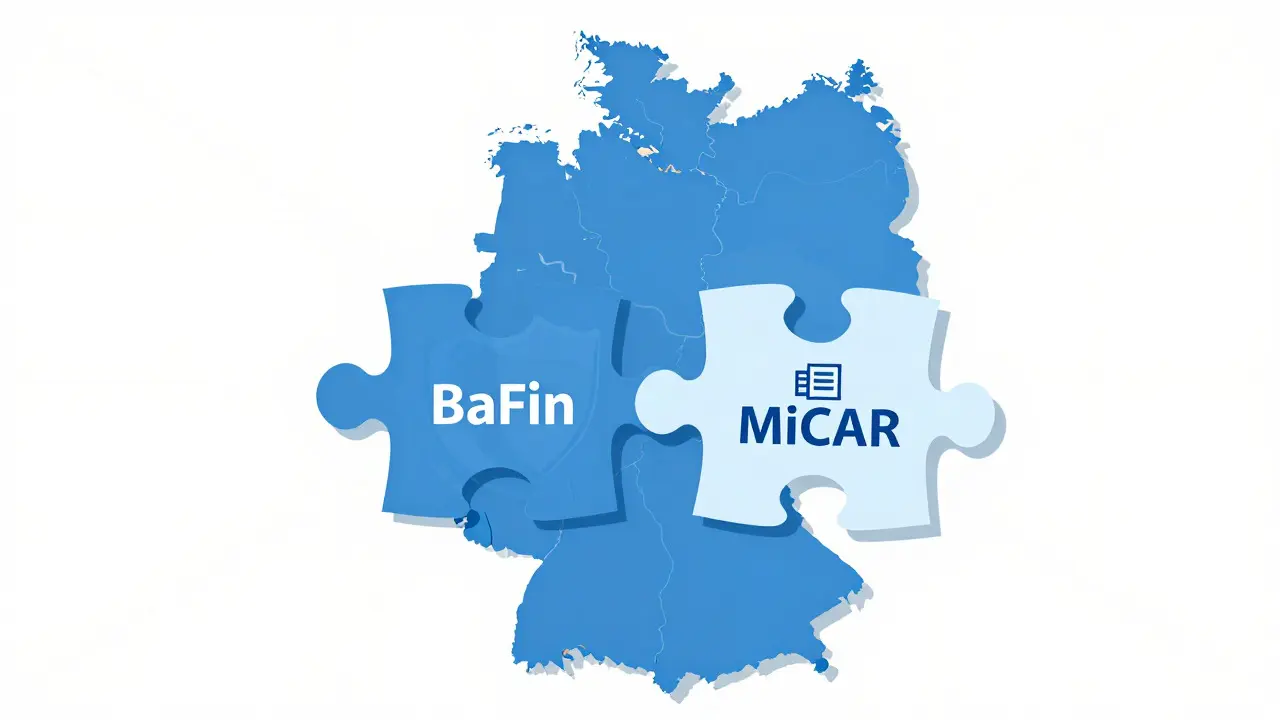
Germany has built one of the most rigorous regulatory frameworks for crypto custody in Europe. If you are looking to store digital assets securely or launch a custody service here, you need to understand that this is not a wild west environment. It is highly structured, heavily supervised, and designed to protect investors above all else. The landscape shifted dramatically with the implementation of European Union-wide rules, meaning the old ways of doing things are gone.
The core of this system rests on two pillars: the national oversight by the Bundesanstalt für Finanzdienstleistungsaufsicht, commonly known as BaFin, and the new EU regulation called Markets in Crypto-Assets Regulation, or MiCAR. For anyone operating in Germany, understanding how these two interact is the difference between getting licensed and getting shut down.
How the Legal Framework Works
To grasp the current rules, you have to look at the timeline. Germany was actually an early mover, introducing specific crypto custody rules under its Banking Act (Kreditwesengesetz, abbreviated as KWG) back in 2020. This made it one of the first countries in the EU to require licenses for holding crypto keys. However, that national framework is now being merged into the broader MiCAR structure.
MiCAR became fully applicable across the EU on December 30, 2024. Germany implemented these provisions through national legislation effective January 1, 2025. This includes the Act on the Digitalisation of the Financial Market (Finanzmarktdigitalisierungsgesetz, or FinmadiG) and the Act on the Supervision of Markets for Crypto-Assets (Kryptomärkte-Aufsichtsgesetz, or KMAG).
The critical distinction you must make is what kind of asset you are holding. If you are holding cryptocurrencies like Bitcoin or Ether, they fall under MiCAR. But if you are holding security tokens or crypto securities, they remain regulated under the older financial markets directive (MiFID II) and overseen by BaFin according to the KWG. This dual-track system creates complexity but also legal clarity for different types of assets.
Licensing Requirements and Capital Rules
You cannot simply start offering custody services in Germany without permission. Providing any form of safekeeping for private keys requires an explicit license from BaFin. The regulator defines custody in three ways: pure custody (safekeeping), administration (managing transactions), and safeguarding (protecting from theft). Any of these trigger the licensing requirement.
The financial barriers to entry are significant. For a pure crypto custody provider, you need minimum operational capital of €125,000. If you offer multiple services, such as trading plus custody, that requirement jumps to up to €730,000 under MiCAR Article 6. These aren't just suggestions; they are hard limits enforced during the application process.
If you are already a traditional bank or financial institution licensed under MiFID II, you have a shortcut. You can use an accelerated notification procedure under MiCAR Article 91(2). This reduces the typical 6-9 month licensing process to about 3 months. Deutsche Bank successfully used this path in Q1 2025, allowing them to integrate crypto custody into their existing operations much faster than a startup could.
| Feature | New Crypto-Native Provider | Existing Financial Institution |
|---|---|---|
| Process Type | Full Application | Accelerated Notification |
| Timeline | 6-9 months | ~3 months |
| Min. Capital (Pure Custody) | €125,000 | Varies by existing license |
| Regulatory Basis | MiCAR + KWG | MiCAR Art. 91(2) + MiFID II |

Technical and Operational Standards
Getting the license is only half the battle. Keeping it requires meeting stringent technical standards. BaFin’s guidance note from January 3, 2025, lays out exactly what is expected. The primary rule is segregation: client assets must be physically or logically separated from the custodian’s own assets. This is non-negotiable.
Your infrastructure must be robust. Hardware wallets used for storage must comply with Common Criteria EAL 4+ security certification standards. Software solutions need regular penetration testing by independent third parties, with results submitted to BaFin every quarter. You also need business continuity plans that can withstand disruptions for at least 72 hours.
Data retention is another key area. You must keep detailed transaction records for a minimum of five years. This aligns with anti-money laundering (AML) requirements and ensures that auditors can trace every movement of funds. Failure to maintain these records is a common reason for fines or license revocation.
Market Impact and Institutional Adoption
Despite the complexity, the market is growing fast. As of June 30, 2025, total assets under custody in Germany reached €48.7 billion, a 28.3% increase year-over-year. Traditional banks dominate this space. Deutsche Bank, Commerzbank, and DZ Bank collectively hold 58% of the market share by assets under custody.
This dominance makes sense. Institutional investors trust established names with deep pockets and strict compliance cultures. According to data from Q2 2025, 63% of DAX 30 companies are using licensed German custody providers. This high level of adoption suggests that the regulatory friction is actually acting as a filter, building confidence among large corporate clients who might otherwise shy away from crypto due to perceived risk.
However, smaller firms struggle. A survey by Blockchain Bundesverband in June 2025 showed that 54% of German crypto firms spent over €250,000 on regulatory compliance in the previous year. This is significantly higher than the EU average of €175,000. For startups, these costs can be prohibitive, leading to consolidation where larger players absorb smaller ones or exit the market entirely.
Future Changes: DAC 8 and Tax Implications
The rules are not static. Looking ahead to 2026, the introduction of DAC 8 reporting requirements will change how custody providers operate. Effective January 1, 2026, providers must report crypto transactions to tax authorities, implementing the OECD's Crypto-Asset Reporting Framework. This means you will need new technical interfaces ready by Q4 2025 to handle this data flow automatically.
Tax treatment is also evolving. An updated circular from March 6, 2025, introduced distinctions between active and passive staking. Active staking is now taxed as commercial income, which has major implications for yield-generating custody services. Additionally, Germany is revising its civil securities law, with completion planned for Q2 2026. This revision will determine which crypto assets qualify as securities under civil law, potentially shifting more custody activities from financial services licenses to stricter banking licenses.
Common Pitfalls to Avoid
Many applicants fail because they underestimate the documentation required. BaFin’s standardized application demands 47 distinct components, including detailed business plans, organizational charts showing three lines of defense, and IT security architecture diagrams. Missing even one can delay your application by months.
Another common error is insufficient Anti-Money Laundering (AML) procedures. In Q1 2025, 22% of initial license applications were rejected specifically for weak AML frameworks. You need to integrate MiCAR’s transaction monitoring requirements seamlessly with Germany’s existing AML laws. It is not enough to have basic checks; you need sophisticated monitoring systems.
Finally, do not ignore the talent shortage. You must employ at least two senior managers with 'fitness and propriety' certification. KPMG’s June 2025 talent report highlighted a severe shortage of qualified personnel, with only 312 certified crypto custody compliance officers serving 87 licensed entities in Germany. Hiring experienced staff is difficult and expensive, so plan your recruitment strategy early.
What is the minimum capital required for crypto custody in Germany?
For a pure crypto custody provider, the minimum operational capital is €125,000. If you offer multiple services, such as trading and custody combined, the requirement increases to up to €730,000 under MiCAR Article 6.
How long does it take to get a crypto custody license from BaFin?
For new applicants, the process typically takes 6 to 9 months. However, existing financial institutions licensed under MiFID II can use an accelerated notification procedure, reducing the timeline to approximately 3 months.
Does MiCAR apply to all crypto assets in Germany?
No. MiCAR applies to cryptocurrencies like Bitcoin and Ether. Security tokens and crypto securities remain regulated under MiFID II and the German Banking Act (KWG). This creates a dual-regulatory environment depending on the asset type.
What are the technical security requirements for hardware wallets?
Hardware wallet providers must comply with Common Criteria EAL 4+ security certification standards. Software solutions must undergo regular independent penetration testing, with results submitted to BaFin quarterly.
When do DAC 8 reporting requirements start?
DAC 8 reporting requirements will take effect on January 1, 2026. Custody providers are expected to implement the necessary technical interfaces by Q4 2025 to ensure compliance with the OECD's Crypto-Asset Reporting Framework.
Leave a comments