
It’s August 2026, and if you’re an Indian citizen trying to buy Bitcoin or trade Ethereum on your favorite offshore platform, you’ve likely hit a wall. The app won’t load. The website shows a “blocked” error. Or worse, you realize your account is frozen because the exchange isn’t registered with Indian authorities. This isn’t a glitch; it’s policy. The regulatory landscape for cryptocurrency in India has shifted dramatically from the open-access era of the early 2020s to a tightly controlled environment defined by strict compliance mandates.
The core issue isn’t that cryptocurrency is banned in India-it isn’t. But accessing it through unregistered offshore channels is effectively prohibited. The Financial Intelligence Unit - India (FIU-IND) has been aggressively enforcing the Prevention of Money Laundering Act (PMLA) 2002, targeting platforms that serve Indian users without proper registration. For the average user, this means navigating a complex web of legal requirements, high taxes, and limited platform choices. Understanding these restrictions is no longer optional; it’s essential for protecting your assets and staying compliant with Indian law.
The October 2025 Crackdown: A Turning Point
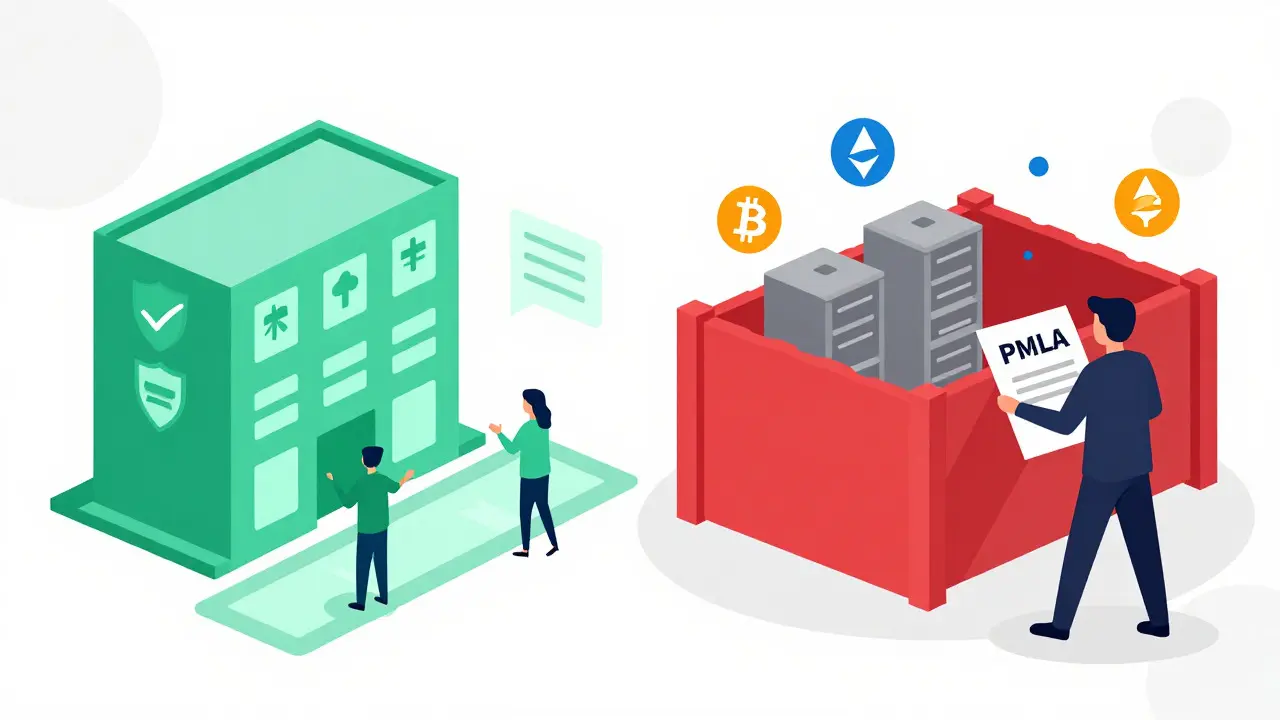
To understand where we stand in 2026, we need to look at the major enforcement action that reshaped the market. On October 1, 2025, the FIU-IND issued notices to 25 offshore cryptocurrency exchanges for non-compliance with the PMLA. This wasn’t just a warning shot; it was a coordinated takedown order. The government directed internet service providers to block access to the applications and URLs of these platforms within India.
This move followed a similar crackdown nearly two years prior, which targeted nine prominent exchanges including Binance, KuCoin, OKX, and Bybit. The latest list included names like Huione, Paxful, CEX.IO, Coinex, BitMex, Bitrue, CoinCola, Changelly, and BingX. These platforms were operating from international jurisdictions but actively soliciting Indian users without registering as reporting entities under Indian law. The result? Millions of Indian traders suddenly lost access to their preferred trading venues overnight.
The key takeaway here is clear: physical presence in India doesn’t matter. If an exchange facilitates transactions involving Indian citizens, it must comply with Indian regulations. The Ministry of Finance has made it explicit that these obligations are activity-based. Whether you’re exchanging virtual digital assets for fiat currency, transferring assets between wallets, or providing safekeeping services, you fall under the radar if you touch the Indian market.
Is Crypto Actually Banned in India?
Despite the headlines about blocked apps and seized accounts, a widespread misconception persists: that cryptocurrency is illegal in India. It’s not. As of 2026, there is no blanket ban on holding or trading cryptocurrencies. The legal status remains in a grey area, characterized by heavy regulation rather than prohibition.
The confusion stems from past events. In 2018, the Reserve Bank of India (RBI) imposed a banking ban, prohibiting financial institutions from servicing crypto businesses. This effectively froze the ecosystem until the Supreme Court struck down the restriction in 2020 via the landmark Internet and Mobile Association of India v Reserve Bank of India judgment. Since then, the government has walked a tightrope, balancing innovation with risk mitigation.
Today, the focus is on compliance. The government wants visibility into crypto transactions to prevent money laundering and terror financing. That’s why the registration requirement for Virtual Digital Asset Service Providers (VDA SPs) is so critical. Approximately 50 VDA SPs were registered with FIU-IND as of October 2025. If your exchange isn’t on that list, you’re operating in no-man’s-land.
| Feature | Registered (Compliant) Exchanges | Unregistered (Blocked) Exchanges |
|---|---|---|
| Access in India | Open via local ISPs | Blocked/Taken Down |
| PMLA Compliance | Yes (Reported to FIU-IND) | No (High Legal Risk) |
| TDS Deduction | Automated (1%) | User Responsibility (Risk of Penalty) |
| Liquidity & Volume | Moderate (Growing) | High (But Access Restricted) |
| Legal Protection | Higher (Regulated Entity) | Low (Offshore Jurisdiction) |
The Tax Burden: 30% Flat Rate and 1% TDS
If regulatory access is one hurdle, taxation is the other. India has implemented some of the strictest cryptocurrency tax laws globally. Under the current framework, all income from virtual digital assets is taxed at a flat rate of 30%. This applies regardless of whether you made a profit or loss on other trades-no set-off allowed. If you bought Bitcoin at $50,000 and sold it at $40,000, you can’t use that loss to offset gains from selling Ethereum at a higher price. Each transaction is treated independently.
Adding to the cost is the 1% Tax Deducted at Source (TDS) on every transfer of virtual digital assets. This means that every time you sell, swap, or even gift crypto, 1% of the value is deducted and sent to the government. For active traders, this significantly impacts profitability and cash flow. Imagine making ten trades in a month; you’ve already paid 10% in TDS before accounting for the 30% capital gains tax on profits.
While the Ministry of Finance introduced these measures to curb speculation and ensure revenue collection, they have also dampened retail trading enthusiasm. Many investors now view crypto more as a long-term hold asset rather than a short-term trading vehicle. The proposed bill to ban private cryptocurrencies adds another layer of uncertainty, though it hasn’t been introduced in Parliament yet. Until then, the 30% + 1% model stands.
Navigating the Regulatory Maze: Who’s Watching Whom?
One of the most confusing aspects of India’s crypto landscape is the fragmented regulatory oversight. Multiple agencies are involved, each with different priorities and sometimes conflicting approaches.
- Financial Intelligence Unit - India (FIU-IND): The primary enforcer of anti-money laundering laws. They handle registrations and issue show-cause notices to non-compliant exchanges.
- Reserve Bank of India (RBI): Consistently skeptical of cryptocurrencies, viewing them as macroeconomic threats. The RBI is focused on launching its own Central Bank Digital Currency (CBDC), the Digital Rupee, which may eventually compete with private cryptos.
- Ministry of Finance: Sets the tax policy and oversees broader financial regulations. They introduced the 30% tax and are preparing the potential ban on private coins.
- Securities and Exchange Board of India (SEBI): Has suggested a multi-regulator approach, indicating openness to permitting virtual assets within a regulated system, unlike the RBI’s harder stance.
This lack of a single, unified regulator creates ambiguity. For example, SEBI’s willingness to supervise crypto trading contrasts sharply with the RBI’s warnings. For users, this means keeping a close eye on announcements from all these bodies. A change in policy from any one of them could ripple through the entire ecosystem.

Practical Implications for Indian Crypto Users
So, what does this mean for you in your daily life? First, your choice of exchange is severely limited. You must use platforms that are registered with FIU-IND. While this ensures legal safety, it often comes with trade-offs. Registered domestic exchanges may have lower liquidity, fewer trading pairs, and higher fees compared to global giants like Binance or Coinbase (which also face restrictions).
Second, record-keeping is crucial. Because of the 1% TDS and 30% tax, you need meticulous records of every transaction. Use portfolio tracking tools that integrate with Indian tax filing systems. Failure to report accurately can lead to penalties far exceeding the tax itself.
Third, beware of workarounds. Some users turn to VPNs to access blocked offshore exchanges. While technically possible, this carries significant risk. If discovered, you could face legal action for violating PMLA provisions. Moreover, using unregistered platforms means you have little recourse if the exchange fails or gets hacked. Your funds are exposed to counterparty risk without the safety net of Indian regulatory protection.
The Future Outlook: What’s Next for Indian Crypto?
Looking ahead, the trend is toward tighter control, not loosening. The government’s strategy is clear: bring crypto into the formal economy or push it out entirely. With approximately 50 registered VDA SPs currently operating, the compliant market is growing, but slowly. Expect more offshore exchanges to either register or exit the Indian market.
The proposed bill to ban private cryptocurrencies remains a wildcard. If passed, it would allow only the Digital Rupee and potentially stablecoins backed by central banks. However, given the political and economic debates surrounding such a move, it’s unlikely to happen imminently. For now, the status quo of heavy regulation and high taxation will persist.
For Indian citizens, the advice is simple: stay compliant. Stick to registered exchanges, keep detailed records, and consult a tax professional familiar with virtual digital assets. The days of wild-west crypto trading in India are over. The future belongs to those who play by the rules.
Are cryptocurrency exchanges banned in India in 2026?
No, cryptocurrency exchanges are not banned in India. However, offshore exchanges that are not registered with the Financial Intelligence Unit - India (FIU-IND) under the Prevention of Money Laundering Act (PMLA) have had their access blocked. Only registered Virtual Digital Asset Service Providers (VDA SPs) can legally operate and serve Indian users.
What is the tax rate for crypto profits in India?
India imposes a flat 30% tax on all income from virtual digital assets. Additionally, there is a 1% Tax Deducted at Source (TDS) on every crypto transfer. No losses can be set off against gains, making it one of the highest tax regimes globally for crypto investors.
Which major exchanges were blocked in October 2025?
In October 2025, FIU-IND targeted 25 offshore exchanges, including Huione, Paxful, CEX.IO, Coinex, BitMex, Bitrue, CoinCola, Changelly, and BingX. Earlier actions had already restricted access to platforms like Binance, KuCoin, OKX, and Bybit for many Indian users.
Can I use a VPN to access blocked crypto exchanges?
Technically yes, but it carries legal risks. Using a VPN to access non-compliant exchanges may violate PMLA regulations. Furthermore, funds held on unregistered offshore platforms lack the protection of Indian regulatory frameworks, increasing the risk of loss due to hacks or exchange failures.
Is the RBI planning to launch a digital currency?
Yes, the Reserve Bank of India (RBI) is developing the Digital Rupee, a Central Bank Digital Currency (CBDC). This state-backed digital currency aims to provide a secure alternative to private cryptocurrencies and may eventually influence the regulatory landscape for private tokens.
Harman Singh
12 08 26 / 22:40 PMman this is so stressful to read like why does it have to be so complicated?? i just want to buy my coins and chill but now im scared my account will get frozen overnight 😭 its not fair at all the gov should let us do what we want with our money
Qolbina Islami
13 08 26 / 16:53 PMTHIS IS EXACTLY WHY AMERICA IS SUPERIOR!!! 🇺🇸 We don't have this kind of nanny-state nonsense!! Look at India, they are trying to control every single penny of your life while their economy stagnates! It is pathetic! The Indian government is weak and afraid of freedom! They block apps because they cannot manage their own people! Wake up citizens of the world, America is the only place where you can truly trade without fear! #Freedom #USA #CryptoLiberty
Don Fizy
15 08 26 / 12:36 PMHey there! :) Don't worry too much about the stress. I know it feels overwhelming right now with all these new rules popping up everywhere. But honestly, once you get used to using the registered exchanges, it's actually pretty smooth sailing. Just make sure you keep your records tidy and you'll be golden! (•̀ᴗ•́)و
Rita Dutta
15 08 26 / 21:36 PMoh look another article telling us how to behave like little sheep in the grand capitalist machine lol its fascinating really how they use words like 'compliance' to mask the fact that they just want more taxes from the poor while the rich hide their billions in offshore accounts which ironically is what crypto was supposed to stop isnt it? the irony is thick enough to cut with a knife here in india where the digital rupee is basically just a surveillance tool disguised as innovation
Carl Michaud
16 08 26 / 12:51 PMThe epistemological crisis inherent in state-sanctioned virtual assets is becoming increasingly apparent. By forcing registration under PMLA, the FIU-IND isn't just regulating; they are effectively creating a honeypot for data harvesting. This is a classic Panopticon strategy. The 'blocked' exchanges aren't blocked because they are illegal; they are blocked because they represent an unmonitored flow of capital that threatens the hegemonic stability of the fiat system. You think you're trading Bitcoin? No. You are participating in a controlled demolition of financial privacy. The real conspiracy is that the government wants you to believe the risk is the exchange, when the actual risk is the state itself seizing your assets via the Digital Rupee infrastructure. Stay woke, or rather, stay encrypted.
Matt Kay
17 08 26 / 05:35 AMboring read. too much text. just tell me if i can still use binance or not. seems like no. sucks.
Dave Kjendal
18 08 26 / 22:35 PMyou guys are missing the point entirely. its not about the tax or the ban. its about the soul of commerce. when you force every transaction through a central authority you kill the spirit of trust between individuals. its lazy thinking to assume regulation equals safety. history shows us otherwise. the market finds a way always. but until then sit tight and pay your 1% tds because thats what good little citizens do right?
Kat Bennett
19 08 26 / 18:39 PMI've been following this situation closely for quite some time now, and it's genuinely fascinating to observe how the regulatory landscape shifts almost daily. While the initial reaction from many traders was panic, I've noticed that those who took the time to understand the nuances of the FIU-IND requirements have actually found a sense of security in the compliant platforms. It's a bit tedious, I admit, having to track every single transfer for the TDS implications, but knowing that your funds aren't sitting on a server in a jurisdiction that could vanish overnight provides a certain peace of mind that outweighs the inconvenience. Plus, the liquidity on the domestic exchanges has improved remarkably over the last six months, so the trade-off might not be as steep as it initially appeared.
Candice Cornett
20 08 26 / 13:14 PMeveryone is crying about taxes but nobody talks about how stupid it is to gamble with digital tokens in the first place. its a bubble waiting to burst. the government is doing you a favor by making it painful to lose your shirt. stop complaining and save your money for something real like gold or land. crypto is for kids and nerds who dont understand value.
Lance Jantz
22 08 26 / 08:17 AMOh, darling, you simply must understand the sheer audacity of the Indian bureaucracy! It’s positively delicious in its inefficiency. To think they believe they can curb the tide of decentralization with mere ISP blocks is laughable. I mean, really? Do they think we haven’t heard of Tor? Or perhaps the beauty of a well-configured VPN? It’s like trying to hold back the ocean with a sieve. The pretension of calling it 'compliance' while essentially engaging in censorship is just too rich for words. Keep playing your little game, Mr. Government, while we dance around your feet!
Paul Smith
22 08 26 / 23:40 PMHey everyone! 👋 Just wanted to share a friendly tip for those navigating this tricky situation. If you're feeling overwhelmed by the list of registered exchanges, start small. Maybe try one of the newer local platforms that have partnered with Indian banks. It's great to see the ecosystem adapting! Also, don't forget to smile 😊 even when dealing with taxes. A positive mindset helps a lot! Have a wonderful day, folks! 🌟
Rodmun Tarnowski
24 08 26 / 12:16 PMIt is indeed a challenging time for investors, yet we must remain steadfast in our commitment to compliance! Yes, the 30% tax is steep! And yes, the 1% TDS adds up! But consider the alternative: total prohibition! We have seen worse! Let us embrace this structured environment with optimism! There is hope in the growth of the Digital Rupee! There is promise in the regulated exchanges! Let us move forward with confidence! Let us document our trades meticulously! Let us thrive despite the odds! Victory awaits the persistent investor!
Matthew Smith
26 08 26 / 05:59 AMthe moral decay of society is evident in its reliance on speculative assets. when a nation prioritizes quick gains over stable savings it loses its ethical compass. the government is merely reflecting the collective greed of its citizens. perhaps if we focused less on bitcoin and more on community building we would find true wealth. but alas we choose the path of least resistance and maximum taxation. typical.
amy miranda
26 08 26 / 20:23 PMIt is absolutely disgraceful how the government continues to stifle individual liberty under the guise of protection. The hypocrisy is staggering. They claim to fight money laundering, yet they turn a blind eye to the rampant corruption within their own ranks. This draconian approach to cryptocurrency regulation is nothing short of tyrannical. Citizens deserve better than to be treated like criminals for holding digital assets. It is a clear violation of economic rights, and it needs to be challenged immediately before the entire financial freedom movement is crushed under the weight of bureaucratic red tape.
Joy Kwant
27 08 26 / 00:32 AMi feel like everyone here is so angry and negative about everything. why cant we just accept the rules and move on? its not the end of the world. maybe we should focus on being grateful we still have access to some exchanges instead of whining about taxes. its exhausting reading all this drama. lets just be nice to each other and do our taxes properly okay?