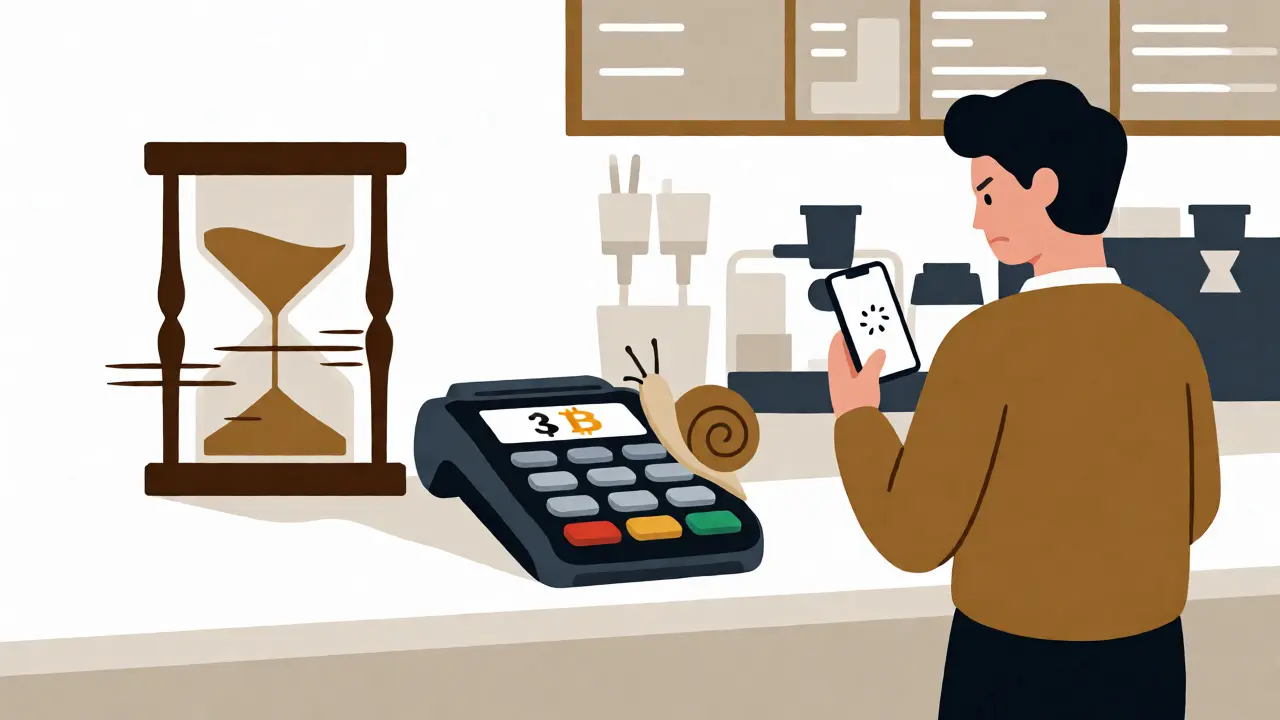
You send a payment. You wait. The spinner turns. In the world of cryptocurrency, that waiting game is defined by one critical metric: transaction speed. It’s not just about how fast you click "send"; it’s about how long until the network confirms your money actually moved. For merchants accepting crypto or users making daily purchases, this delay can mean the difference between a smooth checkout and an abandoned cart.
Here’s the reality check: not all blockchains are built for speed. While some networks process transactions in less than a second, others take minutes-or even hours-to finalize. This article breaks down exactly how different cryptocurrencies stack up against each other in terms of speed, why these differences exist, and what they mean for real-world payments in late 2026.
The Real Cost of Waiting: Why Speed Matters
Think about buying coffee with cash. It takes two seconds. Now imagine if every coffee purchase required a ten-minute wait for bank verification. That’s essentially what using Bitcoin for retail payments feels like. With a block time of roughly 10 minutes, Bitcoin processes only 5 to 7 transactions per second (TPS). If you’re trying to buy lunch during rush hour, you might be standing at the counter while your transaction is still pending.
Speed isn’t just a convenience factor; it’s a barrier to adoption. When we talk about transaction speed, we’re usually looking at two things:
- Throughput (TPS): How many transactions the network can handle simultaneously.
- Finality Time: How long it takes for a transaction to be considered irreversible and safe.
High throughput means the network doesn’t clog up when everyone tries to trade at once. Fast finality means you know your money has arrived before you walk out of the store. Most modern chains try to balance these, but the trade-offs are significant.
The Heavyweights: Bitcoin and Ethereum
Let’s start with the giants. Bitcoin remains the gold standard for security, but it is arguably the slowest major payment network. Its Proof-of-Work consensus requires miners to solve complex puzzles, resulting in a new block every ~10 minutes. While this makes Bitcoin incredibly secure, it limits its practical use for small, frequent payments.
Ethereum improved upon Bitcoin’s design but still faces bottlenecks. Since switching to Proof-of-Stake, Ethereum’s base layer handles about 15-25 TPS with block times around 12 seconds. Better? Yes. Fast enough for global retail? Not really. During peak demand, gas fees spike, and confirmations can lag, pushing users toward Layer-2 solutions.
| Network | Theoretical TPS | Avg Confirmation Time | Consensus Mechanism |
|---|---|---|---|
| Bitcoin | 5-7 | ~10 minutes | Proof of Work |
| Ethereum | 15-25 | ~12 seconds | Proof of Stake |
| Solana | 65,000 | ~0.4 seconds | PoH + PoS |
| Avalanche | 4,500 | ~2 seconds | Avalanche Consensus |
The Speed Demons: Solana, Avalanche, and Sui
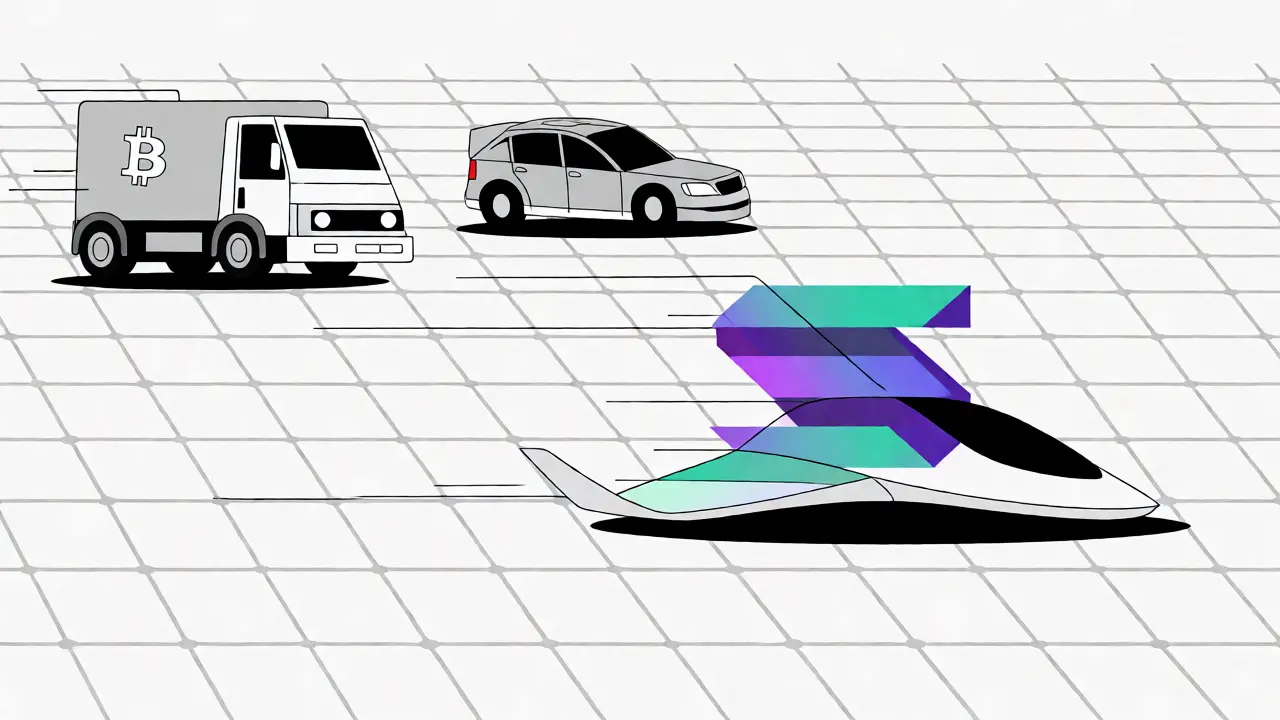
If Bitcoin is a horse carriage, Solana is a fighter jet. Designed specifically for high-frequency applications, Solana claims a theoretical capacity of 65,000 TPS. In practice, during heavy usage periods like the 2025 memecoin surge, it peaked at around 1,500 TPS-still vastly superior to Bitcoin or Ethereum.
Solana achieves this through Proof of History, a clock-like mechanism that timestamps transactions before they’re processed. This eliminates the need for nodes to constantly communicate to agree on order, drastically cutting latency. Users report sub-second confirmations, making it ideal for gaming, DeFi trading, and instant point-of-sale payments.
Avalanche offers a middle ground. With a throughput of ~4,500 TPS and confirmation times under 2 seconds, it uses a unique snowball consensus protocol. It’s faster than Ethereum but maintains a higher degree of decentralization than some ultra-fast competitors. Sui, a newer entrant, has recorded peaks over 850 TPS with even lower latency, leveraging a parallel execution engine that allows multiple transactions to process simultaneously without conflicting.
Layer-2 Solutions: Scaling Ethereum Without Leaving Home
Many developers don’t want to leave the Ethereum ecosystem because of its massive liquidity and developer tooling. Instead, they build on top of it. Enter Layer-2s. Polygon acts as a sidechain that batches transactions and settles them on Ethereum. It boasts speeds up to 7,000 TPS with confirmation times often under 30 seconds.
Other solutions like Arbitrum and Optimism use "rollups" to compress data. They offer near-instant user experiences while inheriting Ethereum’s security. For a merchant, integrating Polygon or Arbitrum provides the best of both worlds: access to Ethereum’s vast user base and significantly faster, cheaper transactions. However, remember that final settlement on the main Ethereum chain can still take a few minutes, though most apps treat L2 confirmations as final immediately.
Theoretical vs. Reality: The Congestion Problem
Here is the uncomfortable truth: theoretical numbers rarely match reality. A network might claim 65,000 TPS, but if hardware requirements are too high for average validators, the network can stall. Solana, despite its speed, has experienced network congestion and occasional outages during traffic spikes. When a network hits its limit, transactions either queue up or fail entirely.
Research from CoinGecko highlights that even the fastest chains operate well below their theoretical maxes. Solana’s actual peak performance was less than 2% of its advertised capacity. Why? Because real-world conditions involve variable internet speeds, hardware inconsistencies among validators, and unexpected spikes in activity. Therefore, when choosing a payment rail, look at historical uptime and average load, not just marketing brochures.

Choosing the Right Network for Your Needs
So, which speed do you actually need? It depends on your job-to-be-done:
- Retail Payments (Coffee, Groceries): You need sub-5-second finality. Solana, Avalanche, or Polygon are strong candidates. Bitcoin is too slow unless you use Lightning Network.
- Cross-Border Transfers: Speed matters, but cost and reliability matter more. Stellar or Ripple (XRP) often compete here, offering near-instant settlement with low fees.
- High-Frequency Trading/DeFi: You need maximum throughput. Solana and Sui excel here due to parallel processing capabilities.
- Large Value Settlements: Security trumps speed. Bitcoin’s 10-minute window is acceptable for moving millions, where trustlessness is paramount.
Consider the user experience too. If your app shows "Transaction Pending" for 10 minutes, users get anxious. If it shows "Confirmed" in 0.5 seconds, they feel confident. This psychological aspect drives adoption more than raw technical specs.
Trade-offs: What Do We Lose for Speed?
Faster networks often require more powerful hardware for validators. Solana’s high speed comes with the caveat that running a node is expensive and technically demanding. This can lead to centralization risks-if only a few entities can afford to run validators, who controls the network? Bitcoin, being slower, allows anyone with a laptop to verify transactions, preserving decentralization.
Additionally, rapid finality can sometimes compromise security guarantees. Some high-speed chains rely on optimistic assumptions that resolve quickly, whereas Bitcoin waits for deep confirmations to prevent double-spending. For most consumer payments, the risk of reversal on fast chains is negligible, but for institutional transfers, the extra caution of slower chains might still hold value.
Future Outlook: Can We Have It All?
The industry is racing to solve the scalability trilemma-the idea that you can’t have speed, security, and decentralization all at once. New architectures like modular blockchains and zk-Rollups aim to break this rule. By 2026, we’re seeing more hybrid models where base layers focus on security while specialized layers handle execution speed.
Expect continued pressure on older networks to adopt scaling solutions. Bitcoin’s Lightning Network continues to improve, enabling thousands of micro-transactions off-chain. Ethereum’s roadmap focuses on danksharding to increase data availability, potentially boosting L2 throughput further. Meanwhile, next-gen chains like Aptos and Sui are refining their parallel execution engines to push past current limits.
Is Bitcoin too slow for everyday payments?
For direct on-chain payments, yes. A 10-minute confirmation time is impractical for buying coffee. However, using Layer-2 solutions like the Lightning Network reduces this to milliseconds, making Bitcoin viable for retail use.
Why is Solana faster than Ethereum?
Solana uses Proof of History to timestamp transactions efficiently, allowing parallel processing. Ethereum processes transactions sequentially in blocks. This architectural difference allows Solana to achieve much higher throughput (TPS) with lower latency.
Do faster networks have higher fees?
Not necessarily. Faster networks often have lower fees because they process more transactions per block, spreading the cost. However, during extreme congestion, fees on any network can rise. Generally, Solana and Polygon offer significantly lower fees than Ethereum's base layer.
What is 'finality' in crypto transactions?
Finality refers to the point after which a transaction cannot be reversed or altered. On Bitcoin, this takes several blocks (hours). On Solana, it happens in seconds. For merchants, knowing when a transaction is final is crucial for releasing goods or services.
Are Layer-2 solutions as secure as the main chain?
Most Layer-2s inherit security from the underlying Layer-1 (like Ethereum). They post compressed data back to the main chain periodically. While there are minor risks related to bridge contracts or sequencer downtime, they are generally considered highly secure for typical payment volumes.
Leave a comments