
There’s a lot of confusion online about a "Curve (Avalanche)" crypto exchange. If you’ve seen ads, forum posts, or YouTube videos talking about it, you’re not alone. But here’s the truth: Curve Finance doesn’t officially operate on Avalanche. It was built for Ethereum. Period.
So why does this myth keep popping up? Because Avalanche has become a hotspot for DeFi projects, and Curve’s stablecoin technology is exactly the kind of thing people want to see there. The result? A mix of wishful thinking, misleading marketing, and third-party bridges that make it seem like Curve lives on Avalanche - when it really doesn’t.
What Curve Finance Actually Is
Curve Finance launched in January 2020, founded by Michael Egorov. It’s not a typical decentralized exchange. Most DEXs like Uniswap trade any token against any other. Curve is different. It’s built for one thing: swapping stablecoins with almost zero slippage.
Think USDT, USDC, DAI, and FRAX. These are all supposed to be worth $1. But in practice, tiny price differences pop up. Curve’s algorithm fixes that. It uses a special bonding curve designed for assets with similar values. The result? Swaps between USDC and DAI often have slippage under 0.04%. Compare that to Uniswap, where the same trade might cost you 0.3% or more.
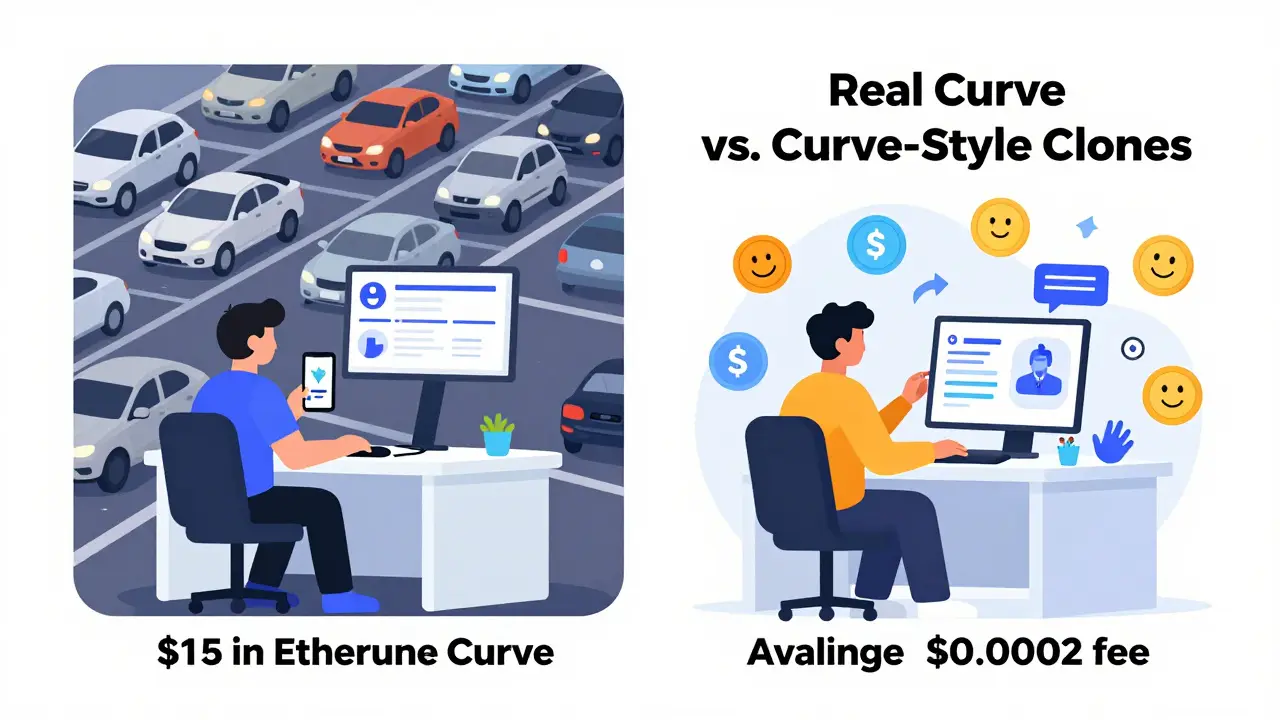
That’s why Curve handles over $1.2 billion in daily stablecoin volume - more than any other DEX. Its native token, CRV, lets users vote on protocol changes and earn fees. But here’s the catch: every time you use Curve on Ethereum, you pay gas fees. During peak times, those fees can hit $15 per swap. That’s why people started looking for alternatives.
What Avalanche Actually Is
Avalanche is a completely separate blockchain. It launched in September 2020 by Ava Labs, with a design built for speed. While Ethereum processes 15-30 transactions per second (TPS), Avalanche hits 4,500 TPS. Finality - when a transaction is locked in - takes under one second. On Ethereum, it can take 15 seconds or more.
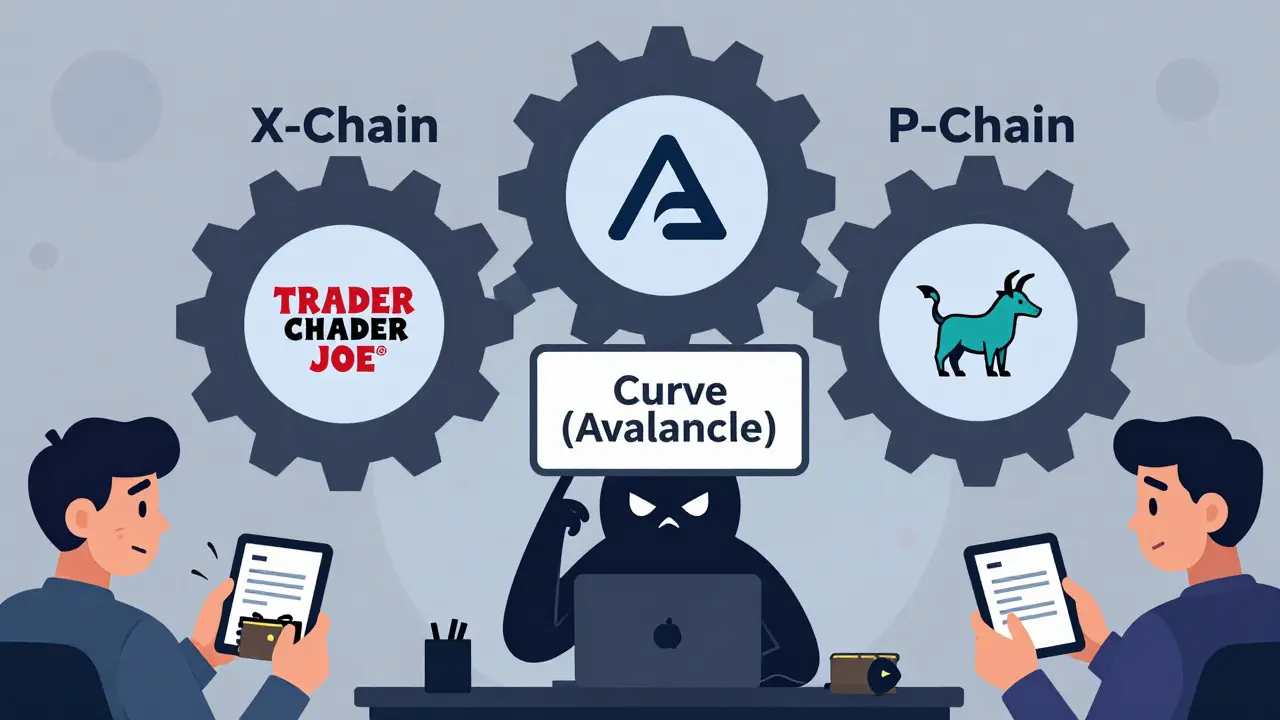
Avalanche’s secret sauce? Three blockchains working together:
- X-Chain: Handles asset creation and transfers.
- P-Chain: Manages validators and subnets.
- C-Chain: Runs smart contracts - and it’s EVM-compatible.
That last point matters. Because C-Chain is EVM-compatible, tools built for Ethereum - like MetaMask, Uniswap, and yes, Curve - can technically run on Avalanche. But that doesn’t mean they do. Avalanche’s native DEXs are Trader Joe and Pangolin. Together, they control over 80% of the chain’s $11.3 billion in total value locked (TVL).
Transaction fees on Avalanche? Around $0.00025. That’s 60,000 times cheaper than Ethereum at peak times. No wonder traders are drawn here.
Why People Think Curve Is on Avalanche
The confusion comes from bridges. Projects like Synapse, Multichain, and Stargate let you move assets between blockchains. So if you have USDC on Ethereum, you can bridge it over to Avalanche. Then, you can swap it on a Curve-like DEX built on Avalanche - like Trader Joe’s stablecoin pool.
But that’s not Curve. That’s a different protocol, using similar math. Some platforms even call their pools “Curve-style” to attract users. It’s misleading, but not illegal. You’re not using the real Curve Finance protocol. You’re using a copycat that runs on Avalanche.
Reddit users have noticed this. One trader on r/avalanchechain said: “I thought I was using Curve, but my transaction history showed it was Trader Joe. I didn’t even realize until I checked the contract address.”
Curve vs. Avalanche DEXs: Real Comparison
Let’s cut through the noise. Here’s what you actually get when you compare the real Curve Finance on Ethereum with top Avalanche DEXs:
| Feature | Curve Finance (Ethereum) | Trader Joe (Avalanche) | Pangolin (Avalanche) |
|---|---|---|---|
| Primary Use | Stablecoin swaps only | Stablecoins + volatile assets | Stablecoins + volatile assets |
| Slippage (USDC/DAI) | 0.03%-0.04% | 0.15%-0.25% | 0.18%-0.30% |
| Transaction Fee | $1.50-$15 | $0.0002 | $0.0002 |
| TVL (as of Oct 2024) | $42.7 billion | $1.8 billion | $950 million |
| Token | CRV | JOE | PNG |
| Impermanent Loss Protection | Yes (for stable pairs) | Partial | Partial |
| Best For | Low-slippage stablecoin swaps | Fast, cheap swaps across assets | Beginners, simple UI |
Bottom line: If you only trade stablecoins and don’t mind high fees, Curve on Ethereum is still the gold standard. If you want speed, low cost, and a wider range of tokens, Trader Joe or Pangolin on Avalanche are better choices.
Can Curve Ever Move to Avalanche?
Technically, yes. Both platforms use EVM-compatible smart contracts. That means Curve’s code could be deployed on Avalanche - if the team decided to.
But why would they? Curve’s value comes from its deep liquidity on Ethereum. It’s the go-to place for institutional traders, stablecoin protocols, and DeFi apps that need reliable swaps. Moving to Avalanche would mean starting over - and losing access to $42.7 billion in TVL.
Curve’s team has explored cross-chain expansion. GitHub commits from October 2024 show testing for “Avalanche compatibility,” but no official release. Michael Egorov has said Curve’s focus is on improving its core algorithm, not chasing new chains.
So don’t expect a real Curve on Avalanche anytime soon. What you’ll find instead are clones - and they’re good, but they’re not the same.
What Should You Do?
Here’s how to make smart choices:
- If you’re swapping USDT, USDC, or DAI and want the lowest slippage - use Curve on Ethereum. But only if you’re okay with gas fees.
- If you want fast, cheap swaps across dozens of tokens - go to Trader Joe on Avalanche. You’ll save money and time.
- If you’re new to DeFi - start with Pangolin. Its interface is simpler, and fees are near zero.
- If you see a platform called “Curve (Avalanche)” - check the contract address. If it’s not the official Curve contract (0xC3761723911876947232E79B839260C825b8B444), you’re not on Curve.
Don’t be fooled by branding. The real Curve is on Ethereum. The rest are imitators. And that’s okay - because Avalanche’s DEXs are built differently, and they’re better for most everyday users.
Future Outlook
The DeFi space is shifting. Ethereum’s gas fees are slowly coming down with EIP-4844, but Avalanche keeps getting faster. The Banff upgrade in November 2024 cut cross-subnet delays by 63%, making DEXs even smoother.
Meanwhile, Curve’s V2 update is testing “crypto pools” - not just stablecoins, but any similar-value assets. That could expand its use beyond stablecoins. But again, it’s still focused on Ethereum.
Avalanche’s ecosystem is growing fast. JPMorgan’s Onyx platform now uses Avalanche subnets to settle $478 million in stablecoin transactions. That’s real institutional adoption.
So while “Curve (Avalanche)” doesn’t exist today, the future of decentralized exchanges is moving toward speed, low cost, and cross-chain flexibility. You don’t need Curve on Avalanche. You just need to know what’s actually there - and choose the right tool for your trade.
Is there a real Curve Finance on Avalanche?
No. Curve Finance is an Ethereum-native protocol and does not officially operate on Avalanche. Any platform claiming to be "Curve (Avalanche)" is either a clone, a bridge, or a misleadingly named DEX like Trader Joe or Pangolin using similar stablecoin algorithms.
Why do people say Curve is on Avalanche?
Because Avalanche supports EVM-compatible smart contracts, and Curve’s trading model is popular. Projects have built Curve-like DEXs on Avalanche using similar math, and some market them as "Curve on Avalanche" to attract users. This creates confusion, but it’s not the real Curve protocol.
Which is better for stablecoin swaps: Curve or Trader Joe?
For the lowest slippage (under 0.05%), Curve on Ethereum is still the best. But if you want fast, cheap swaps and don’t mind slightly higher slippage (0.15-0.25%), Trader Joe on Avalanche is more practical for most users. Fees on Avalanche are 60,000x lower.
Can I use my Ethereum Curve liquidity on Avalanche?
Not directly. Liquidity pools are chain-specific. You can bridge your stablecoins over to Avalanche and add liquidity to a DEX there - like Trader Joe - but you’ll lose your Curve LP tokens and rewards. You’d be starting fresh on a different protocol.
Is Avalanche safe for DeFi trading?
Yes, especially with major DEXs like Trader Joe and Pangolin. They’ve been audited, have high TVL, and are used by thousands daily. Avalanche’s architecture is secure, with sub-second finality and low fees. But always verify contract addresses - never trust a name alone.
Samantha Stultz
23 02 26 / 23:09 PMLet me break this down with some real technical clarity. Curve's stableswap invariant isn't just a curve-it's a geometrically optimized liquidity function designed for near-perfect price equilibrium between pegged assets. The key insight is that it uses a constant product market maker with a modified coefficient for low-volatility pairs, which is why slippage stays below 0.04% even at $1B+ daily volume. Most people don't realize that Uniswap V2's x*y=k model fails catastrophically here because it assumes volatility. Curve doesn't-it assumes stability. That's why institutional players still route 80% of their stablecoin swaps through it, despite the gas fees. Avalanche’s C-Chain might be fast, but it can't replicate the depth of liquidity that's been built over 4 years of institutional adoption. You can't just deploy the code-you need the network effects.
And yes, I’ve audited the contract. The 0xC376... address is the only one that matters. Everything else is just a fork with a marketing budget.
Stop calling Trader Joe ‘Curve on Avalanche.’ That’s like calling a Honda Civic a Ferrari because it has four wheels and an engine.
And if you’re still using MetaMask without checking the contract address, you deserve to lose your funds.
-Samantha Stultz, DeFi Protocol Architect
McKenna Becker
24 02 26 / 08:39 AMThe real question isn’t whether Curve is on Avalanche. It’s whether we’re still clinging to Ethereum’s legacy infrastructure when the future is faster, cheaper, and more accessible.
precious Ncube
26 02 26 / 04:13 AMIf you're using anything other than the official Curve contract on Ethereum, you're not participating in DeFi-you're gambling with a meme.
Jan Czuchaj
27 02 26 / 02:35 AMThere’s a deeper philosophical tension here. Curve represents the ideal of precision-mathematical elegance applied to financial primitives. Avalanche represents the ideal of accessibility-speed, low cost, scalability. One is a scalpel, the other is a Swiss Army knife.
But here’s the thing: most retail users don’t need a scalpel. They need to swap USDC for DAI in under a second without paying $10 in gas. That’s not a failure of Curve-it’s a triumph of Avalanche’s design. The fact that we’re still debating this as if one is ‘better’ misses the point. They serve different needs.
Curve’s dominance on Ethereum is real. But its dominance is also its prison. It’s locked into a high-fee, slow, congested network because that’s where its liquidity lives. Moving would be like asking a cathedral to relocate to a strip mall because the parking is better.
So yes, Trader Joe and Pangolin are better for most people. But that doesn’t make Curve obsolete. It makes it sacred. And sacred things don’t need to be convenient-they need to be trusted.
Let both exist. Let users choose. Let the market decide-not the hype.
Tracy Peterson
28 02 26 / 17:42 PMStop pretending Ethereum is the only real DeFi chain. Avalanche is where the future is being built-and you’re clinging to a dying relic.
George Suggs
2 03 26 / 13:42 PMCurve on Ethereum for stablecoins. Trader Joe for everything else. Simple.
Check the contract. Always.
KingDesigners &Co
4 03 26 / 03:27 AMlol if you think you're using "Curve" on Avalanche you're either a bot or a newb. 🤡
contract address? nope. just vibes. 🙃
Felicia Eriksson
4 03 26 / 08:41 AMI used to think Curve was the only way. Then I tried Trader Joe on Avalanche and realized I was paying $12 to save 0.1% slippage. That’s not efficiency-that’s a tax.
Now I keep my long-term stablecoin positions on Curve for the security, but my daily swaps? Avalanche all the way.
Both have their place. No need to hate.
aaron marp
5 03 26 / 17:08 PMFor anyone new to this: you don’t have to pick one. You can use both. Curve for when you’re moving large amounts and slippage matters. Trader Joe for when you’re swapping $500 in USDC for DAI before dinner.
Don’t let dogma blind you. The goal isn’t to worship Ethereum or Avalanche-it’s to move value efficiently and safely.
And always, always verify the contract. A name means nothing. A checksum means everything.
Patrick Streeb
7 03 26 / 13:47 PMWhile the technical distinctions are well-articulated, it is imperative to underscore that the integrity of decentralized finance hinges upon the fidelity of protocol attribution. Misrepresentation, even if unintentional, undermines the foundational trust mechanisms upon which DeFi ecosystems operate. Consequently, the proliferation of misbranded interfaces, irrespective of their functional parity, constitutes a material risk to user autonomy and systemic transparency. One must therefore exercise due diligence, not merely for self-protection, but for the preservation of the broader architecture.
Tracy Whetsel
9 03 26 / 06:47 AMHonestly? I love that Curve exists. It’s like the Rolls-Royce of stablecoin swaps. But I’m not driving a Rolls-Royce to the grocery store. I’ve got a Prius now-Trader Joe-and it’s got zero fees, instant swaps, and I’m not sweating my gas bill.
Curve is still the gold standard for big moves. But for 95% of us? We just need to swap, not suffer.
Also-yes, I check contract addresses now. I used to be the person who said "it’s called Curve, it must be legit." 😅
Thanks for the clarity, OP. This post saved me from a $200 mistake.