 Imagine waking up to find a random coin has jumped 400% in price. Your first instinct might be to jump in and buy, fearing you're missing out. But then you ask: why? Is the project actually solving a problem, or is it just a hype train fueled by a few loud voices on social media? This is where
fundamental analysis is
a method of evaluating the underlying economic, financial, and technical factors that determine the actual value of a digital asset.
Also known as FA, it helps you stop gambling on price charts and start investing in technology.
Imagine waking up to find a random coin has jumped 400% in price. Your first instinct might be to jump in and buy, fearing you're missing out. But then you ask: why? Is the project actually solving a problem, or is it just a hype train fueled by a few loud voices on social media? This is where
fundamental analysis is
a method of evaluating the underlying economic, financial, and technical factors that determine the actual value of a digital asset.
Also known as FA, it helps you stop gambling on price charts and start investing in technology.
The core goal here is to find the "intrinsic value" of a coin. If the intrinsic value is higher than the current market price, you've found an undervalued gem. If the market price is way higher than the actual value, you're looking at a bubble waiting to burst. Unlike technical analysis, which looks at patterns in price movement, FA looks at the engine under the hood to see if the car can actually drive.
The Pillars of Crypto Fundamental Analysis
In the stock market, you'd look at earnings reports and balance sheets. Since most crypto projects don't have a traditional CEO or a quarterly profit statement, we have to look at different markers. First, look at the business model. A project needs a clear plan for how it generates value and how that value is distributed. If the team can't explain how they make money or sustain the network, the project is likely a house of cards.
Next, evaluate the Whitepaper. This is the project's manifesto. Does it solve a real-world problem, or is it just using buzzwords like "revolutionary" and "hyper-deflationary" without explaining the tech? You want to see a concrete use case. For instance, a project that reduces cross-border payment fees from 7% to 0.1% has a clear value proposition. A project that claims to "change the world" without a technical roadmap does not.
Then there's the team and the community. You aren't just betting on code; you're betting on people. Check the developers' backgrounds on LinkedIn or GitHub. Are they seasoned engineers or anonymous accounts? A strong, engaged community on forums and social media is also a huge green flag, as network effects drive adoption. If nobody is using the tool, the token is worthless.
Understanding Tokenomics and Treasury
You can have the best technology in the world, but if the Tokenomics is broken, the price will crash. Tokenomics is the study of the supply and demand characteristics of a cryptocurrency. You need to ask: Is the supply capped? Is there a massive amount of tokens locked for the founders that will be dumped on retail investors in six months? A sustainable emission schedule that incentivizes holding rather than constant selling is what keeps a token's value stable over the long haul.
Treasury management is the other side of this coin. A transparent treasury shows exactly how much capital the project has and how it's being spent. If a project has $100 million in its treasury but no clear plan for development or marketing, that money is just sitting idle. If they're burning through cash with no product launch in sight, it's a major red flag.
| Feature | Fundamental Analysis (FA) | Technical Analysis (TA) |
|---|---|---|
| Primary Focus | Intrinsic Value & Utility | Price Trends & Volume |
| Time Horizon | Long-term Investment | Short-to-Medium term Trading |
| Key Tools | Whitepapers, On-chain data, Team audits | Candlestick charts, RSI, MACD |
| Core Question | "Why should this exist?" | "When will the price move?" |

The Power of On-Chain Metrics
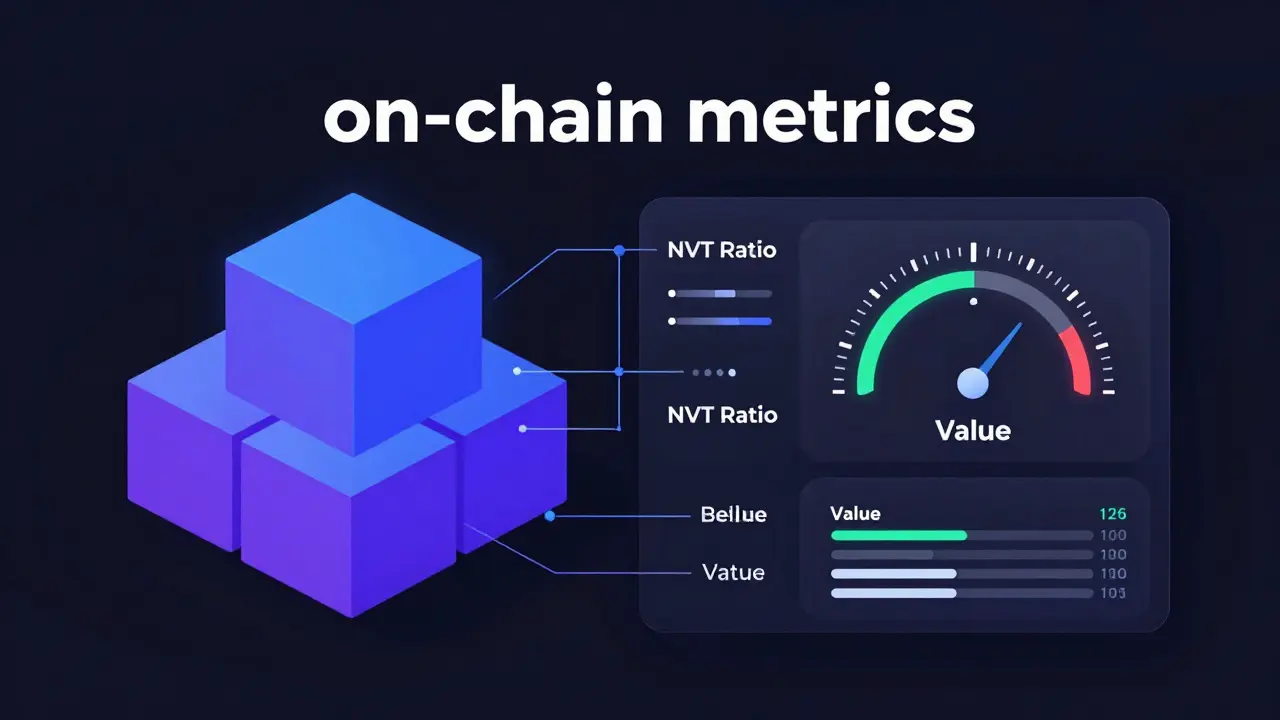
One of the coolest things about blockchain is that it's an open book. We don't have to wait for a company to release a PDF report every three months. We have On-chain metrics, which are data points pulled directly from the ledger in real-time. This is the backbone of modern crypto FA.
A key metric to watch is the NVT Ratio (Network Value to Transactions). Think of this as the crypto version of a P/E ratio in stocks. It's calculated by dividing the network value (market cap) by the daily transaction volume. If the NVT is very high, it means the price is skyrocketing while the actual usage of the network is lagging-a sign that the asset might be overvalued. Conversely, a low NVT suggests the network is being used heavily, but the market hasn't priced that utility in yet.
Other metrics to track include active wallet addresses and developer activity on GitHub. If the number of unique users is growing every month, the network effect is kicking in. If the developers have stopped pushing code updates, the project is likely dead, regardless of what the price chart says.
A Step-by-Step Framework for Your Analysis
If you're staring at a new project and don't know where to start, follow this five-step process to avoid expensive mistakes:
- Deep Research: Read the whitepaper and the official documentation. Scour GitHub to see if the code is actually being updated. Look for the project's roadmap and check if they've hit their previous milestones.
- Industry Context: Look at the broader landscape. Is this a Layer 1 blockchain competing with Ethereum? A DeFi protocol competing with Uniswap? Understand the macro trends, like regulatory shifts or new technological standards, that could help or hurt the project.
- Project Audit: Evaluate the team's expertise. Have they built successful projects before? Is the community organic, or is it full of bots shouting "To the moon!"?
- Valuation: Use the NVT ratio and check the tokenomics. Compare the project to its closest competitors. If Project A has a $1 billion market cap but only 10% of the users that Project B has (which has a $100 million market cap), Project B might be the better value.
- The Final Call: Based on the data, decide if the asset is undervalued (buy), overvalued (sell/avoid), or fairly priced (hold).
Avoiding Common Pitfalls
Even with a structured approach, it's easy to get blinded by a great story. Many investors fall for the "narrative trap," where a project has a compelling vision but no actual product. Remember that a great idea is not the same as a working product. Always look for a Minimum Viable Product (MVP) or a live testnet before committing significant capital.
Another mistake is relying on a single metric. For example, a high transaction volume might look great, but it could be caused by a few "wash traders" moving money back and forth to fake activity. This is why you must triangulate data: check the NVT ratio, then verify it with unique wallet growth and GitHub commits. When three different data points tell the same story, you're onto something.
Finally, don't ignore the importance of combining FA with technical analysis. While FA tells you what to buy, TA helps you decide when to buy. Buying an undervalued coin at the absolute top of a hype cycle is still a bad trade. Wait for the fundamentals to align with a favorable price entry point.
How long does it take to master fundamental analysis?
Depending on your starting point, it typically takes about 3 to 6 months of dedicated study. You'll need to get comfortable with blockchain basics, basic economic principles, and how to use on-chain data tools like Glassnode or Messari.
Can I rely solely on fundamental analysis for trading?
You can, but it's risky for short-term gains. FA is designed for long-term investing. In the short term, market sentiment and hype often override fundamentals. Most professional traders combine FA to pick the asset and TA to time the entry and exit.
What is the most important metric in crypto FA?
There is no single "golden" metric, but the NVT Ratio is among the most respected because it links market value to actual network utility. However, Tokenomics (specifically the inflation rate and unlock schedule) is just as critical for long-term price sustainability.
How do I know if a project's team is reliable?
Look for "doxxed" teams (those who reveal their real identities) with a track record in computer science, cryptography, or finance. Check their LinkedIn profiles and see if they have contributed to other successful open-source projects on GitHub.
Is a whitepaper enough to prove a project has value?
Absolutely not. A whitepaper is a proposal, not a product. Many failed projects had brilliant whitepapers but failed in execution. Always look for a working product, a growing user base, and active development to verify the claims made in the whitepaper.
Brendan Thraxton
26 04 26 / 17:37 PMreally helpful breakdown for anyone just starting out. focusing on the actual utility instead of just chasing green candles is how you actually make it in this space long term
Janis Naglis
28 04 26 / 02:14 AMThe synergy between on-chain metrics and tokenomics is absolutely pivotal!!! Looking at the circulating supply versus the total supply is such a critical alpha-generator for any serious investor... definitely a game-changer!!!
Ryan Nakielny
30 04 26 / 00:27 AMOh yeah, because reading a whitepaper written by a 19-year-old in a basement is definitely the peak of financial due diligence. Totally works every time.
Sri Astuti
1 05 26 / 08:27 AMImagine actually believing that a simple NVT ratio can predict the movement of a volatile asset when we all know that whale manipulation and coordinated pump-and-dumps completely negate any 'intrinsic value' that you pretend exists in these digital tokens 🙄 honestly the sheer naivety of thinking a PDF manifesto equates to a business model is just laughable at this point.
Elle Kharitou
3 05 26 / 05:40 AMIt is truly fascinating to contemplate how we are shifting the very paradigm of value from centralized trust to decentralized verification, allowing us to see the heartbeat of a project through its code and community growth 🌟. When we look at the deeper philosophical implications of a transparent treasury, we realize that we are not just trading coins, but investing in a new social contract for the digital age where honesty is enforced by the protocol itself ✨. It's such a beautiful journey of discovery to move from blind faith to data-driven conviction, and I believe this shift will eventually lead us to a more equitable financial system for everyone across the globe 🌏.
Nitin Gupta
5 05 26 / 00:22 AMI agree with the points on developer activity. It might be a bit tedious to check GitHub daily, but it really is the only way to be sure the project isn't abandoned.
Wayne Gillis
6 05 26 / 23:33 PMWho cares about the whitepaper? Just tell me which coin is going to 100x next week! 🚀💰 Give us the tickers!
Noel Mandotah
8 05 26 / 20:03 PMImagine thinking TA is a 'tool' and not just astrology for men. Hilarious.
Livvy Cooper
10 05 26 / 08:03 AMThis is all too complicated. Most of these coins are just scams anyway so why bother reading a long paper about it.
Lex Harley
12 05 26 / 04:56 AMI totaly agree that the NVT ratio is key but do you think the liquidy providr incentives might skew the transation volume too much? Like if the yield farming is too high it might fake the utilty
Arti Jain
13 05 26 / 07:43 AMPurely amateur analysis. India is leading the actual dev work anyway.
Emily A
15 05 26 / 03:50 AMThe distinction between a manifesto and a product is the most critical point here. Most investors lack the discipline to make that distinction.
Gabby Puche
15 05 26 / 15:57 PMLoving this vibe! It's so important to keep a cool head and just follow the data 🌈✨
Kathleen Warren
16 05 26 / 13:56 PMI can see how confusing this is at first. Just take it one step at a time and you'll get the hang of it.
Barbara Jones
17 05 26 / 04:28 AMi tried doing this for a coin last month but i got confussd with the tokenomics part lol. its still a good way to avoid rugs tho
Abhishek Verma
18 05 26 / 04:41 AMSure, because a 'transparent treasury' is definitely not just a fancy way to hide how the founders are spending our money on luxury villas in Bali. Keep believing the fairy tales.
Tracy McBurney
18 05 26 / 09:37 AMThe failure to mention the impact of regulatory headwinds on fundamental value is a glaring omission in this guide. If the SEC classifies your 'utility token' as a security, your intrinsic value drops to zero instantly regardless of your GitHub commits.
Pramendra Singh
19 05 26 / 20:24 PMI think it's very helpful to have a framework like this. It makes the process feel much less overwhelming for new investors.
Bevon Findley
20 05 26 / 14:35 PMPretty basic stuff but accurate :)