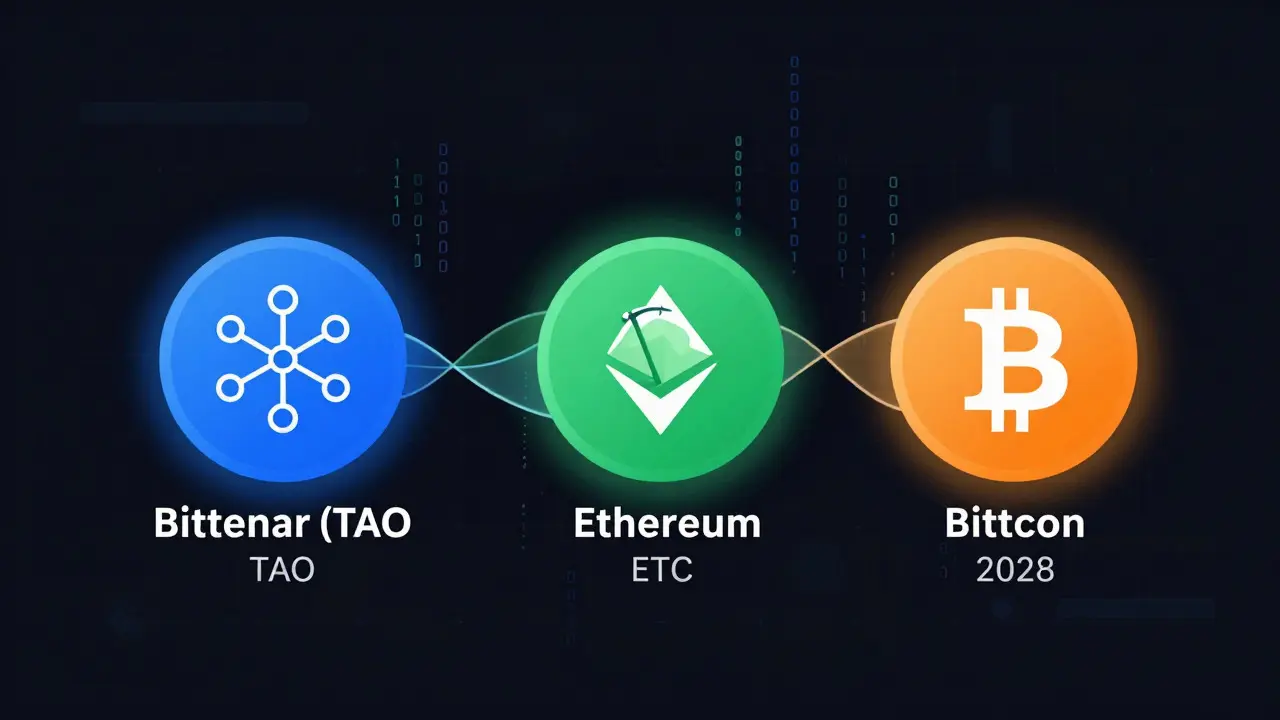
The clock is ticking on the next wave of supply shocks in the cryptocurrency market. If you have been watching Bitcoin since 2017 or even 2020, you know the drill: the halving happens, miners get paid less, supply tightens, and eventually, price goes up. But the landscape has changed dramatically. We are no longer looking at a single event isolated in time. Instead, we are facing a convergence of major halvings across different blockchain ecosystems within a compressed three-year window from 2025 to 2028.
This isn't just about nostalgia for past bull runs. The mechanics of these events are evolving. With Bittensor (TAO) undergoing its first-ever halving, Bitcoin preparing for its fifth, and Ethereum Classic following suit, the long-term impact extends far beyond simple price predictions. These events test the sustainability of mining economics, the stability of complex multi-token ecosystems, and the resilience of institutional adoption strategies. Let's break down what is coming, who it affects, and why the old rules might not apply anymore.
The Convergence of Major Supply Reductions
Historically, Bitcoin was the only game in town when it came to significant, protocol-level supply shocks. Other coins had inflation rates that were either negligible or so high they didn't matter to retail investors. Today, however, we see a synchronized sequence of events that could create ripple effects across the entire digital asset class.
The timeline is dense. First, we have the unique case of Bittensor, which operates on a decentralized machine learning network. Its inaugural halving is projected between December 2025 and February 2026. Unlike Bitcoin's predictable block count, TAO's halving is triggered by circulating supply hitting 10.5 million tokens out of a 21 million hard cap. As of mid-2026, this threshold is being approached rapidly, driven by token recycling from miner deregistrations and subnet registration fees.
Shortly after, on July 23, 2026, at block 25,000,001, Ethereum Classic (ETC) will execute its scheduled halving. ETC remains one of the few major networks still using proof-of-work consensus, making its halving directly comparable to Bitcoin's historical model. Finally, Bitcoin itself will undergo its fifth halving around April 2028 at block 1,050,000, reducing the block reward from 3.125 BTC to 1.5625 BTC.
| Asset | Estimated Date | Trigger Mechanism | Impact Type |
|---|---|---|---|
| Bittensor (TAO) | Dec 2025 - Feb 2026 | Circulating supply reaches 10.5M | Complex multi-subnet liquidity shift |
| Ethereum Classic (ETC) | July 23, 2026 | Block 25,000,001 | Standard PoW supply reduction |
| Bitcoin (BTC) | April 2028 | Block 1,050,000 | Major institutional supply shock |
This clustering of events means capital flows and miner behaviors in one network could influence sentiment and liquidity in others. When TAO faces liquidity constraints due to reduced issuance, traders may rotate profits into other assets, potentially affecting ETC or altcoin markets before Bitcoin's turn arrives two years later.
Bittensor: The Unknown Variable in Multi-Token Economics
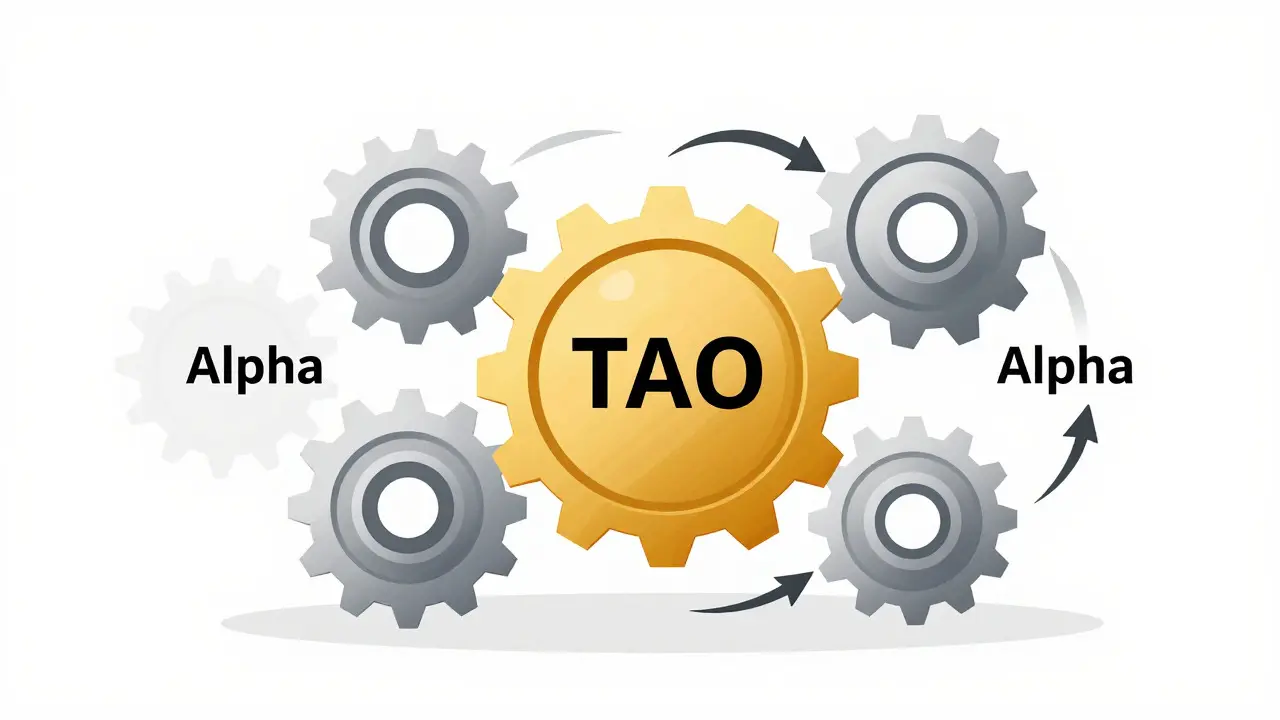
Bittensor represents the most complex halving scenario because it lacks historical precedent. While Bitcoin’s model is straightforward-fewer new coins enter the market-Bittensor’s architecture involves dozens of subnets, each with native Alpha tokens. The halving reduces TAO issuance but simultaneously ramps up the dilution of Alpha tokens relative to TAO.
Why does this matter? Because the incentive structure for validators and miners in these subnets depends on the balance between TAO rewards and Alpha token emissions. If TAO becomes scarcer while Alpha tokens continue to inflate, subnet-specific economies could destabilize. Miners might find their revenue streams squeezed if the value of Alpha tokens drops relative to TAO, leading to potential sell pressure as they liquidate positions to cover operational costs.
Currently, approximately 9.4 million TAO tokens are in circulation. The path to 10.5 million is not linear; it fluctuates based on cold-key swaps, deregistrations, and new subnet launches. This unpredictability makes TAO a high-risk, high-reward play for those betting on decentralized AI infrastructure. Investors need to monitor subnet health metrics closely, as a failure in key subnets could negate any bullish price action from the halving itself.
Ethereum Classic: A Pure Proof-of-Work Test Case
Ethereum Classic offers a cleaner comparison to Bitcoin because it maintains a proof-of-work consensus mechanism. After Ethereum’s transition to proof-of-stake, ETC became the largest remaining PoW chain. Its halving on July 23, 2026, will cut block rewards in half, directly impacting miner profitability.
The critical question for ETC is whether the reduced supply will drive price appreciation enough to keep miners online. In smaller-cap PoW chains, a halving can sometimes lead to a security risk if prices don’t rise sufficiently. Miners may switch their hash rate to more profitable chains like Bitcoin or Litecoin, leaving ETC vulnerable to attacks or slower block times. However, if institutional interest in "pure" PoW assets grows, ETC could benefit from a narrative shift toward transparency and decentralization purity.
Unlike Bitcoin, where institutional custody solutions are mature, ETC relies more on community-driven exchanges and self-custody. This means price discovery might be more volatile and less efficient during the halving period. Traders should watch exchange reserves closely; a drop in available ETC on exchanges often signals strong holder conviction.
Bitcoin’s Fifth Halving: Institutional Maturity vs. Historical Cycles
Bitcoin’s upcoming halving in April 2028 is the most anticipated, yet it may behave differently than previous cycles. Historically, Bitcoin’s price peaks 12-18 months after a halving. The 2024 halving saw Bitcoin reach an all-time high near $110,000 in January 2025, roughly nine months later. Analysts project the next peak could push prices toward $175,000 in the short term, with long-term forecasts suggesting $900,000 by 2030.
However, several factors suggest these traditional four-year cycles are extending. Macroeconomic conditions, including elevated interest rates and longer debt maturities, have slowed the velocity of money. Additionally, institutional adoption has changed the player base. Companies like ARK Invest, led by Cathie Wood, have accumulated tens of millions in Bitcoin, treating it as a strategic reserve rather than a speculative trade.
This shift means that the immediate post-halving price spike might be muted. Instead of a rapid pump-and-dump, we could see a gradual accumulation phase lasting years. Global liquidity metrics, such as M2 money supply expansion, remain strong correlates with Bitcoin rallies. If central banks maintain restrictive policies, Bitcoin’s upward trajectory may be delayed but ultimately stronger due to sustained scarcity.
Furthermore, Bitcoin is approaching its 21 million cap. With 29 more halvings until 2140, the block reward will become negligible. Eventually, transaction fees must replace coinbase rewards to secure the network. This transition is already visible in fee markets, where Layer 2 solutions like Lightning Network help scale transactions while keeping main-chain fees manageable for large transfers.
Long-Term Implications: Mining Economics and Network Security
The long-term impact of these halvings extends beyond price charts. They fundamentally alter the economic incentives for securing blockchain networks. For Bitcoin, the progression toward minimal block rewards requires higher token prices to maintain mining profitability. If prices stagnate, miners may shut down, reducing network hash rate and potentially compromising security.
However, technological advancements in mining hardware efficiency mitigate some of this risk. New ASICs consume less energy per terahash, allowing miners to operate profitably at lower reward levels. Additionally, the rise of renewable energy-powered mining farms helps stabilize operational costs, making miners less sensitive to short-term price fluctuations.
For Bittensor, the challenge is maintaining subnet sustainability. If Alpha token inflation outpaces TAO appreciation, validators may exit the network, degrading the quality of decentralized machine learning services. This could create a feedback loop where poor performance drives users away, further reducing demand for TAO. Conversely, successful subnets could attract enterprise clients willing to pay premium fees, stabilizing the ecosystem regardless of halving dynamics.
Institutional investors are also adapting their strategies. Rather than chasing pre-halving pumps, many are focusing on dollar-cost averaging over multi-year periods. This behavior smooths out volatility and reduces the likelihood of extreme bubble bursts. Data from CryptoQuant shows declining exchange reserves for Bitcoin, indicating that holders are moving coins to cold storage for long-term holding. This trend supports bullish scenarios but suggests that price movements will be driven by macroeconomic shifts rather than technical events alone.
Strategic Considerations for Investors and Developers
Navigating this period of multiple halvings requires a nuanced approach. Here are key considerations for different participants:
- For Bitcoin Holders: Expect extended cycle timelines. Do not panic if price action is muted immediately after the 2028 halving. Focus on macroeconomic indicators like global liquidity and institutional inflows. Consider using Layer 2 solutions for daily transactions to avoid main-chain congestion.
- For Bittensor Participants: Monitor subnet health metrics closely. Diversify exposure across multiple subnets to mitigate risks associated with individual Alpha token failures. Be prepared for increased volatility as the market adjusts to the new emission schedule.
- For Ethereum Classic Traders: Watch hash rate trends carefully. A sudden drop in hash rate could signal miner capitulation, presenting a buying opportunity if you believe in the long-term viability of PoW. Conversely, stable hash rates indicate strong miner confidence.
- For Developers: Build applications that are resilient to token emission changes. For example, design DeFi protocols that adjust collateral requirements dynamically based on underlying asset volatility. This ensures sustainability regardless of halving-induced price swings.
Another critical factor is regulatory clarity. As cryptocurrencies mature, governments are implementing clearer frameworks for taxation and compliance. This reduces uncertainty for institutional players, encouraging deeper market participation. However, regulations can also restrict access to certain jurisdictions, fragmenting liquidity. Stay informed about local laws, especially if you are operating mining operations or running staking nodes.
Finally, consider the environmental narrative. Proof-of-work chains face ongoing scrutiny regarding energy consumption. Highlighting green mining initiatives or carbon-neutral operations can enhance brand reputation and attract ESG-focused investors. For Bittensor, emphasizing the utility of decentralized AI in solving real-world problems can justify its energy use and drive organic demand.
Will Bitcoin's 2028 halving cause an immediate price surge?
Historically, Bitcoin's price appreciation occurs 6-18 months after a halving, not immediately. Given current institutional adoption and macroeconomic factors, the 2028 halving may follow a similar delayed pattern. Immediate reactions are often muted as markets digest the supply change gradually.
How does Bittensor's halving differ from Bitcoin's?
Bittensor's halving is triggered by circulating supply reaching 10.5 million tokens, not a fixed block height. It also impacts a complex ecosystem of subnets with independent Alpha tokens, creating unpredictable liquidity dynamics. Bitcoin's halving is a simple reduction in block rewards every 210,000 blocks.
Is Ethereum Classic safe to hold through its 2026 halving?
Ethereum Classic's safety depends on miner retention. If price doesn't rise enough to offset reduced rewards, miners may leave, weakening network security. However, its status as a major proof-of-work chain provides some stability. Monitor hash rate trends closely for signs of miner confidence.
What role do transaction fees play in Bitcoin's future?
As block rewards diminish, transaction fees will become the primary source of miner revenue. This transition is essential for network security. Layer 2 solutions like Lightning Network help manage fee pressure by handling small transactions off-chain, ensuring main-chain fees remain sustainable for large transfers.
How should I prepare my portfolio for multiple simultaneous halvings?
Diversify across assets with different risk profiles. Allocate core holdings to established assets like Bitcoin, while using smaller positions in newer projects like Bittensor for higher growth potential. Maintain cash reserves to buy dips during volatility spikes caused by halving-related news.
Leave a comments