
Remember the days when you could trade Bitcoin for Ethereum in private and hope the IRS never noticed? Those days are officially over. If you hold digital assets today, you need to understand that cryptocurrency taxation has shifted from a gray area into a highly regulated, automated system. The landscape changed dramatically with regulations implemented in 2025, and by mid-2026, the dust has settled enough to see exactly how the new rules affect your wallet.
The Internal Revenue Service (IRS) still treats cryptocurrency as property, not currency. This means every time you swap, sell, or spend crypto, you trigger a taxable event. But the way those events are tracked and reported has been revolutionized. With the mandatory rollout of Form 1099-DA and the elimination of universal accounting methods, the government now sees almost everything you do on-chain. Ignoring these changes isn't just risky; it's practically impossible.
The New Standard: Form 1099-DA and Automated Reporting
The biggest shift in the cryptocurrency tax landscape is the introduction of Form 1099-DAa new IRS tax form specifically designed for reporting digital asset transactions. Starting January 1, 2025, all U.S.-based cryptocurrency exchanges were required to track and report investor transactions directly to the IRS using this form. Think of it like the 1099-B form used for stocks, but built for the complexity of blockchain.
Before 2025, many platforms only reported interest income or staking rewards. Now, they must report sales, exchanges, and disposals. This means if you sold $5,000 worth of Solana on Coinbase, both you and the IRS get a copy of that transaction data. The era of self-reporting alone is dead. The IRS now receives real-time data on your cost basis, proceeds, and holding periods from major exchanges.
This change forces a higher level of transparency. If your personal records don’t match what the exchange reports, you’ll likely face an audit flag. For most retail investors, this actually simplifies things because the exchange does the heavy lifting of tracking. However, it also means there is no hiding spot for large trades executed on centralized platforms.
Wallet-by-Wallet Accounting: The End of Universal Averaging
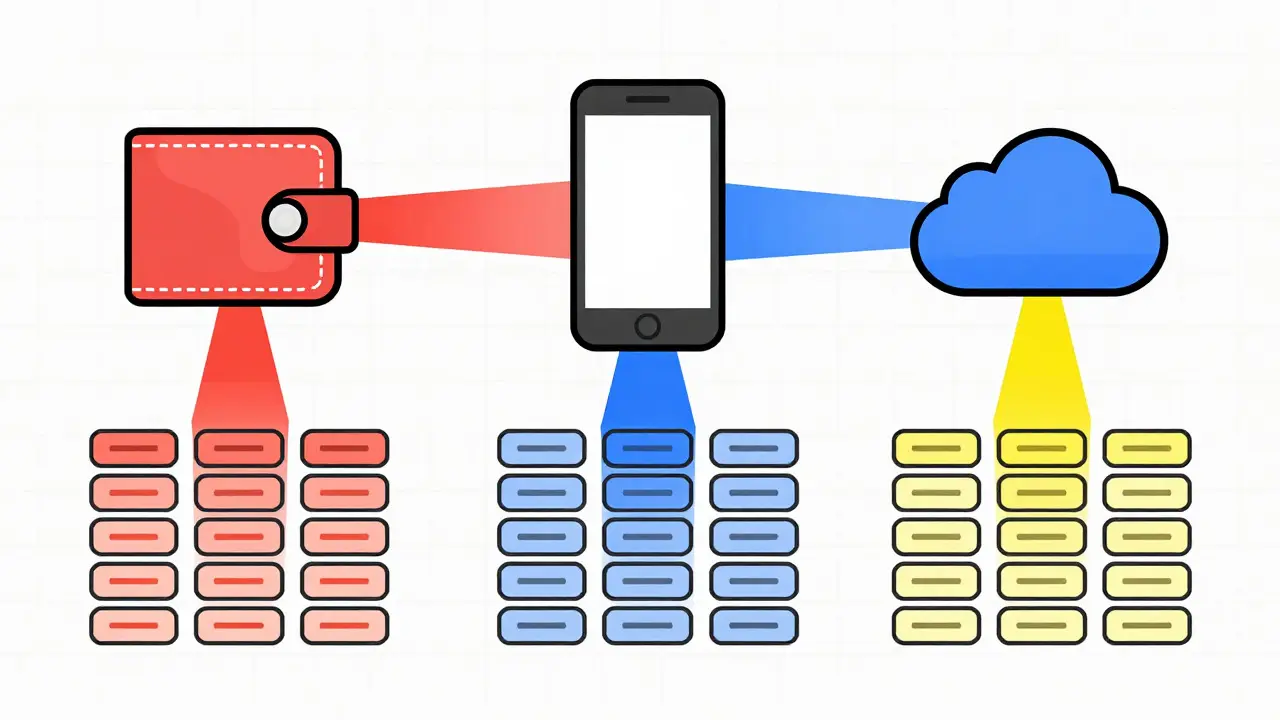
Alongside Form 1099-DA, the IRS eliminated the "universal" accounting method for calculating cost basis. Previously, some taxpayers could use a simplified average cost method across all their holdings. That option is gone. As of 2025, investors must use a wallet-by-wallet accounting methoda strict tracking system requiring individual cost basis calculation for each specific digital asset wallet.
This requires granular tracking. You can no longer lump all your Bitcoin together in one mental bucket. If you have Bitcoin in a hardware wallet, another batch in a cold storage device, and some on an exchange, each group must be tracked separately for its purchase price and date. When you sell coins from your hardware wallet, you must identify exactly which coins you sold (using FIFO, LIFO, or Specific Identification) based on the history of that specific wallet.
This creates a significant burden for active traders who move funds between multiple wallets. You must keep detailed logs of self-transfers. Even moving crypto from your own exchange account to your own Ledger device is a recordable event to ensure the cost basis travels with the asset. Without this meticulous record-keeping, calculating your true profit or loss becomes nearly impossible during tax season.
Capital Gains Rates: Short-Term vs. Long-Term
Understanding the rate you pay is just as important as tracking the transaction. Crypto profits fall into two buckets: ordinary income and capital gains. If you earn crypto through mining, staking, or airdrops, that value is taxed as ordinary income at the time you receive it. The rates range from 10% to 37%, depending on your total annual income.
For trading and selling, the clock starts ticking the moment you acquire the asset. Here is the breakdown for the 2026 tax year:
- Short-Term Capital Gains: If you hold crypto for less than one year, profits are taxed as ordinary income. This means your top marginal tax rate applies. For high earners, this can mean paying up to 37% plus the Net Investment Income Tax (NIIT).
- Long-Term Capital Gains: Hold for more than one year, and you qualify for preferential rates. These are typically 0%, 15%, or 20%. For single filers in 2026, the 0% bracket usually covers incomes up to approximately $48,350. The 15% rate applies to incomes between $48,350 and $533,400. Above $533,400, the rate jumps to 20%.
Don't forget the extra costs. High-income earners may face the 3.8% Net Investment Income Tax on top of their capital gains. Add state taxes, and your effective tax rate on short-term gains can easily exceed 40% in states like California or New York. Planning your holding period to cross that one-year threshold can save you thousands.
| Scenario | Tax Treatment | Potential Rate Range |
|---|---|---|
| Selling BTC held for 6 months | Short-Term Capital Gain | 10% - 37% + NIIT |
| Selling ETH held for 18 months | Long-Term Capital Gain | 0% - 20% + NIIT |
| Earning SOL via Staking | Ordinary Income | 10% - 37% |
| Selling NFTs (Collectibles) | Collectible Capital Gain | Up to 28% |
| Donating Crypto to Charity | Non-Taxable Event + Deduction | 0% (with deduction benefit) |
NFTs and Collectibles: A Higher Price Tag
If you are invested in Non-Fungible Tokens (NFTs), pay close attention. The IRS classifies many NFTs as collectibles, similar to stamps or art. This classification triggers a different tax rule. While standard long-term capital gains cap at 20%, gains from collectibles are capped at 28%. This means if you buy a Bored Ape Yacht Club NFT and sell it for a profit after holding it for two years, you might pay a significantly higher rate than you would for selling Bitcoin.
This distinction often catches investors off guard. Always verify whether your digital asset falls under the collectible category. If it does, factor that 28% ceiling into your exit strategy calculations.
The Wash Sale Rule Controversy
One of the most debated topics in crypto taxation is the wash sale rulea regulation preventing investors from claiming tax losses on securities sold at a loss if substantially identical securities are repurchased within 30 days. Traditionally, this rule applied only to stocks. It prevented traders from selling a stock at a loss to offset gains, then immediately buying it back.
In recent budget proposals, including those discussed during the transition to the current administration, there have been strong pushes to apply the wash sale rule to cryptocurrency. While the full implementation details for 2026 are still being refined by the Treasury Department, investors should assume this rule is coming. If enacted, selling Bitcoin at a loss and buying it back three days later will disqualify you from claiming that loss on your taxes. This eliminates a popular tax-loss harvesting strategy for crypto traders. Until explicit guidance is finalized, exercise extreme caution when engaging in rapid buy-sell cycles near year-end.

Tax Planning Strategies for 2026
With stricter reporting and complex accounting rules, proactive planning is your best defense. Here are practical steps to manage your liability:
- Harvest Losses Early: Before the wash sale rule potentially tightens, review your portfolio. If you have assets down significantly, consider selling them to realize losses. Just ensure you do not buy back the same asset (or a substantially identical one) for 31 days.
- Extend Your Holding Period: If you bought an asset late last year, wait until it crosses the one-year mark before selling. The drop from your ordinary income rate to the long-term capital gains rate is often substantial.
- Donate Appreciated Crypto: Instead of donating cash, donate crypto that has increased in value. You avoid paying capital gains tax on the appreciation and can deduct the fair market value of the donation, provided you itemize deductions. This is one of the most efficient tax moves available.
- Consolidate Wallets: To simplify wallet-by-wallet accounting, consider consolidating holdings into fewer wallets where possible. Fewer wallets mean fewer records to reconcile and a lower chance of making a costly error.
- Use Professional Software: Manual spreadsheets are no longer sufficient for the volume of data generated by Form 1099-DA. Use specialized crypto tax software that can import data from exchanges and wallets, automatically applying FIFO or specific identification methods.
What Comes Next?
The regulatory environment for crypto is stabilizing, but it remains dynamic. The success of Form 1099-DA and the wallet-by-wallet accounting model will likely influence future legislation. We expect continued integration between traditional financial systems and blockchain protocols. Brokers may soon communicate cost basis data directly to each other, much like they do for stocks, reducing the burden on individual investors to track self-transfers.
However, until that infrastructure is fully mature, the responsibility lies with you. Keep your records clean, understand the difference between ordinary income and capital gains, and respect the new reporting standards. The days of flying under the radar are over, but with proper planning, you can navigate the new system efficiently and keep more of your hard-earned profits.
Does the IRS really know about my crypto transactions now?
Yes, for transactions on U.S.-based exchanges. Since 2025, exchanges are required to file Form 1099-DA, which reports your sales, exchanges, and proceeds directly to the IRS. They also send a copy to you. This means the IRS has a record of your activity independent of your tax return.
What is the wallet-by-wallet accounting method?
This is a new IRS requirement that replaces the old universal averaging method. You must track the cost basis and acquisition date of cryptocurrencies individually for each wallet you own. You cannot mix records from different wallets to calculate gains or losses.
Are NFTs taxed differently than Bitcoin?
Often, yes. Many NFTs are classified as collectibles by the IRS. Long-term capital gains on collectibles are taxed at a maximum rate of 28%, whereas standard long-term capital gains on assets like Bitcoin max out at 20% (plus potential NIIT). Short-term gains are taxed at ordinary income rates for both.
Will the wash sale rule apply to crypto in 2026?
There is significant legislative pressure to apply the wash sale rule to cryptocurrency, which currently only applies to stocks. While final implementation details for 2026 are pending, investors should assume it may be enforced. Avoid selling crypto at a loss and immediately repurchasing it to claim a tax deduction.
How can I reduce my crypto tax bill legally?
Key strategies include holding assets for more than one year to qualify for lower long-term capital gains rates, donating appreciated crypto to charity to avoid gains tax and claim a deduction, and harvesting losses from underperforming assets (while respecting wash sale rules). Using professional tax software can also help ensure you aren't overpaying due to calculation errors.
Do I need to pay taxes on crypto-to-crypto trades?
Yes. The IRS treats cryptocurrency as property. Trading one crypto for another (e.g., swapping USDT for ETH) is a taxable event. You must calculate the gain or loss based on the fair market value of the asset received at the time of the trade compared to your cost basis.
Leave a comments