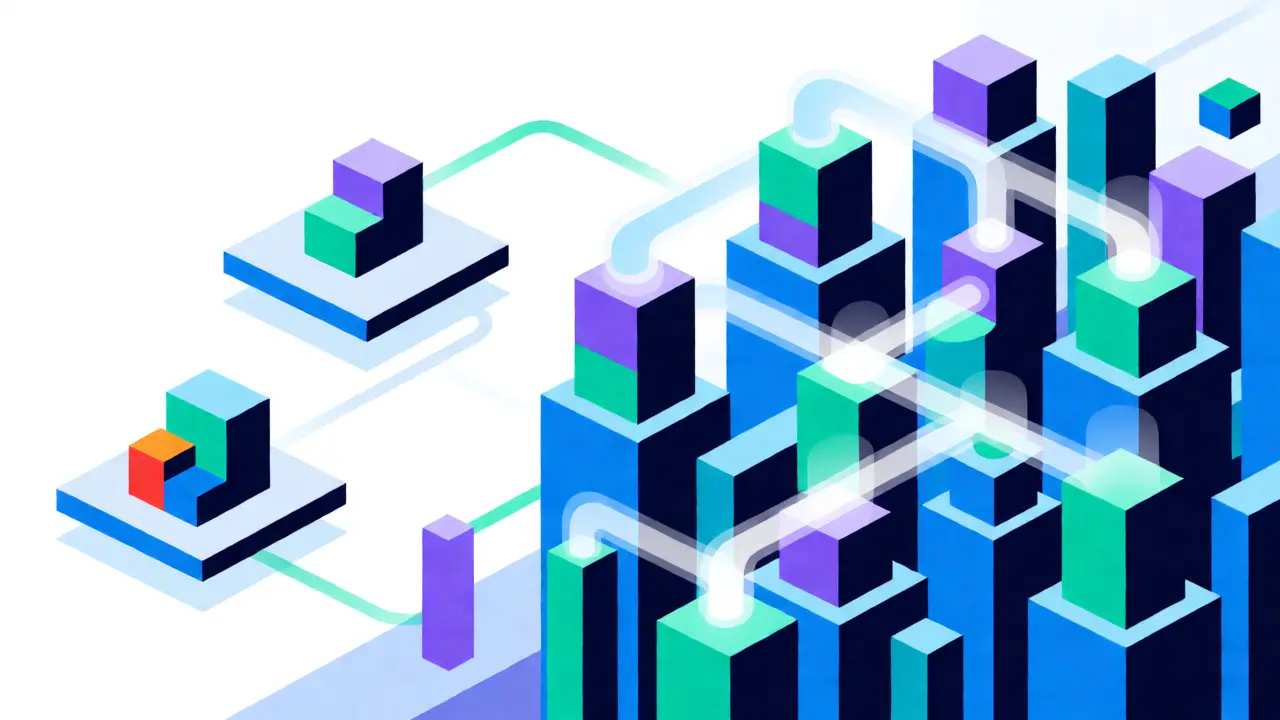
Imagine trying to build a house where every time you want to add a window, you have to renegotiate the price with the glass manufacturer, hire a new contractor, and wait three months for approval. That’s traditional finance. Now imagine grabbing a pre-made window from a shelf, snapping it into place, and moving on in five minutes. That’s DeFi composability, the architectural capability that allows decentralized finance protocols to interoperate seamlessly like modular building blocks. It is the engine driving the next wave of financial innovation, but as we look toward 2026 and beyond, this "money lego" model faces a critical test: can it scale without collapsing under its own complexity?
The Evolution from Single-Chain to Cross-Chain Networks
Back in 2018, when Uniswap launched, composability was a local affair. You could swap tokens or lend assets, but everything happened on one chain. Fast forward to today, and the landscape has exploded. We are no longer just stacking blocks on Ethereum; we are connecting entire cities. The total value locked (TVL) in protocols enabling this interoperability hit $23.5 billion recently, signaling that cross-chain architecture isn't just a buzzword-it's the standard.
Why does this matter? Because capital efficiency skyrockets when assets aren't trapped in silos. In traditional finance, moving money between institutions takes days. In DeFi, standardized interfaces allow assets to participate in multiple protocols simultaneously. For example, you can stake your ETH, use the receipt token as collateral for a loan, and deploy those borrowed funds into a liquidity pool-all within minutes. This velocity is impossible in legacy banking, where legal negotiations alone take weeks.
Intent-Based Systems: Hiding the Complexity
Here is the problem with current composability: it is messy. To execute a complex yield strategy, you often need to interact with five different smart contracts, manage gas fees across chains, and pray nothing breaks mid-transaction. Enter intent-based systems, a user-centric approach where users specify desired outcomes rather than technical execution steps.
Instead of telling the blockchain exactly how to swap your tokens, you simply state what you want: "I want to swap Token A for Token B at the best possible rate across all available networks." Solvers-specialized bots or protocols-then compete to find the most efficient path. Recent data suggests this shift reduces user errors by up to 63%. Platforms leveraging these intents abstract away the scary parts of multi-protocol interaction, making DeFi feel less like coding and more like using a modern app.
| Feature | Traditional Composability | Intent-Based Systems |
|---|---|---|
| User Responsibility | High (manages routes/gas) | Low (specifies outcome only) |
| Error Rate | Higher due to manual steps | Reduced by ~63% |
| Execution Speed | Dependent on user speed | Optimized by solver competition |
| Complexity Barrier | Steep learning curve | Beginner-friendly interface |
The Rise of Real-World Assets (RWAs)
If composability is the plumbing, Real-World Assets (RWAs) are the fresh water flowing through it. Analysts predict that RWAs represent a $16 trillion opportunity for DeFi. Why? Because tokenizing things like US Treasuries, real estate, or carbon credits brings stable, yield-bearing assets onto the blockchain.
This changes the game for institutional investors. They don't want to hold volatile crypto; they want exposure to stable returns with the transparency of blockchain. By 2027, experts project that 65% of institutional participation will occur through curated composability stacks. These aren't wild-west experiments; they are carefully monitored environments where compliance meets code. When a Treasury bill is tokenized, it becomes composable with lending markets, allowing banks to borrow against it instantly without waiting for T+2 settlement times.

Combinatorial Risk: The Achilles' Heel
But let's not get too excited. There is a dark side to stacking legos: combinatorial risk. This occurs when the failure of one protocol triggers a cascade effect across interconnected systems. Remember the Terra/Luna collapse? It wiped out $40 billion in 72 hours because so many protocols were tightly coupled to its stability mechanisms.
Newer exploits show similar patterns. If a bridge hack compromises an asset's backing, any protocol relying on that asset for collateral faces liquidation risks. Users lose money not because their specific trade failed, but because the underlying infrastructure cracked. Data from recent quarters shows $47 million in losses attributed specifically to misconfigured protocol interactions. The solution isn't to stop composing; it's to build better circuit breakers. Imagine if your loan automatically paused if the collateral's oracle feed went offline for more than ten minutes. That's the kind of defensive programming becoming standard in mature DeFi stacks.
Regulatory Landscape and Institutional Adoption
Governments are watching. The EU's MiCA framework now requires aggregators to perform "combinatorial risk assessments," forcing platforms to prove their integrations won't cause systemic failures. In the US, regulators have issued numerous enforcement actions against unsecured composability platforms. This friction is slowing down retail experimentation but speeding up enterprise adoption.
Forty-one Fortune 500 companies are currently experimenting with RWA-DeFi stacks. They aren't looking for high-risk yield farming; they want efficiency. Trade finance, in particular, benefits massively. Instead of letters of credit taking weeks to clear, smart contracts can automate payments upon delivery verification, cutting costs by nearly 40%. This pragmatic use case is pulling traditional finance into the DeFi orbit, regardless of ideological debates about decentralization.

AI-Driven Optimization and Future Outlook
Where do we go from here? Artificial Intelligence is stepping in to manage the chaos. AI-driven risk management systems analyze market conditions in real-time, adjusting protocol combinations to optimize yields while minimizing exposure. Early adopters report 22% higher yield optimization compared to manual strategies.
We are likely heading toward a consolidation phase. Just as SaaS tools bundled features into suites like Salesforce, specialized DeFi protocols will merge into comprehensive financial applications. However, unlike Web2, these suites will maintain open interfaces, allowing developers to plug in new modules without breaking existing functionality. The goal is a seamless experience where the user doesn't even know which chain or protocol handled their transaction-they just see the result.
Frequently Asked Questions
What is DeFi composability in simple terms?
It refers to the ability of different decentralized finance protocols to work together seamlessly, like Lego bricks. One application can call another to access liquidity, lending, or trading functions, creating complex financial products without needing custom integration for every single connection.
Is cross-chain composability safe?
It carries higher risk than single-chain operations due to bridge vulnerabilities and combinatorial complexity. While technology is improving with better audits and insurance protocols, users should be aware that a hack on one connected protocol can impact others in the stack.
How do intent-based systems help beginners?
They hide the technical complexity. Instead of managing gas fees, slippage settings, and routing paths manually, users just state their desired outcome. Solvers then handle the execution details, significantly reducing the chance of user error and making DeFi more accessible.
What role do Real-World Assets play in DeFi growth?
RWAs bring stable, traditional financial instruments like bonds and real estate onto the blockchain. This attracts institutional capital seeking lower volatility and provides deeper liquidity pools for traders, bridging the gap between traditional finance and decentralized ecosystems.
Will regulations hinder DeFi composability?
Initially, yes, as compliance requirements add friction. However, frameworks like MiCA aim to create certainty, which encourages institutional adoption. The long-term view is that regulation will filter out risky, poorly designed compositions, leading to a more robust and sustainable ecosystem.
Leave a comments