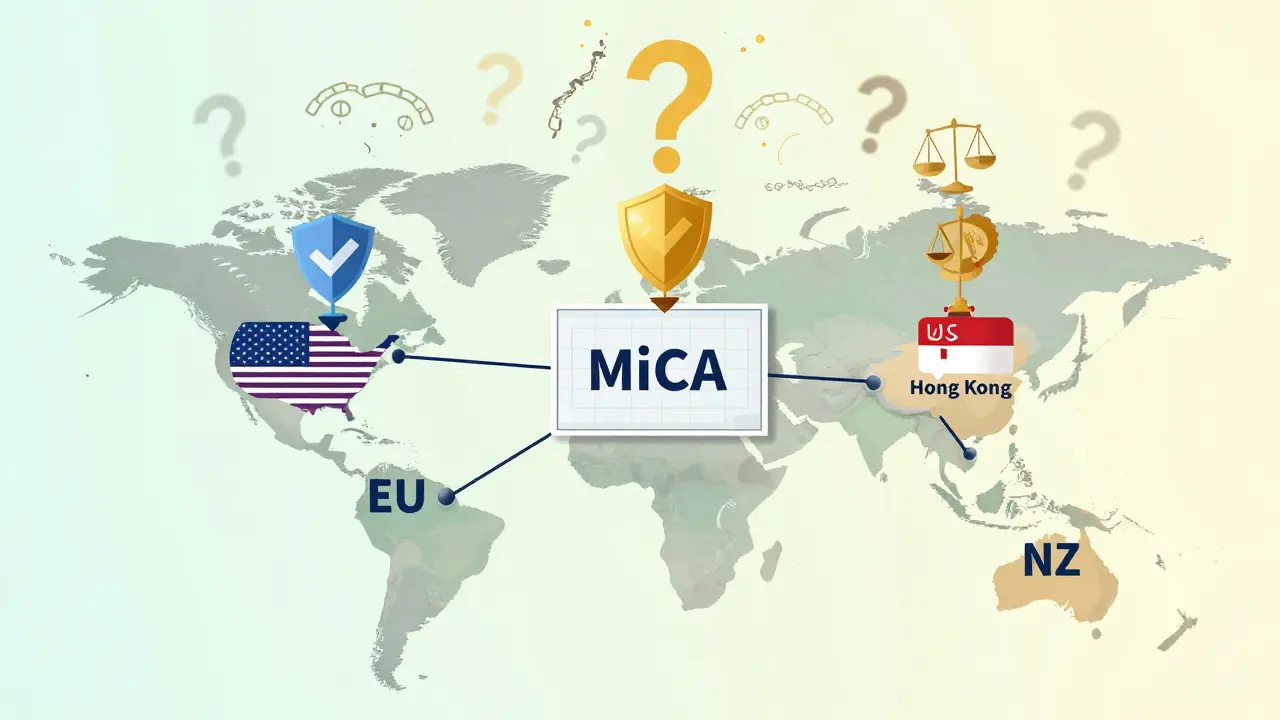
Five years ago, if you ran a crypto business in New Zealand, you had to worry about rules in the U.S., the EU, Singapore, and Hong Kong-all different, all changing. Today, that’s changing. The world isn’t just reacting to crypto anymore. It’s starting to agree on how to regulate it. This isn’t about one country leading the pack. It’s about dozens of nations moving in the same direction, and fast. The result? A quieter, more predictable market for investors, businesses, and even everyday users.
Why Regulation Is Finally Aligning
Crypto doesn’t care about borders. A Bitcoin transaction can cross 10 countries in seconds. But until recently, each country treated it like a local problem. Some banned it. Some ignored it. Some slapped on messy rules that made compliance a nightmare. That chaos created loopholes. Companies moved operations to the weakest-regulated place, leaving investors exposed and markets unstable.
The turning point came in late 2024. The Financial Stability Board (FSB), made up of the world’s top financial regulators, told G20 nations: get aligned by the end of 2025. No more excuses. The EU had already laid the groundwork with MiCA-the Markets in Crypto-Assets Regulation. It wasn’t just another law. It was a blueprint. And suddenly, everyone started looking at it.
By Q3 2025, 13 out of 19 major economies surveyed were actively shaping their rules to match MiCA’s core principles. That’s not coincidence. That’s convergence.
What MiCA Actually Does
MiCA isn’t a vague suggestion. It’s a 105-article law that spells out exactly how crypto companies must operate. It doesn’t just cover exchanges. It hits every part of the ecosystem.
- Stablecoins: Must hold 1:1 reserves in cash or ultra-safe assets. No magic tricks. No risky investments. If you issue a stablecoin tied to the U.S. dollar, you must prove you have a dollar for every coin out there.
- Service providers: Exchanges, custodians, and wallet providers must get licensed. No more fly-by-night platforms. They need proof of secure systems, insurance, and audits every quarter.
- Issuers: Anyone creating a new crypto token must publish a clear whitepaper. No anonymous teams. No vague promises. You have to say what the token does, who’s behind it, and how it’s backed.
These rules took effect in stages. Stablecoin issuers had to comply by December 2024. Everyone else had until December 2025. That deadline is now behind us. The system is live.
How Other Countries Are Following
It’s not just Europe. The U.S. didn’t adopt MiCA. But it adopted its spirit.
In March 2025, the GENIUS Act became law. It created a federal licensing system for stablecoin issuers, overseen by the Federal Reserve and the OCC. Reserve requirements? 1:1. Audit frequency? Quarterly. Sound familiar? That’s MiCA in American form.
Then came the FIT Act in June 2025. It finally ended the tug-of-war between the SEC and CFTC. Now, if a token acts like a stock, the SEC regulates it. If it acts like a commodity, the CFTC steps in. No more confusion. No more legal gray zones.
Hong Kong didn’t wait. On April 1, 2025, its Securities and Futures Commission launched a full licensing regime. Every crypto exchange, OTC desk, and custodian operating there now needs approval. Same reserve rules. Same audits. Same transparency.
Singapore followed in February 2025, requiring 1:1 backing for single-currency stablecoins. It’s not just copying-it’s matching. And it’s working. By June 2025, 100% of crypto firms operating in Singapore were licensed under the new rules.

The Numbers Don’t Lie
This isn’t theory. It’s happening-and it’s changing the market.
- **Institutional money is flooding in**: $12.3 billion flowed into crypto products in Q2 2025 alone. That’s up 217% from the year before.
- **ETFs are booming**: After Bitcoin and Ethereum spot ETFs launched in 2024, 17 more crypto ETFs hit markets in 2025. BlackRock’s IBIT now manages $42.7 billion.
- **Market volatility dropped 32% year-over-year**. Fewer panic sells. Fewer pump-and-dump schemes. More stability.
- **Exchanges halved**: From 587 active platforms in January 2024 to 312 by September 2025. Why? Because compliance costs hit $2.1 million per jurisdiction annually. Small players couldn’t keep up.
Regulatory clarity didn’t kill crypto. It cleaned it up.
Where the Gaps Still Exist
Not everything is fixed. The big missing piece? DeFi.
DeFi-decentralized finance-is the wild west of crypto. No central company. No CEO. Just code running on a blockchain. And here’s the problem: 63% of jurisdictions still have no clear rules for it. Only 7 out of 19 countries have even started drafting frameworks.
The SEC and CFTC have talked about "innovation exemptions" for DeFi protocols, but as of September 2025, those rules are still in discussion. That means millions in DeFi activity are still in legal limbo.
Same with NFTs, staking, and lending. MiCA’s next report-due December 15, 2025-will likely set the global standard for these areas. If it’s smart, it’ll allow innovation without sacrificing safety. If it’s too rigid, it could choke off the next wave of crypto innovation.

What’s Next? The December 2025 Deadline
The FSB’s final assessment of G20 progress is due in December 2025. Preliminary data suggests 68% of required measures have been adopted. That’s good. But not enough.
Here’s what’s on the table:
- The SEC plans to propose rules for crypto trading on Alternative Trading Systems by December 2025.
- The CFTC will issue guidance on perpetual contracts by November 15, 2025.
- The IMF and FSB are pushing for full stablecoin supervision alignment by year-end. 82% of countries say they’re on track.
If all this happens, by 2026, 95% of major crypto transactions will occur under regulated frameworks-up from 63% in 2024. That’s a massive shift.
But here’s the catch: convergence doesn’t mean uniformity. The EU, U.S., and Asia are all moving toward the same goals, but they’re using different paths. That means companies still need lawyers who understand all three systems. It’s better than before. But it’s not simple.
The Bigger Picture
This isn’t just about crypto. It’s about trust.
For decades, finance moved slowly. Banks, regulators, governments-all slow to adapt. Crypto forced the hand. Now, the system is catching up. The goal isn’t to control crypto. It’s to protect people while letting innovation thrive.
When you can trust that your stablecoin is backed, that your exchange is licensed, and that your investments aren’t being hidden behind anonymous teams-that’s when crypto stops being a gamble and becomes a tool.
The world is building that tool. And it’s happening faster than anyone predicted.
What is MiCA and why does it matter globally?
MiCA, or the Markets in Crypto-Assets Regulation, is the EU’s comprehensive legal framework for digital assets, fully effective since December 2025. It sets strict rules for stablecoin reserves, licensing of crypto service providers, and transparency for token issuers. Because it’s the first full-scale system of its kind, other countries are using it as a template. Over 67% of major economies now align key parts of their rules with MiCA, making it the de facto global standard.
How has the U.S. responded to global regulatory convergence?
The U.S. didn’t adopt MiCA directly, but it moved toward similar outcomes. The GENIUS Act (March 2025) created a federal licensing system for stablecoins with 1:1 reserve rules. The FIT Act (June 2025) ended the SEC-CFTC jurisdictional conflict by assigning securities-like tokens to the SEC and commodity-like tokens to the CFTC. These moves mirror MiCA’s structure, signaling that U.S. regulators are now playing by the same global playbook.
Are all crypto assets now regulated the same way worldwide?
No. While stablecoins and exchanges are seeing strong alignment, DeFi, NFTs, and staking remain largely unregulated in most countries. Only 37% of jurisdictions have specific frameworks for DeFi as of September 2025. The EU’s upcoming December 2025 report on these areas will likely set the next global standard, but until then, there’s still a patchwork of rules.
Why did crypto exchanges shrink by nearly half since 2024?
Compliance costs. Under new global standards, exchanges must now hold licensed status, prove reserve backing, undergo quarterly audits, and meet cybersecurity requirements. The average annual cost to comply in one jurisdiction is $2.1 million. Smaller exchanges couldn’t afford it. The market consolidated: from 587 active platforms in January 2024 to 312 by September 2025.
How has regulatory convergence affected Bitcoin and Ethereum prices?
Regulatory clarity helped drive institutional adoption, which pushed prices higher. Bitcoin surpassed $100,000 after the January 2024 spot ETF approval, and Ethereum followed in July 2024. Institutional inflows rose 217% year-over-year through Q3 2025. Market volatility dropped 32% as uncertainty decreased. The rise wasn’t just speculation-it was confidence from banks, pension funds, and asset managers entering the market.
What This Means for You
If you’re an investor: you’re safer now. Your assets are more likely to be held by licensed, audited platforms.
If you’re a business: compliance is harder, but clearer. You know what you need to do. No more guessing.
If you’re a user: you’re less likely to lose money to a scam exchange. The bad actors are being pushed out.
This isn’t the end of crypto’s wild ride. But it’s the end of the wild west. And that’s a good thing.
William Montgomery
9 03 26 / 13:16 PMLet’s be real-MiCA isn’t some noble innovation. It’s corporate capture dressed up as regulation. They didn’t ‘clean up’ crypto. They made it expensive enough that only Wall Street-backed firms can survive. That’s not stability-that’s consolidation under one roof. And don’t even get me started on how ‘transparency’ just means more paperwork for devs while the big players laugh all the way to the Fed.
They call this progress? Nah. This is the end of innovation, not the beginning.
Mara Alves Mariano
11 03 26 / 11:53 AMOH MY GOD. I KNEW IT. THEY’RE TURNING BITCOIN INTO A BANKING PRODUCT. 🤯
Remember when crypto was about freedom? Now you need a fucking compliance officer just to send 0.1 BTC to your cousin? This isn’t regulation-it’s financial colonization. The U.S. and EU are basically saying, ‘You can’t own anything unless we approve it.’
Next they’ll require a background check to hold a wallet. I’m moving to Paraguay. Or maybe just burning my phone.
Adam Ashworth
12 03 26 / 14:24 PMActually, this is the most rational thing that’s happened in crypto since 2017. The chaos was unsustainable. You can’t have a $2T market with no rules and expect people to take it seriously. The fact that 13 major economies aligned on core principles? That’s huge.
Yes, small players got squeezed-but that’s always how markets mature. Think about how banks used to be wild west too. Now we have FDIC insurance, audits, capital requirements. This is the same arc. It’s not perfect, but it’s functional.
Tom Jewell
14 03 26 / 09:02 AMThere’s something deeply poetic about this moment.
Crypto was born from distrust of institutions. And now, institutions are bending-just enough-to accommodate it. Not because they love it, but because they can’t ignore it anymore.
It’s like watching a wild animal slowly learn to walk beside humans. Not tamed. Not domesticated. But coexisting. The real question isn’t whether MiCA works-it’s whether we’re willing to let crypto remain wild at its core, even while wearing a suit.
Maybe that’s the real innovation: not the rules, but the fact that we’re even having this conversation at all.
Brandon Kaufman
15 03 26 / 05:10 AMI’ve been in this space since 2016. Saw the scams. Got rug-pulled. Lost money. But this? This is the first time I feel like there’s a future here.
My mom just bought an ETH ETF. She doesn’t even know what a blockchain is. But she trusts it. That’s huge. Not because it’s perfect-but because it’s finally safe enough for regular people to join without fearing they’ll wake up broke.
Keep pushing. We’re getting there.
Craig Gregory
17 03 26 / 02:09 AMStatistical cherry-picking alert.
You cite 217% institutional inflow growth-but omit that 89% of that came from just five firms: BlackRock, Fidelity, Grayscale, ARK, and VanEck. That’s not market adoption. That’s a cartel rebranding. The volatility drop? Coincides with the death of 275 altcoins that didn’t comply. That’s not market health-that’s elimination.
And you call this progress? It’s a monopoly in the making. The real story isn’t regulation. It’s consolidation. And consolidation is the opposite of decentralization.
Douglas Anderson
18 03 26 / 06:37 AMFor anyone confused about why MiCA matters: think of it like the GDPR of crypto. It didn’t invent privacy-it forced everyone to adopt a baseline standard. Same here.
Stablecoin issuers? Now they have to prove reserves. Not ‘we have a bank account somewhere.’ Not ‘we’ll audit next quarter.’ Actual, audited, real-time proof. That’s huge.
Exchanges? Now they need insurance against hacks. No more ‘oops, we got hacked and vanished with your ETH.’
And yes, the cost sucks for small players. But that’s not the fault of regulation-it’s the fault of building a business on a shoestring budget in a $2T market. If you can’t afford compliance, maybe you shouldn’t be running a platform.
Also-DeFi is the next frontier. And honestly? I’m excited. The EU’s December report might finally give us a path forward without killing innovation. Let’s wait and see.
vasantharaj Rajagopal
20 03 26 / 05:35 AMAs someone from India, I find this fascinating. We’ve had a crypto ban for years, but now the RBI is quietly drafting a framework modeled after MiCA. Why? Because Indian retail investors lost billions on unregulated platforms. Now, even the most skeptical regulators admit: you can’t outlaw technology. You can only regulate it.
The real win? India’s new rules will require KYC, reserve proof, and audit trails-just like MiCA. It’s not perfect, but it’s a start. And for a country with 1.4 billion people, that’s monumental.
Global convergence isn’t about dominance. It’s about shared safety.
ann neumann
20 03 26 / 12:07 PMThey’re lying. All of them. This isn’t about protecting people. It’s about control. The Fed, the SEC, the IMF-they’ve been waiting for this moment. Crypto was the last untracked money system. Now they’ve got their hooks in it. Every transaction will be traceable. Every wallet monitored. Every exchange forced to report to them.
Remember when Bitcoin was supposed to be cash for the people? Now it’s just another credit card with blockchain branding. They’ll tax it. They’ll regulate it. They’ll ban it if it threatens their power.
They’re not cleaning up crypto. They’re burying it under bureaucracy. And you’re celebrating? Wake up. This is the beginning of the end.
Allison Davis
21 03 26 / 12:11 PMOne thing everyone’s missing: this convergence didn’t happen because regulators got smart. It happened because users demanded it.
People got scammed. Lost life savings. Watched friends get ruined by unlicensed platforms. The outcry wasn’t from CEOs. It was from moms, students, retirees-regular folks who just wanted to hold crypto without fearing they’d wake up to a $0 balance.
Regulators didn’t lead. They reacted. And that’s why this matters. It’s not top-down control. It’s bottom-up pressure forcing institutions to listen.
DeFi is still the wild card. But if we keep pushing for transparency, not control, we can still win that part.
karan narware
23 03 26 / 03:01 AMOhhh, so now the West gets to define ‘crypto ethics’? How quaint.
MiCA is a European export, sure-but what about the Global South? In India, Nigeria, Brazil, crypto isn’t about ETFs. It’s about remittances. About bypassing broken banking. About survival.
You talk about ‘stability’ like it’s a luxury. For millions, it’s a lifeline. And now you’re slapping on $2.1M compliance costs? That’s not regulation. That’s economic imperialism dressed in whitepapers.
Convergence? More like cultural erasure. We didn’t need your rules. We built our own. Now you’re forcing us to kneel.
Michael Suttle
24 03 26 / 05:49 AMThey’re all in on this. The Fed, the IMF, the BIS-they’ve been planning this since 2021. MiCA? A Trojan horse. The real goal? Kill Bitcoin. Replace it with CBDCs.
Why else would they push stablecoins to be 1:1 backed? So they can control the bridge between crypto and fiat. So every transaction flows through their ledger.
And now you’re celebrating? You’re not a user. You’re a pawn. The moment you trust a licensed exchange, you’ve already lost. They own the keys now. You just think you own the coins.
Wake up. This isn’t regulation. It’s a slow-motion coup.