
Imagine you have a locked box containing a valuable piece of jewelry. You want a jeweler to polish it, but you don't trust them with the key to the box. In the physical world, this is impossible. But in the digital world, Homomorphic Encryption is a cryptographic method that allows computations to be performed on encrypted data without ever needing to decrypt it first. Essentially, the jeweler can polish the jewelry through the walls of the box using "magic gloves," and when you get the box back and unlock it, the jewelry is polished, but it never actually left the secure container.
For anyone dealing with blockchain or cloud computing, this is a game-changer. Usually, if you want a server to analyze your data, you have to give them the decryption key or send the data in plaintext. That's where the risk lives. With homomorphic encryption, the server processes the ciphertext and returns an encrypted result. The server never sees your actual information, yet the math still works. This solves the age-old conflict between needing to use data and needing to keep it secret.
The Three Flavors of Homomorphic Encryption
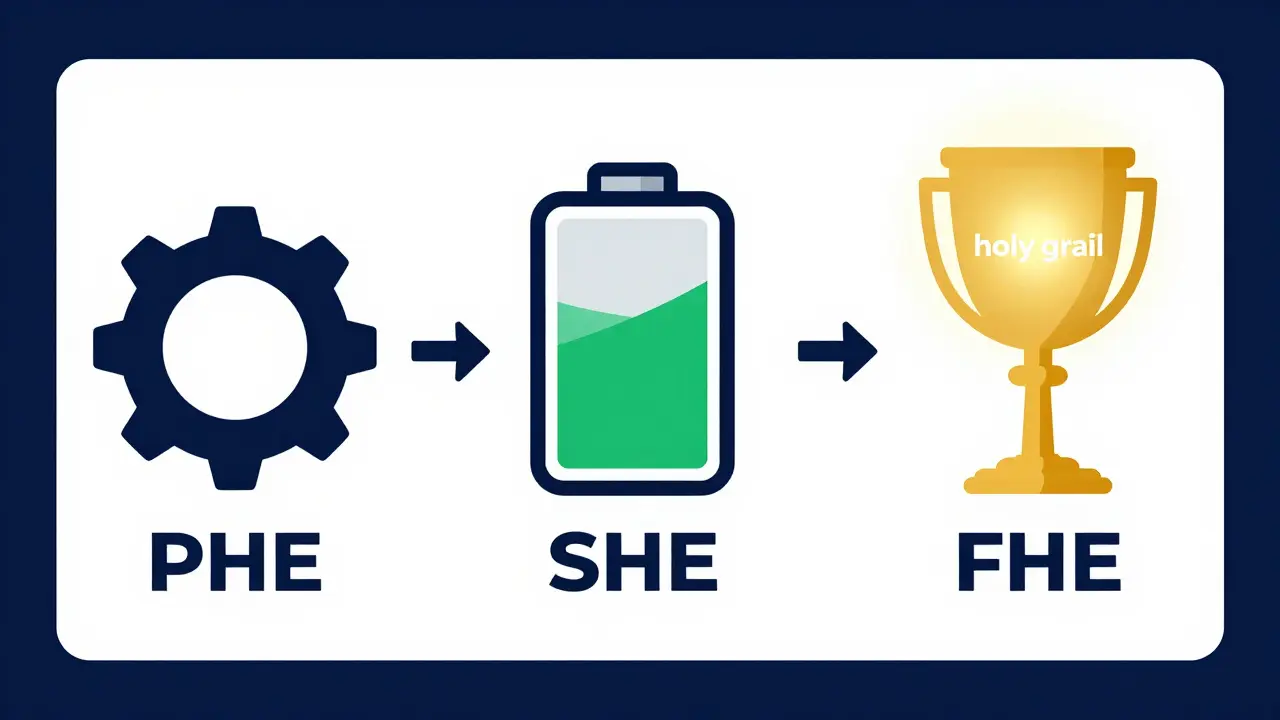
Not all homomorphic encryption is created equal. Depending on what you need to calculate, you'll encounter three different levels of capability. Think of these as the "evolutionary stages" of the technology.
- Partially Homomorphic Encryption (PHE): This is the simplest version. It only supports one type of operation-either addition or multiplication-but you can do that operation as many times as you want. Old school examples include RSA and ElGamal. While limited, they are fast and useful for specific, simple tasks.
- Somewhat Homomorphic Encryption (SHE): This is a step up. SHE allows both addition and multiplication. The catch? It can only do a few of them before the "noise" (mathematical errors that accumulate during processing) becomes too loud, making the data impossible to decrypt. It's like a battery that runs out of juice after a few operations.
- Fully Homomorphic Encryption (FHE): This is the "holy grail." First realized by Craig Gentry in 2009, FHE supports an infinite number of additions and multiplications. It uses a process called "bootstrapping" to clean up the noise and reset the mathematical state, allowing for any complex program to run on encrypted data.
| Type | Supported Operations | Operation Limit | Performance |
|---|---|---|---|
| PHE | Only Addition OR Multiplication | Unlimited | Fast |
| SHE | Addition AND Multiplication | Limited | Moderate |
| FHE | Addition AND Multiplication | Unlimited | Slow |
How the Math Actually Works
You don't need a PhD in number theory to get the gist, but the core logic relies on maintaining a mathematical relationship between the plaintext (the original data) and the ciphertext (the encrypted data). When you add two encrypted numbers together, the result-when decrypted-is exactly the sum of the two original numbers. The same goes for multiplication.
In computer science terms, this allows the creation of boolean circuits. If you can perform addition (which acts like an XOR gate) and multiplication (which acts like an AND gate), you can theoretically build any single-instruction-multiple-data process. This means a cloud provider could run a full machine learning model on your medical records without the provider ever knowing your name, your condition, or the result of the diagnosis.
However, this "magic" comes with a heavy cost. Because each single bit of data is wrapped in complex mathematical layers to hide it, a tiny piece of information can expand into 1-2 MB of ciphertext. This creates a massive storage overhead. Furthermore, the computational power required is staggering; operations in FHE can be 10,000 to 1,000,000 times slower than if you were just working with regular plaintext data.
Real-World Use Cases and Industry Impact
Despite the speed issues, high-stakes industries are already diving in. When the cost of a data breach is millions of dollars or a legal nightmare, a slow computation is a fair trade-off for absolute privacy.
In healthcare, this is a lifesaver. A consortium of researchers recently used homomorphic encryption to analyze 10,000 patient genomes. Because the data remained encrypted during the analysis, they stayed fully HIPAA compliant. The cloud provider performed the heavy lifting of the genomic sequencing, but they never saw a single raw genetic marker.
The financial sector is also a big adopter. Banks are using FHE for secure credit scoring. By encrypting a user's financial history, a bank can run a scoring algorithm to determine loan eligibility without actually "seeing" the sensitive balance sheets of the customer during the processing phase. While it takes a few seconds longer to get the answer, the security guarantee is nearly absolute.
In the blockchain space, this technology opens doors for private smart contracts. Imagine a decentralized auction where the bids are encrypted. The smart contract can determine who the highest bidder is using FHE, but no one (not even the contract owner) knows what the other bids were until the auction closes and the result is decrypted.

The Implementation Hurdle: Tools and Pitfalls
If you're a developer looking to implement this, be warned: the learning curve is a cliff. You can't just plug in a library and expect it to work. You need a solid grasp of linear algebra and number theory. Most experts report that it takes 3 to 6 months of dedicated study just to become proficient.
There are a few primary libraries to look at:
- Microsoft SEAL: Highly regarded for its comprehensive documentation and stability. Great for those starting with the BFV or CKKS schemes.
- IBM HElib: One of the pioneers in the FHE space, offering robust tools for complex encrypted computations.
- OpenFHE: A community-driven project that aims to provide a standardized framework for various homomorphic schemes.
The biggest mistake beginners make is ignoring "noise management." Every time you perform a multiplication in an FHE scheme, you add a bit of mathematical noise to the ciphertext. If you do too many operations without "bootstrapping" (refreshing) the ciphertext, the noise overwhelms the data, and your decrypted result will just be random gibberish. Getting the noise parameters right for something as simple as a logistic regression model can take weeks of trial and error.
What's Next for Privacy-Preserving Tech?
We are currently in the "Peak of Inflated Expectations" phase of the hype cycle, but the underlying progress is real. The next few years will likely see a shift from software-only solutions to hardware-accelerated ones. Intel's SGX and AWS Nitro Enclaves are already making strides in supporting the heavy lifting required by FHE.
We are also seeing the rise of more accessible frameworks. The Zama project's Concrete ML, for example, is trying to bridge the gap by allowing data scientists to run machine learning models on encrypted data without needing to be cryptography experts. The goal is to move FHE from a specialized tool used by PhDs to a standard part of the enterprise security stack.
By 2030, it's likely that "privacy by design" won't just be a legal requirement for GDPR or CCPA-it will be a technical reality. We'll stop asking "Do I trust this cloud provider with my data?" and start saying "It doesn't matter if I trust them, because they can't see my data anyway."
Is homomorphic encryption the same as end-to-end encryption?
No. End-to-end encryption (E2EE) protects data as it travels from point A to point B. However, to do anything with that data at point B, it must be decrypted. Homomorphic encryption protects data in use. It allows the data to be processed while it is still encrypted, meaning it never has to be decrypted during the computation phase.
Why is FHE so much slower than regular encryption?
The slowness comes from the mathematical complexity. To allow operations on encrypted data, each piece of information is transformed into a massive polynomial. A simple addition of two numbers becomes a complex operation on these polynomials. Additionally, the "bootstrapping" process required to clear mathematical noise is computationally expensive, often consuming over 90% of the processing time.
Can a hacker crack homomorphic encryption?
Like any encryption, its security depends on the algorithm and the key length. Most modern FHE schemes are based on "lattice-based cryptography," which is believed to be resistant to quantum computer attacks (quantum-resistant). While no system is 100% unhackable, FHE is considered one of the most secure ways to handle sensitive data.
Which FHE scheme should I use: BFV or CKKS?
It depends on your data. Use BFV (Brakerski-Fan-Vercauteren) if you are working with integers and need exact results (like counting votes in an election). Use CKKS (Cheon-Kim-Kim-Song) if you are working with floating-point numbers and can tolerate a tiny bit of approximation, which is typical for machine learning and data science workloads.
Does this technology require special hardware?
You can run it on a standard x86-64 CPU, but you'll really want a processor that supports AVX2 or AVX-512 instruction sets to handle the vectorization. You also need a significant amount of RAM (16GB minimum) because the ciphertext expansion makes the data footprints much larger than normal.
Mary Tawfall
20 04 26 / 19:04 PMThis is such a hopeful glimpse into how we can keep our most personal details safe while still benefiting from modern tech. It's really inspiring to see the progress being made in healthcare specifically!
Benjamin Forg
20 04 26 / 19:32 PMlattice based cryptography is just another way for them to hide the backdoors they've already built in the hardware the math is just a smokescreen to keep the peasants from realizing their data is already owned by the state
Mike Krasner
22 04 26 / 01:04 AMwho cares if its slow its just more money for cloud providers to charge for higher compute tiers lol
Robert Mosolygo
23 04 26 / 00:10 AMThe storage overhead mentioned is the real red flag here. If a single bit expands into megabytes, we are creating a massive bottleneck that will inevitably be used to justify a transition to proprietary, centralized 'acceleration' hubs. It is a textbook example of solving a problem by creating a dependency.
Alex Hunter
24 04 26 / 21:17 PMFor anyone struggling with the math, I highly recommend starting with the basics of modular arithmetic before jumping into the SEAL library. It makes the concept of 'noise' much more intuitive.
Keith Garcia
25 04 26 / 12:05 PMThe sheer audacity of suggesting a novice could 'study for 3 to 6 months' and be proficient is quaint 🙄. This requires a level of mathematical rigor that simply isn't taught in bootcamps. Truly a pedestrian overview of a complex topic 💅.
Miranda Jamieson
26 04 26 / 02:37 AMCiting 'HIPAA compliance' as a win is a joke. Compliance isn't security, it's just paperwork. If you can't handle the latency of FHE, you're just playing around with toys.
Liz Ariza
27 04 26 / 15:03 PMWow, this is just mind-blowing! 🌟 Imagine a world where my medical records are totally secret but the doctors still get the answers they need! Such a sparkly future for tech! ✨💖
Tony Gurley-Ward
28 04 26 / 19:56 PMMaybe the 'noise' isn't a bug but a feature! A digital metaphor for the chaos of existence where meaning only emerges from the static. Anyway, the 10,000x slowdown is a beautiful excuse to actually think about the data we're sending.
Sarah Fisher
29 04 26 / 11:33 AMIt's interesting to think about the shift in trust. We're moving from trusting the person to trusting the math. That's a fundamental change in how human society interacts with authority and institutions.
Ali Tate
30 04 26 / 18:27 PMtypical academic garbage talking about 2030 while the real world is still using excel’s vlookup for everything we need real hardware acceleration now not some fantasy project from a lab in europe
Findlay Duncan Lyon
2 05 26 / 04:43 AMAbsolute game changer for the fintech sector in London.
Gary Lingrel
2 05 26 / 12:36 PMwhy do we even need this if we just trust the big tech overlords anyway lol it's all a game :)
Guy Bianco
3 05 26 / 18:33 PMI believe the integration of AVX-512 is a prudent step toward viability. It is encouraging to see the community collaborating on OpenFHE. (-_-)
Lisa Camp
4 05 26 / 12:33 PMSTOP TALKING ABOUT THE HURDLES AND JUST BUILD IT! WE NEED THIS NOW!
Mike Word
5 05 26 / 12:44 PMThe distinction between E2EE and FHE is a really important point. A lot of people conflate the two, but processing in the encrypted state is where the real magic happens.