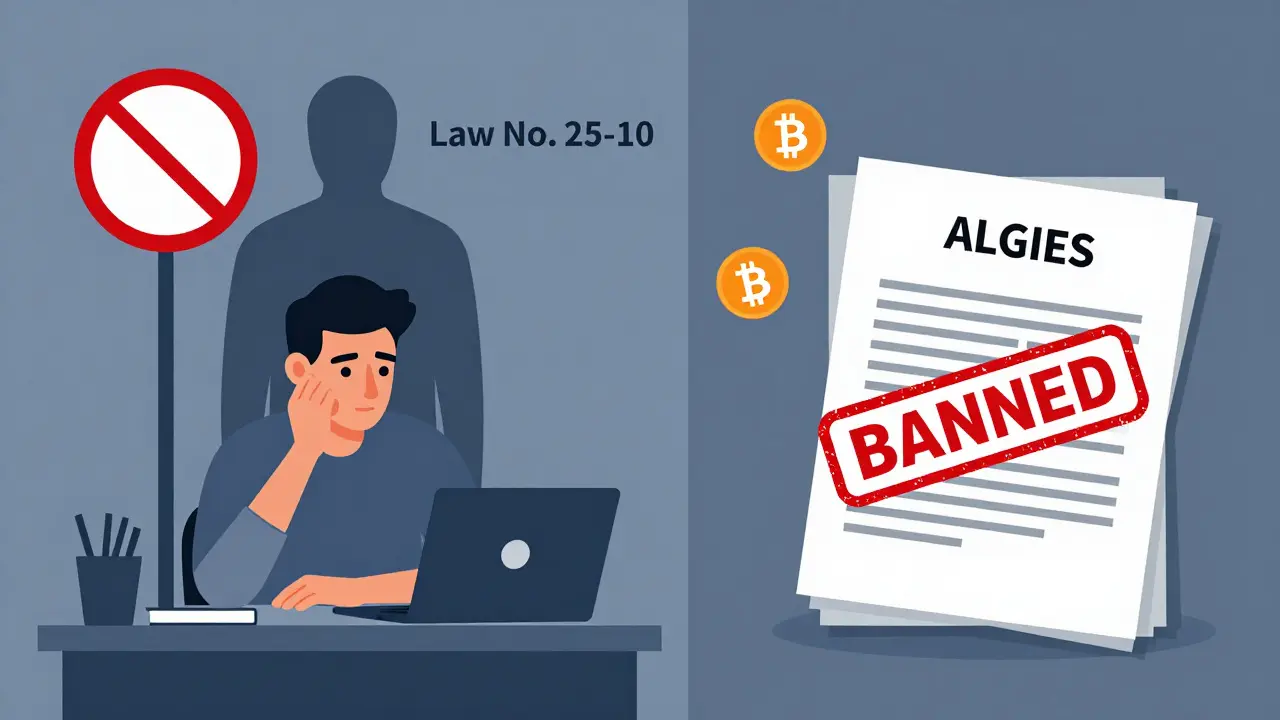
For years, accessing cryptocurrency exchanges in Algeria was a game of cat and mouse. You used a VPN, found a trusted peer-to-peer (P2P) trader on Telegram, and hoped your bank didn’t flag the transfer. It was risky, but it was possible. Then, on July 24, 2025, the government slammed the door shut. With the publication of Law No. 25-10, which is a comprehensive legislative act that criminalizes all cryptocurrency activities in Algeria, the landscape changed overnight. Today, there is no legal way for an Algerian citizen to buy, sell, or even hold Bitcoin.
If you are looking for a step-by-step guide on how to sign up for Binance or Coinbase from Algiers right now, you won’t find one here. That’s because doing so would be advising you to commit a crime punishable by prison time and heavy fines. Instead, this article explains the harsh reality of the current legal framework, why the government went so hard on this ban, and what the underground market looks like despite the crackdown.
The New Legal Landscape: Total Prohibition
To understand why access has become nearly impossible, you first need to look at what the law actually says. Before July 2025, Algeria had restrictions under currency regulation laws since 2018, but they were vague. There were no specific penalties for just holding crypto, which allowed a shadow market to thrive. In fact, a Chainalysis report from mid-2024 ranked Algeria as one of the top five fastest-growing crypto markets in the Middle East and North Africa (MENA) region. People were using decentralized finance (DeFi) and tokenized services in droves.
Law No. 25-10 ended that ambiguity completely. The legislation defines cryptocurrencies as "virtual instruments used as means of exchange via a computer system, without support from a central bank." Under this definition, the purchase, sale, use, and holding of these assets are strictly prohibited. This isn't just about big traders; it covers everyone. If you have a wallet with Ethereum or Tether, you are technically violating federal law.
The scope of the ban is incredibly wide. It prohibits:
- Using crypto as a payment method.
- Mining digital currencies.
- Creating or operating platforms for exchanging or storing digital assets.
- Promoting or advertising any crypto-related services.
- Even providing educational content about blockchain technology could potentially result in criminal charges if interpreted as promotion.
This places Algeria alongside only nine other countries worldwide with a complete prohibition, joining nations like China in opting for outright bans rather than regulated integration seen in the European Union or parts of Asia.
Severe Penalties for Violations
The reason most people have stopped trying to access exchanges openly is the penalty structure. The government isn't just issuing warnings; they are enforcing criminal liability. If you are caught engaging in any prohibited activity, the consequences are severe.
| Violation Type | Imprisonment | Fines (Algerian Dinar) | Fines (USD Approx.) |
|---|---|---|---|
| Standard Violation | 2 months to 1 year | 200,000 - 1,000,000 DZD | $1,540 - $7,700 |
| Serious Violation | Up to 1 year | Up to 2,000,000 DZD | Up to $14,700 |
| Repeat Offense | Doubled penalties | Doubled fines | Doubled amounts |
| Organized Crime Link | Enhanced sentencing | Maximum fines | Maximum amounts |
Note that imprisonment and fines can be applied simultaneously. For a young developer or a small business owner in Algiers, a fine of 1 million dinars is not just a slap on the wrist; it’s financially devastating. And if authorities link your crypto activity to organized crime or money laundering, the penalties increase significantly.

Why the Government Cracked Down
You might wonder why the Algerian government chose such a drastic measure. The official justification centers on national security and financial stability. The Central Bank of Algeria has long been concerned about capital flight. When citizens move money into volatile digital assets, it reduces the liquidity available for the local economy and makes it harder for the state to control monetary policy.
Additionally, the government cites guidance from the Financial Action Task Force (FATF). FATF warns against unregulated virtual asset service providers due to risks of money laundering and terrorism financing. By banning crypto entirely, Algeria aims to eliminate these vectors. Government spokespeople emphasize the need to protect citizens from the high volatility and scams associated with digital assets. They argue that without a regulatory framework, retail investors are vulnerable to losing everything.
However, critics argue that this approach is counterproductive. By criminalizing the entire ecosystem, the government has sparked a "blockchain talent exodus." Developers, DeFi specialists, and analysts who previously worked in Algeria are leaving the country for jurisdictions where their skills are valued and legal. This stifles innovation and deters foreign investment in the digital economy, potentially isolating Algeria from global fintech trends.
The Underground Market: How People Still Try
Despite the ban, demand doesn’t disappear; it goes underground. Human nature finds a way, especially when traditional banking options are limited or inefficient. So, how do Algerians still try to access crypto? They don’t use legitimate exchanges anymore. Instead, they rely on covert methods that carry significant risk.
Peer-to-Peer (P2P) Trading via Encrypted Channels The most common method remains P2P trading. Users connect through encrypted messaging apps like Telegram or Signal. They agree on a price, often at a premium due to the risk involved, and arrange payment via cash deposits or informal hawala-style transfers. The seller then releases the crypto from their personal wallet. This method avoids centralized exchanges but relies entirely on trust. Scams are rampant, and if either party is reported to authorities, both face prosecution.
Virtual Private Networks (VPNs) Some users attempt to bypass geo-restrictions by using VPNs to access foreign exchanges like Binance or Kraken. However, Algerian agencies have enhanced their digital monitoring capabilities. Internet Service Providers (ISPs) can detect and block traffic to known crypto domains, and deep packet inspection technologies can identify suspicious patterns. Using a VPN itself may draw scrutiny, and if linked to crypto transactions, it becomes evidence of intent to violate the law.
Decentralized Exchanges (DEXs) Technically savvy individuals might use non-custodial decentralized exchanges. Since there is no central entity to shut down, these platforms are harder to block. However, interacting with DEXs requires connecting a digital wallet to the internet, which leaves a traceable blockchain footprint. While the wallet address might not be directly linked to your identity initially, sophisticated analysis tools used by law enforcement can sometimes deanonymize users, especially if they ever interact with a centralized service or make a mistake in operational security.
All these methods are illegal. The enhanced digital monitoring implemented by Algerian law enforcement makes detection increasingly likely. Every transaction is a potential trap.

Impact on the Local Crypto Community
The human cost of Law No. 25-10 is significant. Prior to the ban, Algeria had a vibrant community of blockchain enthusiasts. There were meetups, coding bootcamps, and startups exploring supply chain solutions using distributed ledger technology. Overnight, this sector was effectively eliminated.
Professionals who specialized in smart contract development or crypto analytics found themselves unemployed or forced to leave the country. The "brain drain" is real. Young talent that could have contributed to Algeria’s digital transformation is now working in Dubai, London, or Berlin. This loss of expertise will take years to recover, even if regulations change in the future.
Moreover, the ban limits financial inclusion. In many developing nations, crypto offers a way for unbanked populations to access global financial services. By prohibiting this, Algeria denies its citizens a tool that could otherwise provide economic opportunities, particularly for those excluded from the traditional banking system due to bureaucratic hurdles or lack of documentation.
Future Outlook: Will the Ban Lift?
As of June 2026, there is no indication that the government plans to repeal Law No. 25-10. The stance remains firm: total prohibition. Unlike countries that started with bans and later moved toward regulation (like India or Brazil), Algeria has doubled down on enforcement.
Global trends are moving toward structured frameworks. The European Union’s Markets in Crypto-Assets (MiCA) regulation provides a clear path for compliance. The United States is gradually clarifying rules for securities vs. commodities. Algeria’s divergence from these norms isolates it further. However, political shifts or economic pressures could eventually force a reconsideration. If the informal economy grows too large, or if remittance flows (a key source of foreign currency for Algeria) are severely disrupted, policymakers might explore a controlled legalization model.
Until then, the message is clear: stay away. The risks far outweigh the rewards. For Algerians interested in blockchain technology, the focus has shifted to offline learning and theoretical study, avoiding any practical interaction with digital assets.
Is it legal to own Bitcoin in Algeria in 2026?
No. Under Law No. 25-10, which took effect in July 2025, the holding, purchase, sale, and use of cryptocurrencies like Bitcoin are strictly prohibited. Owning crypto is a criminal offense punishable by fines and imprisonment.
What are the penalties for trading crypto in Algeria?
Violators face imprisonment from two months to one year and fines ranging from 200,000 to 1,000,000 Algerian dinars (approx. $1,540-$7,700). Serious violations can incur fines up to 2 million dinars. Repeat offenses double these penalties.
Can I use a VPN to access Binance or Coinbase in Algeria?
While technically possible to bypass geo-blocks with a VPN, doing so to access crypto exchanges is illegal under Algerian law. Authorities have enhanced digital monitoring to detect such activities, and getting caught results in severe criminal penalties.
Why did Algeria ban cryptocurrency?
The government cites national security, financial stability, and prevention of money laundering and terrorism financing. They aim to maintain control over the national financial system and protect citizens from the volatility and risks of digital assets.
Is peer-to-peer (P2P) crypto trading safe in Algeria?
No. P2P trading is illegal and carries high risks. Beyond the threat of prosecution, users face scams and fraud since there is no legal recourse. Transactions conducted via encrypted apps are monitored, and participants can be prosecuted.
Has the crypto ban affected Algeria's tech industry?
Yes. The ban has caused a "blockchain talent exodus," with developers and specialists leaving the country. This has stifled innovation and deterred investment in the digital economy, isolating Algeria from global fintech advancements.
Leave a comments