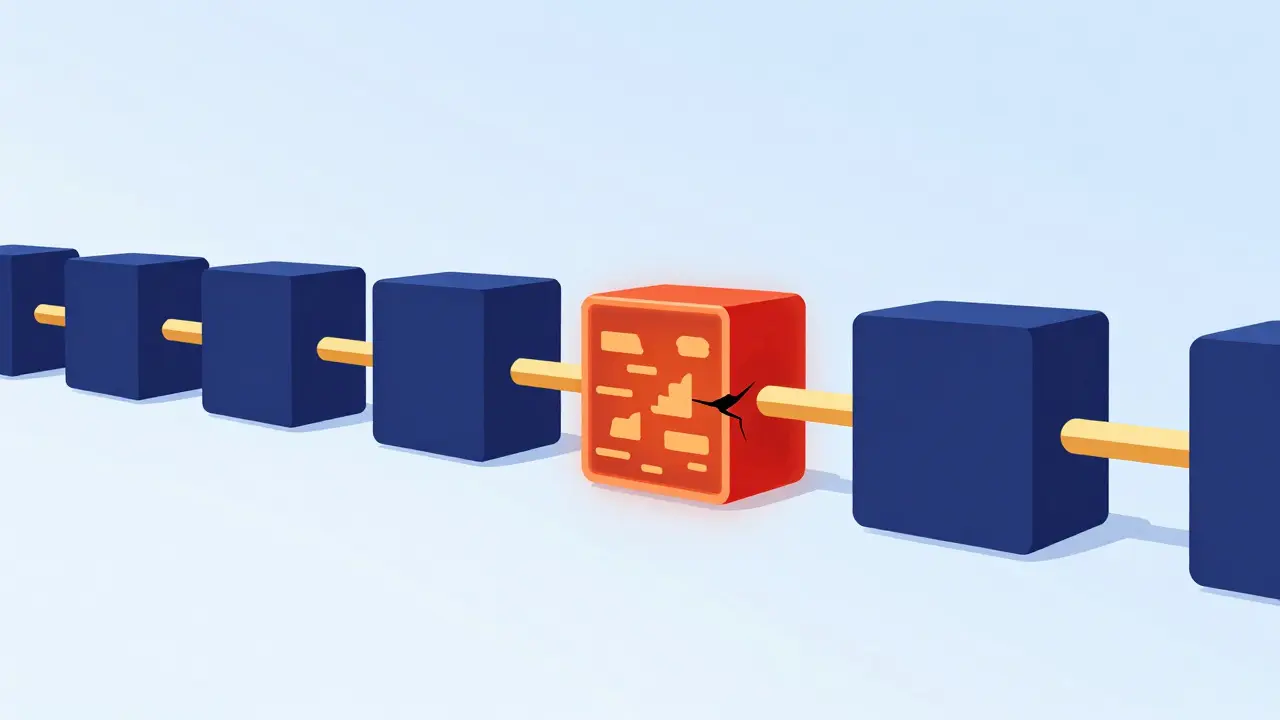
Imagine trying to alter a single digit in a bank statement from ten years ago. In a traditional database, you just open the file, edit it, and save. But on a blockchain is a decentralized, immutable ledger that records transactions in cryptographically linked blocks, that simple act triggers a cascade of failures across thousands of computers. Why? Because every block contains a unique fingerprint of the previous one. If you change the data, the fingerprint changes, breaking the chain. This article breaks down exactly how these digital bricks hold your data together, from the raw bytes of a transaction to the complex trees that verify them.
The Anatomy of a Block
To understand how data is stored, you first need to see what’s inside a block. Think of a block as a sealed envelope with two distinct parts: the header and the body. The header is the metadata-the administrative details-while the body holds the actual payload, which is your transaction data.
In Bitcoin, the header is fixed at 80 bytes. It contains five critical pieces of information:
- Version Number: Indicates the protocol version used for mining.
- Previous Block Hash: A 32-byte link to the parent block, creating the "chain."
- Merkle Root: A single hash representing all transactions in the block.
- Timestamp: The time the block was mined (Unix epoch).
- Nonce: A random number miners adjust to find a valid hash under Proof-of-Work.
The body follows immediately after the header. In Bitcoin, this section can grow up to 1 MB (or roughly 4 MB with SegWit), containing hundreds or even thousands of individual transactions. Each transaction is a self-contained record that includes the sender’s address, the receiver’s address, the amount transferred, and a digital signature proving ownership.
From Raw Data to Cryptographic Fingerprint
Once a transaction is packed into the block body, it doesn’t just sit there as plain text. It gets processed through a cryptographic hash function. For Bitcoin, this is SHA-256; for Ethereum, it’s Keccak-256. These functions take variable-length input (your transaction data) and output a fixed-length string of characters, known as a hash.
Here’s the magic: the hash is deterministic but irreversible. If you change one pixel in an image, the entire MD5 hash changes completely. Similarly, if you move one satoshi (the smallest unit of Bitcoin) in a transaction, the resulting hash becomes unrecognizable. This property, called the avalanche effect, ensures that any tampering with the data is instantly detectable because the calculated hash will no longer match the recorded one.
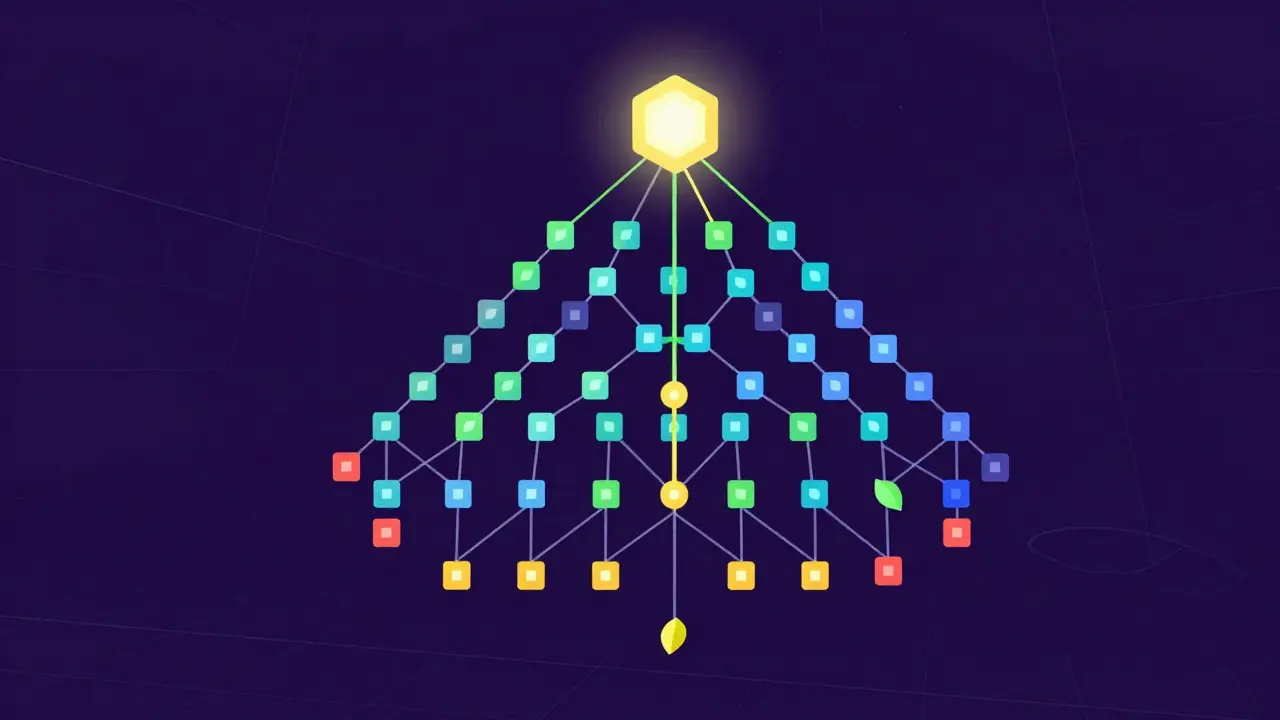
But how do we verify a specific transaction without downloading the entire block? We use a Merkle Tree is a binary tree data structure where each non-leaf node is a hash of its children. Invented by Ralph Merkle in 1979, this structure allows for efficient verification. Instead of checking every transaction in the block, you only need to check the path from your specific transaction up to the root. This is why light wallets on your phone can verify Bitcoin payments without storing the full 475GB blockchain-they just need the Merkle proof, which is a few hundred bytes.
On-Chain vs. Off-Chain Storage Strategies
Not all data needs to live directly inside the block. In fact, storing large files like videos or high-resolution images on-chain is prohibitively expensive. This leads to a critical distinction between on-chain and off-chain storage.
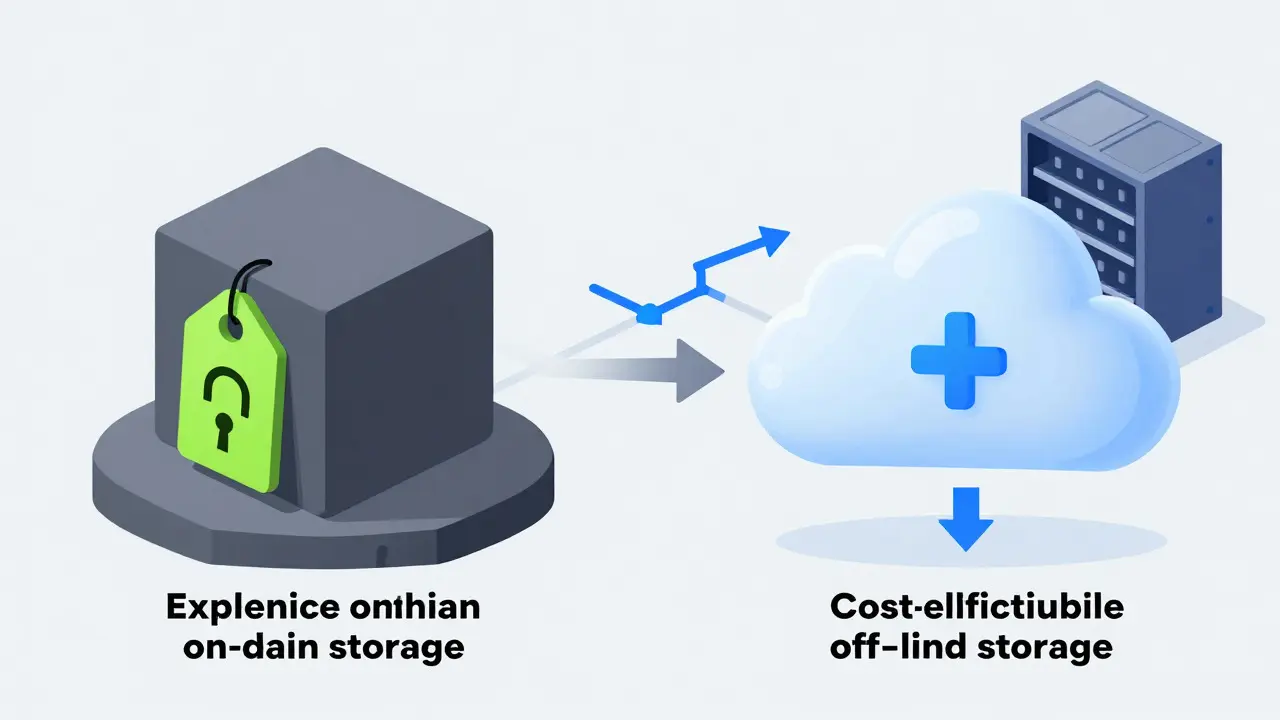
On-chain storage means the data itself is written into the block. This offers maximum security and permanence because the data is distributed across every node in the network. However, it comes with a steep price tag. On Ethereum, storing 1KB of data can cost several dollars in gas fees. That’s why developers often store only essential state variables (like a user’s balance) on-chain.
Off-chain storage moves the heavy data outside the blockchain, typically to decentralized file systems like IPFS (InterPlanetary File System) or centralized servers. What remains on-chain is just the cryptographic hash of that external data. This reduces costs by up to 99.9% while still allowing anyone to verify that the file hasn’t been altered since the hash was recorded. For example, when Beeple sold his famous NFT for $69 million, the actual JPEG wasn’t stored on Ethereum. Only the hash was. The image lived on a centralized server, creating a dependency risk, but keeping the transaction fee manageable.
| Attribute | On-Chain Storage | Off-Chain Storage |
|---|---|---|
| Security Level | Maximum (distributed across nodes) | Dependent on external infrastructure |
| Cost per KB | High (e.g., ~$10 on Ethereum) | Negligible (fractions of a cent) |
| Data Size Limit | Strict (limited by block size/gas) | Unlimited |
| Verification Method | Direct data comparison | Hash matching against on-chain record |
| Best Use Case | Critical state, token balances | Documents, media, logs |
The Cost of Immutability
Immutability is the superpower of blockchain, but it’s also its biggest weakness. Once data is written, it stays forever. There is no "undo" button. If a smart contract has a bug, or if a user sends funds to the wrong address, the error cannot be deleted-it can only be overwritten by new transactions, leaving the mistake permanently visible in the history.
This rigidity creates significant storage overhead. Every node must keep a copy of every byte ever written. As of late 2023, the Bitcoin blockchain weighed over 475GB, and Ethereum’s exceeded 1.2TB. Running a full node requires terabytes of SSD space and significant bandwidth. This redundancy is intentional-it prevents a single point of failure-but it makes blockchain less efficient than traditional databases for general-purpose data storage. NIST researchers have noted that storing identical data across 10,000+ nodes represents a massive energy and storage overhead compared to centralized SQL databases.
Modern Solutions: Scaling Storage Efficiency
Engineers are actively working around these limitations. The most notable development is Ethereum’s Dencun upgrade, which introduced "proto-danksharding." This mechanism allows for "blob-carrying transactions," where temporary data is stored in a separate, cheaper layer that expires after a certain period. This reduces storage costs by approximately 90% for Layer 2 networks, making it viable to store more complex application states without bloating the main chain.
Another approach is modular blockchains. Projects like Celestia separate the consensus layer from the data availability layer. Instead of forcing every node to process every transaction, they specialize in ensuring data is available and verifiable. Celestia can handle 10MB blocks with 10,000 transactions per second, demonstrating that specialized architectures can solve the scalability bottleneck better than monolithic designs.
For enterprises concerned about privacy, zero-knowledge proofs offer another path. By using ZK-rollups, companies can bundle thousands of transactions off-chain and submit only a single proof of validity on-chain. This keeps the transaction details private while leveraging the security of the public blockchain for final settlement.
Frequently Asked Questions
Can you delete data from a blockchain?
Technically, no. Once a block is confirmed and added to the chain, the data is permanent. To remove data, you would need to achieve a majority consensus to fork the chain and exclude that block, which is economically irrational for large networks like Bitcoin. You can, however, render data useless by moving assets to new addresses or updating smart contract state variables, but the old records remain in the historical log.
What is the difference between a block and a transaction?
A transaction is a single event, such as sending 1 BTC from Alice to Bob. A block is a container that bundles many transactions together (along with metadata) and seals them with a cryptographic hash. Blocks are created periodically (every 10 minutes for Bitcoin, every 12 seconds for Ethereum) to maintain a consistent pace of data addition to the chain.
Why is the Merkle Root important?
The Merkle Root is a single hash that summarizes all transactions in a block. It allows for lightweight verification. If you want to prove a specific transaction is included in a block, you don't need to download the whole block; you just need the Merkle Path (a set of sibling hashes) leading to the root. This saves bandwidth and storage for mobile devices and light clients.
Is it cheaper to store data on Bitcoin or Ethereum?
Generally, Ethereum is more flexible for structured data due to its smart contract capabilities, but both are expensive for large datasets. Bitcoin is primarily designed for value transfer, so storing arbitrary data is technically possible but inefficient. For pure data storage, neither is ideal; hybrid models using IPFS or Filecoin with on-chain hashes are significantly cheaper and more scalable.
How does gas limit affect data storage in Ethereum?
In Ethereum, every operation consumes "gas." Writing data to the blockchain (state changes) costs more gas than reading it. The block gas limit caps the total amount of computation and data that can fit in a single block. If a transaction requires too much gas, it won't be included until the limit increases or the gas price drops. This economic constraint naturally limits how much data can be stored per second, encouraging developers to optimize code and use off-chain solutions for bulk data.
Leave a comments