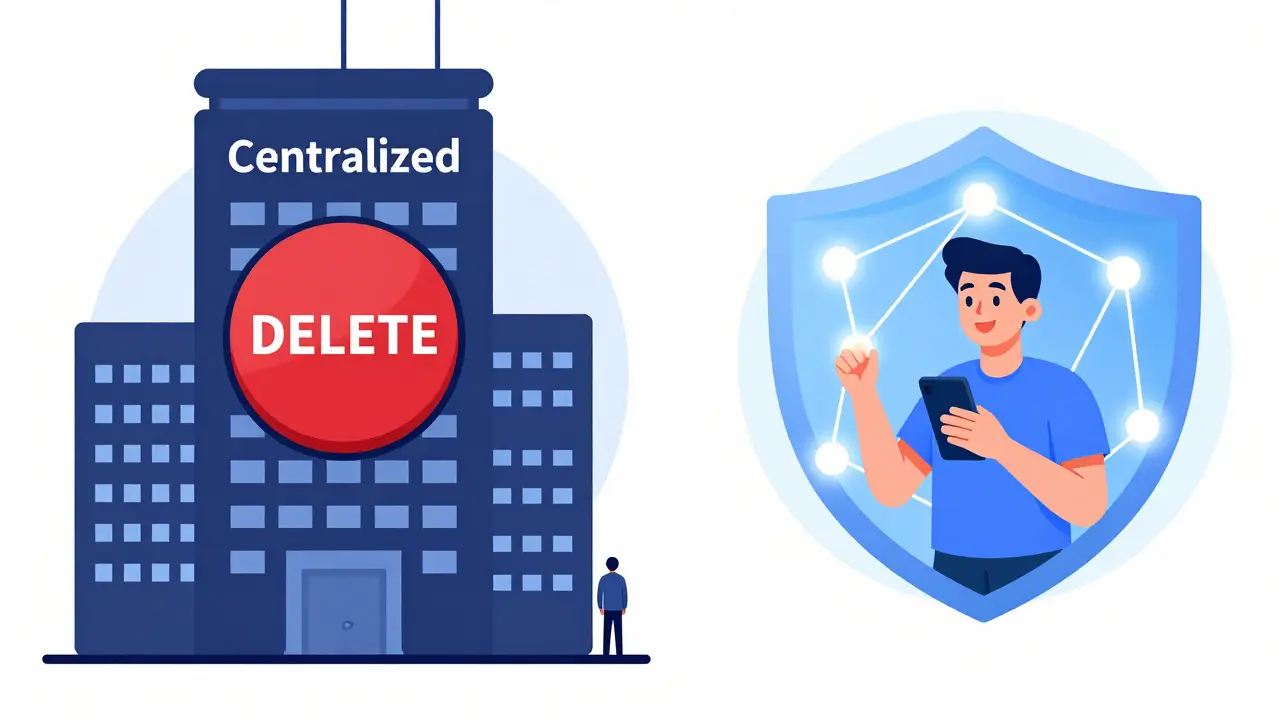
Imagine posting a status update that no government, corporation, or algorithm can delete. It sounds like science fiction, but it is the core promise of blockchain social networks, which are decentralized platforms that use distributed ledger technology to ensure user content remains permanent and uncensorable. In mid-2026, this isn't just a theoretical concept anymore. With recent high-profile cases like the imprisonment of Pavel Durov and the blocking of X (formerly Twitter) in countries like Brazil, Iran, and Venezuela, the vulnerability of centralized platforms has never been clearer. When you rely on a single company for your voice, they hold the kill switch.
Traditional social media works because we trust intermediaries. We give Facebook or X our data, and they manage the servers. But that trust is fragile. If a government demands access, or if an algorithm decides your post violates a vague community guideline, your account vanishes. Blockchain social networks remove that middleman entirely. By storing data on a public ledger, these platforms make it functionally impossible to reverse transactions or blacklist addresses without banning money itself. This shift changes everything about how we think about free speech online.
The Five Pillars of Censorship Resistance
To understand why blockchain social media is different, you have to look under the hood. It’s not magic; it’s cryptography and network design. There are five specific mechanisms working together to keep your data safe from censors.
- Decentralization: Instead of one server farm in California controlling your posts, the data lives on thousands of nodes worldwide. No single party has complete control, making it nearly impossible to filter content centrally.
- Immutability: Once data is written to the blockchain, it cannot be changed or removed. Every block contains a cryptographic hash of the previous one. To alter history, you’d need to rewrite every subsequent block across the entire network simultaneously-a task that requires more computing power than exists on Earth.
- Transparency: On public blockchains, all transactions are visible to everyone. This openness discourages manipulation because any attempt to censor or alter data becomes immediately obvious to the network participants.
- Cryptography: Strong encryption protects your communications. While the transaction is public, your identity and private messages remain secure unless you choose to share them. This ensures data integrity while preserving privacy.
- Consensus Mechanisms: Whether using Proof-of-Work or Proof-of-Stake, the network requires agreement among participants to validate new blocks. This prevents any single entity from forcing their will on the system.
These pillars create a system where "practically anyone can use these blockchains" as noted by researchers at the New York Federal Reserve. The result is a financial and communication landscape that is fairer and more open, though not without its own set of challenges.
How It Works in Practice: The OP_RETURN Method
You might wonder how you actually post a tweet-like message on a blockchain. You don’t upload a file to a server. Instead, you embed text directly into a cryptocurrency transaction. One of the most practical examples comes from the Bitcoin Cash Research community, which has pioneered using OP_RETURN transactions for social messaging.
OP_RETURN is a scripting opcode in Bitcoin Cash that allows users to attach small amounts of data to a transaction. Currently, the limit is 220 bytes, but there is active debate within the developer community to increase this to 300 bytes. Why does this matter? Because 300 bytes provides greater coherence for messages and enhances resistance to censorship. It allows users to post directly in the transaction layer rather than relying on third-party services like Memo.cash, which can still be blocked by ISPs.
For example, you can find real-world instances of this technology in action by looking at explorer transactions such as 01159eb6020b1cbb10f2b57eb4996c79020e8333a7b0bef24a1174cc43b683b0. These aren't just random numbers; they are permanent records of user expression stored on-chain. By increasing the data capacity, developers aim to simplify application mechanics and enable a wider variety of smart contracts for social interactions.
| Feature | Centralized (X, Facebook) | Decentralized (Blockchain Social) |
|---|---|---|
| Data Storage | Private corporate servers | Distributed public ledger |
| Censorship Risk | High (single point of failure) | Low (requires global consensus to alter) |
| User Identity | Tied to email/phone | Tied to wallet address |
| Cost Model | Free (ad-supported) | Paid (transaction fees per post) |
| Account Control | Platform owns account | User owns private keys |
The Real-World Urgency: Why Now?
This technology isn't just for crypto enthusiasts. It’s becoming a necessity for people living under restrictive regimes. In 2026, we’ve seen a trend of imminent blocks on traditional platforms. When X was blocked in Brazil last month, millions of users were instantly silenced. In Iran, Venezuela, and Cuba, internet infrastructure is tightly controlled by state actors.
Blockchain social networks offer a bypass. Because the data is embedded in financial transactions, censoring it effectively means banning the use of money itself. As one community member put it, "censorship becomes unfeasible without banning the use of money." This creates a powerful leverage point. Governments can block websites, but blocking a global, permissionless ledger like Bitcoin Cash is exponentially harder.
However, experts warn that blockchains have limits. Cointelegraph analysis points out that while anti-censorship capabilities are robust, governments can still restrict network access at the ISP level. They may also establish permissioned, tightly controlled blockchains to mimic decentralization while maintaining oversight. The fundamental structure of public blockchains encourages free expression, but the network layer-your internet connection-remains a potential chokepoint.
Challenges and Trade-offs
If blockchain social media is so superior, why hasn’t everyone switched yet? The answer lies in user experience and cost. Traditional social media is free because you are the product. Your attention is sold to advertisers. Blockchain social media flips this model. You pay a small transaction fee for each post, like, or comment. This removes the ad-driven incentive to manipulate your feed, but it adds friction for casual users.
There’s also a steep learning curve. To participate, you need a cryptocurrency wallet and must manage private keys. If you lose your key, you lose your account forever. There is no "forgot password" button. For the average person used to logging in with Google, this feels cumbersome. Scalability is another hurdle. Most blockchain networks process far fewer transactions per second than X or Facebook, leading to slower speeds and higher costs during peak times.
Yet, for communities requiring guaranteed free speech protections, these trade-offs are worth it. The cost of entry is a few cents, but the value of uncensorable expression is priceless. As technical improvements reduce transaction costs and simplify wallet management, adoption is likely to grow. The focus right now is on making the backend invisible to the user while keeping the censorship-resistant properties intact.
Looking Ahead: The Future of Free Speech Online
The trajectory for blockchain social networks is clear. As censorship events increase globally, the demand for alternatives will rise. Developers are actively working on Layer 2 solutions to improve throughput and reduce fees. The debate over OP_RETURN limits continues, with strong arguments for expanding data capacity to support richer social interactions.
We are moving toward a hybrid future. Mainstream users may continue using centralized apps for convenience, but activists, journalists, and those in restricted regions will increasingly rely on decentralized protocols. The key is education. Understanding how to use a wallet, how to read a transaction, and how to verify data on-chain empowers individuals to take control of their digital lives.
The question is no longer whether blockchain social networks can work-they already do. The question is whether we are ready to embrace a model where our voices belong to us, not to a corporation. With tools like Bitcoin Cash’s on-chain messaging, the infrastructure is here. The next step is up to us.
What is the main advantage of blockchain social networks over traditional ones?
The primary advantage is censorship resistance. Unlike traditional platforms where a single company or government can delete your account or hide your posts, blockchain social networks store data on a decentralized ledger. This makes it extremely difficult for any single entity to suppress content without disrupting the entire network.
How do I post on a blockchain social network?
You typically use a cryptocurrency wallet to send a transaction that includes your message in the data field, such as using the OP_RETURN opcode in Bitcoin Cash. You pay a small transaction fee, and your post becomes part of the permanent blockchain record. No central server hosts your content.
Is blockchain social media anonymous?
It is pseudonymous. Your posts are tied to your wallet address, not your name or email. However, since the blockchain is transparent, anyone can view the transaction history associated with that address. True anonymity requires additional privacy-enhancing tools and careful operational security.
Why is there a limit on how much data I can store in a transaction?
Blockchains have limited block space to maintain efficiency and prevent spam. For example, Bitcoin Cash currently limits OP_RETURN data to 220 bytes. Increasing this limit, as some developers propose to 300 bytes, would allow for longer messages but could impact network performance if not managed carefully.
Can governments still block access to blockchain social networks?
Governments can block access to specific websites or apps that interface with the blockchain, but they cannot easily stop the underlying protocol. Since the data is stored on a global, decentralized network, censoring it would require shutting down the entire cryptocurrency ecosystem, which is economically and technically challenging.
Ed Wallace
2 08 26 / 05:45 AMIt is fascinating to consider how the architecture of our digital lives shapes the very nature of truth and memory. When we outsource our recollections to centralized servers, we are essentially renting space in someone else's attic, where the landlord can throw out whatever they deem unsightly at a moment's notice. The blockchain offers a different paradigm, one where history is not curated but accumulated, immutable and stark. It forces us to confront the raw data of human interaction without the softening filter of algorithmic curation.
Joshua Hofford
3 08 26 / 03:20 AMI think this is a huge step forward for global connectivity. In many parts of the world, people are used to having their voices silenced by local authorities who just want to keep things quiet. Giving them a tool that works like money, something you cannot easily ban, is incredibly empowering. It feels like the internet is finally living up to its original promise of being a borderless library of human thought rather than a series of gated communities run by corporations.
Subhash Kashyap Dm
4 08 26 / 07:28 AMyou think this is real decentralization it is not. the big tech companies will just buy up the mining pools and control the consensus mechanism from behind closed doors. they are already doing it with cloud infrastructure why would they stop here. it is all a illusion designed to make you feel safe while they harvest your metadata through wallet addresses. wake up sheeple
Pernelia Wahkan
5 08 26 / 08:15 AMThe technical nuance of the OP_RETURN limit is often overlooked in these high-level discussions. While 220 bytes might seem restrictive for a novel, it is actually quite sufficient for the core function of social signaling-likes, short comments, and status updates. Increasing it to 300 bytes is a pragmatic compromise that balances network bloat with user utility. It is a clever engineering solution to a sociopolitical problem.
Subhash Kashyap Dm
7 08 26 / 03:13 AMengineering solutions do not matter when the protocol itself is compromised by sybil attacks. you need quantum resistant cryptography or none of this matters. the NSA has been backdooring open source code for decades. trust no one
amy miranda
7 08 26 / 10:20 AMOne must critically examine the moral implications of paying for speech. If only those with cryptocurrency can afford to be heard, are we not simply replacing corporate censorship with economic elitism? It creates a tiered society where the wealthy have louder voices on the blockchain while the poor remain silent. This is hardly the democratic ideal we were promised.
Erica Johnson
7 08 26 / 18:05 PMActually, the transaction fees are usually fractions of a cent. It is negligible for most people if they use Layer 2 solutions. The barrier to entry is more about understanding wallets than actual cost. Plus, paying for posts reduces spam significantly, which improves the quality of discourse overall. 🤷♀️
Ken G
9 08 26 / 17:34 PMthe elites will always find a way to tax your freedom. first they block twitter then they tax your tweets. it is all part of the plan to control information flow. you think you are free but you are just paying tolls on a road owned by bankers
Lorraine Surringer
10 08 26 / 19:37 PMI just feel so drained reading all this negativity. People are trying to build something beautiful here. Why can't we just appreciate the innovation? It is exhausting to see everyone tearing down ideas before they even get off the ground. Let's focus on the positive potential for free speech instead of doom-scrolling through conspiracy theories.
Marcia Albert
11 08 26 / 03:08 AMI just vibe with the idea of owning my own data. It feels right, like taking back my keys after leaving them at a shady bar. The learning curve is steep sure, but once you get the hang of it, there is a nice sense of agency. I am watching this space closely to see how the UX evolves over the next year.
Emma Smith
11 08 26 / 16:32 PMdeep dive into the metaphysics of identity reveals that the wallet address is merely a shadow of the soul projected onto the ledger. we are all nodes in a vast neural network of consciousness. the boundary between self and chain is porous. let go of ego and merge with the block
Ed Mitchell
13 08 26 / 06:38 AMIt is an undeniable fact that the current system is rigged against the common man. The governments are terrified of this technology because it strips away their power to manipulate narratives. They will try to ban it, but they will fail because the genie is out of the bottle. We must remain vigilant and assertive in our defense of these protocols.
Billy Cunningham
15 08 26 / 00:12 AMCool stuff. 🔒🔑
Michael Mostyn
16 08 26 / 04:58 AMThe philosophical underpinnings of immutability warrant serious consideration. If nothing can be deleted, does that mean errors in judgment become permanent scars on one's digital reputation? There is a tension between the desire for absolute free speech and the human need for redemption and forgetting. A truly ethical system might require mechanisms for contextual revision, even if technical deletion is impossible.