
You see those flashy APY numbers on DeFi dashboards-sometimes 40%, sometimes more-and you wonder if it’s real money or just a mirage. It is real, but it’s not free money. When you provide liquidity, you’re essentially becoming the bank. You deposit two tokens into a smart contract pool, allowing others to trade against your funds. In exchange, you earn a slice of the trading fees every time someone swaps assets in that pool.
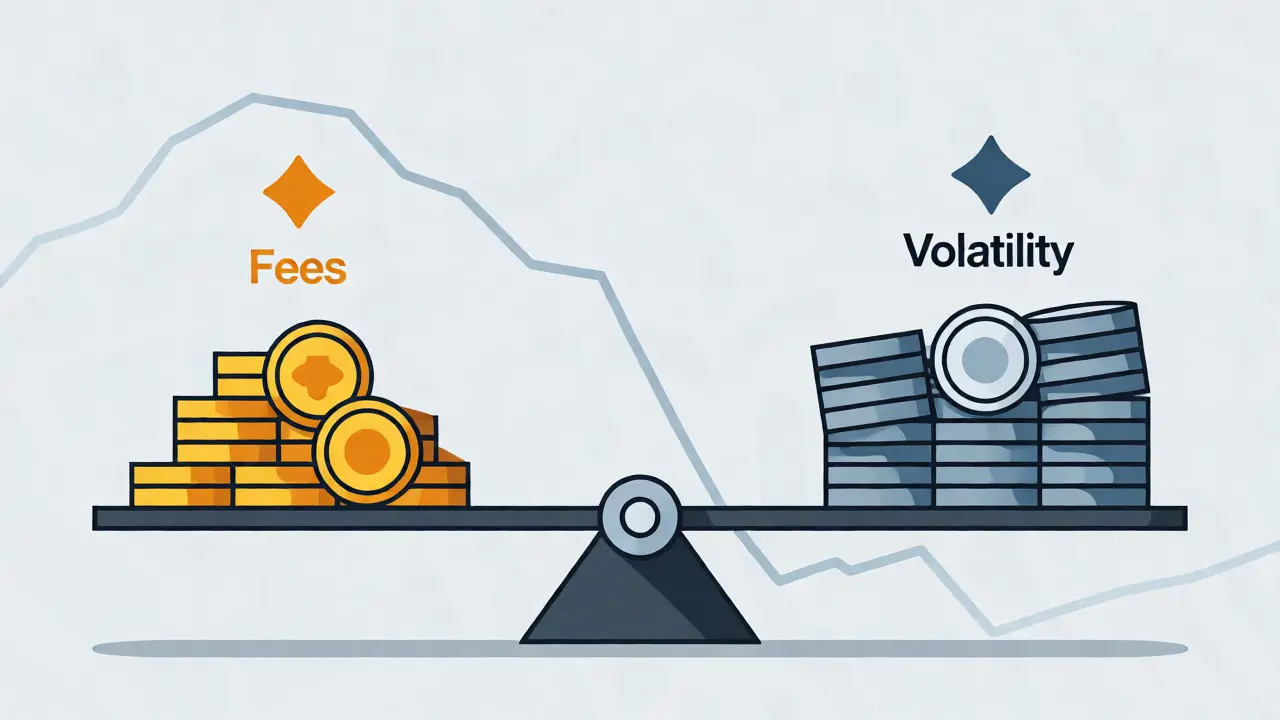
But here’s the catch most beginners miss: while you earn fees, you also expose yourself to price volatility. If one token crashes and the other stays flat, you might end up with less value than if you had just held the coins in your wallet. This guide breaks down exactly how to navigate this trade-off, choose the right pools, and actually keep the profits you generate.
The Mechanics: How Liquidity Pools Actually Work
Traditional exchanges use order books where buyers and sellers match manually. Decentralized Finance (DeFi) uses Automated Market Makers (AMMs). Instead of matching you with another person, an AMM algorithm lets you trade directly against a pile of tokens called a Liquidity Pool.
Here is the basic loop:
- Deposit: You put in equal dollar values of two tokens (e.g., $100 of ETH and $100 of USDC).
- Receive LP Tokens: The protocol gives you "LP tokens" representing your share of the pool. These are receipts proving you own a percentage of the total funds.
- Trading Happens: Users swap ETH for USDC or vice versa. Each swap incurs a fee, typically 0.3% on platforms like Uniswap V2.
- Earn Fees: That 0.3% fee goes straight into the pool, increasing the amount of ETH and USDC available. Since you hold a fixed percentage of the pool, your claim on those assets grows automatically.
When you decide to exit, you burn your LP tokens and withdraw your share of the now-larger pile. If trading volume was high, your withdrawal amount will be higher than your initial deposit. If volume was low, it might barely break even after gas fees.
Choosing Your Battlefield: Platforms and Pairs
Not all pools are created equal. Your choice of platform and asset pair determines your risk and reward profile. As of late 2026, the landscape has matured, but the core players remain dominant.
| Platform | Best For | Typical Fee Structure | Risk Level |
|---|---|---|---|
| Uniswap | High-volume major pairs (ETH/USDC) | 0.05%, 0.3%, 1% | Moderate-High (Volatility) |
| Curve Finance | Stablecoins & Pegged Assets | ~0.04% | Low (Peg Risk) |
| Balancer | Custom Weighted Portfolios | Variable | Moderate |
| Raydium | Solana Ecosystem Users | 0.25% | Moderate (Ecosystem Risk) |
Uniswap remains the king of Ethereum-based liquidity, controlling a massive chunk of Total Value Locked (TVL). However, its V3 update introduced Concentrated Liquidity. Unlike older models where your capital was spread across all possible prices, V3 lets you specify a price range (e.g., only providing liquidity when ETH is between $2,000 and $2,500). This boosts efficiency but requires active management; if the price moves out of your range, you stop earning fees entirely.
If you hate volatility, look at Curve Finance. It specializes in stablecoin pairs like DAI/USDC. Because these assets are pegged to the dollar, their price rarely diverges significantly. You earn lower fees per transaction, but the yield is consistent and the risk of losing principal due to price swings is minimal. It’s the closest thing to a savings account in crypto, though still subject to smart contract risks.
The Silent Killer: Understanding Impermanent Loss
This is the concept that trips up 90% of new liquidity providers. Impermanent Loss (IL) occurs when the price ratio of your deposited tokens changes compared to when you entered the pool.
Imagine you deposit 1 ETH and 1000 USDC when ETH is $1,000. The pool rebalances as people trade. If ETH shoots up to $2,000, the AMM algorithm automatically sells some of your ETH to buy more USDC to maintain the balance formula ($x imes y = k$). When you withdraw, you might have 0.7 ETH and 1400 USDC. Let’s do the math:
- HODL Strategy: You would have 1 ETH + 1000 USDC = $3,000 total value.
- Liquidity Provider: You have 0.7 ETH ($1,400) + 1400 USDC = $2,800 total value.
You lost $200 relative to holding, despite the market going up. That’s impermanent loss. It becomes permanent only if you withdraw before the price returns to your entry point. However, remember that you also earned trading fees during this period. If those fees exceeded $200, you came out ahead. If not, you lost money compared to simply holding.
Rule of Thumb: IL is roughly 5.7% if one token doubles in price relative to the other. To beat IL, you need high trading volume or a very long holding period to accumulate enough fees.
Step-by-Step: Executing Your First Position
Ready to try it? Here is the practical workflow using a standard wallet like MetaMask or Phantom.
- Fund Your Wallet: Ensure you have both tokens in the correct chain (e.g., Ethereum Mainnet, Arbitrum, or Solana). Remember, you need extra native currency (ETH or SOL) for gas fees.
- Connect to a DEX: Go to the platform’s website (e.g., app.uniswap.org). Connect your wallet.
- Select 'Pool' or 'Liquidity': Navigate to the section for adding liquidity.
- Choose Pair: Select your two tokens. Start simple: ETH/USDC or USDT/USDC.
- Enter Amounts: Input the dollar value you want to deposit. The interface will auto-calculate the required amount of the second token to maintain the current pool ratio.
- Approve Tokens: You’ll likely need to sign two transactions. One to approve the smart contract to spend your Token A, and another for Token B. On some chains, this happens simultaneously.
- Add Liquidity: Confirm the final transaction. Wait for the block confirmation.
- Check Your Dashboard: Visit the "Your Positions" tab. You should see your LP tokens and accrued fees.
Pro Tip: Check gas fees before committing small amounts. On Ethereum Mainnet, entering and exiting a position can cost $20-$100 depending on network congestion. If you’re investing $100, a $50 fee eats half your potential profit instantly. Layer 2 solutions like Arbitrum or Optimism, or alternative L1s like Solana, often reduce these costs to under $1.
Advanced Strategies: Beyond Basic Swaps
Once you understand the basics, you can layer strategies to boost yields.
Yield Farming with LP Tokens: Many protocols allow you to stake your LP tokens in a separate "farm" contract. For example, you provide liquidity on Uniswap, receive UNI-V2-LP tokens, then stake those in SushiSwap’s MasterChef contract to earn SUSHI rewards. This stacks two income streams: trading fees from the pool and governance tokens from the farm. Be warned: this adds complexity and smart contract risk.
Correlated Pairs: To minimize impermanent loss, pair assets that move together. ETH/wstETH (wrapped staked ETH) is a popular choice because wstETH is designed to track ETH’s price closely. Since the ratio doesn’t fluctuate wildly, IL is near zero, and you collect pure fee income.
Concentrated Liquidity Management: If you use Uniswap V3, don’t just set it and forget it. Monitor your position. If the price drifts out of your chosen range, you stop earning. Active managers rebalance their ranges weekly or daily, moving their liquidity to follow the current price. This increases capital efficiency but demands time and attention.

Risks You Can’t Ignore
Beyond impermanent loss, there are structural risks in DeFi.
- Smart Contract Bugs: If the code governing the pool has a vulnerability, hackers can drain the funds. Stick to audited, battle-tested protocols like Uniswap or Curve.
- De-Pegging: Stablecoins aren’t always stable. If USDC loses its peg to the dollar (as briefly happened in March 2023), your "safe" stablecoin pair could suffer significant losses.
- Regulatory Changes: Governments are watching DeFi. Future regulations could impose KYC requirements or tax complexities on LP earnings.
- Gas Fee Spikes: High network activity can make it expensive to enter or exit positions quickly, trapping you in a losing position until fees drop.
Final Checklist Before You Deposit
Before you click "Add Liquidity," run through this quick audit:
- Do I understand the pair? Am I comfortable holding both assets long-term?
- Is the trading volume high enough to justify the effort? Check the 24-hour volume on DefiLlama or Dune Analytics.
- Have I accounted for gas fees? Will they eat my first month’s profits?
- Am I prepared for impermanent loss? Do I have a strategy to offset it (e.g., farming rewards)?
- Is the protocol reputable? Has it been audited by firms like CertiK or Trail of Bits?
Providing liquidity isn’t magic, but it is a powerful tool for generating passive income in crypto. By starting with stable pairs, understanding the math behind impermanent loss, and choosing the right chain for your budget, you can turn market volatility into a revenue stream rather than a liability.
What is the minimum amount needed to provide liquidity?
There is no strict protocol minimum, but economic viability depends on gas fees. On Ethereum Mainnet, you generally need at least $500-$1,000 to make fees worthwhile after covering transaction costs. On Layer 2 networks like Arbitrum or Polygon, or on Solana, you can start with as little as $50-$100 because transaction fees are negligible.
Do I lose my tokens when I provide liquidity?
No, you don't lose them permanently. You convert your ERC-20 tokens into LP tokens, which represent your share of the pool. You can redeem these LP tokens back into the underlying assets (plus any accumulated fees) at any time. However, the composition of those assets may change due to trading activity and price fluctuations.
Is impermanent loss guaranteed?
No, it is not guaranteed. Impermanent loss only occurs if the price ratio between the two tokens changes significantly after you deposit. If prices remain stable or move in perfect correlation, you avoid IL. Additionally, if trading fees earned exceed the value of the IL, your net outcome is positive regardless of the IL calculation.
Which blockchain is cheapest for providing liquidity?
Solana and Layer 2 solutions like Arbitrum, Optimism, and Base currently offer the lowest transaction costs, often under $0.10 per interaction. Ethereum Mainnet remains the most expensive, with fees ranging from $5 to over $50 depending on network congestion. For small portfolios, cheaper chains are essential to preserve profitability.
Can I lose all my money in a liquidity pool?
Yes, in extreme scenarios. While rare in major pools, smart contract hacks can drain funds completely. Additionally, if one token in your pair goes to zero (like Terra/LUNA did in 2022), your position value collapses. Diversifying across multiple pools and sticking to established assets mitigates this risk.
Leave a comments