Imagine making money on Bitcoin, only to owe the government more than you actually earned. For Indian traders, this isn't a hypothetical nightmare-it’s the daily reality under the country’s 30% crypto tax. Implemented via Section 115BBH of the Income Tax Act, this flat rate applies to all gains from Virtual Digital Assets (VDAs), regardless of how long you held them or whether you’re an investor or a day trader. If you’re trading in India, understanding this framework isn’t just about compliance; it’s about survival.
The Core Mechanism: Why It Hurts More Than You Think
Most countries treat crypto like stocks or property, offering lower rates for long-term holdings. India doesn’t play by those rules. The tax is a flat 30% on profits, plus a 4% health and education cess, pushing the effective rate to 31.2%. There are no slabs, no deductions for transaction fees, and crucially, no distinction between short-term and long-term capital gains. Whether you bought Bitcoin yesterday or three years ago, if you sell at a profit, that 30% bill comes due immediately.
Here is where it gets tricky for active traders: you cannot offset losses. In most jurisdictions, if you lose ₹50,000 on Ethereum but make ₹50,000 on Bitcoin, your net taxable gain is zero. In India, you still pay 30% on the Bitcoin gain, and the Ethereum loss is essentially wasted for tax purposes. This rule alone can turn a break-even year into a tax liability year, forcing many to question the viability of active trading strategies.
The Hidden Costs: TDS and GST
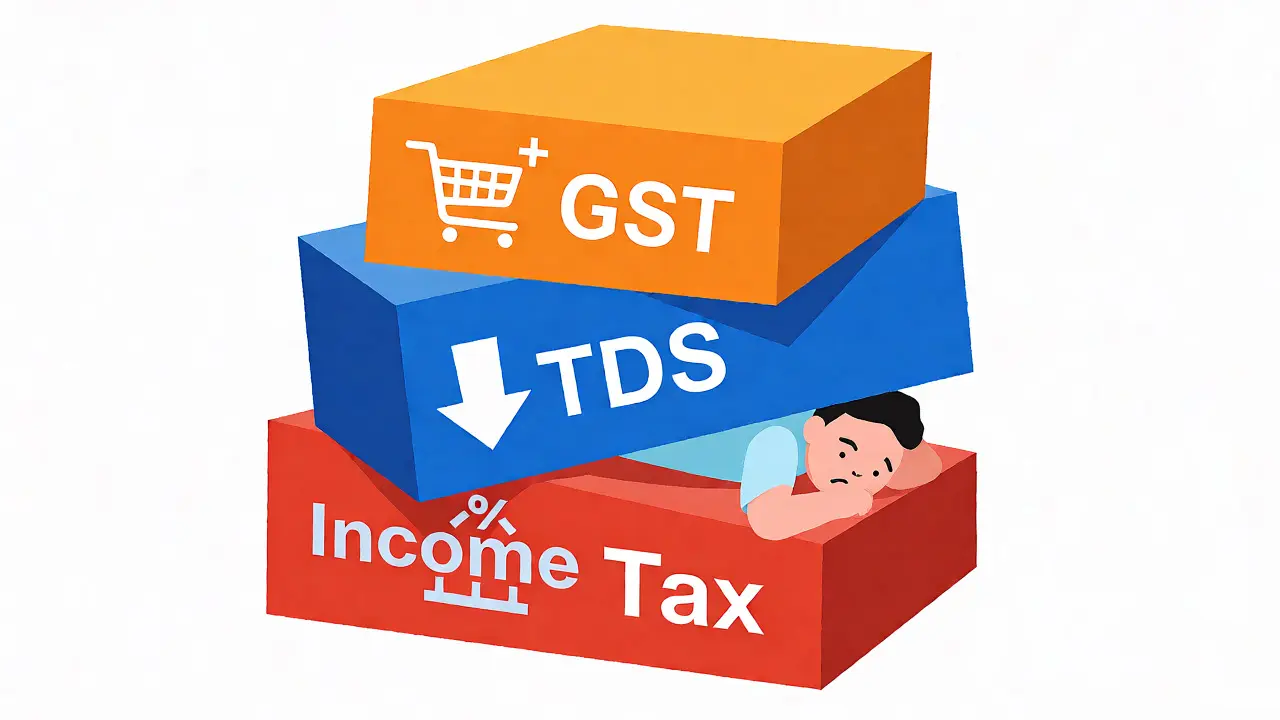
The 30% income tax is just one layer. Since July 2022, a 1% Tax Deducted at Source (TDS) has been mandatory on transfers exceeding ₹50,000 annually (or ₹10,000 for certain entities). This deduction happens automatically when you sell through compliant Indian exchanges. While it sounds minor, it creates massive cash flow issues. You might have sold at a loss, yet 1% of the total sale value was deducted because the system looks at gross turnover, not net profit.
Then there’s the new wrinkle added in July 2025: an 18% Goods and Services Tax (GST) on platform services. This means every time you trade, you’re paying fees that include GST, further eating into your margins. So, for every rupee of potential profit, you’re fighting against a 30% income tax, a 1% upfront TDS, and 18% GST on the service costs. It’s a triple-taxation structure that few other major economies impose with such severity.
| Feature | India | USA | Germany | Singapore |
|---|---|---|---|---|
| Tax Rate | 30% Flat + Cess | 0-20% (Capital Gains) | Free after 1 year | 0% |
| Loss Offset | No (Asset-specific) | Yes (Against gains) | Yes | N/A |
| Holding Period | Irrelevant | Short vs Long Term | >1 Year = Tax Free | Irrelevant |
| TDS/GST | 1% TDS + 18% GST | None | None | None |
Who Is Affected? Defining Virtual Digital Assets
The term "Virtual Digital Asset" (VDA) is broad. It covers Bitcoin, Ethereum, altcoins, NFTs, and even utility tokens. If it’s digital and transferable, it likely falls under this net. However, central bank digital currencies (CBDCs) and traditional gift cards are excluded. For Bitcoin traders, this means every swap, every sale for fiat, and potentially even some complex DeFi interactions could trigger a taxable event. The definition is intentionally wide to catch as much activity as possible, leaving little room for ambiguity regarding what constitutes a "crypto" asset.
Compliance Headaches: Record Keeping and Filing
If you think calculating the tax is hard, try proving it. The Income Tax Department requires detailed records for every single transaction. You need dates, times, purchase prices, selling prices, and exchange names. For traders using multiple platforms-say, buying on Binance and selling on WazirX-consolidating these records is a nightmare. Most spreadsheet templates fail here because they don’t account for the specific cost-basis rules or the inability to offset losses across different assets.
You must file Schedule VDA in your annual return. Missing this section or providing inaccurate data can lead to penalties. Many traders spend 10-15 hours a year just organizing their paperwork, while active traders might spend upwards of 40 hours. Software tools like ClearTax or Koinly have adapted to these rules, but they often struggle with P2P transactions or international exchanges that don’t provide standardized API data.

Strategies for Surviving the Tax Regime
Can you beat the system? Not really, but you can manage it. First, stop frequent trading unless you have high-margin strategies. The 30% rate punishes churn. Second, be aware of the TDS threshold. If you stay under ₹50,000 in annual sales, you might avoid the automatic 1% deduction, though you still owe the 30% tax on gains. Third, consider holding periods carefully. While the rate doesn’t change, holding longer reduces the frequency of taxable events, simplifying your compliance burden.
Some traders look offshore. Moving assets to jurisdictions with better tax treaties helps, but residency rules in India are strict. If you’re a resident, global income is taxable. Simply moving your server location won’t save you. The most practical approach for many is to accept the cost of doing business, budget for the tax hit, and focus on net returns rather than gross performance.
The Market Impact: Has It Killed Adoption?
Since April 2022, trading volumes on Indian exchanges dropped by 40-60%. Retail investors, who were driving the boom, pulled back significantly. The fear of unexpected tax bills and the complexity of compliance scared off casual users. Institutional adoption remains slow because the lack of loss offsetting makes portfolio hedging difficult. While the market hasn’t disappeared, it has shrunk and matured. Those remaining are either deeply committed believers or professional traders with sophisticated accounting teams.
Looking ahead, there is hope for reform. Industry bodies continue to lobby for loss offsetting and clearer definitions for staking rewards. Until then, the 30% regime stands firm. For now, knowledge is your best defense. Understand the rules, keep meticulous records, and never assume your net portfolio value equals your taxable income.
Can I offset my Bitcoin losses against my Ethereum gains?
No. Under Section 115BBH, losses from one virtual digital asset cannot be set off against gains from another. Each asset is treated separately for tax purposes. If you lose on BTC but win on ETH, you pay tax on the ETH gain and cannot use the BTC loss to reduce it.
What is the current TDS rate on crypto transactions in India?
The standard TDS rate is 1% under Section 194S. This applies to transfers exceeding ₹50,000 in a financial year for regular individuals. For non-residents or specific entities, the threshold may be lower at ₹10,000. The buyer is responsible for deducting this before payment.
Does the 30% tax apply to mining or staking rewards?
Yes, but differently. Mining and staking rewards are taxed as "Income from Other Sources" at your applicable slab rate when received. When you later sell these coins, any appreciation above the fair market value at the time of receipt is subject to the flat 30% VDA tax.
Are there any deductions allowed besides the purchase price?
No. Only the cost of acquisition is deductible. Transaction fees, wallet maintenance costs, internet bills, and advisory fees are not deductible against capital gains. This makes the effective tax burden higher than the nominal 30% rate suggests.
How does the new GST affect my crypto trading?
Effective July 2025, an 18% GST applies to services provided by crypto exchanges and platforms. This increases the operational cost of trading. While it doesn't change the 30% income tax on gains, it reduces your net profit margin on every trade executed through compliant Indian platforms.
Leave a comments