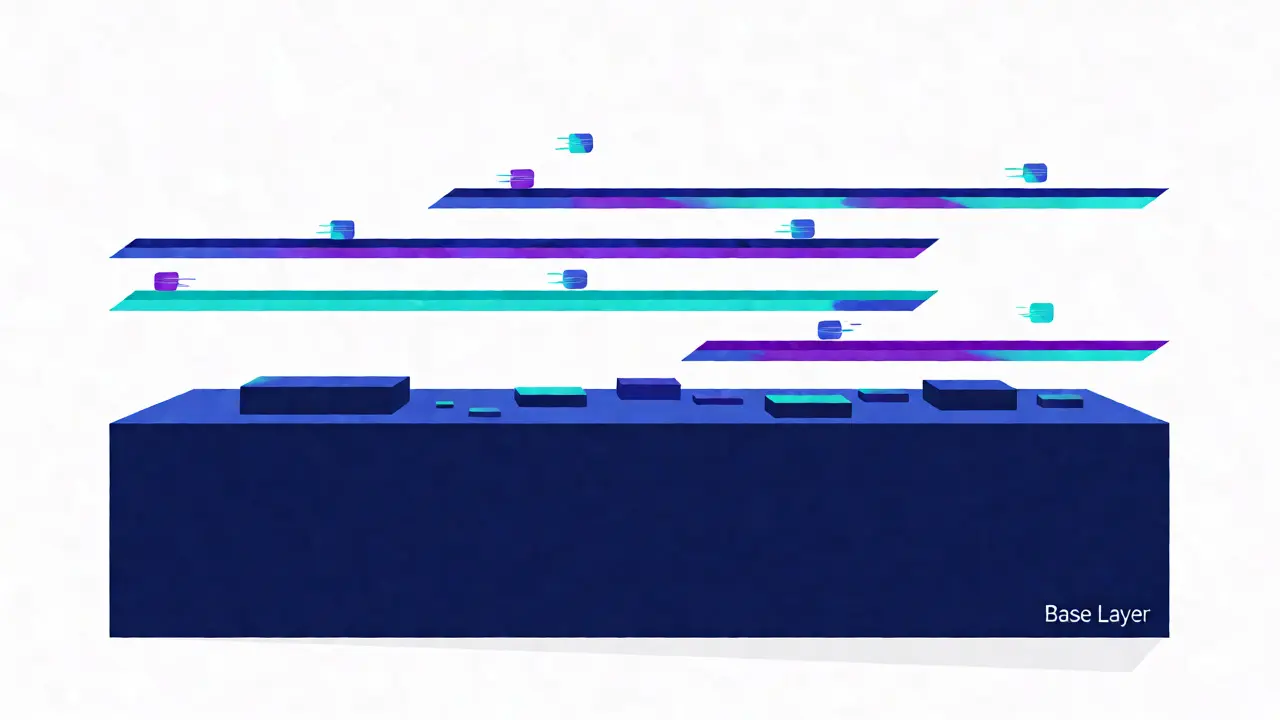
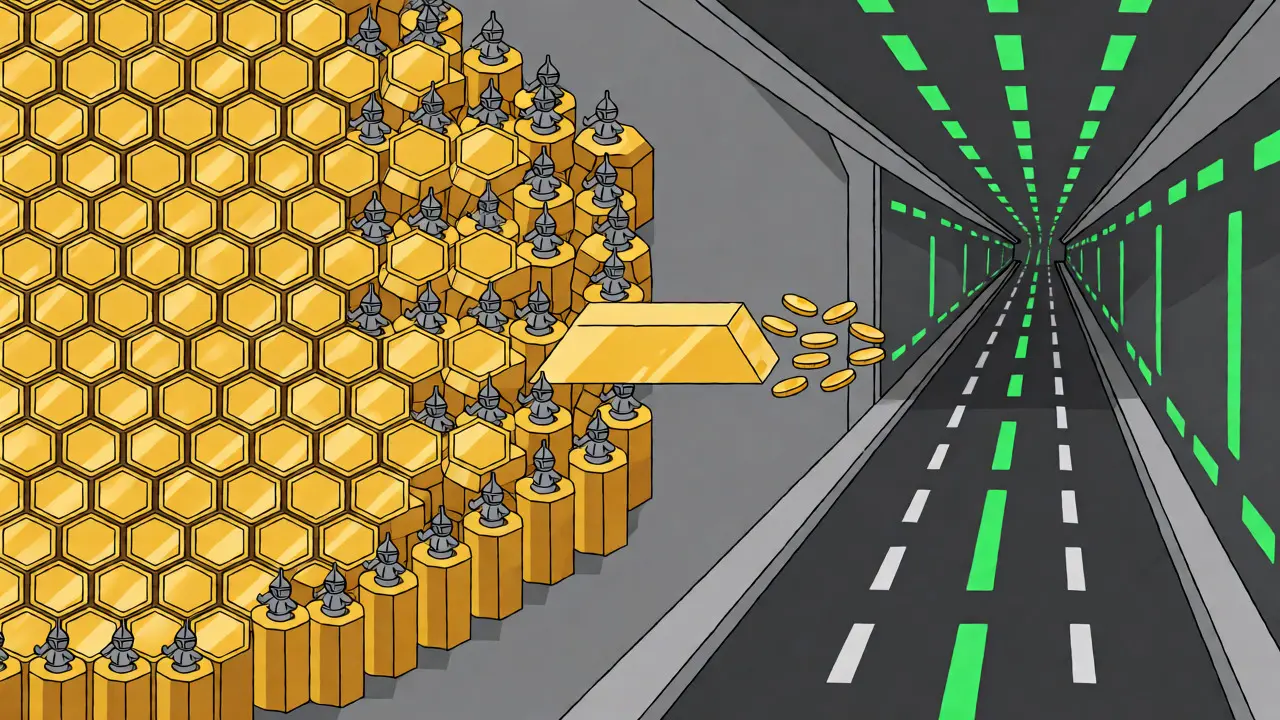
Imagine trying to pay for a coffee with a $50 bill and getting change in gold bars. That’s roughly what it felt like to use Ethereum during the 2021 NFT boom, where gas fees hit $200 per transaction. It worked, sure, but it was absurdly expensive and slow for everyday users. This friction sparked one of the biggest debates in crypto infrastructure: should we fix the base road (Layer 1) or build express lanes on top of it (Layer 2)? If you’re confused about which network to deploy your dApp on, or why your funds are stuck in a bridge, this breakdown clears up the technical fog without drowning you in jargon.
The Core Difference: Base Layer vs Scaling Solution
At its simplest, a Layer 1 (L1) is the foundational blockchain network that handles its own consensus and security. Think of Bitcoin or Ethereum as the main highway system-they process every transaction directly, verify them, and settle them permanently. They are independent islands of trust. In contrast, a Layer 2 (L2) is a secondary protocol built on top of an L1. It doesn’t have its own independent security model; instead, it inherits security from the underlying L1 while processing transactions off-chain to boost speed and cut costs. The distinction isn't just semantic-it dictates how much you pay, how fast you get confirmation, and how many trust assumptions you’re willing to accept.
When you send money on Bitcoin, you’re using Layer 1. When you use the Lightning Network to send that same amount instantly for pennies, you’re using Layer 2. The L2 batches thousands of small payments together, compresses them into a single data packet, and posts that summary back to the L1. This allows L2s to achieve throughput that would be impossible on the base layer alone. For instance, while Ethereum’s base layer manages about 15-30 transactions per second (TPS), Layer 2 solutions like Arbitrum or Optimism can handle 2,000-4,000 TPS. That’s not a marginal improvement; it’s a fundamental shift in capability.
Security Models: Who Protects Your Assets?
This is where things get tricky for newcomers. Layer 1 networks derive their security from massive, decentralized validator sets. As of late 2024, Ethereum has over 835,000 validators securing the network. If you want to attack Ethereum, you need to compromise a huge portion of this global network, which is prohibitively expensive. Layer 2s, however, introduce new trust assumptions. Most current Ethereum L2s rely on a centralized sequencer-an operator who orders transactions before posting them to Ethereum. If that sequencer goes offline or acts maliciously, your transactions might halt, even if the underlying Ethereum network remains secure.
| Feature | Layer 1 (e.g., Ethereum) | Layer 2 (e.g., Arbitrum/Optimism) |
|---|---|---|
| Consensus Mechanism | Proof-of-Stake (PoS) / Proof-of-Work (PoW) | Inherited from L1 + Sequencer logic |
| Validator Count | High (835k+ for ETH) | Low (Often 1-100 operators) |
| Fraud Proofs | N/A (Native finality) | 7-day challenge window (Optimistic) |
| Cryptographic Proofs | N/A | Instant verification (zk-Rollups) |
Not all Layer 2s are created equal here. Optimistic Rollups (like Optimism and Arbitrum) assume transactions are valid unless proven otherwise within a 7-day fraud proof window. This means if you move funds from an Optimistic Rollup back to Ethereum, you might wait a week. zk-Rollups (like StarkNet or zkSync Era), on the other hand, use zero-knowledge proofs to mathematically prove validity instantly. This reduces the trust needed in the sequencer but requires complex cryptography. If you value immediate withdrawal speeds and maximum decentralization, zk-Rollups are generally preferred, though they are harder to build on.
Performance and Cost: The User Experience Gap
Let’s talk numbers, because this is usually why people switch. During periods of high congestion, Ethereum Layer 1 transaction fees can spike dramatically. In January 2022, average fees hit nearly $200. Even in quieter times, swapping tokens on Uniswap V3 on Ethereum mainnet often costs between $5 and $20. Now compare that to Layer 2. On Polygon PoS, the average fee hovers around $0.0005. On Arbitrum One, it’s typically under $0.02. For a developer deploying a smart contract, the difference is staggering. One user reported cutting deployment costs from $15,000 on Ethereum to just $150 on Arbitrum for the same set of transactions.
Speed is another major factor. Ethereum blocks are produced every 12 seconds, but finality-the point where a transaction cannot be reversed-can take several minutes depending on network conditions. Bitcoin takes about 60 minutes for high-confidence finality. Layer 2s offer near-instant confirmation. When you click "swap" on a decentralized exchange running on Base or Optimism, the UI updates in milliseconds. Behind the scenes, the L2 confirms the trade immediately, while the batched data settles on Ethereum later. This creates a seamless experience that feels more like Web2 apps than traditional crypto transactions.
Bridging Risks: The Hidden Pitfall
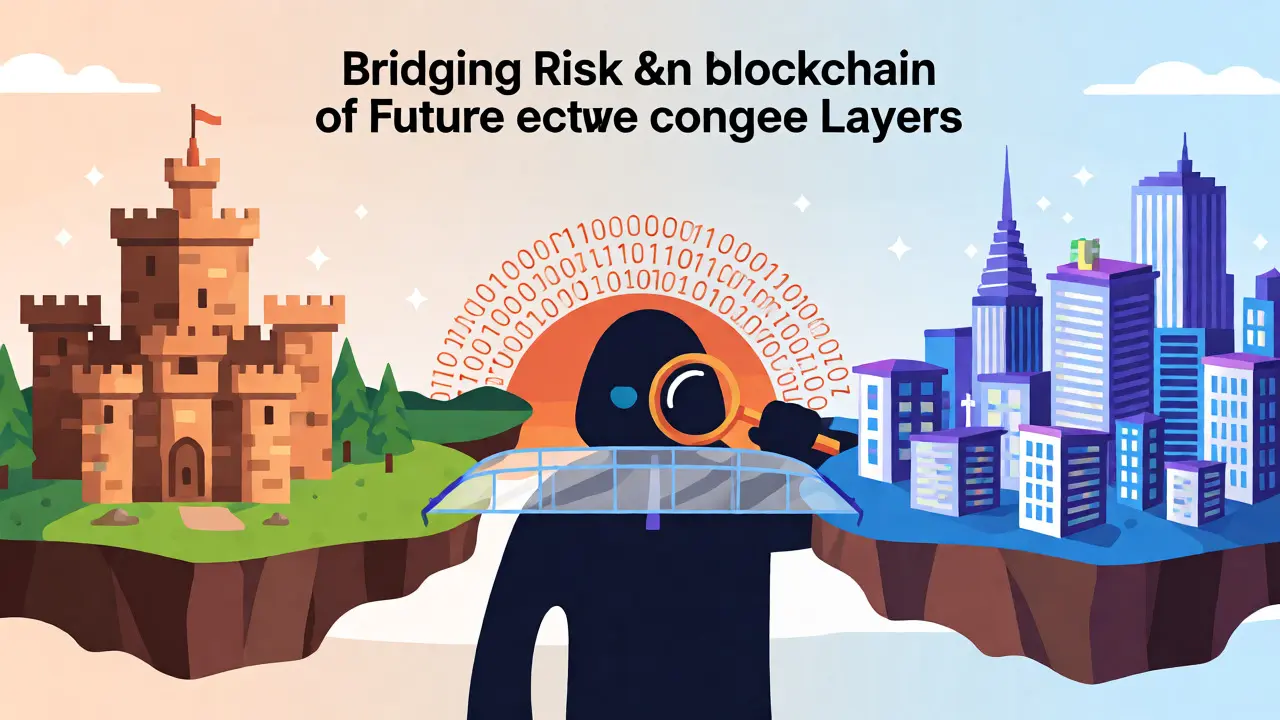
If Layer 2s are so cheap and fast, why not just use them for everything? Because moving assets between layers is risky and cumbersome. To use a Layer 2, you must first "bridge" your funds from Layer 1. This involves locking your assets in a smart contract on L1 and minting equivalent tokens on L2. While convenient, bridges have become prime targets for hackers. The Ronin Bridge hack in March 2022 resulted in a loss of $613 million, largely due to compromised validator keys. Similarly, the Wormhole bridge suffered a $320 million exploit in February 2022.
These incidents highlight a critical vulnerability: bridges add an extra layer of complexity and attack surface. You’re no longer just trusting the blockchain’s consensus; you’re trusting the bridge code, the oracle services, and the multisig wallets managing the locked funds. Academic analysis suggests that while L2s reduce transaction costs by 97%, they increase bridge-related security risks by 37% compared to staying purely on L1. If you’re holding large amounts of capital, the risk of a bridge exploit might outweigh the savings on gas fees.
Which Should You Choose?
The choice depends entirely on your role and goals. If you are a long-term holder (HODLer) of Bitcoin or Ethereum, sticking to Layer 1 makes sense. The security is absolute, the liquidity is deepest, and there are no bridging risks. However, if you are an active trader, DeFi user, or gamer, Layer 2 is almost always the better option. The cost savings are too significant to ignore, and the user experience is vastly superior.
For developers, the decision is nuanced. Building on Layer 1 gives you access to the most mature tooling and highest liquidity pools. But if your application relies on high-frequency interactions-like a game or a social media platform-Layer 1 fees will kill your user retention. Many projects now adopt a hybrid approach: keeping treasury management and high-value settlements on Layer 1, while directing user-facing activity to Layer 2. This balances security with usability.
The Future: Convergence and Specialization
The line between Layer 1 and Layer 2 is blurring. Ethereum’s recent Dencun upgrade introduced "proto-danksharding," which slashed Layer 2 data costs by 90%. This makes L2s even cheaper, reinforcing their dominance for daily usage. Meanwhile, newer Layer 1s like Solana aim to solve scalability natively through parallel processing, potentially reaching 1 million TPS. This challenges the need for Layer 2s on those specific chains, creating a fragmented landscape where some ecosystems rely on L2s (Ethereum) and others scale via L1 improvements (Solana).
Industry analysts predict that by 2026, 70% of enterprise blockchain implementations will use Layer 2 for transaction processing while relying on Layer 1 for settlement. We are moving toward a multi-layered future where Layer 1 acts as the secure foundation-like a vault-and Layer 2 serves as the bustling marketplace. Understanding this hierarchy helps you navigate the ecosystem smarter, ensuring you don’t pay premium prices for basic utility or expose yourself to unnecessary bridge risks.
Is Layer 2 safer than Layer 1?
No, Layer 1 is inherently safer because it has its own independent consensus mechanism and larger validator set. Layer 2 inherits security from Layer 1 but introduces additional trust assumptions, such as reliance on sequencers and bridge contracts. While Layer 2s are secure enough for most daily uses, Layer 1 offers the highest level of cryptographic certainty.
Why do I have to wait 7 days to withdraw from some Layer 2s?
This delay applies specifically to Optimistic Rollups like Optimism and Arbitrum. They operate on an "optimistic" assumption that transactions are valid unless challenged. The 7-day period is a fraud proof window allowing anyone to dispute invalid transactions. zk-Rollups like zkSync do not have this delay because they use mathematical proofs to validate transactions instantly.
Can I lose my money when bridging from Layer 1 to Layer 2?
Yes, bridging carries risks. Major hacks like the Ronin Bridge ($613M) and Wormhole ($320M) exploits occurred at the bridge level, not the blockchain itself. These vulnerabilities often stem from compromised private keys or bugs in the bridge smart contracts. Always use reputable bridges and consider the size of your transfer relative to the risk.
Do Layer 2 tokens have the same value as Layer 1 tokens?
Generally, yes. Tokens like USDC or ETH on Layer 2 are pegged 1:1 to their Layer 1 counterparts. However, liquidity can vary. If you try to swap a large amount of a niche token on a smaller Layer 2, you might face slippage due to lower liquidity depth compared to Ethereum mainnet. Stablecoins and major assets usually maintain parity across layers.
Should I move my entire portfolio to Layer 2?
It depends on your activity level. For active traders and DeFi users, moving to Layer 2 saves significant fees. For long-term holders who rarely touch their assets, staying on Layer 1 avoids bridging risks and provides easier access to hardware wallet compatibility and broader institutional custody options. A balanced approach often works best: keep core holdings on L1 and use L2 for interaction.
Barelvi Power
30 10 26 / 16:18 PMOh, wonderful. Another article explaining why your coffee costs more than the beans used to make it. Look, if you're just starting out, don't overthink the 'express lanes' metaphor. It's simple: L1 is the highway with traffic jams and toll booths that cost a kidney; L2 is the side road where you actually get to your destination before your coffee gets cold.
I've been mentoring folks through this mess for years, and the biggest mistake people make is treating security like an all-or-nothing switch. It's not. You're trading some absolute certainty for usability. If you're moving $50 worth of ETH to play a game, do you really care about the theoretical risk of a sequencer hiccup? Probably not. But if you're holding your life savings? Yeah, maybe stick to the main road. The bridge risks mentioned here are real, but so is the risk of paying $40 in gas fees every time you want to buy a sandwich. Pick your poison.
Sean Roberts
1 11 26 / 11:40 AMhey man nice breakdown i usually keep things simple cause my brain hurts when its too complex
i think u should mention that even on l2 sometimes the bridges suck and u lose ur coins if u use the wrong one i had a bad exp with a random bridge last year
anyway good job explaining the speed stuff its true its way faster now