Imagine spending $50,000 on a machine that screams like a jet engine and eats electricity for breakfast, just to earn about $40 a day. That’s the reality of Bitcoin mining today. But where does that money actually come from? It isn’t magic, and it certainly isn’t free money printed by a central bank. It comes from two specific sources: new coins created out of thin air (the block subsidy) and fees paid by users wanting their transactions confirmed. Understanding how these components interact is the difference between a profitable operation and an expensive space heater.
If you’re looking at the numbers, the landscape has shifted dramatically since the early days. Back in 2009, Satoshi Nakamoto launched the network with a block reward of 50 BTC. Today, following the April 2024 halving, that number sits at 3.125 BTC per block. This reduction isn’t random; it’s hard-coded into the protocol to happen every 210,000 blocks, roughly every four years. The goal? To cap the total supply at 21 million coins. By October 2026, we are deep into this deflationary phase, meaning miners can no longer rely solely on new coin issuance to cover their massive energy bills. They have to compete harder, run more efficient hardware, and secure cheaper power.
The Two Pillars of Miner Income
To grasp miner revenue, you need to split it into its two distinct parts. Think of it like a salary plus tips. The "salary" is the block subsidy, which is fixed and predictable. The "tips" are transaction fees, which fluctuate based on network congestion.
The block subsidy is the primary incentive that keeps the network secure. When a miner successfully solves the cryptographic puzzle-finding a hash below the target difficulty-they get to add the next block to the chain. In return, they claim the newly minted Bitcoin. As of late 2026, this remains the bulk of revenue for most operations, though its share is shrinking. According to recent data from J.P. Morgan, transaction fees now constitute 12-15% of total miner revenue, up from just 5-7% before the last halving. This shift is critical because it signals that the network is maturing. Users are willing to pay more to get their transactions included quickly, especially during bull markets when demand spikes.
However, relying on fees alone is risky. If network usage drops, fee revenue plummets. This is why the transition to a fee-only model, projected around the year 2140, is such a hot topic among economists. Dr. Lee Reiswig from Argo Blockchain has questioned whether fees will ever be enough to justify the cost of solving proof-of-work puzzles without subsidies. On the other hand, Bitbo.io argues that as adoption grows, so will volume, naturally balancing the equation. For now, miners live in a hybrid economy where both streams matter, but the subsidy is still the king.
How Difficulty Eats Your Lunch
You might think that if you buy a powerful rig, your income is guaranteed. Wrong. The Bitcoin network adjusts itself to keep block times at an average of 10 minutes. Every 2,016 blocks (about two weeks), the network looks at how fast blocks were mined. If they came too fast, the difficulty goes up. If too slow, it goes down.
This mechanism means your revenue is inversely related to the total network hashrate. If more miners join the party, the pie gets sliced thinner for everyone. In 2023, difficulty growth averaged 10-15% monthly. Imagine buying a machine expecting stable returns, only to see your earnings drop 37% in three months because thousands of new terahashes came online. This happened to many users on Reddit’s r/BitcoinMining, who reported significant profit squeezes despite stable electricity costs.
The formula for daily output helps illustrate this volatility:
- Daily Output (BTC) = Hashrate × (Block Reward × 86400) ÷ (Current Difficulty × 232) × (1 - Pool Fee)
Notice the "Current Difficulty" in the denominator. As that number climbs, your output shrinks, regardless of how good your machine is. This dynamic forces miners to constantly upgrade or relocate to cheaper jurisdictions to stay ahead of the curve.
Hardware Wars: ASICs vs. Everything Else
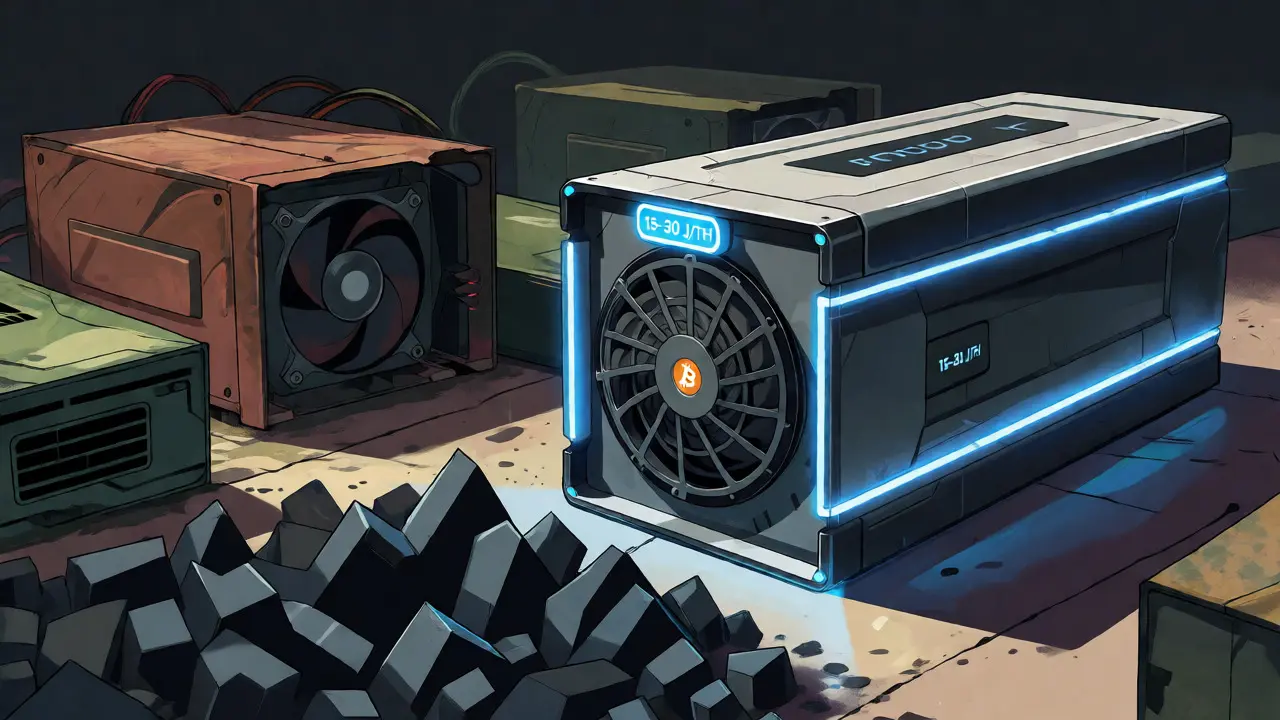
Let’s talk gear. You cannot mine Bitcoin profitably with a gaming PC anymore. The era of GPU mining for BTC ended years ago. Today, it’s all about Application-Specific Integrated Circuits, or ASICs. These are specialized chips designed to do one thing only: calculate SHA-256 hashes.
The efficiency gap is staggering. A top-tier ASIC like the AntMiner S21e XP Hyd 3U achieves efficiencies of 15-30 joules per terahash (J/TH). Compare that to a high-end NVIDIA H100 GPU, which might use 100-300 J/TH for similar workloads (though GPUs are better suited for other algorithms). The financial difference is equally stark. NiceHash data shows an AntMiner S21e generating roughly $39.11 daily, while even the best GPU setups struggle to hit $1.00 per day for Bitcoin specifically.
| Hardware Type | Example Model | Efficiency (J/TH) | Est. Daily Revenue (USD) | Viability for BTC |
|---|---|---|---|---|
| ASIC | AntMiner S21e XP Hyd | 15-30 | $39.11 | High |
| GPU | NVIDIA RTX 4090 | 100-300 | $0.50 | Low |
| CPU | AMD Threadripper 3990X | >500 | $1.16 | Negligible |
The catch with ASICs is their lack of versatility. If Bitcoin crashes or becomes unprofitable, you can’t repurpose that machine for AI training or gaming. It’s essentially e-waste waiting to happen. This creates a high-risk environment where hardware depreciation competes directly with energy costs.
The Cost Side: Electricity and Location
Revenue is only half the story. The other half is cost, and electricity is the big one. Industrial-scale operations consume massive amounts of power. An entry-level ASIC might draw 3,000 watts continuously. Over a year, that’s over 26,000 kWh. At a standard US residential rate of $0.12/kWh, you’d spend over $3,000 just to keep the lights on in your miner’s world.
This is why geography matters. Miners flock to places with cheap, reliable power. Texas, for instance, has become a hub due to its deregulated market and abundant wind energy. However, volatility is a risk. During heatwaves, ERCOT prices in Texas can spike to $9/kWh, forcing miners to shut down temporarily to avoid bankruptcy. Successful miners often negotiate contracts below $0.05/kWh. Anything above $0.06/kWh makes profitability difficult unless Bitcoin’s price is significantly elevated.
Beyond raw electricity, there are hidden costs. Cooling systems add 15-20% to your power bill. Fans fail every 6-12 months, costing $50 a pop. Maintenance isn’t optional; it’s part of the job description. Many beginners underestimate these operational expenses, leading to negative cash flow even when BTC prices look good on the chart.
Mining Pools and Fees
Unless you own a farm with exahashes of power, you won’t find a block solo. Solo mining is a lottery ticket where you might wait years for a win. Instead, most miners join pools. A pool combines the hashing power of many participants and distributes rewards proportionally.
Pools charge a fee, typically between 1% and 2.5%. While this seems small, it compounds over time. Slush Pool charges 2%, while F2Pool charges 2.5%. On a 100 TH/s rig, this difference translates to about $0.45 per day. Over a year, that’s hundreds of dollars left on the table. Choosing the right pool involves balancing fee structure, payout reliability, and server latency. Some miners use multiple pools to diversify risk, a strategy adopted by 53% of professionals according to HashRate review data.
The Halving Effect and Future Outlook
The April 2024 halving was a watershed moment. It instantly cut the block subsidy from 6.25 BTC to 3.125 BTC. For miners, this meant their primary income stream was slashed in half overnight. To survive, they had to either double their efficiency or hope for a doubling in Bitcoin’s price.
Looking ahead, the trend toward centralization continues. Only operations with sub-4 cent/kWh electricity rates remain comfortably profitable. Large firms like Marathon Digital and Riot Platforms are expanding gigawatt-scale facilities to leverage economies of scale. Meanwhile, individual "bedroom miners" represent only 12% of the network, down from 68% in 2017.
Will transaction fees eventually replace block rewards entirely? Analysts are divided. Some predict fees must reach $50-75 per block by 2140 to maintain security levels. Others believe organic growth in adoption will handle it. What is certain is that miner revenue is no longer a passive income stream. It’s a competitive business requiring constant optimization of hardware, energy, and strategy.
What happens to miner revenue after the 21 million BTC cap?
Once all 21 million Bitcoin are mined (projected around 2140), no new coins will be created. Miners will rely exclusively on transaction fees for revenue. This shifts the economic model from inflation-based incentives to service-based fees, potentially increasing the cost of transactions for users.
Why did my mining profits drop even though Bitcoin's price stayed stable?
Network difficulty adjusts every two weeks. If more miners join the network, difficulty increases, reducing the portion of the block reward each miner receives. Additionally, older hardware becomes less efficient compared to newer models, further squeezing margins.
Is GPU mining still profitable for Bitcoin?
No. GPUs are orders of magnitude less efficient than ASICs for Bitcoin's SHA-256 algorithm. While GPUs are useful for mining altcoins, they generally generate negligible revenue for Bitcoin, often failing to cover electricity costs.
How do mining pool fees affect my net revenue?
Pool fees typically range from 1% to 2.5%. While small, they reduce your take-home pay. For example, a 0.5% difference on a high-hashrate rig can amount to hundreds of dollars annually. Always factor these fees into your profitability calculations.
What is the biggest risk to miner profitability?
The combination of low Bitcoin prices and rising network difficulty is the biggest threat. If BTC stays below $35,000 while difficulty grows by more than 15% monthly, stress tests suggest 40-60% of current miners could go offline.
Leave a comments