
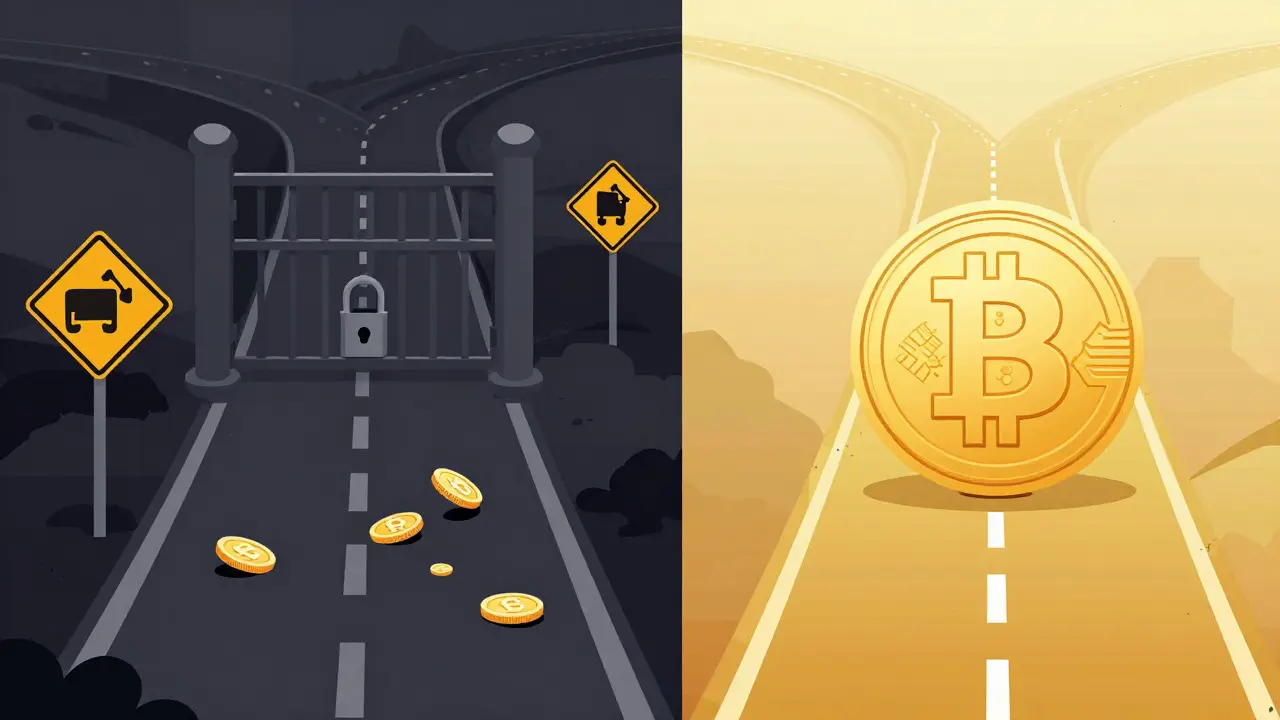
If you're trying to figure out how to handle your digital assets while living or working in China, you've likely noticed the atmosphere has shifted from "cautionary" to "absolute." Since the sweeping crackdown on May 31, 2025, the regulatory environment hasn't just tightened-it has essentially slammed shut. We aren't talking about a few banned apps anymore; we're talking about a total prohibition that treats cryptocurrency is a digital or virtual currency secured by cryptography, which in China is now classified as illegal financial activity as a legal liability.
The core problem for most people is that the rules now follow the person, not just the geography. If you are a Chinese citizen, the government has made it clear that holding assets outside the country doesn't necessarily put you in a safe zone. With the Ministry of Public Security using advanced online tracking and offline inspections, the risk of having funds frozen or facing an investigation is higher than it has ever been. You need a clear understanding of where the red lines are drawn before you make any moves.
The Current Reality of the "Crypto Wipeout"
To avoid restrictions, you first have to understand exactly what is being restricted. The 2025 "crypto wipeout" expanded the ban to cover almost every possible interaction with blockchain assets. It's no longer just about not running a mining farm in your basement. Now, the prohibition extends to simply holding a private key or using a web-based wallet.
The government now views virtual currencies as primary channels for money laundering. Because of this, the monitoring system is incredibly aggressive. Financial institutions and non-bank payment providers are required to flag any transaction that looks like a crypto ramp (the process of converting fiat currency to crypto or vice versa). If your bank account shows a pattern of transfers to known exchange addresses, you aren't just risking a frozen account; you're potentially triggering a criminal investigation.
Comparing the Regulatory Shifts
It helps to see how things evolved to understand why current methods of "avoiding" restrictions are so dangerous. In the early days, the government just didn't like the volatility. Now, they view it as a threat to financial stability and national security.
| Era | Primary Stance | Key Restriction | Risk Level |
|---|---|---|---|
| 2013-2017 | Cautious / Commodity | Banks couldn't handle BTC | Low to Medium |
| 2017-2024 | Domestic Ban | ICOs and local exchanges banned | Medium to High |
| 2025-Present | Absolute Prohibition | Holding and overseas ownership banned | Critical |

The Danger of Traditional "Workarounds"
Many people instinctively reach for a VPN (Virtual Private Network) to access international exchanges like Binance or OKX. While a VPN might hide your IP address from a local ISP, it doesn't hide your identity from the exchange's KYC (Know Your Customer) process. If you used a Chinese passport to verify your account, the exchange knows exactly who you are and where you're from.
Furthermore, the "off-ramp" is where most people get caught. Trying to move USDT (Tether) or Bitcoin back into a Chinese bank account is a massive red flag. The current monitoring systems can trace funds through multiple hops. If the money touches a wallet that has been flagged as part of a crypto-trading circle, the bank's automated systems will trigger an alert to the authorities.
Strategies for Risk Mitigation and Compliance
If your goal is to avoid legal trouble, the only guaranteed method is full compliance with local laws. However, if you are managing existing assets, the focus must shift from "trading" to "extreme discretion" and "separation."
First, decouple your digital identity from your financial activity. Using a domestic bank account for any crypto-related movement is essentially a gamble. Those who have managed to keep their assets safe typically avoid using any local payment providers for transactions that could be linked to virtual currencies.
Second, understand the extraterritorial reach. The 2025 laws imply that the Chinese government may investigate citizens for assets held in foreign jurisdictions. This means that even if you are physically outside China, your status as a citizen makes you subject to these rules. The only way to truly "avoid" these restrictions in a legal sense is to ensure that no assets are transferred into or out of the Chinese financial system.
The Rise of the Digital Yuan as the Only Legal Path
It's no coincidence that the ban on private crypto happened alongside the push for the e-CNY (Digital Yuan). The government isn't against the technology of digital ledgers; they are against the lack of control that comes with decentralized currencies.
The e-CNY is a Central Bank Digital Currency (CBDC), meaning it is fully controlled by the People's Bank of China. While it offers the speed and efficiency of crypto, it provides the government with total visibility into every transaction. For those looking for a legal way to use digital payments within China, the e-CNY is the only sanctioned path. It doesn't offer the profit potential of Bitcoin, but it doesn't carry the risk of a prison sentence.
Common Pitfalls to Avoid
- Using Peer-to-Peer (P2P) Markets: Many think P2P is safer because it's direct. In reality, P2P traders are often the first ones targeted by the Ministry of Public Security. One "dirty" transaction from a counterparty can lead to your account being frozen.
- Storing Keys on Cloud Services: Local cloud providers are required to report illegal content. If a scan finds seed phrases or wallet backups, it could be flagged.
- Publicly Discussing Trades: Social media monitoring in China is world-class. Discussing "buying the dip" or sharing exchange tips can put you on a watchlist.
Is it illegal to simply hold Bitcoin in China?
Yes. As of the May 2025 restrictions, the prohibition has extended beyond trading and mining to include the actual holding of cryptocurrencies. The government views the possession of these assets as part of an illegal financial activity.
Can I use a VPN to trade on a foreign exchange?
While a VPN may bypass the technical block of the website, it does not provide legal immunity. If you are a Chinese resident or citizen, you are still subject to the laws. Furthermore, KYC requirements on these exchanges often link your identity to your nationality, making the VPN irrelevant for legal protection.
Will my bank account be frozen if I use crypto?
There is a high probability. Financial institutions are mandated to monitor funds for any links to virtual currency trading. If the system detects a transfer to or from a known crypto-related entity, your account can be frozen immediately for investigation.
Does the ban apply to me if I live outside China but have a Chinese passport?
Yes. The 2025 regulations have an extraterritorial component, meaning the Chinese government claims the right to investigate and penalize citizens for holding cryptocurrency regardless of where they are physically located.
What is the legal alternative to cryptocurrency in China?
The only legal digital currency alternative is the e-CNY (Digital Yuan). It is the state-sanctioned digital version of the national currency and is the only way to engage in digital-first payments without risking legal repercussions.
Eric Raines
25 04 26 / 13:07 PMEveryone knows the CCP just wants a total monopoly on data. The e-CNY is basically a surveillance tool wrapped in a shiny digital bow. If you think the "security" excuse holds any water, you're delusional. They don't care about money laundering; they care about knowing exactly who bought what at 3 AM in a basement in Shanghai.
Mike Krasner
27 04 26 / 07:53 AMjust use a hardware wallet and keep it in a safe deposit box in singapore lol
Paige Raulerson
27 04 26 / 19:48 PMImagine thinking a hardware wallet saves you when the state can just freeze your actual bank accounts and seize your physical assets. The lack of nuance in some of these suggestions is honestly exhausting. Most of you have no clue how an authoritarian regime actually operates in 2026.
Alex Hunter
29 04 26 / 07:39 AMIt's a tough spot to be in. For anyone actually trying to navigate this, the focus should really be on diversifying your legal residency if you have the means. If you're tied to a passport that's being targeted, the technical "fixes" are just band-aids on a bullet wound. Stay safe and keep your heads down.
Keith Garcia
29 04 26 / 11:35 AMThe sheer audacity of the state to claim extraterritorial jurisdiction over digital bits is simply scrumptious in its arrogance 🙄. We are witnessing a grotesque parade of financial castration masquerading as "stability." It's an absolute circus of draconian measures designed to stifle any semblance of fiscal autonomy 🤡.
Kathleen Bergin
30 04 26 / 17:34 PMThe e-CNY is just a bank account. It's not a new technology, it's just a way for them to see your money better.
Jennifer L
1 05 26 / 02:17 AMOh my goodness, this is just so heartbraking to read!! I feel so deeply for the people who are just trying to save money for their famlies and now they are facing such scary legal trubles... I truly hope everyone can find a way to stay safe and peacefull during this time. It is simply devastatting to think about such fear in one's own home.
jill huyo-a
1 05 26 / 08:14 AMI think it's worth looking into how other countries with strict capital controls handle this. Maybe there's a way to structure holdings through a legal trust in a neutral jurisdiction that doesn't trigger the same red flags as a personal exchange account.
Charlie Queen
2 05 26 / 04:15 AMIt's wild how different the world is becoming! 🌍 Some places go full digital freedom while others go full lockdown. Hope everyone manages to keep their assets safe without getting into trouble! 🤞✨
debashish sahu
3 05 26 / 04:06 AMThis situation mirrors some of the restrictions we've seen in other Asian markets, though the scale here is far more aggressive. It shows that the intersection of technology and national sovereignty is becoming the primary conflict of the decade.
Mike Word
4 05 26 / 13:41 PMThe part about the 2025 wipeout is what really stands out. It's a massive leap from just banning ICOs to making possession itself a crime. I wonder if this is a template for other regions that are struggling with currency devaluation.