
Did you hear the rumor that your Ledger or MetaMask might get blocked in India next month? It’s a scary thought, especially if you’ve just moved your savings off an exchange to avoid those pesky withdrawal fees. But here is the truth: as of late 2025, there is no official ban on non-custodial wallets in India. The government hasn’t outlawed self-custody. Instead, they’ve created a regulatory gray zone so thick it feels like a fog. You aren’t banned; you’re just unregulated, which is arguably worse for planning your taxes.
The Myth of the Total Ban
Let’s clear up the confusion immediately. When people talk about a "ban," they are often conflating two different things: the restriction on private cryptocurrencies and the regulation of service providers. In 2021, the draft Virtual Digital Assets (VDA) Bill hinted at prohibiting private currencies. That language got softened. Fast forward to October 2025, and Union Minister Piyush Goyal confirmed what most of us suspected: heavy taxation, yes; total prohibition, no.
The real issue isn’t a ban on holding coins. It’s the ambiguity around who counts as a "service provider." The Financial Intelligence Unit (FIU) issued notifications requiring Virtual Digital Asset Service Providers (VASPs) to register. The problem? The FIU’s guidelines don’t clearly distinguish between a company like WazirX that holds your keys (custodial) and a piece of software like Trust Wallet that doesn’t touch your keys (non-custodial). This lack of distinction creates anxiety. If the law treats your hardware wallet manufacturer like a bank, do you need KYC just to plug it in? Currently, no, but the legal interpretation remains shaky.
| Feature | Custodial Wallet (e.g., CoinDCX) | Non-Custodial Wallet (e.g., Ledger) |
|---|---|---|
| Key Control | Exchange holds private keys | User holds private keys |
| Regulatory Status | Registered VASP, strict KYC | Ambiguous, often exempt from VASP licensing |
| Tax Handling | Auto-deducts 1% TDS | User must calculate and pay TDS manually |
| Risk Profile | Exchange hack risk (e.g., WazirX breach) | User error risk (lost seed phrase) |
Why the FIU Doesn’t Like Self-Custody
You might ask, "If I control my own money, why does the government care?" The answer lies in anti-money laundering (AML) protocols. The FIU worries that non-custodial wallets create "unmonitored channels." When you send Bitcoin from one Ledger device to another, there is no intermediary filing a report. According to a September 2025 FIU report, this has led to $9.2 billion in cross-border VDA flows that went largely unnoticed by regulators.
Former RBI Deputy Governor Dr. Viral Acharya argued recently that without treating these wallets as VASPs, we invite money laundering. On the flip side, experts like Dr. Indranil Bhattacharya from IIM Ahmedabad call this a misunderstanding of blockchain tech. He points out that forcing a decentralized tool to act like a centralized bank stifles innovation. The current stance is a compromise: they haven’t banned you, but they haven’t given you a clear rulebook either. This leaves you, the user, doing the heavy lifting on compliance.
Tax Nightmares: The 1% TDS Trap
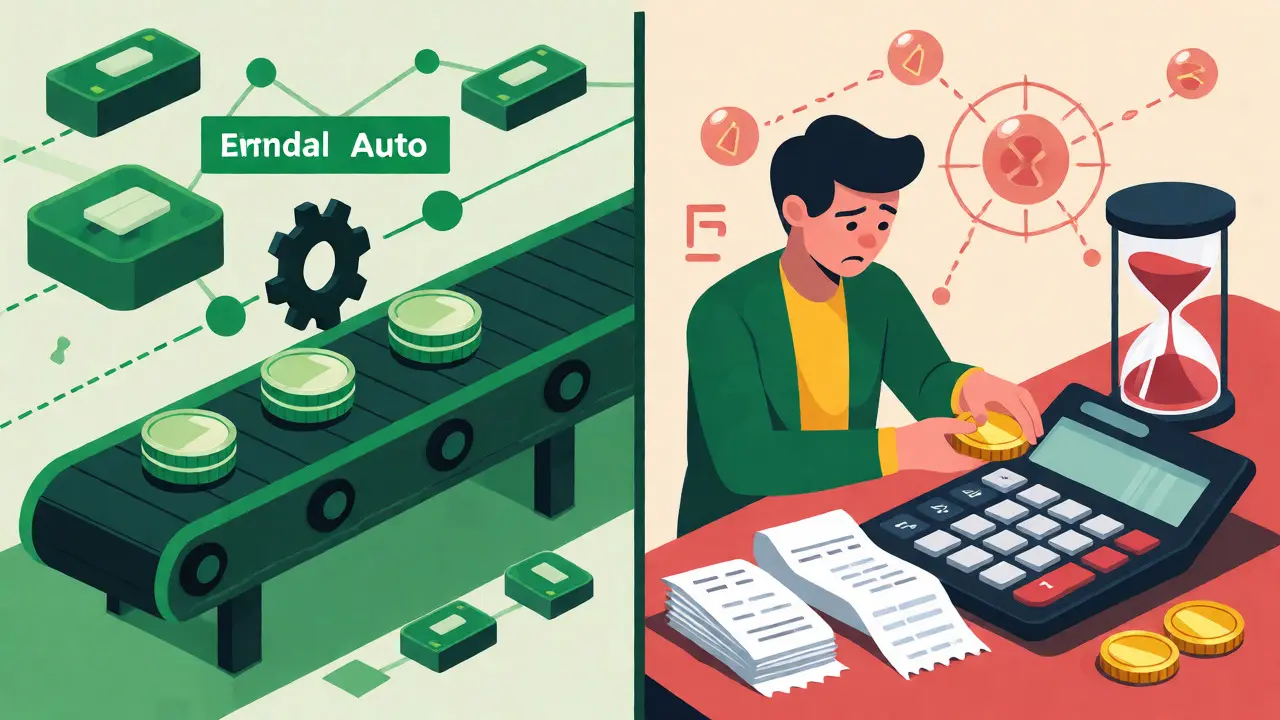
This is where the rubber meets the road for most Indian users. While exchanges automatically deduct 1% Tax Deducted at Source (TDS) on transactions over ₹50,000, non-custodial wallets do not. If you swap ETH for USDT inside MetaMask, no one stops you. No tax is deducted instantly. Does that mean you’re free? Absolutely not.
You still owe that 1% TDS. And because the transaction happened on-chain without a fiat gateway, tracking it becomes a manual chore. A survey by Koinly in October 2025 found that 44.8% of non-custodial users miscalculate their TDS when moving assets between wallets. Why? Because determining the exact value of the asset at the moment of transfer can be tricky if you’re using a decentralized exchange (DEX) with fluctuating liquidity pools.
- Manual Tracking: You must log every trade date, time, and INR equivalent value.
- Payment Deadline: TDS must be paid to the government by the 7th of the following month.
- Penalties: Failure to deposit TDS attracts interest and penalties under the Income Tax Act.
Many users migrate to hardware wallets to avoid exchange freezes, only to realize they’ve traded convenience for administrative burden. Tools like BitcoinTaxes.in have become essential for 28.7% of self-custody holders to automate this reporting.
Google Play and App Store Policies: A Safe Haven?
There was panic in late 2025 when Google updated its policy for financial apps. Many feared crypto apps would be delisted unless they had specific licenses. However, Google clarified on X (formerly Twitter) that non-custodial wallets are explicitly exempt from these new licensing requirements. This was a huge win for the community.
Unlike custodial services that hold your funds and thus require robust consumer protection laws, non-custodial apps are viewed more like browsers or calculators. They provide access to the network, not custody of the asset. This distinction aligns with global standards, such as the EU’s MiCA framework, which also exempts non-custodial providers from certain licensing burdens. For now, you can download Trust Wallet or Exodus without worrying about them vanishing from your app store due to regulatory pressure.

The User Experience Gap
Despite the regulatory clarity improving slightly, the user experience for non-custodial wallets in India remains rough. One major pain point is the lack of native INR integration. Only three out of ten major non-custodial wallets support direct UPI payments. Most require you to buy crypto on an exchange first, then withdraw it to your wallet. This adds friction and exposes you to withdrawal fees.
Security is another double-edged sword. After the massive WazirX hack in July 2024, which lost $230 million worth of assets, over 1.2 million Indians migrated to cold storage. They felt safer knowing no CEO could freeze their account. Yet, this security comes with responsibility. If you lose your seed phrase, your money is gone forever. There is no "Forgot Password" button in DeFi. Support tickets for Trust Wallet India show that 31.5% of issues stem from insufficient gas fee estimation, leading to stuck transactions. It’s a steep learning curve-studies suggest it takes 8-12 weeks for a novice to feel comfortable managing self-custody effectively.
What’s Next: The Draft Amendment Hope
Is there light at the end of the tunnel? Possibly. The Ministry of Finance released a draft amendment in October 2025 stating that "non-custodial wallet providers not facilitating fiat conversion shall not be classified as VASPs." If finalized, this would legally cement the exemption for pure self-custody tools. It would mean that while you still pay taxes, the wallet developer doesn’t need to run a full-fledged compliance department in India.
Industry analysts predict 68.3% compliance among providers by early 2026 if this passes. Until then, stay cautious. Keep meticulous records. Use reputable tax software. And remember, while the government hasn’t banned your wallet, they haven’t made it easy to use either. The best strategy right now is to treat self-custody as a long-term holding solution, not a quick-trading platform, until the tax rules for DEX trades become clearer.
Are non-custodial wallets banned in India?
No, they are not banned. As of late 2025, non-custodial wallets remain fully operational. The confusion stems from regulatory ambiguity regarding whether they qualify as Virtual Digital Asset Service Providers (VASPs), but there is no legal prohibition on using them.
Do I need to pay TDS on transactions made via non-custodial wallets?
Yes. Even though the wallet doesn't automatically deduct 1% TDS like an exchange does, you are legally required to calculate and deposit this tax yourself if the transaction value exceeds the specified threshold. Failure to do so results in penalties.
Can banks block transfers to non-custodial wallets?
Banks generally do not block transfers to external wallets directly since the transaction happens on the blockchain. However, they may scrutinize large inflows/outflows related to crypto activity. Using P2P platforms to convert INR to crypto before sending to a non-custodial wallet is a common workaround to maintain banking compatibility.
Which non-custodial wallets are popular in India?
Hardware wallets like Ledger Nano S Plus and Trezor are highly popular for long-term storage. Software options include MetaMask, Trust Wallet, and Exodus. These apps allow users to manage multiple cryptocurrencies and interact with decentralized applications (dApps).
How do I prove ownership of crypto in a non-custodial wallet for tax purposes?
You need to maintain a detailed transaction history exported from your wallet software. Additionally, linking your wallet address to a verified exchange account can help establish a trail. Specialized tax tools can generate reports that satisfy Indian income tax authorities' requirements for auditable trails.
Leave a comments