Imagine trying to win a lottery where you have to buy billions of tickets every second, but the prize money is fixed. That is essentially what Bitcoin mining looks like today. At the heart of this massive computational race are two technical concepts that often confuse newcomers: the nonce range and mining difficulty. These aren't just random numbers; they are the mathematical locks that keep your digital wallet secure and ensure no one can double-spend their coins.
If you've ever wondered why miners need expensive hardware or how the network stays stable despite thousands of people trying to hack it, the answer lies in how these two elements interact. The nonce is the variable you change, and the difficulty is the target you must hit. Together, they create a system that is simple in theory but incredibly hard to break.
What Is a Nonce in Bitcoin?
To understand the nonce, we first need to look at the structure of a Bitcoin block. Every block has a "header," which acts like an ID card for that chunk of data. Inside this header is a small field called the nonce. The word nonce comes from the phrase "number used once." In cryptography, it’s a value that changes with every attempt to solve a puzzle.
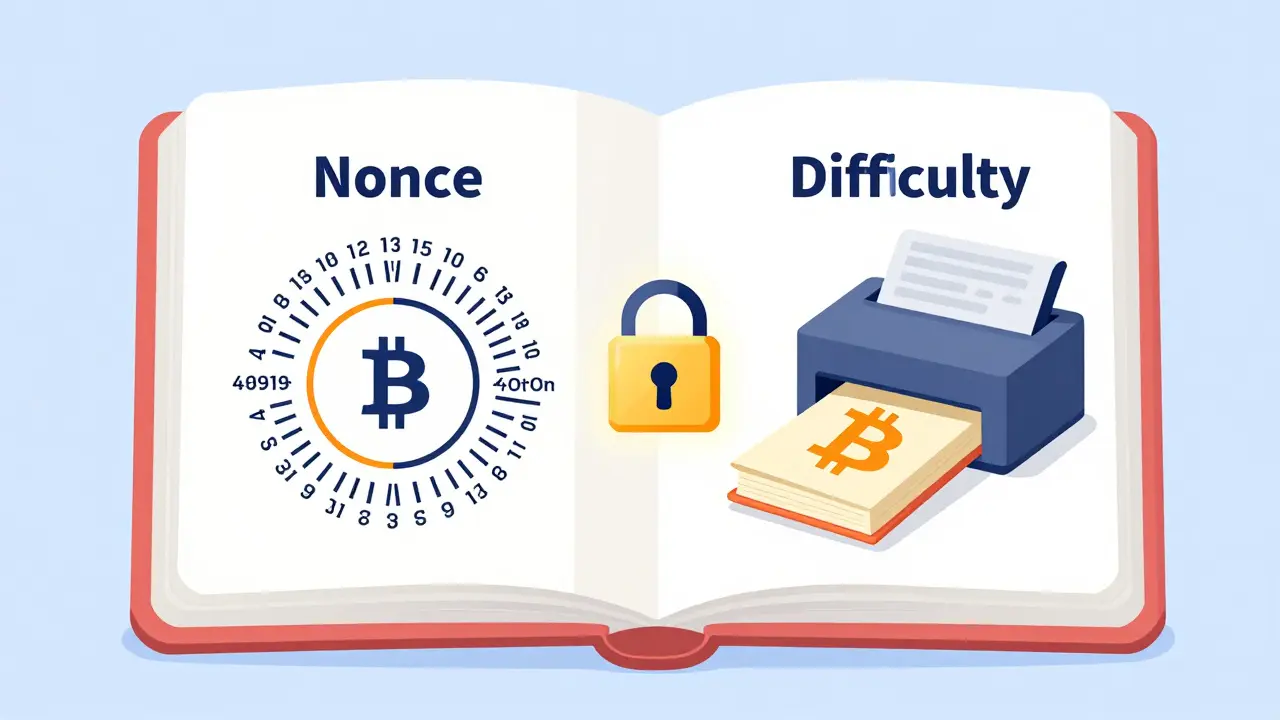
The Bitcoin Nonce is a 32-bit integer field within the block header that miners alter to find a valid hash below the network's difficulty target. It allows for exactly 4,294,967,296 (2^32) possible values.Here is the catch: the nonce is limited to 32 bits. This means there are only about 4.3 billion unique combinations available for any single block template. In the early days of Bitcoin, when mining could be done on a home laptop, this was plenty. A computer could cycle through all 4.3 billion possibilities in minutes. But today? Modern ASIC miners process trillions of hashes per second. They exhaust the entire 32-bit nonce space in milliseconds.
So, if the nonce runs out, does the miner stop? No. That’s where the cleverness of Bitcoin’s design comes in. When the primary nonce hits its limit, miners use a workaround called the "extra nonce." This is stored in the coinbase transaction-the special transaction that rewards the miner. By changing the extra nonce, the miner effectively creates a new block template, resetting the primary nonce counter to zero and starting the search again. It’s like finishing page 100 of a book, realizing you missed a clue, and then photocopying the book with a slightly different cover to start over.
Understanding Mining Difficulty
If the nonce is the key you try, mining difficulty is the lock. Bitcoin doesn’t just want *any* hash; it wants a hash that starts with a specific number of zeros. The more zeros required, the harder the puzzle. This requirement is defined by a "target" value. Your calculated hash must be numerically lower than this target to be accepted by the network.
Think of it like guessing a number between 1 and 1 million. If I say the number is less than 500,000, you have a 50% chance of getting it right on the first try. If I say it’s less than 1, your odds drop to 1 in a million. As more people join the game (hash rate increases), Bitcoin makes the rule stricter. Instead of "less than 500,000," it might become "less than 10." This adjustment is the mining difficulty.
Bitcoin adjusts this difficulty automatically every 2,016 blocks, which takes roughly two weeks. The goal is always the same: maintain an average block time of 10 minutes. If blocks are being found too quickly because too many miners joined the network, the difficulty goes up. If miners leave, the difficulty drops. This self-regulating mechanism is what keeps Bitcoin predictable and secure, regardless of how much computing power is thrown at it.
| Protocol | Nonce Size | Block Time | Consensus Type |
|---|---|---|---|
| Bitcoin | 32-bit (Primary) + Extra Nonce | ~10 Minutes | Proof-of-Work (SHA-256) |
| Ethereum (Legacy) | 64-bit | ~12 Seconds | Proof-of-Stake (Post-Merge) |
| Litecoin | 32-bit | ~2.5 Minutes | Proof-of-Work (Scrypt) |
| Kaspa | 64-bit | ~1 Second | Proof-of-Work (kHeavyHash) |
The Race Against Time: Nonce Exhaustion
Let’s talk about what happens when you run out of nonces. Because the primary nonce is only 32 bits, modern miners hit the ceiling almost instantly. According to data from major mining pools, high-end ASICs like the Bitmain Antminer S19 XP can cycle through all 4.3 billion nonce values in under 30 milliseconds.
When this happens, the miner must rebuild the Merkle tree. The Merkle tree is a cryptographic structure that summarizes all transactions in the block. Changing the extra nonce changes the coinbase transaction, which changes the Merkle root, which changes the block header. This whole process takes time-roughly 0.8 to 1.2 milliseconds per rotation. While that sounds fast, it adds up. If you’re doing this millions of times a second, those milliseconds represent wasted energy and lost potential hashing power.
This is why solo mining is practically dead for individuals. Back in 2016, a dedicated miner had a slim chance of finding a block alone. Today, with the network hash rate hovering around 600 exahashes per second (EH/s), an individual miner would wait thousands of years to find a single block. The nonce space is so crowded that even large mining farms struggle to stay efficient without sophisticated software that pre-computes Merkle roots to minimize downtime during nonce resets.
Why Does Bitcoin Keep the 32-Bit Limit?
You might wonder: why not just make the nonce bigger? Why stick with a 32-bit limit when 64-bit or larger fields are easy to implement? Some newer cryptocurrencies, like Kaspa, use larger nonces to handle higher block rates. But Bitcoin developers, including core contributors like Pieter Wuille, argue that the 32-bit limit is actually a security feature.
A smaller nonce forces miners to frequently rebuild the Merkle tree. This constant rebuilding introduces additional entropy (randomness) into the system. It prevents specialized hardware from optimizing the hashing process too efficiently, making it harder for attackers to predict or manipulate the outcome. It’s a deliberate trade-off: slightly lower efficiency in exchange for higher resistance against pre-computation attacks.
Furthermore, simplicity is king in Bitcoin. Adding complexity to the consensus layer invites bugs and vulnerabilities. The current system has worked flawlessly for over 15 years. As long as the extra nonce mechanism holds up, there is little incentive to risk breaking the protocol for a marginal gain in speed.
Real-World Impact on Miners
For the average person looking into mining, understanding nonce exhaustion is crucial. Many beginners buy a miner, plug it in, and expect immediate profits. They don’t realize that improper nonce management can waste significant hash rate. Educational platforms report that nearly 70% of new miners lose over 20% of their potential earnings during setup due to inefficient software configurations.
Mining pools help mitigate this by distributing work efficiently. They assign ranges of nonces to different workers, ensuring that no two machines are checking the same values. However, even pools face challenges. When difficulty spikes occur-such as after a halving event when older, less efficient miners shut down-the remaining miners must adjust rapidly. During the 2020 halving, some miners reported exhausting their primary nonce space in under 10 seconds, forcing rapid extra nonce rotations that strained their equipment.
Energy consumption is another factor. Rebuilding Merkle trees repeatedly consumes electricity. With regulatory pressure mounting globally, efficiency matters more than ever. Miners who optimize their firmware to reduce header rebuild times can save significant costs. For example, custom firmware solutions have been shown to improve nonce utilization efficiency to over 99%, turning a potential bottleneck into a streamlined process.
Future Challenges and Quantum Threats
Looking ahead, the relationship between nonce range and difficulty faces new pressures. Hash rates continue to grow, driven by advancements in chip technology. Projections suggest the network could reach 1,000 EH/s in the coming years. At those levels, the strain on the extra nonce mechanism will intensify.
Then there’s the question of quantum computing. Could a quantum computer solve the nonce puzzle instantly? Research indicates that while quantum computers are powerful, they are not magic bullets. Solving Bitcoin’s SHA-256 proof-of-work would require a fault-tolerant quantum computer with nearly 2 billion qubits. Current technology is nowhere near that scale. So, for now, the nonce remains safe.
However, protocol upgrades are being discussed. Proposals like BIP-320 explore auxiliary proof-of-work mechanisms that could expand nonce management capabilities without altering the core consensus rules. These discussions highlight the community’s proactive approach to maintaining security as technology evolves.
Can I mine Bitcoin with my CPU?
Technically yes, but practically no. With current difficulty levels, a modern CPU like an Intel i9 would take thousands of years to find a single block. The nonce space is exhausted too quickly for CPUs to compete with ASICs.
What happens if all nonces are tried?
When the 32-bit nonce reaches its maximum value (4,294,967,295), the miner increments the "extra nonce" in the coinbase transaction. This creates a new block template, resetting the primary nonce to zero and allowing the search to continue.
How often does mining difficulty change?
Difficulty adjusts every 2,016 blocks, which occurs approximately every two weeks. The adjustment aims to keep the average block time at 10 minutes, increasing difficulty if blocks are found faster and decreasing it if they are found slower.
Why is the nonce only 32 bits?
The 32-bit limit is a deliberate design choice by Satoshi Nakamoto. It forces frequent Merkle tree rebuilds, adding entropy and security. It also keeps the protocol simple and avoids unnecessary complexity in the block header.
Does Ethereum still use nonces for mining?
No. Ethereum transitioned from Proof-of-Work to Proof-of-Stake in September 2022 (the Merge). Mining, and thus nonce-based puzzles, were eliminated entirely. Validators now secure the network by staking ETH rather than solving cryptographic puzzles.
JEVON HALL
5 06 26 / 03:26 AMhey everyone, just wanted to drop a quick note about the extra nonce thingy because its super important for anyone trying to understand why miners dont just stop when they hit 4.3 billion hashes 🤯 basically what happens is that the coinbase transaction has some empty space in it called the scriptSig and miners use that space to store an extra counter so when the main nonce runs out they change this extra number which changes the merkle root of the whole block and then they can start the main nonce over from zero again its like having a book with infinite pages but you only write on page 100 each time by changing the cover art slightly 📚✨ this allows them to keep hashing without waiting around for new blocks to be found by other people which would be super inefficient since the network moves fast now days with all these ASICs churning out hashes per second like crazy 🔥 so yeah thats why solo mining is basically dead unless you have like a data center full of S19 XP units or something similar because otherwise your chance of hitting the target before someone else does is practically zero 😅
Greg Lewis
6 06 26 / 09:54 AMthe concept of difficulty adjustment is really just a metaphor for societal pressure isnt it? we adjust our behavior to fit the mold of the collective expectation every two weeks or so its like the network is breathing in and out maintaining homeostasis through sheer computational force one wonders if the entropy generated by the merkle tree rebuilds is actually creating a form of digital consciousness or if we are just burning electricity for nothing while pretending its security the zeros at the beginning of the hash are like the silence before the storm they mean nothing yet everything at the same time 🤔
Dr Lynea LaVoy
7 06 26 / 15:24 PMI appreciate the detailed breakdown here, especially regarding the 32-bit limit. It's fascinating how a seemingly small constraint forces such complex workarounds like the extra nonce. For those who might be confused about why Bitcoin doesn't just expand the nonce field, it's worth noting that simplicity is a core tenet of Bitcoin's design philosophy. Changing the consensus rules even slightly introduces risk, and as long as the current method works securely, there is little incentive to rock the boat. The extra nonce mechanism, while adding complexity to the mining software, keeps the protocol itself clean and robust. It's a good example of engineering trade-offs where efficiency is sacrificed for stability and security.
Matthew Malone
9 06 26 / 10:19 AMTypical tech-bro nonsense about 'security' and 'entropy'. The real reason the nonce is 32 bits is because Satoshi was coding in C++ on a laptop in 2009 and didn't think ahead. Now we have these American mining farms gobbling up energy that could power entire cities just to solve a math puzzle that adds no value to society. Meanwhile, countries like China used to dominate this space until they banned it, which was probably a smart move to save their grid. We should be focusing on real infrastructure, not letting crypto bros burn coal to mine imaginary money. The 'difficulty adjustment' is just a way to keep the scam going longer.
verna kennedy
11 06 26 / 05:46 AMYou clearly don't understand the basics of cryptography if you think a 32-bit integer is a limitation rather than a feature. The extra nonce exists precisely to handle the overflow, and it has been working flawlessly for over a decade. People who complain about energy consumption usually fail to realize that the security model relies on this costliness. If it were easy to mine, the network would be vulnerable to attacks. The fact that miners have to constantly rebuild Merkle trees adds a layer of unpredictability that prevents pre-computation attacks. It's elegant design, not incompetence.
Lee Paige
13 06 26 / 00:27 AMThe narrative that Bitcoin is secure is a carefully constructed illusion maintained by powerful interests. The 'extra nonce' is not a clever workaround; it is a backdoor that allows large mining pools to coordinate and manipulate the block production rate. By controlling the majority of the hash rate, these entities can effectively censor transactions or engage in double-spending attacks despite the 'consensus' rules. The quantum threat mentioned in the article is a distraction from the immediate reality that the system is already compromised by centralization. The 32-bit limit is not about security; it is about control. Wake up.
Caitlin Donahue
13 06 26 / 04:26 AMi totally get what u r saying abt the energy usage but i think its kinda unfair to blame the tech itself lol. like sure its wasteful but thats the price of decentralization right? i mean if u want a system that no single entity controls u gotta pay for it somehow. also the part abt the merkle tree rebuilds being a security feature is pretty cool tbh. its like a forced shuffle that keeps things unpredictable. i guess ill just keep holding my coins and hoping the difficulty doesnt go up too much before the next halving 😅
Caralee Robertson
13 06 26 / 09:24 AMthx for sharing this info! i was always confused bout how the nonce worked exactly. so basically when the miner hits the max number they just change the txns in the block to make a new header? that makes sense now. its kinda crazy how fast they have to do this though. i imagine the software must be super optimized to handle all that math in milliseconds. glad i read this before buying any mining gear lol wouldnt wanna waste my money on something i dont understand.
Brad Ranks
14 06 26 / 01:28 AMThis entire discussion is missing the human element. We are talking about billions of dollars in hardware sitting in warehouses, humming away, generating heat, consuming resources, all for a digital ledger. The tragedy is not technical; it is existential. Miners are modern-day alchemists, turning electricity into gold, but the pot of gold is never reached. They exhaust the nonce, they rebuild the tree, they try again. It is a Sisyphean task performed at terahertz speeds. The frustration of a miner watching their hash rate dip during a nonce reset is palpable, a silent scream in the server room. And yet, they continue. Why? Because the lottery ticket must be bought. The drama is in the futility.
Karthikeyan S
14 06 26 / 10:13 AMur post is boring af dude 😒 nobody cares about the nonce range details unless they are actually mining. most people here just want to know if btc will go to 100k or crash to zero. ur wasting bandwidth explaining basic crypto mechanics that anyone with a brain can figure out. also ur english is kinda stiff, try using more slang or emojis to make it readable. im done reading this wall of text. bye 👋
Dinesh Pattigilli
15 06 26 / 07:44 AMOh please, spare me the simplistic explanation. The nonce exhaustion issue is trivial for anyone who understands computer architecture. The real bottleneck is the memory bandwidth required to update the merkle tree, not the nonce size itself. Your comparison to Kaspa is laughable because Kaspa uses a different algorithm entirely (kHeavyHash) which is memory-hard, making it resistant to ASICs in a different way. Bitcoin's SHA-256 is optimized for parallel processing, and the 32-bit nonce is a relic that works fine because of the extra nonce hack. You're confusing correlation with causation. Typical amateur analysis.
Madhu Menon
16 06 26 / 15:50 PMIn the grand tapestry of existence, the nonce is but a fleeting moment of choice. Each increment is a decision, a path taken among billions of possibilities. The miner, in their relentless pursuit of the hash, mirrors the human condition: searching for meaning in a universe that offers no guarantees. The difficulty adjustment is nature's way of balancing the scales, ensuring that no one individual can dominate the truth. Perhaps the true security lies not in the mathematics, but in the collective faith of those who believe in the chain. 🌌
Kelly Tenney
16 06 26 / 20:14 PMGreat summary! I think it's really important for newcomers to understand that mining isn't just about luck; it's about efficiency and scale. The extra nonce mechanism is a brilliant piece of engineering that allows the network to scale without changing the core protocol. Keep learning and stay curious!