Remember the rush of clicking "Claim" on a free crypto giveaway? For many users who participated in the PolkaWar airdrop campaign hosted by CoinMarketCap, that moment felt like finding money on the street. But fast forward to late 2026, and the story has taken a sharp turn. The initial excitement has faded into a landscape of low trading volumes, massive price depreciation, and questions about long-term viability. If you are digging up old wallets or just curious about what happened to this once-promising GameFi project, you need more than just the headline news. You need the hard data.
This guide breaks down exactly what the PolkaWar airdrop was, how the token performed since then, and whether the project still holds any relevance in today's saturated blockchain gaming market. We will look at the technical specs, the harsh reality of its current market cap, and the specific mechanics that defined its early days. No fluff, just the facts you need to understand where PWAR stands right now.
What Was the PolkaWar CoinMarketCap Airdrop?
The airdrop wasn't just a random giveaway; it was a strategic marketing push during a period when cryptocurrency markets were expanding rapidly. CoinMarketCap, acting as a major aggregator for digital asset data, partnered with PolkaWar to distribute tokens to their user base. The goal was simple: boost visibility and engage retail investors who might otherwise ignore a new entry in the crowded GameFi sector.
Participants could win up to 75 PWAR tokens each. While 75 tokens sounds small compared to some modern airdrops worth thousands of dollars, the context matters. At the time, the total value of the campaign was estimated around $30,000. This was part of a broader trend where exchanges and data platforms used airdrops to onboard users onto specific blockchains. For PolkaWar, which launched primarily on the Binance Smart Chain (BSC), this was a way to leverage BSC's low fees and fast transaction times to attract a global audience without breaking the bank on gas fees.
| Feature | Detail |
|---|---|
| Total Campaign Value | $30,000 USD |
| Max Reward Per User | 75 PWAR Tokens |
| Host Platform | CoinMarketCap |
| Target Blockchain | Binance Smart Chain (BSC) |
| Primary Goal | User Engagement & Brand Awareness |
If you held onto those tokens from day one, you likely watched them ride a rollercoaster. The all-time high hit nearly $1.20 per token. Today, as of November 2026, the price hovers around $0.00204. That is a decline of over 99%. It serves as a stark reminder that promotional hype does not equal sustainable value.
Inside the PolkaWar Ecosystem: More Than Just a Token
To understand why people bought PWAR in the first place, you have to look at what they were actually buying into. PolkaWar is a cross-chain decentralized fighting game that integrates Non-Fungible Tokens (NFTs) with competitive gameplay. Unlike passive yield farming projects, PolkaWar aimed to create an active economy where players earned through skill and strategy rather than just staking.
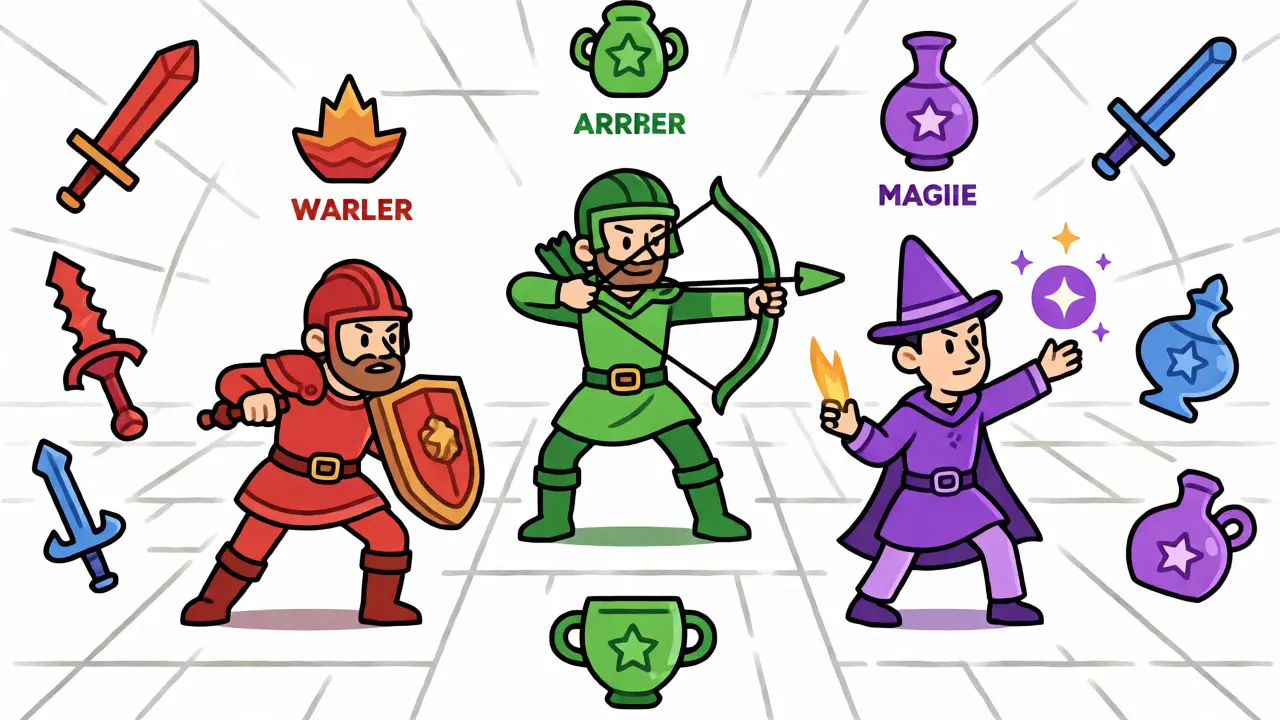
The game features three distinct character classes, each with unique combat styles:
- Warrior: High defense and melee damage, ideal for close-quarters combat.
- Archer: Ranged attacks with high mobility, suited for kiting enemies.
- Magician: Area-of-effect spells and crowd control, powerful but fragile.
Players equip these characters with various weapons, including Swords, Big Knives, Bows, Guns, Tessens, Scepters, and Magic Vases. These items aren't just cosmetic; they are NFTs stored on the blockchain. This means if you find a rare sword, you own it outright. You can sell it on the PolkaWar NFT Marketplace or even lease it out to other players.
The ecosystem consists of three main pillars:
- PolkaWar Realm: The core game where battles happen.
- NFT Marketplace: A hub for trading equipment and characters.
- PolkaWar Logistics: A unique service offering physical replicas of digital assets. Imagine winning a virtual sword and having a high-quality metal replica shipped to your door in Wellington or anywhere else in the world. This bridge between digital ownership and physical goods was a standout feature intended to differentiate PolkaWar from competitors.
Current Market Performance and Volatility
Let's talk numbers, because the data tells a sobering story. As of mid-November 2026, PWAR trades at approximately $0.00204 USD. The 24-hour trading volume sits at roughly $40,670. In the grand scheme of crypto, this is negligible. For comparison, top-tier GameFi tokens often see millions in daily volume.
The circulating supply is about 82.82 million tokens, representing 82.82% of the maximum supply of 100 million. With such a high percentage already unlocked, there is little room for dilution shocks, but also little incentive for new buyers if the community isn't growing. The market capitalization fluctuates wildly depending on the source, ranging from $49,000 to $161,000. This discrepancy usually points to low liquidity-meaning large buy or sell orders can swing the price significantly with minimal effort.
Price trends show negative momentum. Recent 24-hour changes show drops of around 3.45%, while weekly declines hover near 6.91%. Some regional exchanges report slight positive movements, but these are often outliers caused by thin order books. The token currently ranks around #2931 on CoinMarketCap, placing it deep in the lower tiers of the crypto hierarchy.
Why Did PolkaWar Struggle Despite Early Hype?
It is easy to blame the bear market, but that is only half the story. The GameFi sector became incredibly crowded after 2021. Projects needed superior gameplay loops to survive, not just flashy tokenomics. PolkaWar faced stiff competition from established giants like Axie Infinity and newer entrants with polished AAA graphics.
Several factors contributed to the stagnation:
- Limited Adoption: Low trading volumes suggest that the player base did not scale as expected. Without a critical mass of active players, the NFT marketplace remains quiet.
- Technical Challenges: While launching on BSC offered speed, transitioning to Polkadot and other chains proved complex. Cross-chain compatibility is difficult to execute seamlessly, and delays can frustrate users.
- Market Saturation: By the time PolkaWar gained traction, investors had become skeptical of "play-to-earn" models that relied heavily on new users paying for entry costs.
The lack of recent major updates or announcements further signals reduced activity. In the fast-moving world of Web3, silence is often interpreted as abandonment. However, the project hasn't officially shut down, which keeps a small group of holders hoping for a revival.
Should You Still Consider PWAR?
If you missed the airdrop or sold early, should you jump back in? Probably not, unless you are a high-risk speculator looking for a lottery ticket. The fundamentals don't support a massive resurgence without significant development news or a viral gameplay update.
Here is a quick decision framework for potential investors:
| Pros | Cons |
|---|---|
| Low entry price ($0.002) | Extremely low trading volume |
| Unique physical NFT logistics concept | Over 99% down from All-Time High |
| Established smart contract history | Lack of recent development updates |
| High circulating supply ratio | Fierce competition in GameFi sector |
The upside is capped by the fact that most supply is already circulating. There is no "unlock" event coming to drive price action. The downside is clear: continued zero-volume trading could lead to delisting from major exchanges, making it harder to exit positions.
Final Thoughts on Legacy Airdrops
The PolkaWar story is a case study in the difference between marketing success and product longevity. The CoinMarketCap airdrop successfully put the name on the map. Thousands of users claimed their tokens. But claiming a token doesn't make you a customer. Playing the game, buying NFTs, and engaging with the community do.
For those holding PWAR today, it is a lesson in due diligence. Always ask: Does this project solve a real problem? Is the gameplay fun enough to retain users without financial incentives? In PolkaWar's case, the answers seem to be "maybe" and "not yet." Keep an eye on official channels for any signs of life, but manage your expectations accordingly.
Is the PolkaWar airdrop still active?
No, the original CoinMarketCap airdrop campaign concluded several years ago. It was a one-time promotional event. While new partnerships may offer smaller rewards, the major CMC airdrop is closed.
What is the current price of PWAR?
As of November 2026, PWAR trades at approximately $0.00204 USD. Prices vary slightly across exchanges due to low liquidity, so always check the live ticker before trading.
Where can I trade PolkaWar tokens?
PWAR is primarily traded on decentralized exchanges within the Binance Smart Chain ecosystem and listed on some centralized exchanges like Binance (regional variants). Liquidity is limited, so use limit orders to avoid slippage.
Did PolkaWar launch on Polkadot?
The project initially launched on the Binance Smart Chain (BSC) for cost efficiency. Expansion to Polkadot was planned to enhance interoperability, but full deployment and widespread adoption on Polkadot remain unclear based on recent activity levels.
Is PolkaWar a good investment in 2026?
It is considered a high-risk speculative asset. With a market cap under $200,000 and declining prices, it lacks the momentum of leading GameFi projects. Only invest capital you can afford to lose completely.
Leave a comments