Imagine you need to buy Bitcoin using a Russian bank card. You open your favorite global exchange, and it’s blocked. You try another one, and the fees eat up half your profit. This is exactly where Polyx fits into the picture. Founded in 2019 and registered in the United Kingdom, this platform has carved out a specific niche by focusing heavily on Eastern European and CIS markets. But here is the catch that keeps many users awake at night: as of mid-2026, Polyx remains unregulated by major financial authorities. That lack of oversight raises serious questions about safety, especially when we are talking about storing real money.
If you are looking for a massive selection of altcoins or advanced derivatives trading, you might want to stop reading right now. Polyx isn’t built for that. However, if you are stuck in a region with strict banking restrictions and need a straightforward way to move fiat currency into crypto without jumping through hoops, Polyx offers a solution that big players like Binance or Coinbase simply cannot match. Let’s break down whether the convenience outweighs the risk.
Who Actually Uses Polyx?
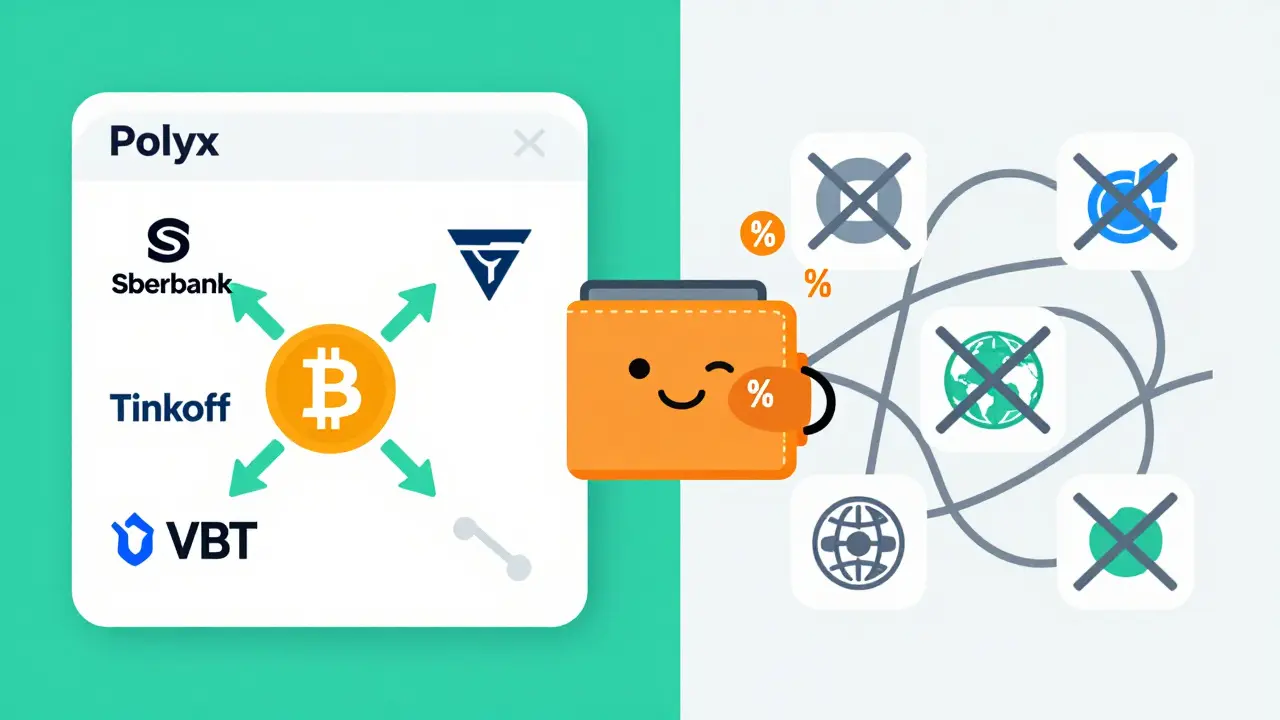
To understand Polyx, you have to look at its user base. The platform serves approximately 150,000 registered users globally, but the vast majority are concentrated in Russia and the Commonwealth of Independent States (CIS). Why? Because Polyx integrates directly with local banking giants like Sberbank, Tinkoff, VTB, Raiffeisen, and Alfa-Bank. According to a January 2026 analysis by Cointelegraph, none of the top ten global exchanges support these specific bank transfers directly. For a user in Moscow or Minsk, this integration is a game-changer. It removes the friction of third-party payment processors that often freeze transactions.
However, this regional focus comes with a trade-off. If you are based in the US, UK, or EU, Polyx is likely not for you. The platform lacks the necessary licenses to operate legally in those jurisdictions. In fact, its absence from the 2025 Chainalysis Geography of Cryptocurrency Report highlights its limited compliance footprint outside its target regions. You aren't just choosing an exchange; you are choosing a geographic ecosystem.
Fees and Supported Assets: Simple but Limited
Let's talk money. One of Polyx's biggest selling points is its fee structure. The exchange charges a flat 0.1% fee on all trades. Compare that to Coinbase, which often charges around 0.6% or more depending on your location and payment method, or Binance, where fees can vary based on volume and token holdings. For high-frequency traders, that difference adds up quickly. Polyx also launched a "Polyx Power" loyalty program in early 2026, allowing users who hold at least 1,000 PLX tokens to reduce their fees further to between 0.08% and 0.05%.
| Feature | Polyx | Binance | Coinbase |
|---|---|---|---|
| Trading Fee | 0.1% (flat) | 0.1% (maker/taker varies) | ~0.6% (standard) |
| Supported Coins | 6 major assets | 350+ tokens | 200+ tokens |
| Min Deposit (BTC) | 0.001 BTC | Varies by region | $2 - $10 |
| Regulation Status | Unregulated | Licensed in multiple jurisdictions | Licensed in 48 US states |
The downside? Variety. Polyx supports only six core cryptocurrencies: Bitcoin (BTC), Ethereum (ETH), Tron (TRX), Binance Coin (BNB), Polygon (MATIC), and its native PLX token. If you are hunting for new meme coins or obscure DeFi tokens, you will be disappointed. This limitation suggests Polyx positions itself as a utility tool for moving value rather than a speculative playground. Minimum deposits are also quite low-just 1 USDC, 50 USDT, or 0.001 BTC-making it accessible for small-scale users.
Security Risks: The Elephant in the Room
Here is where things get tricky. Security in crypto isn't just about hackers; it's about trust. Polyx claims to store 95% of user assets in cold storage according to their December 2025 security whitepaper. They also enforce mandatory two-factor authentication (2FA) for all transactions on their mobile apps, which run on Android 8.0+ and iOS 12.0+. These are good baseline practices.
But there is a critical missing piece: proof-of-reserves. Major audits by firms like CertiK in 2025 highlighted that Polyx lacks transparent, third-party verified proof-of-reserves mechanisms. Without this, you are trusting the exchange's word that they actually hold the funds you deposit. Maria Petrova, a senior analyst at Wikibit, explicitly warned in January 2025 that "Polyx's unregulated status presents significant counterparty risk." When an exchange is not regulated by bodies like the FCA or SEC, you have fewer legal recourses if something goes wrong. The Bank of Russia announced in January 2026 that domestic crypto exchanges must obtain mandatory licensing, a move that threatens Polyx's current business model since it operates without such a license in that key market.
User Experience and Performance
From a technical standpoint, Polyx is fast. SourceForge's 2025 benchmarks showed average order execution times of 1.2 seconds for market orders and 3.7 seconds for limit orders during peak traffic. That is competitive with larger platforms. The interface is standard: order books, candlestick charts, and portfolio tools. New users can register and complete basic verification in about 15 minutes.
However, the experience isn't perfect. The P2P marketplace, which uses escrow protection, is a double-edged sword. While it allows peer-to-peer trading, Wikibit found that 62% of first-time users needed external tutorial videos to navigate the dispute resolution process successfully. The app itself has stability issues; 31% of negative reviews on SourceForge mentioned crashes during P2P transactions. And then there is customer support. Trustpilot data from January 2026 shows an average response time of 58 hours for email inquiries. If you have an urgent issue with a frozen withdrawal, waiting three days for a reply is not ideal. Many users turn to Polyx's Telegram community, which has over 12,500 members, for unofficial help.
Is Polyx Worth the Risk?
So, should you use Polyx? It depends entirely on your situation. If you are in the CIS region and need to convert RUB to BTC quickly using a local bank transfer, Polyx is currently one of the most efficient options available. The low fees and direct banking integrations save you time and money compared to workarounds involving other platforms.
But if you are a beginner who values maximum security, or if you live in a regulated market like the US or EU, Polyx is probably not the right choice. The lack of regulation and proof-of-reserves means you are taking on higher risk. With regulatory pressure increasing across Eastern Europe in 2026, the platform's long-term viability is uncertain. Delphi Digital projects a 30% contraction in unregulated exchange market share by late 2026. Polyx is trying to adapt with a planned "Regulatory Compliance Module" for Q2 2026, but until that is implemented and verified, proceed with caution. Never deposit more than you can afford to lose, and consider using a hardware wallet for long-term storage rather than leaving large balances on any centralized exchange.
Is Polyx a regulated cryptocurrency exchange?
No, as of July 2026, Polyx is not regulated by major financial authorities such as the FCA, SEC, or BaFin. It is registered in the UK but operates without the specific licenses required for regulated crypto activities in most Western jurisdictions. This unregulated status increases counterparty risk for users.
What cryptocurrencies can I trade on Polyx?
Polyx supports a limited selection of six major assets: Bitcoin (BTC), Ethereum (ETH), Tron (TRX), Binance Coin (BNB), Polygon (MATIC), and its native PLX token. It does not offer a wide variety of altcoins or new listings.
How much does it cost to trade on Polyx?
Polyx charges a flat 0.1% trading fee for all transactions. Users can reduce this fee to between 0.05% and 0.08% by participating in the "Polyx Power" loyalty program, which requires holding a minimum balance of 1,000 PLX tokens.
Can I use Russian bank cards on Polyx?
Yes, Polyx specializes in supporting Russian banking institutions, including Sberbank, Tinkoff, VTB, Raiffeisen, and Alfa-Bank. This makes it a popular choice for users in Russia and the CIS region who face restrictions on global exchanges.
Is my money safe on Polyx?
While Polyx uses cold storage for 95% of assets and enforces 2FA, it lacks third-party proof-of-reserves audits. Combined with its unregulated status, this presents higher security risks compared to licensed exchanges. Users should exercise caution and avoid storing large long-term balances on the platform.
Why do some users complain about Polyx withdrawals?
User feedback on Trustpilot indicates that withdrawal delays exceeding 72 hours are a common complaint, particularly during high-volume periods. Additionally, customer support response times average around 58 hours, which can exacerbate frustration when issues arise.
Leave a comments