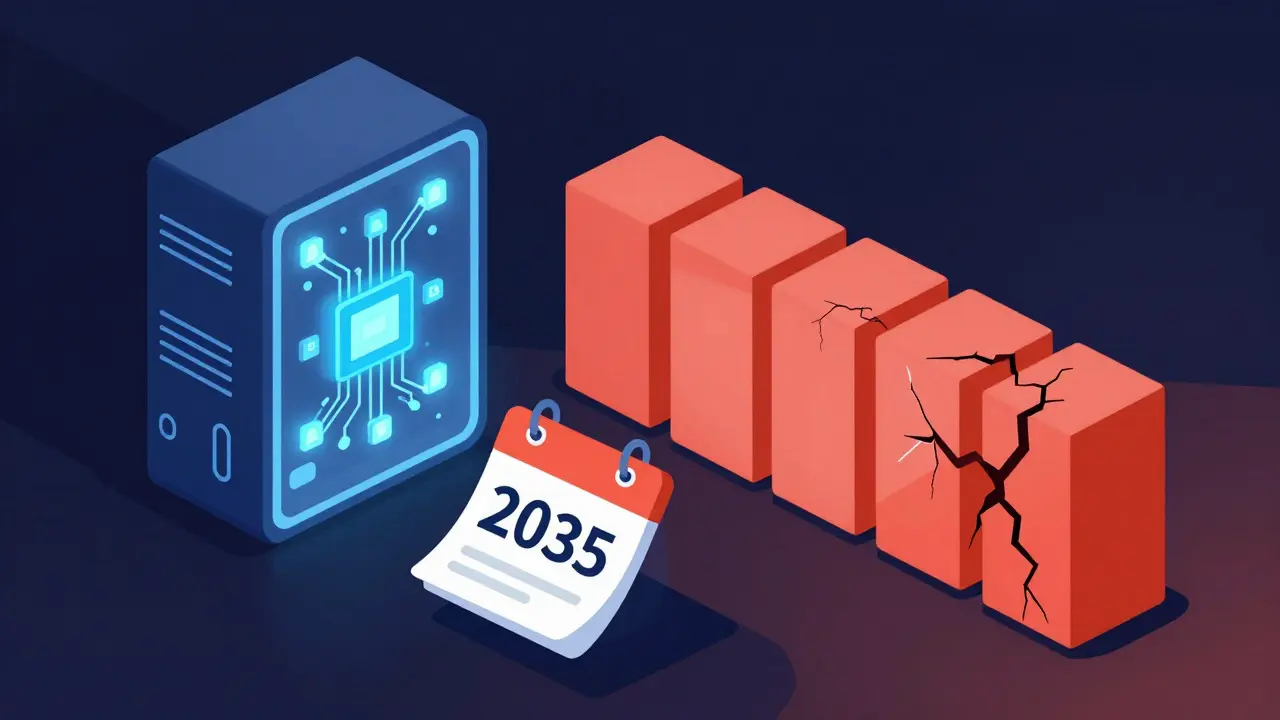
Imagine waking up in 2034 to find that every Bitcoin address you’ve ever held is suddenly accessible to anyone with a powerful enough quantum computer. It sounds like science fiction, but for cryptographers and security experts, it’s a ticking clock. Quantum computers don’t just threaten your bank PIN; they threaten the very foundation of digital trust. Traditional encryption methods like RSA and ECDSA, which secure most blockchains today, rely on math problems that are hard for classical computers but trivial for quantum ones. This isn't a hypothetical future risk anymore-it's an engineering challenge we are solving right now.
The race to build quantum-safe blockchain projects is no longer niche. It’s becoming urgent. With NIST finalizing its post-quantum cryptography (PQC) standards and tech giants like Microsoft setting migration deadlines before 2035, the industry is scrambling to adapt. But not all solutions are created equal. Some projects are built from scratch to resist quantum attacks, while others are retrofitting existing networks. Understanding these differences is critical if you want to know where your assets-and the data you store-will be safe in the coming decade.
Why Current Blockchains Are Vulnerable
To understand why we need new systems, we first have to look at why the old ones are breaking. Most major cryptocurrencies, including Bitcoin and Ethereum, use Elliptic Curve Digital Signature Algorithm (ECDSA) or similar public-key cryptography. These algorithms work by creating a pair of keys: a private key you keep secret and a public key that acts as your address. The security relies on the fact that deriving the private key from the public key is computationally impossible for classical computers.
Quantum computers change this equation entirely. Using Shor’s algorithm, a sufficiently powerful quantum computer could reverse-engineer your private key from your public address in minutes. While current quantum hardware isn’t there yet, the "store now, decrypt later" threat is real. Attackers can harvest encrypted data or public addresses today and wait until quantum technology matures to crack them. Since blockchain data is immutable and permanent, any transaction recorded today remains vulnerable forever unless protected by quantum-resistant signatures.
This vulnerability isn't just theoretical. In August 2025, Microsoft explicitly warned that "future scalable quantum computing could break public-key cryptography methods currently in use." They aren't alone. Governments worldwide are setting 2035 as a deadline for full transition to post-quantum standards. If your blockchain doesn't upgrade by then, it becomes obsolete-not because it stops working, but because it stops being trusted.
The Two Paths to Quantum Resistance
When looking at post-quantum cryptography implementations in blockchain, developers generally take one of two paths. The first is building a purpose-built network designed exclusively for quantum resistance. The second is creating migration layers or hybrid architectures that allow existing ecosystems to adopt PQC without starting over.
Purpose-built chains offer clean slate advantages. They don’t have legacy code debt or backward compatibility constraints. However, they often struggle with adoption because users have to learn new wallets, new interfaces, and sometimes even new programming languages. On the other hand, migration paths preserve ecosystem value but introduce complexity. How do you upgrade a decentralized network of thousands of nodes without causing a fork? How do you ensure that old transactions remain valid while new ones are quantum-proof?
This tension defines the current landscape. You’ll see projects choosing sides based on their target audience. Institutional players often prefer hybrid models that integrate with compliance frameworks, while crypto-native communities lean toward dedicated quantum-resistant coins. Let’s look at who’s leading the charge in each category.
Project Spotlight: QRL and Project Zond
Quantum Resistant Ledger (QRL) is one of the few cryptocurrencies designed from scratch to be quantum-proof. Unlike projects that bolt on security later, QRL was born with XMSS (eXtended Merkle Signature Scheme) at its core. XMSS is a hash-based signature scheme endorsed by NIST for post-quantum cryptography. It’s stateful, meaning it requires careful management of signature states, but it’s mathematically robust against quantum attacks.
QRL’s approach is pure but comes with trade-offs. Hash-based signatures like XMSS can produce large signature sizes compared to lattice-based alternatives, impacting storage and bandwidth. More importantly, QRL operates as a standalone chain. If you want quantum safety here, you leave the broader Ethereum or Bitcoin ecosystems behind. For some, that’s a price worth paying for guaranteed security. For others, it’s too isolating.
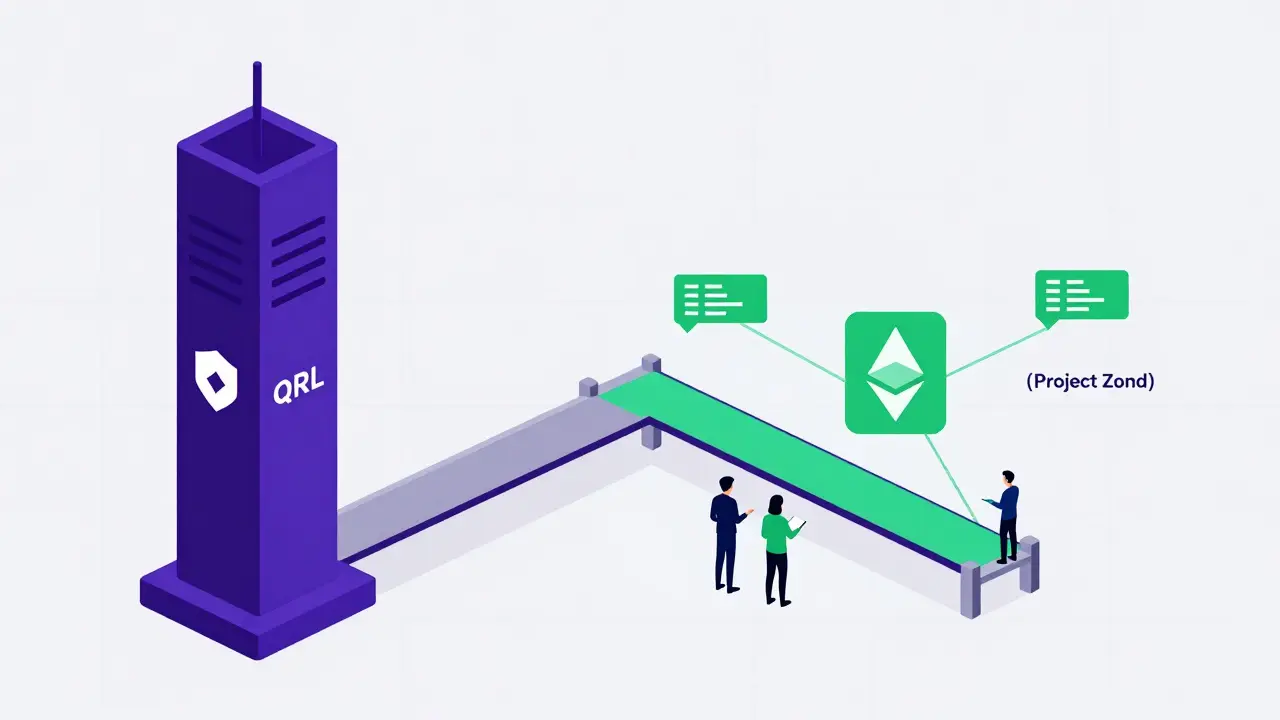
Enter Project Zond is a quantum-resistant layer that maintains Ethereum compatibility through its Zond Virtual Machine (ZVM). Unveiled at ETHDenver 2025, Project Zond aims to solve the adoption problem. It allows developers to write smart contracts using familiar Solidity tools while automatically upgrading cryptographic primitives to be quantum-safe. The ZVM mimics the Ethereum Virtual Machine (EVM), so existing dApps can migrate with minimal code changes.
This hybrid strategy is clever. It keeps the liquidity and developer talent of Ethereum while addressing the quantum threat. Ryan Malinowski, Director of Marketing at QRL, noted during ETHDenver 2025 that conversations around quantum threats were more advanced than expected, signaling growing awareness among traditional finance professionals. Project Zond bridges that gap, offering a path for Ethereum users to stay in their ecosystem while securing their future.
Enterprise Focus: Diamante’s Hybrid Architecture
While QRL and Project Zond cater largely to public blockchain users, Diamante is a permissioned blockchain platform providing enterprise-grade security reinforced by quantum-resistant cryptography. Diamante targets institutions-banks, governments, supply chain operators-who need compliance, privacy controls, and auditability alongside quantum safety.
Diamante uses NIST-standardized algorithms directly at its base layer: CRYSTALS-Kyber for key encapsulation and CRYSTALS-Dilithium for digital signatures. By integrating these from day one, Diamante avoids the technical debt of retrofitting. Their architecture supports both permissioned and trustless interactions, allowing enterprises to share data securely without exposing sensitive information to quantum threats.
However, enterprise solutions come with costs. Lattice-based algorithms like Dilithium produce signatures several kilobytes in size, compared to hundreds of bytes for ECDSA. This impacts transaction throughput and storage requirements. Diamante acknowledges this overhead but argues that for high-value institutional transactions, security outweighs speed. Their 2025 guide emphasizes that "native PQC integration eliminates migration complexity," a compelling argument for organizations tired of patching legacy systems.
| Project | Cryptographic Method | Primary Use Case | Ecosystem Compatibility | Key Challenge |
|---|---|---|---|---|
| QRL | XMSS (Hash-based) | Public Cryptocurrency | Standalone Chain | Stateful signature management |
| Project Zond | Lattice-based (via ZVM) | Ethereum Migration | EVM Compatible | Performance overhead vs EVM |
| Diamante | Kyber/Dilithium (NIST Std) | Enterprise/Private | Permissioned/Hybrid | Larger signature sizes |
The Infrastructure Layer: Open Quantum Safe
You can’t talk about quantum-safe blockchains without mentioning the engine room: Open Quantum Safe (OQS) is an open-source project providing liboqs, a library for quantum-resistant cryptographic algorithms. Supported by the Linux Foundation’s Post-Quantum Cryptography Alliance, OQS doesn’t build a blockchain itself. Instead, it provides the tools that blockchain builders use.
liboqs integrates into OpenSSL, the backbone of internet security. When Microsoft announced its plan to integrate ML-KEM and ML-DSA (the standardized names for Kyber and Dilithium) into Windows cryptography APIs, they relied heavily on OQS infrastructure. As of October 2025, the OQS GitHub repository had over 1,200 stars, indicating strong developer interest. This project is crucial because it democratizes access to PQC. Without libraries like liboqs, every blockchain team would have to reinvent the wheel, leading to fragmented and potentially insecure implementations.
For developers, OQS offers a testing ground. You can prototype quantum-resistant features before committing to a full production rollout. This reduces risk and accelerates innovation. It’s the unsung hero of the quantum-safe movement, ensuring that when the quantum threat arrives, the cryptographic foundations are already laid.

Implementation Challenges and Trade-offs
Adopting quantum-safe cryptography isn’t just a swap of algorithms. It introduces significant performance and usability hurdles. First, there’s the size issue. Post-quantum signatures are bulky. A Dilithium signature can be 5-10 times larger than an ECDSA signature. On a blockchain where every byte costs gas fees or storage space, this bloat matters. Transactions become slower, blocks fill up faster, and scalability suffers.
Second, there’s the learning curve. Developers accustomed to elliptic curves must now understand lattice mathematics or hash-based trees. Tools need updating. Wallets need new UIs to handle different key formats. Exchanges must support new deposit addresses. This ecosystem-wide coordination is difficult. As Diamante notes, "backward compatibility with classical blockchain systems requires careful design." You can’t just flip a switch.
Third, there’s the timing dilemma. How early is too early? Implementing PQC now means accepting lower performance for years before quantum computers actually pose a threat. Waiting too long risks obsolescence. Microsoft’s phased approach offers a blueprint: start with foundational components, move to core infrastructure, then extend to endpoints. Target full transition by 2033, ahead of government mandates. This staggered method balances urgency with practicality.
What Should You Do Now?
If you’re holding cryptocurrency, panic isn’t the answer. Current quantum computers cannot break Bitcoin or Ethereum today. But awareness is. Start by diversifying. Don’t keep all your assets on networks with no clear quantum migration plan. Watch for announcements from major platforms regarding PQC integration. Ethereum’s roadmap includes testing cryptographic upgrades, and Bitcoin research groups are exploring Schnorr signatures as a stepping stone.
For developers, experiment with OQS libraries. Try deploying a simple contract on Project Zond’s testnet. Understand how lattice-based signatures behave under load. Build familiarity now so you’re ready when production demands shift. For enterprises, evaluate hybrid solutions like Diamante that offer compliance and security without requiring a complete rebuild.
The quantum threat is distant but inevitable. The projects discussed here-QRL, Project Zond, Diamante, and the underlying OQS infrastructure-are laying the groundwork. They represent different strategies for the same goal: preserving trust in a post-quantum world. Your job is to stay informed, assess your risk tolerance, and prepare for a future where cryptography evolves faster than ever.
Will quantum computers hack my Bitcoin wallet soon?
Not immediately. Current quantum computers lack the qubit stability and count needed to run Shor’s algorithm effectively against Bitcoin’s ECDSA keys. Experts estimate cryptographically relevant quantum computers are 10-15 years away. However, the "store now, decrypt later" threat means data exposed today could be compromised tomorrow. Migration to quantum-resistant standards is essential for long-term security.
What is the difference between XMSS and Lattice-based cryptography?
XMSS is a hash-based signature scheme used by QRL. It’s stateful, meaning you must track which signatures have been used, but it’s highly secure and relies only on hash functions. Lattice-based cryptography (like Dilithium/Kyber) is stateless and produces larger keys/signatures. It’s more flexible for general-purpose use and is the basis for NIST’s selected standards. Both are quantum-resistant but have different performance and implementation profiles.
Is Project Zond a fork of Ethereum?
No, Project Zond is not a fork. It’s a separate layer or virtual machine (ZVM) designed to be compatible with the Ethereum Virtual Machine (EVM). This allows developers to port existing Ethereum smart contracts to Zond with minimal changes, gaining quantum resistance without leaving the Ethereum tooling ecosystem. It facilitates migration rather than replacement.
Why do quantum-safe signatures take up more space?
Post-quantum algorithms rely on mathematical structures that require more data to represent securely. For example, lattice-based signatures involve large matrices and vectors, resulting in kilobyte-sized outputs compared to the compact elliptic curve points. This increased size impacts blockchain storage, bandwidth, and transaction fees, necessitating optimizations in consensus mechanisms and data compression.
How does Microsoft fit into the quantum-safe blockchain narrative?
Microsoft is driving enterprise adoption of post-quantum cryptography. By integrating NIST-standardized algorithms into Windows APIs and Azure services, they set a precedent for cloud infrastructure. Their contribution to the Open Quantum Safe project helps standardize tools that blockchain developers use. Microsoft’s timeline targeting full transition by 2033 pressures the entire industry, including blockchain, to accelerate PQC implementation.
Barclay Chantel
3 06 26 / 01:34 AMOh, please. Another article hyping up the inevitable doom of Bitcoin while ignoring that quantum computers are still in their infancy and likely will be for decades. The real issue isn't whether we can build a quantum-resistant chain; it's whether these new projects have any actual utility or if they're just cash grabs riding on fear-mongering. QRL has been around forever with zero adoption because nobody wants to use a standalone chain that isolates them from the ecosystem. It’s pretentious nonsense.
mark valmart
4 06 26 / 17:26 PMi mean honestly this is kinda scary but also makes sense right like if your keys get cracked then bye bye money lol
saradee dee
5 06 26 / 11:02 AMIt really is quite dramatic when you think about it! I was so worried reading this, my heart was racing. But then I realized that maybe we don't need to panic yet. The experts say 10-15 years, which feels like forever away. Still, it’s nice to know people are working on solutions like Project Zond. It gives me hope that our digital lives won’t just vanish into thin air. We should all stay calm and supportive of these efforts!
Bill Gunn
6 06 26 / 04:03 AMHey folks! 👋 Great discussion here. I’ve been diving deep into the Open Quantum Safe (OQS) library lately, and it’s fascinating how they’re standardizing these algorithms. 🚀 The fact that Microsoft is pushing for integration by 2033 is a huge signal. If you’re a dev, definitely check out liboqs. It’s not just hype; it’s the bedrock of future security. Don’t sleep on this! 💪✨
Crystal Davis
6 06 26 / 21:55 PMYou’re all missing the point. The problem isn’t just the cryptography; it’s the bloat. Dilithium signatures are kilobytes in size. Do you realize what that does to transaction throughput? You’re trading security for scalability, and in crypto, scalability is king. These enterprise solutions like Diamante are fine for banks who don’t care about speed, but for public chains? It’s a death sentence for usability. Stop pretending this is a seamless upgrade.
Joshua Alcover
7 06 26 / 05:26 AMThe epistemological framework of post-quantum cryptography necessitates a rigorous adherence to NIST standards, particularly ML-KEM and ML-DSA, as these constitute the foundational axioms of secure digital interaction in the post-classical era. To suggest otherwise is to engage in intellectual laziness. The migration path must be deterministic and devoid of ambiguity, ensuring that the sovereign integrity of data remains uncompromised by external quantum threats. This is not merely a technical adjustment but a philosophical imperative for the preservation of truth in decentralized systems.
Diana Morris
9 06 26 / 00:44 AMstop overthinking it just move to zond or whatever its called and be done with it no one cares about the math behind it as long as it works
Hadleigh Edwards
9 06 26 / 22:57 PMI have to say, looking at the broader picture, the transition to quantum-safe blockchains represents a monumental shift in how we perceive digital trust, and while the immediate threat may seem distant, the preparatory steps we take now will define the security landscape for generations to come, especially considering the complex interplay between legacy systems and emerging technologies, which requires a nuanced approach that balances innovation with stability, and ultimately, the goal should be to create a resilient infrastructure that can withstand not only quantum attacks but also the evolving nature of cyber threats, thereby ensuring that the value stored within these networks remains protected against all forms of computational advancement, which is why I believe that early adopters who understand the importance of hybrid architectures like those proposed by Project Zond will find themselves in a much stronger position when the full weight of quantum computing capabilities finally arrives on the scene, making it crucial for everyone involved to stay informed and proactive rather than reactive.
Miss Masquer
10 06 26 / 14:09 PMAs someone who follows tech trends closely, I find the comparison between QRL and Project Zond particularly interesting because it highlights the tension between purity and practicality in software development, and while I appreciate the clean slate approach of QRL with its XMSS signatures, I cannot help but feel that the isolation it creates is a significant drawback in an interconnected world where interoperability is key, whereas Project Zond’s ability to maintain Ethereum compatibility through its ZVM offers a more inclusive path forward that respects the existing investments and communities built around Solidity and EVM, thus fostering a smoother transition that doesn’t alienate users but rather empowers them to adapt without starting from scratch, which I believe is essential for widespread adoption and long-term sustainability in the blockchain space.
Dianne Wright
11 06 26 / 01:17 AMyou guys are so naive thinking microsoft will save us they always lag behind and by the time they fix it everything will already be broken i lost so much money last time i trusted big tech promises
Eric Grosso
11 06 26 / 06:20 AMhonestly the whole store now decrypt later thing is wild like imagine hackers sitting on encrypted data waiting for the tech to catch up it gives me the creeps tbh
Edith Mair
12 06 26 / 08:18 AMWe need to stop treating this as optional. If you are running a node or holding significant assets, you need to demand that your platforms support PQC. It’s not enough to just wait for Ethereum to decide. Pressure needs to be applied now. The table comparing QRL, Zond, and Diamante is useful, but it shows how fragmented the solution is. We need a unified standard, not three different paths that don’t talk to each other.
Sam Dashti
13 06 26 / 21:26 PMLook, I’m not a cryptographer, but the idea of lattice-based math sounds like something out of a sci-fi novel. The way these signatures are bloated is a real headache for UX designers. How do you explain to a grandma that her signature is now 5KB instead of 0.5KB? It’s a colorful problem indeed. But hey, better safe than sorry, right? I’m just hoping the wallets update smoothly so I don’t have to learn a new interface every six months.
Debbie Lewis
14 06 26 / 02:50 AMI guess we’ll see. Seems like a lot of noise for something that might not happen for a decade. I’m sticking with BTC for now.
trisya hazriyana
14 06 26 / 12:51 PMoh sure lets just trust the nist standards like theyre some kind of holy grail meanwhile the real innovation is happening in the shadows of open source libs like oqs which nobody talks about because its boring backend stuff but thats where the magic happens so yeah keep dreaming about your shiny new coins while the infrastructure crumbles under the weight of bad design choices
Dana Rapoport
15 06 26 / 11:07 AMThe philosophical implication here is profound: trust is no longer inherent in mathematics alone but must be actively maintained through continuous evolution. We are witnessing the end of static security. It is quiet, reserved, but deeply significant. We must accept that obsolescence is part of the cycle.
Craig Swanson
17 06 26 / 00:16 AMListen up! You’re sleeping on this. If you aren’t moving your assets to a quantum-resistant layer, you’re leaving money on the table. It’s aggressive, yes, but necessary. The window is closing. Don’t let your negligence cost you everything. Get educated, get active, and get secure. Now.
Christina Pearce
19 06 26 / 23:42 PMI’m curious about the stateful nature of XMSS in QRL. How does that impact average users who might lose track of their signature states? It seems like a high barrier to entry. I’d love to hear more about user education strategies for these complex systems.