
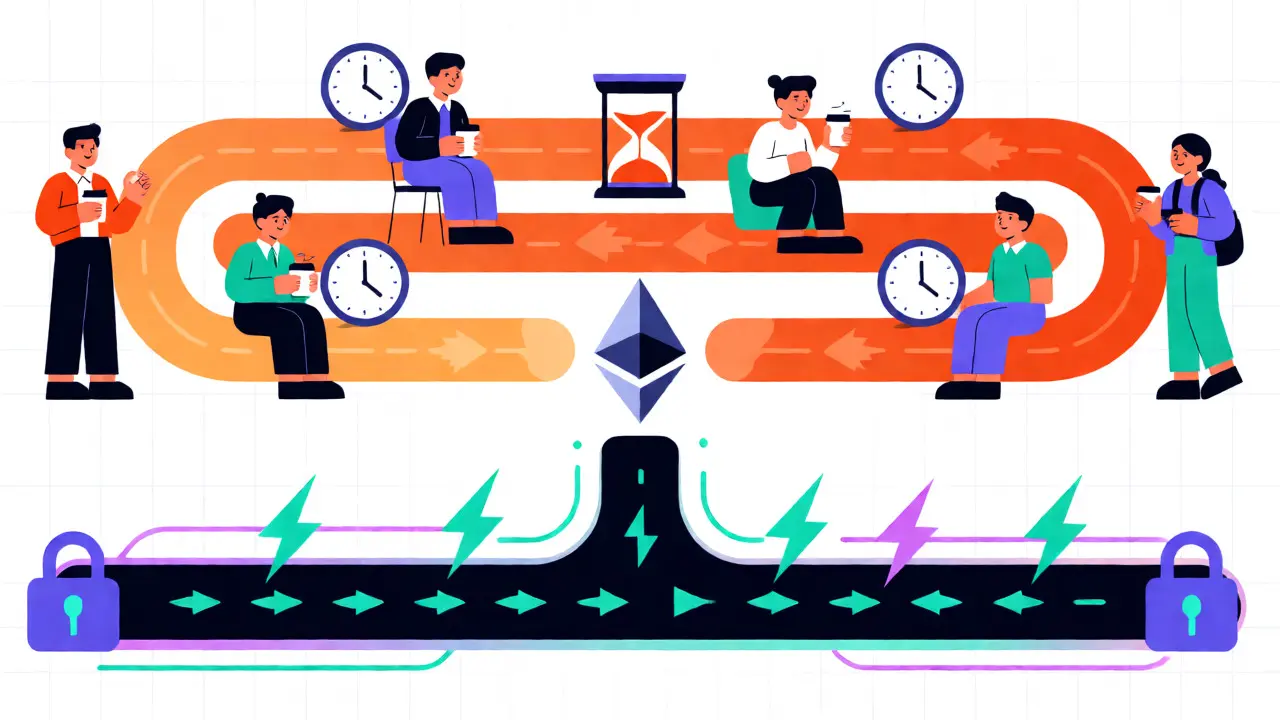
Imagine sending money on Ethereum and having to wait seven days just to get it back. That sounds like a nightmare for traders, but it’s actually the price of safety in many Optimistic Rollups. These systems assume transactions are valid until proven otherwise, relying on fraud proofs to catch bad actors. If you’re building or using Layer 2 solutions today, understanding how this security model works-and where it breaks-is critical. It’s not just about speed; it’s about trust.
| Feature | Optimistic Rollups | ZK Rollups |
|---|---|---|
| Security Mechanism | Fraud Proofs (Challenge Period) | Validity Proofs (Cryptographic) |
| Finality Time | 7 Days (Standard) / 2 Hours (Base) | < 10 Minutes |
| Data Cost | $0.03-$0.15 per tx | 30-50% Lower than Optimistic |
| Hardware Needs | Low | High ($5k-$15k servers) |
| Examples | Arbitrum, Optimism | zkSync Era, StarkNet |
The Core Problem: Scaling Without Losing Trust
Ethereum is secure but slow. To fix this, developers moved computation off-chain to Layer 2 networks called rollups. But here’s the catch: if everyone agrees that a transaction happened off-chain, who checks if it was actually valid? You can’t just take the word of a centralized operator. That’s where Fraud Proofs come in. They act as a police force for the blockchain. Instead of verifying every single transaction on the main chain (which would be too expensive), the network assumes everything is fine unless someone submits mathematical evidence proving a specific transaction was wrong. This "innocent until proven guilty" approach allows for massive throughput increases-often 10 to 100 times faster than Layer 1-while still anchoring security to Ethereum’s base layer.
Vitalik Buterin outlined this concept clearly in his 2021 guide, distinguishing between two main types of rollups. On one side, you have Optimistic Rollups like Arbitrum and Optimism, which use fraud proofs. On the other, you have Zero-Knowledge (ZK) Rollups like zkSync, which use validity proofs. While both aim to scale Ethereum, their security architectures are fundamentally different. One relies on economic incentives and time delays; the other relies on pure cryptography. Choosing between them isn’t just a technical decision-it affects user experience, cost, and risk exposure.
How Fraud Proofs Actually Work
Let’s break down the mechanics of an Optimistic Rollup. When a batch of transactions is submitted to Ethereum Layer 1, it includes a state root-a cryptographic hash representing the final balance of all accounts after those transactions. For a set period, usually seven days, anyone can challenge this state root. If you suspect the sequencer (the entity processing transactions) cheated, you submit a fraud proof. This isn’t just a claim; it’s a precise execution trace showing exactly which step failed and why.
The smart contract on Ethereum then replays the disputed part of the computation. If the challenger is right, the invalid batch is rejected, and the challenger often gets a reward from the sequencer’s bond. This process costs gas-roughly 500,000 to 1,000,000 gas per proof-but it ensures that no single entity can lie about the state without getting caught. However, this system has a major flaw: it requires honest watchers. If no one challenges a fraudulent batch within the window, the invalid state becomes permanent. This is why decentralization of verifiers matters so much. As Barry Whitehat noted, shorter challenge periods increase risk because there’s less time for independent nodes to detect errors.

ZK Rollups: The Cryptographic Alternative
ZK Rollups take a different path. Instead of waiting for someone to find a mistake, they prove correctness upfront. Every batch comes with a validity proof, typically a ZK-SNARK or STARK, which mathematically guarantees that the new state is correct according to the rules. There’s no need for a challenge period because the proof itself is the verification. Once Ethereum verifies the proof, the transaction is final immediately.
This offers huge advantages for users who hate waiting. zkSync Era, for example, achieves finality in under ten minutes compared to Arbitrum’s seven-day standard withdrawal window. But this speed comes at a cost. Generating these proofs requires specialized hardware, costing thousands of dollars per server. Plus, the complexity is higher. Developers face a steeper learning curve, with estimates suggesting 200-300 hours of training to implement secure systems properly. Despite this, adoption is growing fast. By early 2024, ZK Rollups held nearly half of the total value locked in Layer 2s, signaling strong market confidence in their long-term viability.
Risks and Real-World Failures
No system is perfect. In October 2023, Degen Chain experienced 12-hour reorganizations due to delayed batch data publishing. This wasn’t a hack, but a operational failure that highlighted how fragile the data availability layer can be. Similarly, samczsun, a well-known security researcher, documented a subtle bug in an optimistic rollup’s fraud proof mechanism that could theoretically allow invalid states to finalize. Such bugs are rare but catastrophic when they happen.
Another emerging threat is cross-rollup interoperability. As more assets move between different L2s, timing differences between settlement layers create attack vectors. An attacker might exploit a lag between one rollup confirming a transaction and another recognizing it. Researchers categorize this into three stages of security, with most current protocols operating at Stage 0, meaning they only guarantee validity within their own boundary, not globally across all rollups. Until standards improve, moving large sums across different L2s carries extra risk.
Practical Tips for Users and Developers
If you’re a user, your biggest pain point is likely withdrawal delays. On standard Optimistic Rollups, moving funds back to Layer 1 takes up to seven days. Some newer implementations like Base have cut this to two hours, but always check the specific protocol’s docs before assuming instant access. For developers, audit costs are significant-expect to pay $75,000 to $150,000 for a thorough security review. Most projects go through three to four rounds of auditing before launch.
- Check Challenge Periods: Always verify how long you must wait to withdraw funds.
- Audit Your Code: Don’t skip security reviews, especially for fraud-proof logic.
- Monitor Data Availability: Ensure your rollup posts enough data to Ethereum to prevent censorship.
- Consider EIP-4844: Upcoming upgrades will drastically reduce data costs, changing the economics of both rollup types.
The landscape is shifting rapidly. With EIP-4844 (Proto-Danksharding) rolling out, data costs for rollups are expected to drop by 90%. This makes both models cheaper to run, but it also intensifies competition. Will ZK Rollups dominate high-value transfers while Optimistic Rollups serve low-cost applications? Delphi Digital predicts yes, projecting a 65% market share for ZK by 2027. For now, though, both coexist, each serving different needs in the broader Ethereum ecosystem.
Why do Optimistic Rollups have a 7-day delay?
The delay exists to give anyone enough time to notice and challenge a fraudulent transaction. Since the system assumes transactions are valid, it needs a window for honest observers to submit fraud proofs if something goes wrong.
Are ZK Rollups more secure than Optimistic Rollups?
In theory, yes, because they provide immediate cryptographic finality. However, they rely on complex math libraries that can have bugs. Optimistic Rollups are simpler but depend on active monitoring. Neither is perfectly immune to implementation errors.
What happens if no one submits a fraud proof?
If the challenge period expires without a dispute, the transaction is considered final on Layer 1. This means an invalid state could become permanent if no honest verifier catches the error in time.
Do I need special hardware to run a ZK Rollup node?
Yes, generating ZK proofs requires significant computational power. Servers for proof generation can cost between $5,000 and $15,000, making it more resource-intensive than running an Optimistic Rollup node.
How does EIP-4844 affect rollup security?
EIP-4844 reduces data storage costs on Ethereum by 90%. While it doesn’t change the core security model, it makes posting data cheaper, encouraging more robust data availability practices and potentially allowing for tighter security parameters.
Christian Pasamonte
2 09 26 / 16:17 PMIt is frankly exhausting to see yet another article regurgitating the same surface-level talking points about optimistic versus zero-knowledge rollups without addressing the fundamental economic misalignment that plagues the current optimistic model, specifically regarding the incentive structures for challengers who are often deterred by the high gas costs and the sheer complexity of constructing a valid fraud proof in real-time, which effectively means that the 'security' of these chains is largely theoretical rather than practical until we see a significant increase in decentralized verifier participation that actually makes the cost of attacking the network prohibitively expensive for well-funded adversaries who might simply wait out the challenge period or bribe the few active watchers, creating a fragile equilibrium that feels dangerously close to the early days of Bitcoin before mining difficulty adjusted properly, leaving users exposed to risks that are not adequately priced into the transaction fees they pay today.
Courtney Parker
3 09 26 / 05:20 AMlol imagine waiting 7 days just to get your own money back 🙄 this whole "fraud proof" thing sounds like over-engineering to me 😂 why can't we just trust the sequencer? feels like you're making it way more complicated than it needs to be 🤷♀️
Saket Kulkarni
4 09 26 / 22:18 PMI appreciate the clarity with which you have outlined the distinct philosophical underpinnings of both optimistic and zero-knowledge architectures. It seems to me that the choice between them is not merely technical but ethical, reflecting a preference for speed and certainty versus flexibility and lower computational overhead. We must consider that trust is a social construct as much as a cryptographic one, and perhaps the ideal future lies in hybrid models that leverage the strengths of both paradigms while mitigating their respective weaknesses through careful design and community governance.
Eliza Stein-Dodd
5 09 26 / 12:40 PMActually, ZK proofs aren't just about speed; they provide mathematical finality which eliminates the need for trust assumptions entirely. That's a huge security upgrade compared to relying on honest actors to watch the chain. 🔒✨
Kathy Siew
6 09 26 / 10:15 AMyeah but dont forget the hardware costs are insane for zk right now lol. most people cant afford those $15k servers so its basically centralized again anyway. kinda defeats the purpose if only big corps can run nodes imo 🙃
Brittany Ross
7 09 26 / 10:51 AMThis is such a helpful breakdown! I was really confused about why withdrawals took so long on Arbitrum before reading this. The part about EIP-4844 reducing costs by 90% gives me hope though 🥺💖 hopefully things get cheaper soon!
Jennifer Brosnan
8 09 26 / 00:44 AMOh please, spare me the conspiracy theories about centralization. You clearly don't understand how data availability works if you think running a node requires a supercomputer. It’s all marketing fluff designed to scare retail investors away from L2s so whales can accumulate at lower prices. Wake up sheeple 🐑📉
Idowu Emmanuel
9 09 26 / 05:40 AMGreat insights here! I love seeing the comparison table, it really helps visualize the trade-offs. As someone building in this space, I'm excited about the potential for interoperability once these standards mature. Keep up the good work! 🚀
Finlay Samms
11 09 26 / 04:33 AMBoth sides have merit, honestly. Optimistic rollups offer simplicity and lower barriers to entry for developers, while ZK offers superior security guarantees. It doesn't have to be an either/or situation. Perhaps we'll see coexistence where different applications choose the layer that best fits their risk profile and user experience requirements. :)
lea terrade
11 09 26 / 10:39 AMi wonder if the 7 day delay is actually a feature not a bug... forces people to think twice before moving funds maybe? creates friction that reduces panic selling? idk just thinking out loud here
Rachel Leet
12 09 26 / 04:00 AMThe article fails to address the deeper epistemological crisis inherent in fraud proofs: if truth is determined by whoever submits the proof first, then reality becomes a contest of capital and latency rather than objective fact. This transforms blockchain from a trustless ledger into a game of chicken played by sophisticated actors, fundamentally altering the nature of decentralization itself. Until we solve the problem of who watches the watchers, we are merely simulating security, not achieving it.