Imagine sending a payment to a friend. On Bitcoin or Ethereum, you wait for miners to validate it, pay a fee, and hope the network isn't congested. Now imagine doing that same transaction instantly, for free, thousands of times in a row. Sounds too good to be true? That's the promise of state channels. But here is the catch: when you move transactions off the main blockchain, who watches the watchers? If your counterparty tries to cheat, how do you prove they are lying without dragging every single micro-payment back onto the slow, expensive main chain?
This is where state channel security gets tricky. It shifts the burden of trust from the entire global network to just the two (or more) people involved in the channel. It sounds risky, but it’s actually one of the most elegant solutions in Layer 2 scaling technology. By locking funds in a smart contract and using cryptographic proofs, participants can transact freely while keeping their money safe. Let’s break down exactly how this security model works, where it fails, and why you might need to stay online to keep your coins.
The Core Mechanism: Locking Funds and Signing States
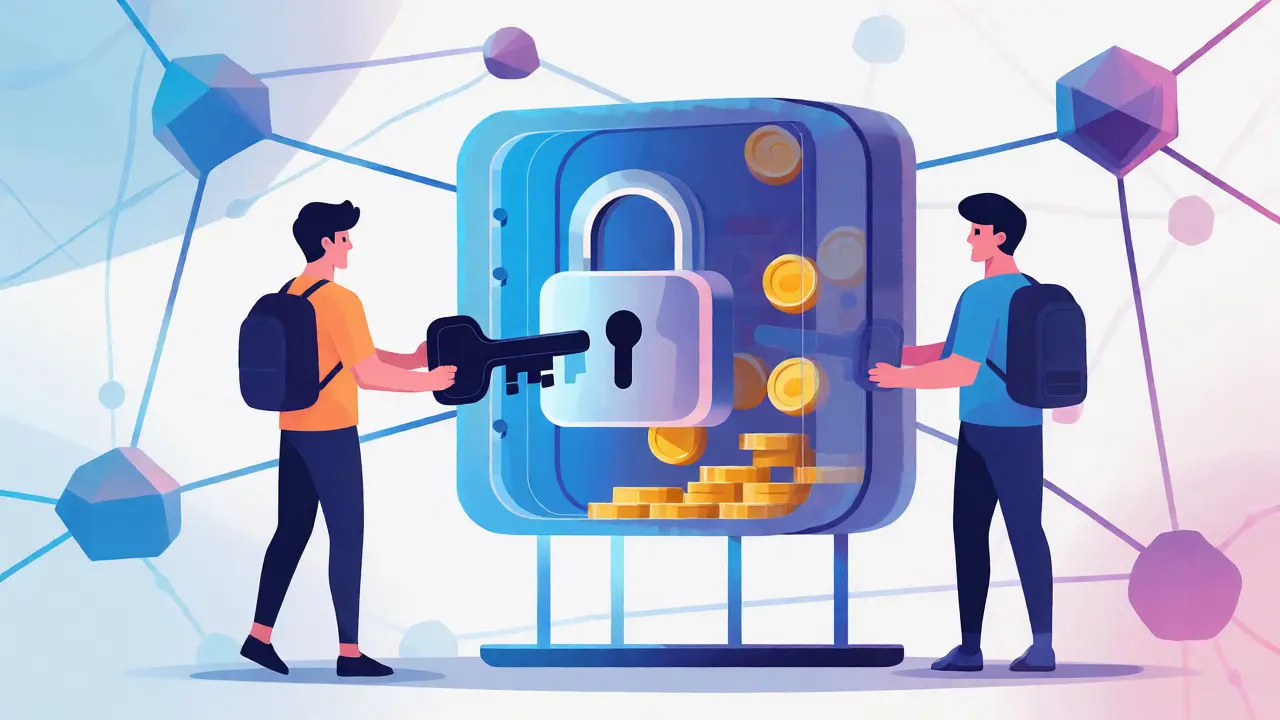
To understand the security, you first have to understand the setup. A state channel starts with an on-chain transaction. You and your counterparty lock a certain amount of cryptocurrency into a multisignature smart contract on the main blockchain. Think of this as putting cash into a joint bank account that requires both your signatures to open. Once locked, you can trade assets between each other off-chain.
Every time you send money to your partner, you don’t broadcast it to the blockchain. Instead, you sign a new "state"-a snapshot of who owns what right now. Your partner signs it back. This creates a chain of signed updates. The latest signature always trumps the previous ones. If you sent $10, then $5, the final state shows you down $15. The magic is that these signatures are cryptographically binding. If your partner tries to claim you only owe them $5 by presenting an old signature, you can produce the newer one to prove them wrong.
This system relies heavily on ECDSA signatures (Elliptic Curve Digital Signature Algorithm). In Bitcoin’s Lightning Network, this uses secp256k1 curves, the same math securing Bitcoin itself. The security guarantee is simple: no one can forge your signature, so no one can change the balance without your consent. However, this also means if you lose your private key, you lose access to the channel. There is no customer support number to call.
The Dispute Window: Your Safety Net Against Cheating
What happens if your partner goes offline or tries to close the channel maliciously? They might submit an outdated state to the blockchain-one where they had more money than they actually did after all those trades. To stop this, state channels use a dispute window, also known as a challenge period.
When someone initiates a closure, the smart contract doesn’t release funds immediately. It waits. For Ethereum’s Raiden Network, this was typically a 200-block challenge period. For Bitcoin’s Lightning Network, it often involves a timeout mechanism measured in blocks (e.g., 144 blocks for HTLCs). During this window, any participant can step in and present a newer, valid state. If you see your partner trying to cheat, you submit the correct signed state. The smart contract verifies the signature, sees it’s newer, and rejects the cheater’s claim.
If the cheater loses the dispute, they usually get penalized. The smart contract slashes their deposited collateral. This economic disincentive is crucial. It makes cheating expensive. Why risk losing your entire deposit for a small gain? This game-theoretic approach ensures that honest behavior is the most profitable strategy. But-and this is a big "but"-you must be watching. If you are asleep during the dispute window and your partner submits an old state, the funds might be released incorrectly before you can react.

Trust Models: Who Do You Actually Need to Trust?
In traditional banking, you trust the bank. In DeFi, you trust the code and the oracle. In state channels, the trust model is radically different. You don’t need to trust the blockchain nodes to verify every transaction because they never see them. You only need to trust the cryptography and the initial smart contract.
However, you do need to trust your counterparty to some extent. Not to steal your money directly-they can’t-but to not play dirty games like griefing attacks. A griefing attack happens when a malicious actor opens many channels with you, locks up your capital, and then refuses to participate, effectively freezing your funds until the long timeout expires. While they can’t steal the money, they can inconvenience you significantly.
| Solution | Who You Trust | Data Availability | Security Guarantee |
|---|---|---|---|
| State Channels | Counterparty & Cryptography | Private (Off-chain) | High for bilateral, low for open participation |
| Optimistic Rollups | Network Validators & Fraud Provers | Public (On-chain data) | Inherits Mainnet Security |
| Sidechains | Separate Validator Set | Public (Sidechain) | Depends on Sidechain Consensus |
As the table shows, state channels offer superior privacy because transactions aren't broadcast to the world. Only you and your partner know the details. But this comes at the cost of composability. You can't easily interact with a third party unless you have a direct channel with them. This limits state channels to specific use cases like micropayments, gaming, or frequent trading between two known entities.
The Online Requirement: The Achilles' Heel
Vitalik Buterin, co-founder of Ethereum, famously noted that state channels require users to be "online periodically." This isn't just a suggestion; it's a security requirement. If you go on vacation for a week and forget about your Lightning channel, a malicious node could try to force-close it with an old state. If you aren't there to contest it within the challenge period, you lose money.
This has led to the rise of Watchtowers. These are third-party services that monitor your channels for you. You pay them a small fee, and they watch the blockchain. If they detect a malicious closure attempt, they automatically submit the correct state on your behalf. Services like Lightning Labs’ Watchtower implementation protect a significant portion of active channels today. Without them, the user experience is stressful. You constantly worry: "Did I miss a block? Is my channel safe?"
User feedback highlights this anxiety. Many report losing funds not because the tech failed, but because they forgot to monitor it. One documented case involved users losing BTC because they didn't check their channels for 72 hours during travel. Automated monitoring tools have reduced this risk, but they introduce a new layer of dependency. Now you have to trust the Watchtower provider to be honest and available.

Common Attack Vectors and Mitigations
While the core protocol is secure, implementations can have bugs. The Ethereum Foundation’s security reviews have flagged issues with improper state revocation handling. If a bug allows an attacker to replay an old signature, the dispute mechanism might fail. Developers must implement robust state management systems. Losing the latest state file can mean permanent fund loss if you can't prove the current balance.
Another risk is channel exhaustion. Since channels have limited capacity, a high-volume trader might run out of liquidity in one direction. They can't send more funds until the counterparty sends some back. If the counterparty stalls, the channel becomes useless. Mitigation strategies include opening multiple channels or using hub-and-spoke networks where a central hub routes payments for you, though this reintroduces some trust in the hub.
Real-World Application and Future Outlook
Despite the complexities, state channels dominate niche markets. They process a large chunk of blockchain-based gaming transactions and micropayments because speed and low fees are non-negotiable there. For example, paying per second for video streaming or betting in real-time poker works perfectly on a state channel. The security model holds up well in these closed-loop environments.
Looking ahead, research is focusing on generalized state channels that allow multi-party interactions without requiring a direct link between everyone. Projects funded by the Ethereum Foundation are exploring ways to make these networks more flexible. However, for general-purpose DeFi, rollups are winning because they don't require users to manage individual channel states. State channels will likely remain a specialized tool, prized for their speed and privacy, but reserved for users who understand the operational security risks.
What happens if I lose my private key in a state channel?
If you lose your private key, you generally lose access to the funds in that specific channel. Unlike custodial wallets, there is no recovery phrase service for decentralized state channels. You cannot sign new states or contest malicious closures. Always back up your channel state files securely.
Do state channels inherit the security of the main blockchain?
Yes, but indirectly. The initial funding and final settlement happen on the main chain, which provides the ultimate security anchor. However, the day-to-day security depends on the participants' ability to monitor and enforce rules via the dispute window, rather than the main chain validating every transaction.
Can a counterparty steal my funds in a state channel?
Not directly. They cannot withdraw funds without your signature. However, they can attempt to cheat by submitting an outdated state during a closure. If you are offline and fail to contest it within the dispute window, they might successfully claim more funds than they deserve.
What is a Watchtower in the context of state channels?
A Watchtower is a third-party service that monitors your state channels on your behalf. If a malicious peer tries to close the channel with an old state, the Watchtower detects it and broadcasts the correct, newer state to the blockchain, protecting your funds even if you are offline.
Are state channels better than rollups for security?
It depends on the use case. State channels offer higher privacy and lower latency for bilateral transactions. Rollups offer better composability and network-wide security guarantees suitable for complex DeFi applications. State channels are more secure for specific, high-frequency interactions between known parties.
Leave a comments