Low Slippage Crypto: Trade Smarter with Less Price Impact
When you trade crypto, low slippage crypto, a trade that executes close to the price you see before clicking buy or sell. It means your order doesn’t get filled at a worse price than expected—no nasty surprises when the market moves fast. Slippage isn’t just a technical term—it’s money lost. If you’re buying $1,000 worth of a token and end up paying $1,020 because the price jumped during your trade, that’s 2% gone. In crypto, where prices swing wildly, low slippage isn’t a luxury—it’s survival.
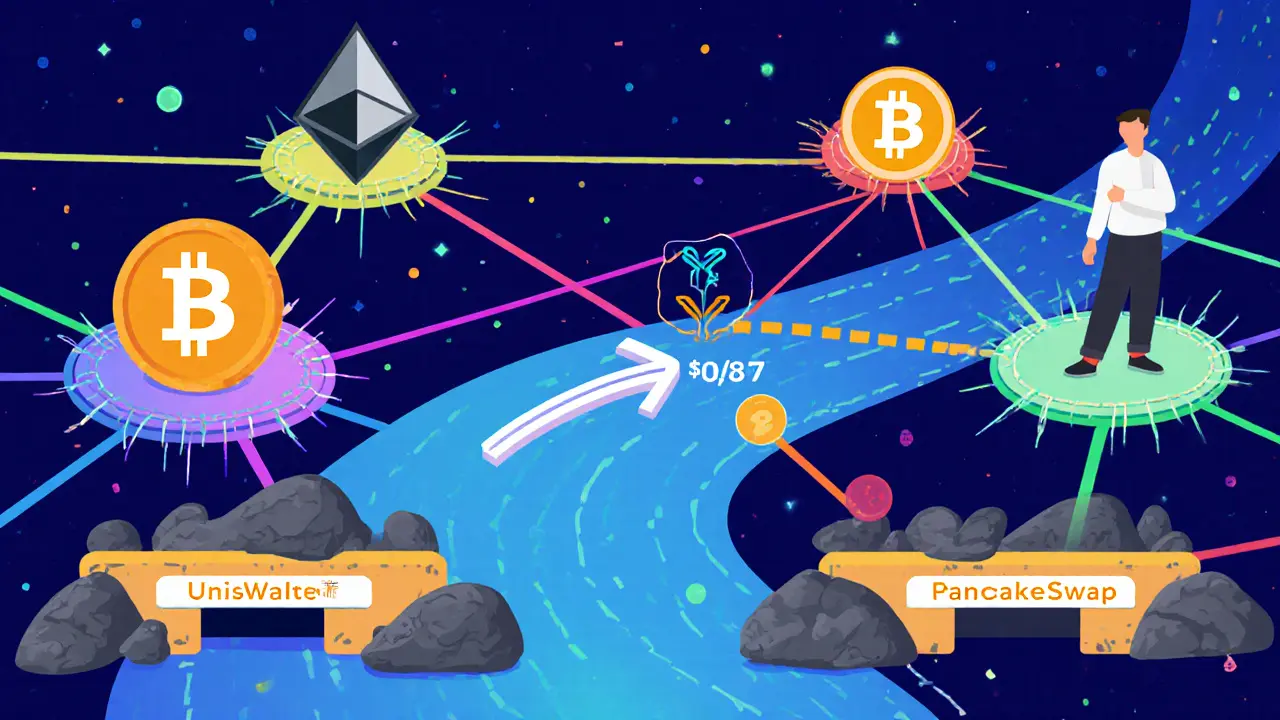
Slippage happens mostly on decentralized exchanges, platforms like Uniswap or PancakeSwap where trades happen directly between users without a central order book. These DEXs rely on liquidity pools, and if there’s not enough money in the pool, your trade pushes the price around. That’s why order book crypto, trading on platforms like BIT.com or Injective that match buyers and sellers directly like traditional stock markets. It’s often the key to tighter spreads and less slippage. You’ll find this in action in posts about Astroport on Injective, where users report near-zero slippage even on larger trades. Compare that to Zenlink on Moonriver, where daily volume is under $15—there’s barely any liquidity, so every trade causes massive price swings.
Low slippage isn’t just about the exchange. It’s also about the token. Big, liquid coins like ETH or BTC rarely have high slippage because thousands of traders are buying and selling every second. But small tokens? Even if they’re trending, low trading volume means your order can move the market. That’s why OMNI, PMPY, or AVAXAI—tokens with tiny communities and near-zero volume—are risky for anyone who cares about price accuracy. You might think you’re getting in at $0.01, but your buy order could push it to $0.015 before it even fills.
Slippage tolerance settings on wallets and DEXs help, but they’re not magic. If you set it to 5% and the market drops 8%, your trade still fails. The real fix? Trade on platforms with deep liquidity, stick to tokens with real volume, and avoid anything that looks like a hype coin with no trading history. The posts below show you exactly where low slippage crypto works—and where it doesn’t. You’ll see real examples from Injective, Moonriver, and others, so you don’t have to guess which exchanges are safe and which are traps.
WOOFi Crypto Exchange Review: Cross-Chain DEX with Low Slippage and Pro Trading Tools
WOOFi is a cross-chain DEX offering low-slippage swaps, one-sided staking, and futures trading with up to 1:50 leverage. Ideal for active traders who want DeFi control without high fees or complex bridges.
Details +