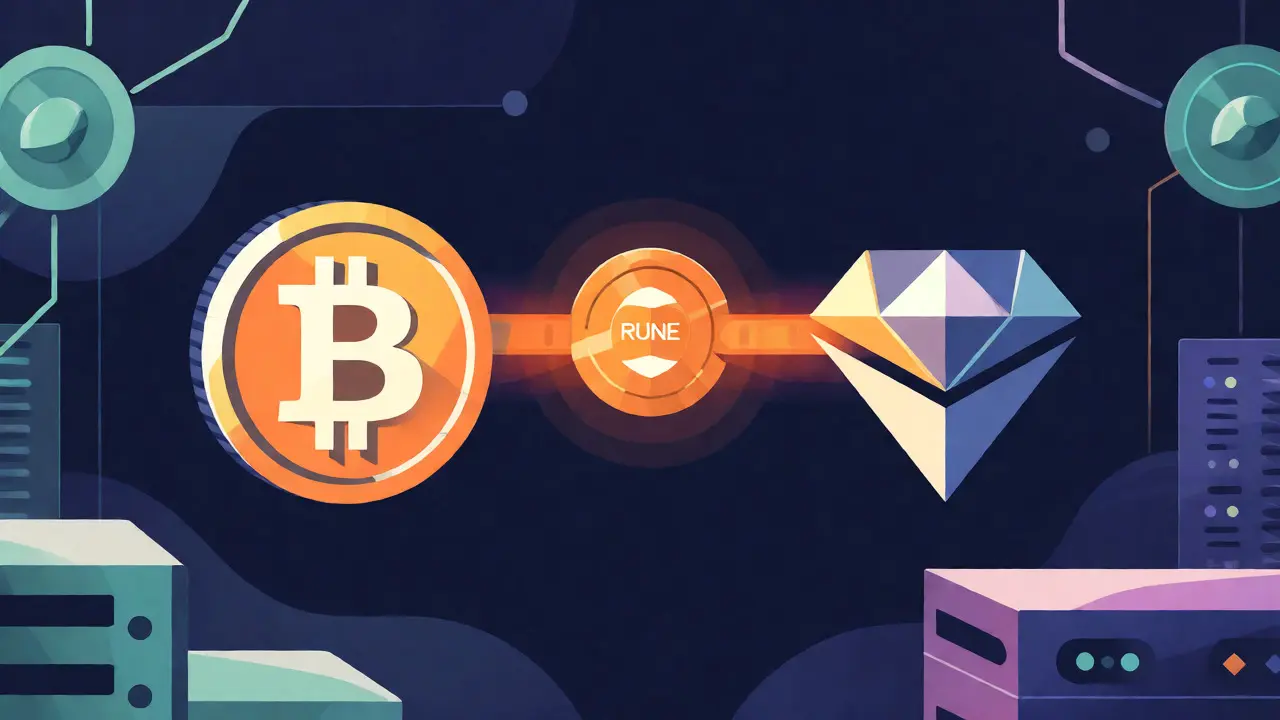
Ever tried swapping Bitcoin for Ethereum without handing your keys over to a centralized exchange? It’s usually a headache. You either use a wrapped asset like WBTC, which adds smart contract risk, or you trust a middleman who can freeze your funds. THORChain is a decentralized liquidity protocol that enables direct, trustless swaps between native assets across different blockchains. Founded in 2018 by Oleg Udoev and Gavin Cox, it solves the interoperability problem that has plagued DeFi for years. But as of late 2026, with the market shifting and new competitors emerging, does it still hold up as the go-to solution for cross-chain trading?
This review cuts through the noise. We’re looking at how THORChain actually works, why its unique economic model matters, and whether the trade-offs in speed and user experience are worth it for your portfolio. If you value self-custody above all else, keep reading.
Key Takeaways
- True Native Swaps: Unlike most DEXs, THORChain allows you to swap native BTC for native ETH without wrapping assets, reducing counterparty risk.
- The RUNE Backbone: The RUNE token serves as the base pair for all liquidity pools and secures the network through staking, creating a unique economic equilibrium.
- Performance Trade-off: Expect slower transaction times (3-5 TPS) compared to centralized exchanges, but enjoy full custody retention.
- Security Evolution: Post-2025 upgrades have significantly hardened the protocol against oracle attacks, though multi-chain reliance remains a complex security vector.
- User Experience: Interfaces like THORSwap are improving but still pose a steep learning curve for beginners managing multiple wallets.
How THORChain Actually Works
Most decentralized exchanges (DEXs) operate on a single blockchain. Uniswap lives on Ethereum; PancakeSwap lives on BNB Chain. They can’t talk to each other natively. THORChain bridges this gap using a continuous liquidity pool (CLP) model. Here is the core mechanic: every asset paired in a liquidity pool is paired with RUNE. So, if you want to swap Bitcoin for Ethereum, you aren’t swapping BTC directly for ETH. Instead, you swap BTC for RUNE, and then RUNE for ETH. This creates a unified liquidity layer where RUNE acts as the universal bridge currency.
The protocol relies on a network of validator nodes secured by Byzantine Fault Tolerance (BFT). These nodes don’t just validate transactions; they manage the movement of assets between chains. When you initiate a swap, the nodes lock your BTC on the Bitcoin chain and mint equivalent value in RUNE within the THORChain ecosystem. Then, they release ETH from their reserves on the Ethereum chain. This process requires no central custodian. Your assets move through a system of bonded collateral, where node operators must stake significant amounts of RUNE to participate. If they act maliciously, they lose their stake. This "skin in the game" mechanism is what keeps the system honest without needing a CEO or headquarters.
| Feature | THORChain | Centralized Exchange (e.g., Binance) | Wrapped Asset DEX (e.g., Uniswap) |
|---|---|---|---|
| Custody | Non-custodial (Self) | Custodial (Exchange) | Non-custodial (Self) |
| Asset Type | Native Assets | IOUs / Internal Ledger | Wrapped Tokens (e.g., WBTC) |
| KYC Requirement | None | Mandatory | None |
| Transaction Speed | Slow (Blockchain dependent) | Instant | Fast (L1 dependent) |
| Smart Contract Risk | Protocol + Node Security | Platform Risk | Wrapper Contract Risk |
The Economics of RUNE
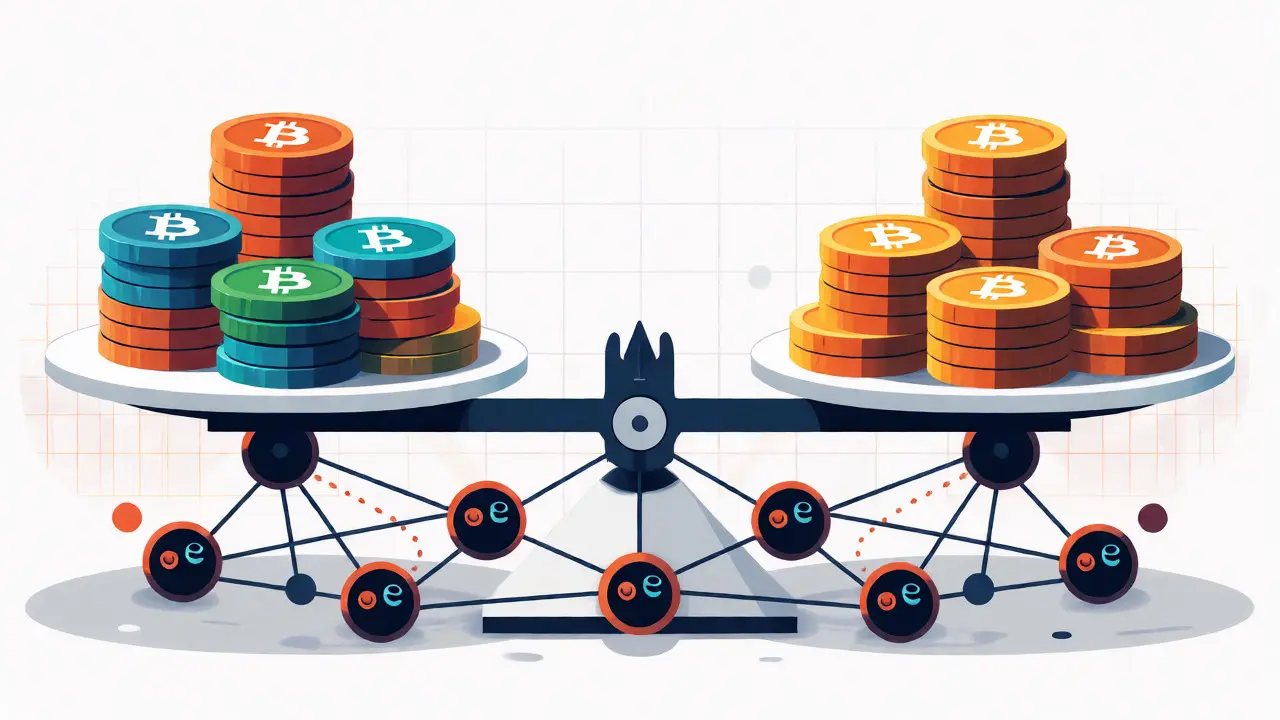
You can’t understand THORChain without understanding RUNE. It’s not just a governance token; it’s the fuel and the ballast of the entire ship. Because every pool uses RUNE as one side of the pair, demand for RUNE increases linearly with the total value locked (TVL) in other assets. If $1 billion flows into Bitcoin pools, roughly $1 billion worth of RUNE must be bought and locked to maintain the 1:1 ratio. This creates a powerful flywheel effect.
However, this model has faced scrutiny. In early 2025, the protocol experienced a crisis where excessive minting of RUNE to cover debts outpaced burning mechanisms, causing price volatility. To fix this, the team introduced TCY (THORChain Yield) tokens to manage liabilities without inflating the RUNE supply. As of late 2026, this adjustment has stabilized the tokenomics. Market analysts note that while RUNE’s price action is volatile-often correlating with broader market sentiment-the underlying utility has strengthened. With a max supply capped at 500 million tokens, scarcity plays a role, but the primary driver remains actual usage volume. If cross-chain trading grows, RUNE captures that value. If users prefer cheaper, faster Layer 2 solutions, THORChain’s dominance could wane.
Pros and Cons: Is It Right For You?
Let’s get real about the user experience. THORChain isn’t designed for high-frequency traders who need sub-second execution. It’s designed for people who care about ownership.
The Good:
- No KYC: You connect your wallet, swap, and leave. No uploading passports or waiting for approval emails. This privacy is increasingly rare in regulated markets.
- Native Asset Support: You are swapping real Bitcoin, not a claim on Bitcoin. This eliminates the risk of the wrapper provider going bankrupt or freezing assets.
- Cross-Chain Reach: With recent integrations like NEAR Intents, THORChain now supports over 12 blockchains, including Bitcoin, Ethereum, Avalanche, and Polkadot. This breadth is unmatched in the pure-play DEX sector.
The Bad:
- Speed: A swap can take anywhere from 30 seconds to several minutes, depending on confirmation times on both source and destination chains. During Ethereum congestion, fees spike, and wait times drag.
- Complexity: Managing slippage and understanding the fee structure (paid in the source asset) confuses many new users. A Reddit survey indicated 63% of new users failed their first swap attempt due to interface confusion.
- Liquidity Depth: While TVL exceeds $80 million, large trades can still suffer from slippage compared to centralized giants. If you’re moving millions, you might impact the price more than you expect.

Security and Risks
Security in decentralized protocols is never absolute. THORChain employs a multi-layered defense. First, there’s the consensus layer. Nodes must bond RUNE to participate. Second, there’s the external audit trail. Firms like CertiK have audited the codebase, identifying vulnerabilities before they became exploits. Third, there’s the community oversight. Open-source development means thousands of eyes are watching for bugs.
But here’s the catch: THORChain relies on the security of the connected blockchains. If Bitcoin forks unexpectedly, or if Ethereum has a major consensus failure, THORChain inherits those risks. Additionally, the "oracle problem"-how nodes agree on off-chain data-was a historical weak point. Recent architecture changes have improved resilience against oracle manipulation, but it remains a theoretical attack vector. Always consider that while you retain custody, you are trusting the protocol’s code and the economic incentives of its validators.
Final Verdict
THORChain occupies a specific niche: the intersection of decentralization, multi-chain capability, and native asset support. It is not the fastest, nor the cheapest option for small trades. But for large cross-chain movements where you refuse to trust a centralized intermediary, it is arguably the best tool available today. The improvements made since the 2025 crisis show a maturing protocol that listens to its community. If you are comfortable with slightly longer settlement times and navigating a non-custodial interface, THORChain offers peace of mind that centralized exchanges simply cannot match.
Do I need to pay gas fees on THORChain?
Yes, but differently than on a standard DEX. You pay the native blockchain fees (like Bitcoin miner fees or Ethereum gas) to send your assets to the THORChain vault. Additionally, THORChain charges a swap fee, typically around 0.3%, which is deducted from the output amount. There is no separate "gas" paid in RUNE for the swap itself.
Is THORChain safe after the 2025 hacks?
The protocol underwent significant architectural changes following incidents in early 2025. These updates focused on hardening the oracle infrastructure and adjusting the bonding requirements for node operators. While no system is immune to zero-day exploits, current audits and the reduced incident rate suggest a much more resilient state compared to previous versions.
Can I swap any cryptocurrency on THORChain?
No. THORChain only supports specific native assets from supported blockchains. Currently, this includes major coins like BTC, ETH, ATOM, AVAX, and others. It does not support arbitrary ERC-20 tokens unless they are part of a supported L2 integration or have been specifically onboarded via the Mayan Mainnet upgrade.
Why is my swap taking so long?
Cross-chain swaps require confirmations on both the source and destination blockchains. If you are swapping BTC to ETH, you must wait for Bitcoin confirmations (usually 1-3 blocks) and then Ethereum confirmations. Network congestion on either chain will delay the process. Checking the status on the THORSwap explorer can help identify which stage is pending.
What happens if I send the wrong asset to the THORChain vault?
If you send an unsupported asset or the wrong amount, the funds may be stuck or lost. THORChain does not have a customer support team to manually refund mistakes. Always double-check the memo field and the asset type before sending. Using a test transaction with a small amount is recommended for new users.
Leave a comments