
Before 2025, running a crypto business in Nigeria was like navigating a maze with no map. Banks blocked transactions. No clear rules existed. Now, if you want to operate legally, you need a VASP license from the Securities and Exchange Commission (SEC). It’s not optional anymore. It’s the only way to stay open, access banking services, and serve Nigerian customers without fear of shutdowns or fines.
What Exactly Is a VASP License?
A VASP - Virtual Asset Service Provider - license lets your company legally offer services involving digital assets in Nigeria. This includes cryptocurrency exchanges, wallet providers, staking platforms, token issuers, mining operations, airdrop distributors, and even crypto payment processors. If your business touches crypto in any way, and you serve Nigerian users, you’re now under SEC jurisdiction.
The 2025 Investments and Securities Act changed everything. It officially classified virtual assets as securities. That means the SEC now has the legal power to regulate, monitor, and enforce rules on crypto firms. No more gray zones. No more informal peer-to-peer operations. If you’re in the business, you’re regulated.
Minimum Financial Requirements
You can’t just register and start. Nigeria demands serious financial commitment. The minimum paid-up capital required is N500,000,000 - about $325,000 USD. This isn’t a suggestion. It’s a hard cutoff. The SEC wants to make sure only companies with real financial backing can operate. This rules out small startups and fly-by-night operators.
Alongside the capital, you need audited financial statements. If you’re new, you submit a statement of affairs prepared by a certified public accountant. If you’ve been around, you provide your latest audited accounts. No shortcuts. No estimates. The SEC checks every number.
Corporate Structure and Physical Presence
Your business must be legally incorporated with the Corporate Affairs Commission (CAC). You need your Certificate of Incorporation, Memorandum and Articles of Association (MEMART), and a current CAC Status Report. But that’s just the start.
Here’s where it gets strict: you must have a physical office in Nigeria. Not a virtual address. Not a co-working space you rent for a day. A real office with a local director who lives in Nigeria. This person must be a company officer - either the CEO or Managing Director. They’re accountable. They’re on the ground. The SEC wants someone you can physically locate if things go wrong.
This requirement alone blocks many foreign crypto firms that tried to operate remotely. If you don’t have a Nigerian resident director, you don’t get licensed.
Operational Compliance: KYC, AML, and Record Keeping
Running a crypto business isn’t just about technology. It’s about compliance. The SEC works with the Central Bank of Nigeria (CBN) to enforce strict anti-money laundering (AML) and Know Your Customer (KYC) rules.
You must verify every customer’s identity - full name, address, government ID, proof of income source. No anonymous wallets. No cash deposits without paperwork. You need systems that flag suspicious behavior in real time - large transfers, rapid movement between wallets, repeated small deposits that look like structuring.
And you keep records. Not for six months. Not for a year. For seven years. Every transaction, every ID document, every chat log with a customer. The SEC can demand them at any time. Failure to produce records? That’s a license suspension.
You also have to register with the Federal Inland Revenue Service (FIRS) and report suspicious activity to the Nigerian Financial Intelligence Unit (NFIU). Tax compliance isn’t optional. It’s part of the license.

The Two Paths to Licensing: Standard vs. ARIP
The SEC offers two routes: the standard process and the Accelerated Regulatory Incubation Program (ARIP).
The standard path is long. Submit all documents, wait for review, go through multiple rounds of questions, get approved. It can take 6-12 months.
ARIP is designed for serious players who want to move fast. You don’t need full compliance upfront. You get preliminary approval in principle. That lets you start operating under SEC supervision while you finish paperwork.
To qualify for ARIP, you must:
- Be incorporated with CAC
- Have a Nigerian resident director
- Have a clear business model in crypto or securities
- Be actively applying for VASP registration
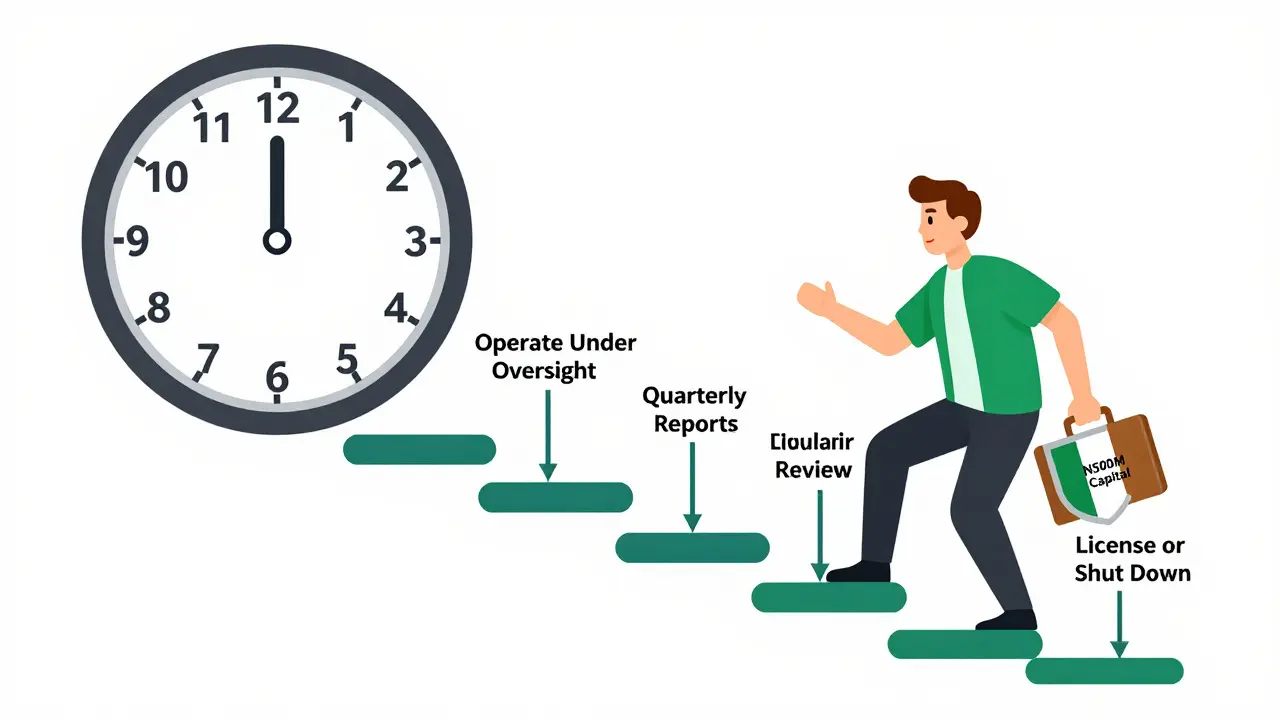
The ARIP timeline is tight:
- Apply and get conditional approval
- Start operations under SEC oversight
- Submit quarterly progress reports
- At month 10, you get a regulatory review
- At month 12, you either get full license or must shut down
ARIP isn’t a shortcut to avoid rules. It’s a way to test your systems under real supervision. If you can’t meet the full requirements by month 12, you’re out.
Documentation You Can’t Skip
Beyond incorporation and capital, you need a full operational playbook:
- A detailed business model - what you do, who your customers are, how you make money
- Complete KYC and AML procedures - written, tested, and auditable
- Risk management protocols - how you handle hacking, fraud, market crashes
- Internal rules on investor protection, conflict of interest, and dispute resolution
- Proof of staffing - names, roles, qualifications of your tech, compliance, and operations teams
- Technical infrastructure specs - servers, encryption, backup systems, cybersecurity certifications
- Letters of no objection from other regulators if you’re also in banking, payments, or fintech
Every document must be signed, stamped, and submitted in hard copy and digital form. The SEC doesn’t accept vague descriptions. They want evidence - not promises.
Sworn Undertakings and Ongoing Oversight
Before you get approved, a director or company secretary must sign a sworn undertaking. This isn’t a formality. It’s a legal promise to comply with the Investment and Securities Act and all SEC rules. If you lie, you face criminal penalties.
Once licensed, you’re not done. You must file regular returns - quarterly reports on transactions, customer growth, suspicious activity, and financial health. The SEC can audit you at any time. They can demand access to your systems. They can freeze your assets if they suspect fraud.
There’s no set-and-forget here. Compliance is continuous. You’re under watch.
How Nigeria Compares Globally
Nigeria’s rules are among the strictest in Africa. The N500 million capital requirement is higher than most African countries. It’s closer to EU standards than to Kenya’s or South Africa’s. The seven-year record retention matches FATF guidelines. But the resident director rule? That’s stricter than the U.S. or Singapore, where remote operations are allowed.
This isn’t about control for control’s sake. It’s about accountability. Nigeria’s government wants to collect taxes. It wants to stop money laundering. It wants to bring crypto into the formal economy - not let it run wild.
Challenges for Crypto Businesses
Getting licensed isn’t easy. Many firms have failed because they underestimated the burden.
- Hiring a Nigerian resident director costs money and creates cultural friction
- Building compliant tech systems requires serious investment - often over $200,000 in cybersecurity alone
- Coordinating with SEC, CBN, CAC, and FIRS means dealing with four different bureaucracies
- Operating costs go up 30-50% after licensing, and those costs get passed to users
Some platforms have shut down entirely. Others have moved operations offshore. The market is shrinking - but the survivors are stronger.
Why This Matters for Nigeria’s Economy
The government isn’t just regulating crypto. It’s trying to tax it. Nigeria collects less than 10% of its GDP in taxes. By 2027, it wants to hit 18%. Crypto businesses are a new revenue stream.
With licensed VASPs, tax collection becomes possible. Transactions are traceable. Income is reported. Fees are taxed. This isn’t just about compliance - it’s about fiscal survival.
For consumers, it means more trust. If you’re using a licensed exchange, your funds are protected. Your identity is secure. You have recourse if something goes wrong.
For investors, it means legitimacy. Foreign venture capital is starting to flow into Nigerian crypto firms that have VASP licenses. The market is becoming real - not speculative.
What’s Next?
The 2025 law is just the start. The SEC is still writing guidance. They’re refining ARIP. They’re testing how to regulate DeFi, NFTs, and tokenized assets.
Expect changes in 2026: clearer rules on cross-border transfers, updated cybersecurity standards, and possibly adjustments to capital requirements based on industry feedback.
One thing won’t change: if you want to operate in Nigeria, you play by their rules. No exceptions. No loopholes. The age of unregulated crypto is over.
Christopher Hoar
16 03 26 / 20:58 PMlol so Nigeria just turned crypto into a bureaucratic nightmare with a $325k entry fee and a resident director who probably doesn't even know what a blockchain is. classic. they're not regulating crypto, they're just trying to extract every dime before the whole thing collapses. i've seen this movie before - it ends with regulators crying in a room full of empty desks.
Sarah Zakareckis
18 03 26 / 18:44 PMThis is actually such a powerful move for long-term stability! Think about it - by mandating real capital, physical presence, and full KYC/AML, Nigeria isn’t just locking down fraud, they’re building infrastructure for institutional adoption. The ARIP pathway? Genius. It lets innovators move fast while staying accountable. This isn’t overregulation - it’s strategic scaffolding. The future of African fintech is being forged here, and it’s going to be robust.
Heather James
19 03 26 / 17:23 PMResident director requirement is wild. But honestly? Kinda fair.
Sarah Hammon
20 03 26 / 06:41 AMSeven years of record keeping?? That’s insane… but also makes sense? I mean, if you’re doing crypto right, you gotta be able to prove it. I’m just worried about small teams getting crushed by the paperwork. Maybe they need a template library or something? 🤔
iam jacob
21 03 26 / 17:52 PMthey’re just scared. they don’t understand it. so they build walls. classic.
Ross McLeod
21 03 26 / 19:03 PMLet’s be real - the N500 million capital requirement isn’t about financial stability. It’s about exclusion. It’s a deliberate mechanism to keep out grassroots innovation and funnel everything into the hands of well-connected entities with ties to the Nigerian elite. The SEC isn’t protecting consumers - they’re protecting the status quo. The ARIP program? A theatrical distraction. You still need the same documents, the same infrastructure, the same bribes. It’s regulation dressed up as reform. And the resident director clause? That’s not about accountability - it’s about control. You want to know who’s really running this? It’s not the SEC. It’s the same old power brokers who’ve been siphoning off Nigeria’s digital economy for years. This isn’t progress. It’s capture.
Elizabeth Kurtz
22 03 26 / 15:42 PMI love how Nigeria’s approach mirrors the EU’s MiCA framework but with local flavor - physical presence, strict KYC, long-term records. It’s not perfect, but it’s intentional. They’re not trying to kill crypto. They’re trying to integrate it. And honestly? That’s smarter than the US’s ‘wait and see’ chaos. This could be a blueprint for emerging markets. Imagine if Kenya or Indonesia followed this model - real legitimacy, real tax revenue, real trust. It’s not about control. It’s about inclusion.
john peter
24 03 26 / 14:57 PMOne must ask: Is regulation the path to legitimacy, or merely the ritual of institutional assimilation? The VASP license, in its current form, functions not as a shield for the consumer, but as a gatekeeper for capital - a modern-day guild system, where the initiates pay not in gold, but in audited balance sheets and Nigerian resident directors. The seven-year retention period? A monument to bureaucratic permanence. The ARIP program? A Sisyphean trial, wherein the applicant is permitted to dance under the watchful eyes of regulators - only to be judged at the twelfth month by standards that shift like desert sands. One cannot help but wonder: Is this the dawn of a regulated crypto economy… or the funeral march of decentralized ideals?
Marc Morgan
25 03 26 / 15:03 PMSo Nigeria’s basically saying ‘you wanna play? Pay up, show up, and don’t blink for 7 years.’ Honestly? Respect. Most countries are still arguing whether crypto is money or a pyramid scheme. Nigeria just built a courtroom and threw the keys in. The resident director thing? Genius. No more ‘I’m from Mars’ crypto ops. If you’re here, you’re here. No ghosts. No shell companies. Just real people with real offices. I’m not saying it’s easy… but at least it’s honest.
Anastasia Thyroff
26 03 26 / 20:15 PMI just lost 3 years of my life trying to get this license and now I’m crying in my 3rd coffee shop in Lagos because the SEC asked for a signed affidavit about my server’s IP address and I didn’t have a notary on standby and now my co-founder is sleeping on the couch and my investors are ghosting me and I just want to go back to 2021 when we could just send crypto and hope for the best
Kira Dreamland
27 03 26 / 20:09 PMHonestly? I’m kinda proud. Nigeria’s doing what a lot of countries are too scared to do - building real rules for a real industry. Yeah it’s tough. Yeah it’s expensive. But look - the ones who made it through? They’re not just surviving. They’re building trust. And that’s worth more than any short-term hustle.