
You hold Bitcoin. You traded Ethereum last month. Maybe you even minted an NFT that you’re still sitting on. In India, none of this is illegal-but it is heavily monitored, and the taxman is watching every move. If you think you can ignore your crypto gains because they’re “just digital tokens,” you’re walking into a trap. The Indian government has built one of the strictest tax frameworks for Virtual Digital Assets (VDAs), which are cryptocurrencies, NFTs, and similar digital tokens defined under Section 2(47A) of the Income Tax Act in the world.
This isn’t about vague guidelines anymore. Since April 1, 2022, the rules have been crystal clear: if you profit from VDAs, you pay a flat 30% tax. No loopholes. No indexation benefits. And if you lose money? Sorry, you can’t offset those losses against your salary or other income. This guide breaks down exactly how this works, what changed with the new Income Tax Act, 2025, which modernized India's tax code by introducing 'Tax Year' assessment periods and digital-first enforcement mechanisms, and how to stay compliant without losing your shirt.
What Exactly Counts as a Virtual Digital Asset?
Before we talk taxes, let’s get clear on what the law actually covers. Many people think "crypto" means just Bitcoin or Ethereum. But the definition is much broader. Under Section 2(47A), a VDA includes any information, code, number, or token generated through cryptographic means that represents value. It must be transferable, storable, or tradeable electronically.
- Cryptocurrencies: Bitcoin (BTC), Ether (ETH), Solana (SOL), etc.
- NFTs: Non-fungible tokens representing art, collectibles, or ownership rights.
- Stablecoins: Even USDT or USDC count if they’re held as investments.
- DeFi Tokens: Governance tokens, yield-bearing assets, and liquidity pool shares.
What does not count? Indian Rupees (INR) and foreign fiat currencies (USD, EUR). Also, physical gold or stocks don’t fall under this category. The key distinction is that VDAs are not legal tender-you can’t use them to buy groceries at Big Bazaar. They are investment assets, period. This classification matters because it triggers specific tax obligations that don’t apply to traditional savings.
The Core Tax Rules: 30% Flat Rate & No Deductions
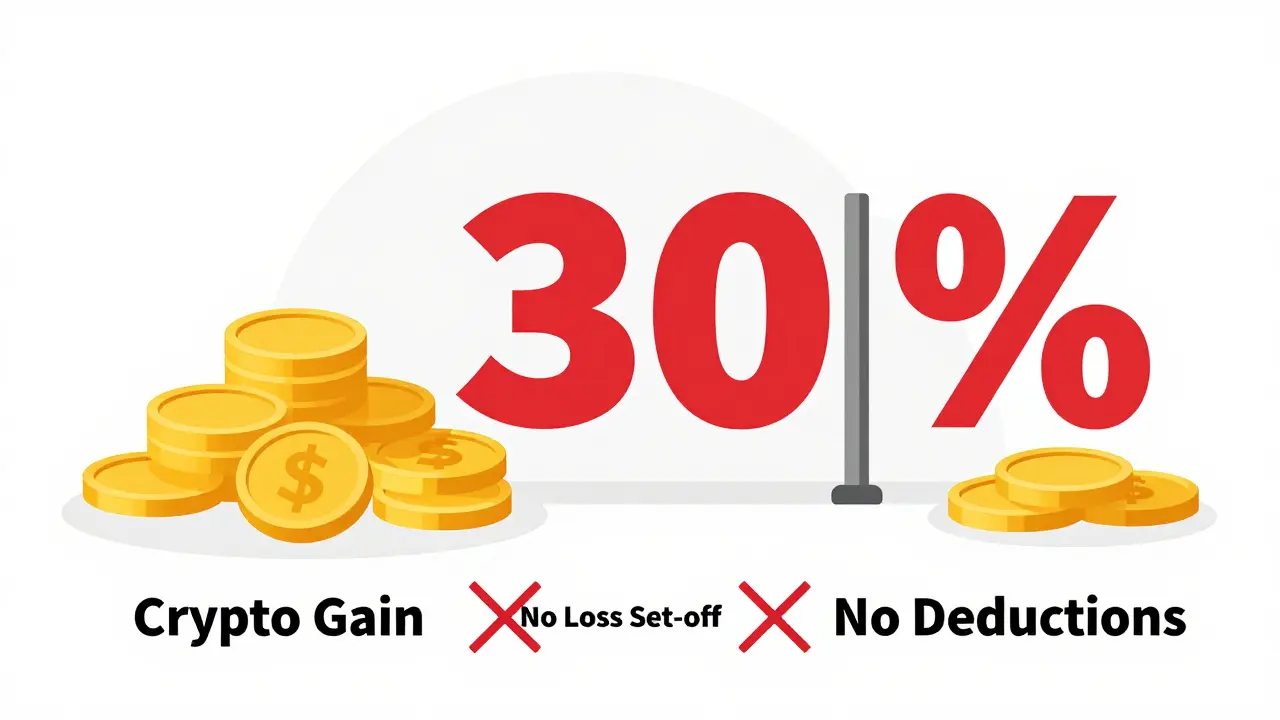
Here is the part that hurts most investors. When you sell a VDA for a profit, the gain is taxed at a flat 30% under Section 115BBH of the Income Tax Act. This rate applies regardless of your income slab. Whether you earn ₹5 lakhs or ₹50 lakhs a year, the tax on your crypto gains stays the same.
There are no deductions allowed except for the cost of acquisition. Let’s say you bought Bitcoin for ₹10 lakh and sold it for ₹15 lakh. Your taxable gain is ₹5 lakh. You pay 30% on that ₹5 lakh. That’s ₹1.5 lakh in tax. Simple, right? Well, almost. Here is where it gets tricky:
- No Expense Claims: You cannot deduct transaction fees, gas fees, mining electricity costs, or wallet storage fees. Only the purchase price counts.
- No Loss Set-off: If you lost ₹2 lakh on Ethereum but gained ₹5 lakh on Bitcoin, you cannot net them out. You pay 30% on the full ₹5 lakh gain. The loss sits there, unused.
- Carry Forward Losses: You can carry forward VDA losses for up to eight years, but only to offset future VDA gains. You cannot use them to reduce your salary tax liability.
This structure eliminates the complexity of short-term vs. long-term capital gains. Before 2022, holding crypto for over 36 months gave you indexation benefits, effectively lowering your tax rate. Those days are gone. The government wants simplicity and compliance, not tax planning tricks.
TDS on Crypto Transactions: Who Pays What?
To ensure you don’t hide transactions, the government introduced Tax Deducted at Source (TDS) on VDA transfers. This is handled by exchanges and platforms when you sell or swap assets. The threshold depends on who you are:
| Category | Annual Transaction Limit | TDS Rate |
|---|---|---|
| Non-Specified Persons | ₹10,000 | 1% |
| Specified Persons | ₹50,000 | 1% |
| No PAN Provided | Any amount | 20% |
A "specified person" is someone with lower business turnover-individuals or HUFs with annual business turnover ≤ ₹1 crore or professional gross receipts ≤ ₹50 lakhs. If you’re a regular salaried employee with no side business, you likely fall here. Exchanges like CoinDCX or WazirX will automatically deduct this 1% when you withdraw or sell. Make sure your PAN is linked to your exchange account. If you forget, the TDS jumps to 20%, which can cripple your cash flow.
Note that Section 206AB provisions, which previously mandated higher TDS for non-filers, were omitted effective April 1, 2025. However, failing to file returns still carries heavy penalties, so don’t treat this as a free pass.
Filing Your Returns: Schedule VDA & Documentation
You cannot hide crypto transactions from the Income Tax Department. All VDA gains must be reported in Schedule VDA, which is a mandatory section in ITR-2 and ITR-3 forms for reporting virtual asset transactions. You need to provide four key details for each transaction:
- Acquisition Date: When did you buy or mine the asset?
- Transfer Date: When did you sell or swap it?
- Cost of Acquisition: How much INR did you spend to get it?
- Full Value of Consideration: How much INR did you receive upon sale?
If you traded crypto-to-crypto (e.g., BTC for ETH), you must convert both values to INR using exchange rates from notified platforms like CoinDCX or WazirX at the time of transaction. This creates a taxable event even if you didn’t touch fiat currency. Many users miss this step, leading to notices later.
Keep your records tight. The National Institute of Securities Markets (NISM) reports that 65% of tax disputes stem from poor record-keeping. Save exchange statements, wallet addresses, and blockchain transaction hashes. If you mined coins, treat the initial receipt as business income (taxed at your slab rate) and subsequent sales as VDA gains (30%). Mixing these up is a common error cited in 28% of tax notices issued in FY2023-24.
How the Income Tax Act 2025 Changes Things
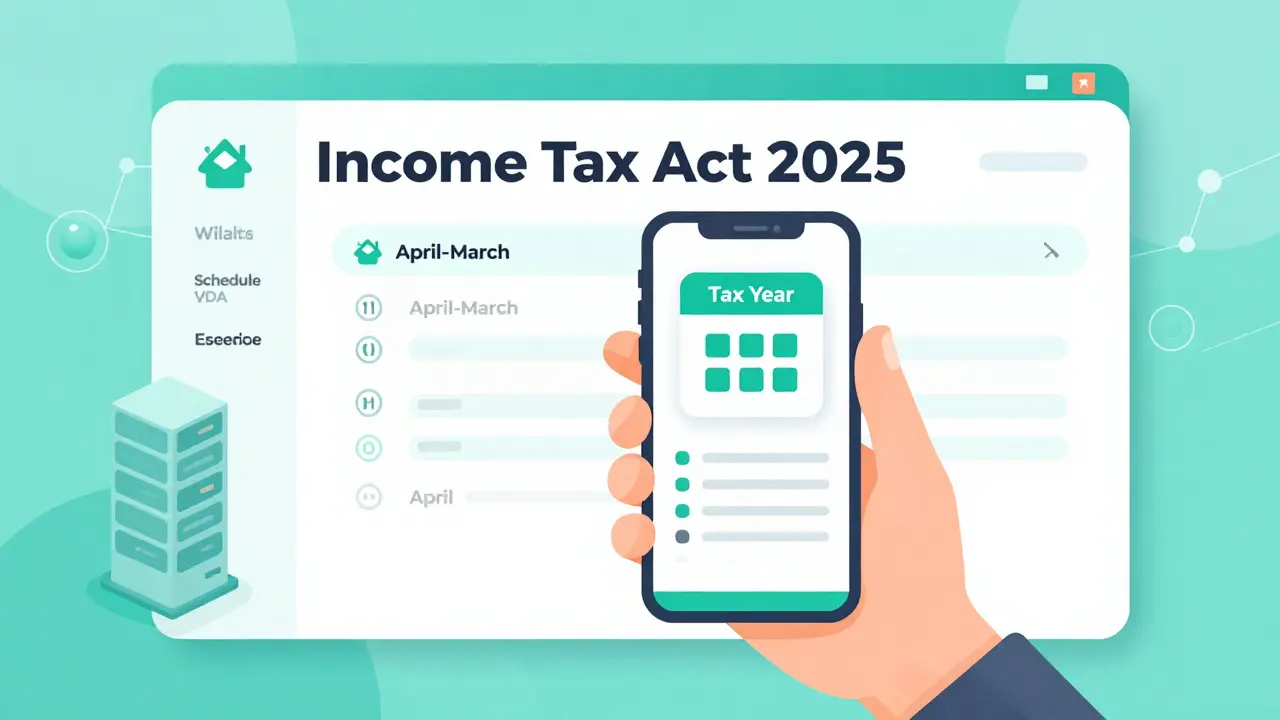
The landscape shifted again with the Income Tax Act, 2025, which received presidential assent in August 2025 and replaced the financial year with 'Tax Year' assessments. While the 30% tax rate remains unchanged, the administration has become more digital and streamlined.
The biggest change is the introduction of "Tax Year" as the assessment period, moving away from the traditional April-March financial year cycle. This aligns India closer to global standards and simplifies cross-border reporting. The Act also formalizes VDA definitions and creates specialized dispute resolution channels for crypto-related cases. Expect faster processing times but stricter automated audits.
Finance Minister Nirmala Sitharaman stated in her budget speech that the framework aims for 15% annual VDA tax revenue growth through 2030. This means the government is doubling down on compliance. With ICRA forecasting VDA tax revenues to hit ₹9,200 crore by FY2025-26, the scrutiny will only intensify. Platforms are now required to integrate directly with tax databases, making anonymous trading nearly impossible.
Real-World Impact: What Experts Say
Is this system fair? Opinions are sharply divided. Pankaj Nahta, Founder of Tax2Win, argues that the 30% rate with minimal deductions makes crypto economically unviable for all but speculative traders. He notes that net returns often drop below bank fixed deposit yields after taxes for annual gains under 45%.
On the flip side, Dr. S. Rajeesh of Kerala University points out that the framework reduces compliance costs by 60-70% compared to previous ad-hoc interpretations. The CBDT collected ₹3,920 crore in FY2023-24, exceeding projections by 27%. For professional traders, the predictability is a relief. One top contributor on TradingQ&A.com noted that the flat rate saves 8-10 hours monthly in tax planning.
Institutional investors have reacted differently. A KPMG India survey found that 68% of institutional players reduced their Indian crypto exposure by over 50% post-implementation. BlackRock’s India portfolio manager publicly stated that the tax structure makes India non-competitive for global crypto allocation, potentially costing $2.1-3.4 billion in FDI annually. Yet, retail participation remains strong. Chainalysis data shows India ranked 20th globally in crypto adoption in 2023, with $221 billion in transaction volume between 2021-2023.
Strategies to Minimize Your Tax Burden
You can’t avoid the 30% tax, but you can manage it smarter. Here are practical steps used by savvy investors:
- Gifting Assets: Transfer VDAs to family members in lower tax brackets. Gifts to relatives are not taxable events for the giver, though the recipient inherits the original cost basis.
- Hold Long-Term: While there’s no tax break for holding longer, volatility decreases over time. Fewer trades mean fewer taxable events and less TDS friction.
- Use Bitcoin ETFs: Some investors convert crypto holdings to Bitcoin ETFs before year-end. These may be taxed as securities rather than VDAs, offering potential arbitrage opportunities. Consult a CA before attempting this.
- Maintain Impeccable Records: Use tools like Koinly or CoinTracker to auto-track transactions. Manual errors lead to penalties that far exceed the software cost.
Avoid offshore platforms thinking they’ll escape scrutiny. FIU-IND monitors Anti-Money Laundering (AML) compliance under PMLA 2002, requiring all VDA platforms to verify identities and report transactions above ₹10 lakh. Cross-border data sharing is increasing, making evasion riskier than ever.
Can I claim losses from crypto trading against my salary income?
No. Under current Indian tax laws, losses from Virtual Digital Assets cannot be set off against any other head of income, including salary, house property, or business income. You can only carry forward these losses for up to eight years to offset future VDA gains.
Do I need to pay tax if I swap one cryptocurrency for another?
Yes. Swapping crypto-to-crypto (e.g., BTC for ETH) is treated as a transfer event. You must calculate the gain or loss based on the INR value of the asset received minus the cost of acquisition of the asset given up. This triggers capital gains tax liability.
What happens if I don't declare my crypto transactions in my ITR?
Failure to declare VDA transactions can lead to severe penalties, including fines up to 10% of the tax evaded and imprisonment for up to three years. With increased data sharing between exchanges and the Income Tax Department, undeclared transactions are increasingly detected during automated audits.
Is mining cryptocurrency considered business income or VDA gain?
Mining rewards are initially treated as business income and taxed at your applicable slab rate plus surcharge and cess. When you later sell the mined coins, the difference between the selling price and the market value at the time of receipt is taxed as VDA gain at 30%.
Will the 30% tax rate change in the near future?
The Income Tax Act 2025 maintains the 30% flat rate. Government officials have indicated this framework is stable through 2030 to ensure consistent revenue collection. Any changes would likely involve administrative improvements rather than rate reductions.
Leave a comments