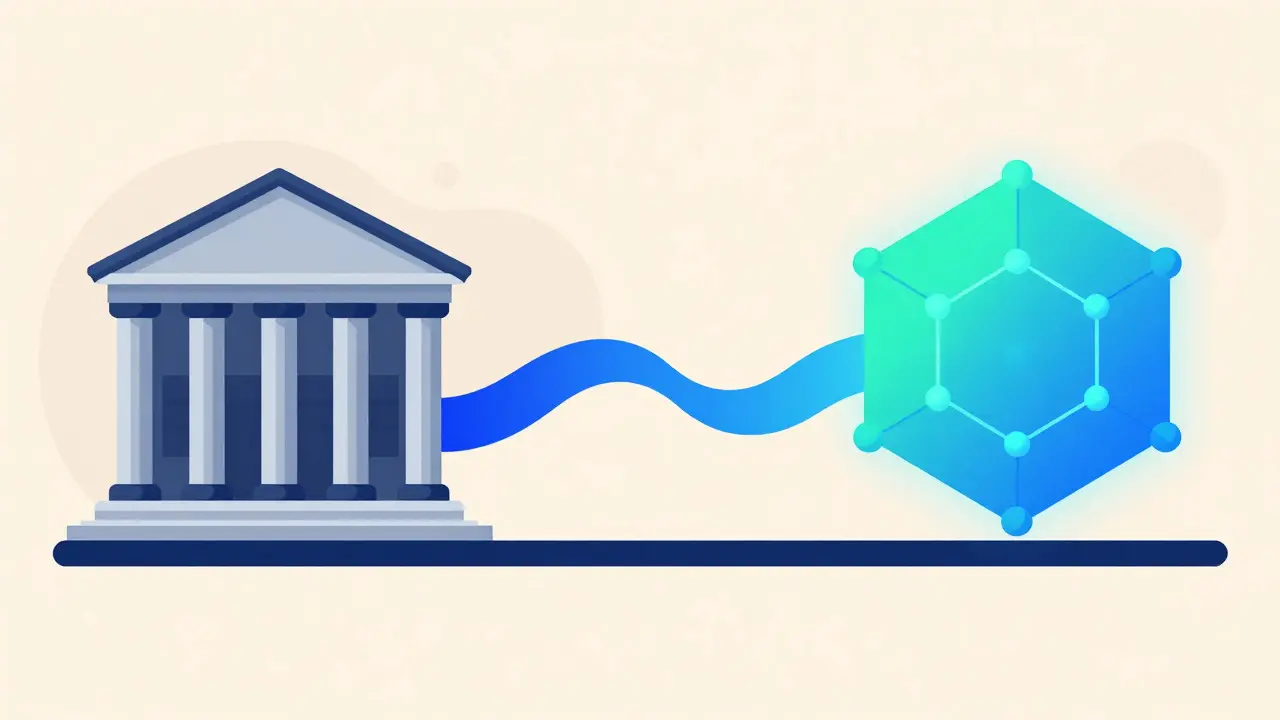
Imagine holding a piece of Wells Fargo without opening a brokerage account. That is exactly what the Wells Fargo Tokenized Stock (Ondo) offers. Tickered as WFCon, this asset lets you track the value of WFC shares on the blockchain. It is not a traditional coin like Bitcoin; it is a digital mirror of a real-world bank stock. Created by Ondo Finance, WFCon allows global investors to gain economic exposure to U.S. banking giants while staying within the crypto ecosystem.
What Exactly Is WFCon?
At its core, WFCon is a Real-World Asset (RWA) token. Think of it as a digital receipt for a share of Wells Fargo stock. However, there is a catch: you do not own the actual stock directly. Instead, you hold a smart contract claim that mirrors the price movement and dividend reinvestment of the underlying shares. This structure is designed for non-U.S. investors who find traditional U.S. brokerage accounts cumbersome or inaccessible. By using Ethereum technology, WFCon enables 24/5 trading, meaning you can buy or sell your exposure during times when traditional markets are closed.
- Issuer: Ondo Finance
- Underlying Asset: Wells Fargo & Company (WFC) Common Stock
- Blockchain: Ethereum (ERC-20 standard)
- Primary Use Case: Global access to U.S. equity markets via crypto
How the Tokenization Works
The mechanism behind WFCon relies on a custodial model. Ondo Finance holds the actual Wells Fargo shares in a traditional custody account off-chain. On-chain, a smart contract issues WFCon tokens that represent fractional claims to those holdings. When you buy WFCon, your money goes into the pool that buys more WFC stock. Conversely, when you redeem, the pool sells stock and pays you out in stablecoins. This "distributed" tokenization type means that no single token equals one full share; rather, the total supply adjusts based on investor demand and the value of the underlying assets.
This setup creates a bridge between DeFi and TradFi. You get the liquidity and composability of Ethereum-like using your WFCon in decentralized applications-without the administrative headache of managing a U.S. tax residency or brokerage paperwork. The dividends from Wells Fargo are automatically reinvested into the structure, compounding your economic exposure over time. This is a key differentiator from simple price-tracking tokens that ignore income streams.
Market Metrics and Current Status
As of mid-2026, WFCon remains a niche but active instrument. It does not compete with major cryptocurrencies in terms of market cap, sitting in the low millions of dollars range. Specifically, the circulating supply hovers around 15,000 tokens. With each token priced typically between $85 and $95, the total market capitalization lands between $1.2 million and $1.35 million. These figures indicate a specialized product rather than a mass-market asset.
| Metric | Value/Range | Note |
|---|---|---|
| Circulating Supply | ~15,000 tokens | Dynamic based on mint/redemption |
| Price Range | $85 - $95 USD | Tracks WFC stock + dividends |
| Market Cap | $1.2M - $1.35M | Niche RWA segment |
| Daily Volume | $50K - $500K+ | Varies by exchange activity |
| Volatility | Low-Moderate | Mirrors large-cap equity moves |
Price volatility for WFCon is significantly lower than typical altcoins. Since it tracks a blue-chip bank, daily swings are usually under 2%, reflecting the stability of Wells Fargo's stock price. However, multi-month trends can see swings of 10-30%, aligning with broader financial sector performance. For example, in late 2025, the token saw a dip to the mid-$70s before recovering, mirroring the underlying WFC share price movements.

Where to Trade WFCon
Liquidity for WFCon is concentrated on a few centralized exchanges and through wallet integrations. If you want to trade quickly, centralized venues are your best bet. MEXC and BitMart are primary hubs where WFCON/USDT pairs are actively traded. Spreads on these platforms are generally tight, ranging from 0.5% to 1.2%, making them suitable for retail traders.
For those preferring self-custody, MetaMask supports WFCon directly. This allows you to manage your tokens on-chain, swap them via integrated DEXs, or hold them long-term without relying on an exchange. Note that availability may vary; some platforms like Crypto.com list the price but do not yet support direct trading, so always check your specific app's capabilities before attempting a purchase.
Risks and Considerations
While WFCon offers unique access, it introduces layers of risk beyond just stock market fluctuations. First, there is issuer risk. You are trusting Ondo Finance to manage the underlying assets correctly. If Ondo faces legal or operational issues, your token could be affected. Second, regulatory uncertainty looms. Because WFCon provides economic exposure without direct ownership, it operates in a gray area for some jurisdictions. Additional restrictions may apply depending on where you live.
Smart contract risk is also present. Since WFCon lives on Ethereum, any bug in the contract code could theoretically impact token holders. Finally, liquidity risk exists due to the small float. In times of high stress, buying or selling large amounts of WFCon might move the price more than expected compared to highly liquid assets like Ethereum or USDT. Always cross-check data across multiple sources like CoinGecko and RWA.xyz, as minor discrepancies in reported supply and price are common in this emerging sector.
Why Investors Choose WFCon
The appeal of WFCon lies in its simplicity and accessibility. For international investors, setting up a U.S. brokerage account involves tax forms, address verification, and currency conversion hurdles. WFCon bypasses much of this friction. You can mint or redeem tokens against traditional exchange liquidity, effectively getting instant access to U.S. banking stocks. Furthermore, the integration with the Ethereum ecosystem opens doors to DeFi strategies. You could potentially use WFCon as collateral in lending protocols or participate in yield-farming opportunities, something impossible with traditional shares held in a bank account.
Ondo Finance’s inclusion in the DTCC Industry Working Group on tokenization signals strong institutional backing. Alongside giants like BlackRock and JPMorgan, Ondo is helping shape the standards for how traditional assets move on-chain. This validation suggests that products like WFCon are part of a larger, maturing infrastructure rather than a fleeting experiment. As the $114 trillion tokenization opportunity unfolds, WFCon serves as a practical example of how blue-chip equities can be made globally accessible through blockchain technology.
Frequently Asked Questions
Do I get voting rights with WFCon?
No. WFCon holders have economic exposure to Wells Fargo stock, including dividend reinvestment, but they do not hold direct legal shareholder rights such as voting at annual meetings. The rights remain with the entity holding the underlying shares.
Which blockchain does WFCon operate on?
WFCon operates on the Ethereum blockchain. It follows the ERC-20 token standard, which allows it to be used in most Ethereum-compatible wallets and decentralized applications.
Is WFCon available to all investors?
Primarily, yes, but with caveats. It is designed for non-U.S. retail and institutional investors. However, specific regulatory restrictions may apply in certain jurisdictions, so you should verify local compliance rules before purchasing.
How does the dividend reinvestment work?
Dividends paid by Wells Fargo on the underlying shares are automatically reinvested into the tokenized structure. This increases the total economic value represented by the existing WFCon tokens, effectively boosting your exposure over time without you needing to take action.
Can I store WFCon in MetaMask?
Yes. MetaMask natively supports WFCon, allowing you to view, send, receive, and swap the token directly within the wallet interface. This provides a self-custody option for users who prefer not to keep assets on centralized exchanges.
Sarah Campbell
21 08 26 / 00:29 AMFinally someone talking about real assets instead of just another memecoin 🇺🇸. I have been holding WFC for years and this is the only way my cousins in Europe can get in without jumping through hoops.
Lance Konig
21 08 26 / 06:46 AMTo be precise, the "digital receipt" analogy is flawed because you do not hold legal title to the shares; you hold a contractual claim against Ondo Finance. The distinction matters significantly when considering bankruptcy remoteness. If Ondo were to face insolvency proceedings, your WFCon tokens would likely become unsecured claims rather than direct equity ownership, which is a critical nuance often overlooked in these simplified guides. Furthermore, the ERC-20 standard implies compatibility with DeFi protocols, but most major lending markets currently exclude RWA tokens due to regulatory ambiguity, so the composability argument is largely theoretical at this stage. One must also consider the tax implications of holding foreign-listed or tokenized equities, as the IRS may treat these differently from traditional brokerage holdings depending on future guidance. The dividend reinvestment mechanism is automated on-chain, but the actual cash flow still passes through a custodian, introducing counterparty risk that does not exist in a direct stock purchase. Liquidity is indeed thin, as noted by the $50K daily volume, meaning large exits could result in significant slippage compared to trading WFC directly on NYSE. The mention of BlackRock and JPMorgan in the DTCC group is marketing fluff; their presence signals interest in the sector, not endorsement of this specific product. Investors should verify the custody arrangements with a qualified attorney before committing capital. The volatility profile mirrors the underlying asset, but the bid-ask spread on secondary markets adds an extra layer of cost. This instrument is best suited for high-net-worth individuals seeking diversification, not retail traders looking for quick gains. The 24/7 trading feature is a double-edged sword, as it exposes holders to weekend news shocks without the protection of market halts. Regulatory clarity remains the biggest hurdle, with the SEC watching closely how these RWAs are marketed. Until the legal framework solidifies, treat WFCon as a speculative bet on infrastructure adoption. The low market cap indicates limited institutional participation so far. It is a fascinating experiment in financial engineering, but one should proceed with caution.
Patrick Quairoli
21 08 26 / 12:24 PMWait wait wait... so we trust some random crypto company called Ondo to hold our bank stocks? Sounds like a setup to me. Remember FTX? They said they held the coins too. Now they hold WFC shares off-chain. What if the CEO runs away with the keys? Its all a con! The elites are trying to trap us in these digital cages while they print money. Wake up sheeple! 🚨
Dina Lazarova
22 08 26 / 07:13 AMOne might observe that the excitement surrounding such niche instruments often masks a fundamental lack of understanding regarding basic portfolio theory. For the discerning investor, the question is not merely *can* one access Wells Fargo via Ethereum, but *should* one bear the additional layers of smart contract and issuer risk for marginal convenience? The fee structure alone, when aggregated over time, likely erodes any potential alpha generated by the underlying equity. It is a quaint attempt at democratization, yet it serves primarily to enrich the intermediaries who built the bridge.
Alexander Scheel
24 08 26 / 02:09 AMIt is truly remarkable how quickly society embraces complex financial derivatives while ignoring the moral implications of fractionalizing ownership of institutions that have historically profited from predatory lending practices. One wonders if the ethical weight of holding a "token" differs from holding a share, or if we simply prefer the abstraction. Perhaps we are not investing in banks, but in the narrative of technological progress itself.
Evelyn Kula
24 08 26 / 23:39 PMThis is exactly why America needs more innovation! 🇺🇸 While Europe is stuck in red tape, we are building the future. But let's be honest, the SEC is probably circling like vultures waiting to shut this down. Typical government interference. These guys at Ondo are doing the work that regulators won't. Just watch out for the hidden fees though, always check the fine print. 📉
manish jha
26 08 26 / 01:27 AMIn my experience, true wealth is not found in chasing trends but in understanding the fundamental value of assets. Many young investors today look at blockchain and see magic, but it is merely a ledger. The bank remains the same entity regardless of the wrapper. Do not confuse the map for the territory. Discipline is key.
alex fordy
27 08 26 / 19:30 PMI think there's a lot of valid points here about the convenience for non-US folks. I've always wanted to diversify into US equities but the paperwork was a nightmare. 😊 Does anyone know if the gas fees on Ethereum make small trades impractical right now?
Sonia Gomez Gomez
29 08 26 / 10:53 AMYou really need to stop hiding behind pseudonyms and admit you're just afraid of change. It's obvious you don't understand how modern finance works. We are entering a new era and those who resist will be left behind. Face the music!
SHIV SHANKAR KANTA
31 08 26 / 05:11 AMThe soul of the market is not in the coin but in the belief of the holder. When you buy WFCon you are not buying a stock you are buying a piece of the American dream wrapped in code. The pain of regulation is the price of freedom. Embrace the chaos.
Daniel Brown
31 08 26 / 06:56 AMJust checked the liquidity depth on MEXC and it's surprisingly decent for a token with $1.3M market cap. You can move $5k in size without moving the needle more than 0.2%. This is better than many mid-cap alts. The spreads are tight because the arbitrage bots are already working the WFC spot price. If you are holding long term, the dividend compounding effect is actually quite powerful if you ignore the exit friction. I'd recommend keeping a portion in MetaMask for self-custody peace of mind.
Marco Maldonado
1 09 26 / 01:31 AMStop acting like its complicated. Its just a stock. Why do we need lawyers to explain a simple exchange? The only reason this exists is because the old guard wants to keep you poor. Buy the dip. Trust the process. 🇺🇸
Darren Moon
2 09 26 / 20:06 PMFrom a purely structuralist perspective, the integration of Real World Assets into the Ethereum ecosystem represents a fascinating convergence of heterogeneous liquidity pools. However, the reliance on a centralized custodian undermines the decentralization thesis somewhat. One must consider the systemic risk introduced by bridging TradFi and DeFi without adequate isolation mechanisms. The 'composability' mentioned in the guide is largely aspirational until major DeFi blue chips accept RWAs as collateral. Until then, it remains a siloed product with limited utility beyond price tracking. The volatility mismatch between the underlying equity and the tokenized version during periods of extreme stress could lead to significant dislocation events. It is a curious artifact of our current financial experimentation phase.
Quang Thai Tran
3 09 26 / 02:04 AMLet us examine the data with rigorous scrutiny. The correlation coefficient between WFCon and WFC has been near-perfect since inception, suggesting efficient pricing. However, the beta factor appears slightly elevated during high-volatility regimes, indicating that the token may amplify downside moves due to liquidity constraints. This is consistent with the behavior of thinly traded derivative instruments. The issuance model relies on continuous rebalancing, which requires active management by the issuer. Any delay in minting or redemption could create arbitrage opportunities for sophisticated players. The regulatory environment in Canada is evolving, but cross-border compliance remains a headache. One must monitor the DTCC standards closely as they will dictate the viability of this entire class of assets.
Dianne Ritter
3 09 26 / 16:24 PMI appreciate the balanced view in the article. It seems like a solid option for people who want exposure without the hassle. I'm just glad we have options now.
Kate Staab
5 09 26 / 14:49 PMOh, how delightful. Another chance for the masses to gamble their savings on a digital promise. I suppose if you enjoy the thrill of uncertainty, this is your playground. Just remember, the house always wins, whether it's a casino or a blockchain protocol. 💅
Calliope Clio
6 09 26 / 01:32 AMOMG this is so cool!! I bought some yesterday and felt like a total pro trader. 🚀 The fact that I can use it in DeFi later is amazing. Who else is riding this wave? Let's gooo! 🔥
OLIVER CHRISTIAN
7 09 26 / 06:45 AMWelcome to the thread! It's great to see so much discussion around RWA tokenization. For those new to this, I'd suggest starting with a small position to get comfortable with the wallet mechanics. Make sure you have a backup plan for your seed phrase. The community here is generally helpful, so don't hesitate to ask if you get stuck. Happy investing! 🌟
Kelsey Anne
7 09 26 / 11:30 AMRead the docs. Check the audit. Don't be lazy.