Imagine finding a digital currency that promises total anonymity, uses less energy than Bitcoin, and lets you stake without revealing your balance. Sounds like the holy grail of privacy coins, right? That was the pitch for ALIAS, a cryptocurrency designed to offer robust financial privacy through advanced cryptography. But if you are looking at ALIAS today in May 2026, you need to look past the marketing and face the cold, hard data. The reality is starkly different from the promise.
ALIAS is technically still alive, but it is functionally dead in terms of market relevance. It sits outside the top 5,800 cryptocurrencies by market cap, with a trading volume so low that moving even $50 worth of tokens can trigger massive price swings. For most people asking "What is ALIAS crypto?", the answer isn't about its technology-it's about why you should probably avoid it unless you are a collector of obscure digital assets or a researcher studying failed blockchain projects.
The Privacy Promise: How ALIAS Works
To understand where ALIAS went wrong, you first have to understand what it tried to do right. When it launched, ALIAS aimed to solve the biggest problem with early cryptocurrencies: transparency. In blockchains like Bitcoin, every transaction is public. If someone knows your wallet address, they can see your entire financial history. ALIAS wanted to fix this.
The project relies on three main technical pillars:
- Ring Signatures: This technology mixes your transaction signature with others, making it impossible to trace which specific user initiated the transfer. It’s like hiding in a crowd where everyone wears the same mask.
- Tor + OBFS4 Integration: Unlike many coins that rely on users to manually route their traffic through Tor, ALIAS built this directly into its wallet. This obfuscates your IP address, adding a network-level layer of anonymity.
- Proof-of-Anonymous-Stake (PoAS): Activated in a major hard fork in May 2019, this consensus mechanism allows users to earn rewards by staking their coins without revealing their identity or balance. It’s an energy-efficient alternative to the mining-heavy Proof-of-Work used by Bitcoin.
On paper, this stack looks impressive. It combines cryptographic privacy with network-level anonymity and an eco-friendly consensus model. However, technology alone doesn’t build a successful currency. You need users, merchants, and liquidity. ALIAS has none of these.
The Market Reality: A Zombie Coin?
Let’s talk numbers, because they tell the real story. As of late 2025 and carrying into 2026, ALIAS trades with a market capitalization of roughly $2.4 million. To put that in perspective, Bitcoin’s market cap is over $1 trillion. ALIAS represents less than 0.0001% of the total crypto market value.
But market cap is only half the story. Liquidity is the other, and here is where ALIAS fails completely. Daily trading volumes often dip below $1,000. What does that mean for you? If you try to buy or sell a significant amount, you will experience extreme slippage. One user reported trying to trade $50 and losing 15% of their value due to the thin order book. That is not investing; that is gambling against the exchange itself.
| Metric | ALIAS (ALIAS) | Monero (XMR) | Zcash (ZEC) |
|---|---|---|---|
| Market Cap | ~$2.4 Million | ~$2.8 Billion | ~$520 Million |
| Daily Volume | <$1,000 | $50M+ | $10M+ |
| Exchange Listings | 6 (mostly obscure) | 120+ | 50+ |
| Community Activity | Negligible | Very High | High |
This table highlights the chasm between ALIAS and its competitors. Monero and Zcash dominate the privacy sector because they have actual usage. People use them. Developers update them. Regulators watch them. ALIAS is invisible to all three.
Why Did ALIAS Fail?
ALIAS wasn’t always this way. Back in January 2018, it hit an all-time high of $6.74 per coin. Today, it hovers around $0.06-$0.08, representing a 98.85% drop from its peak. So, what happened?
1. Lack of Differentiation
When ALIAS launched, it entered a market already crowded with better-funded, more established players. Monero had been around since 2014 and had a fiercely loyal community. Zcash had strong academic backing and institutional interest. ALIAS offered similar features but couldn’t convince users to switch. In crypto, network effects are everything. Once a standard is set, it is incredibly hard to displace it.
2. Development Stagnation
A healthy crypto project needs constant updates. Security patches, feature improvements, and community engagement keep a project alive. Look at the GitHub repository for ALIAS. In the last 12 months leading up to late 2025, there were only three minor commits. Compare that to Monero, which sees dozens of updates monthly. The team behind ALIAS effectively stopped innovating years ago. The last major upgrade was the PoAS implementation in 2019. Since then, it has been maintenance mode at best.
3. Regulatory Pressure
Privacy coins have faced increasing scrutiny from governments worldwide. Exchanges like Binance and Coinbase have delisted several privacy-focused tokens to comply with anti-money laundering (AML) regulations. While ALIAS wasn’t explicitly banned everywhere, the general crackdown made it harder for such small projects to maintain listings. With only six active markets left, it is nearly impossible for new users to find a reliable place to buy or sell.
Can You Still Use ALIAS?
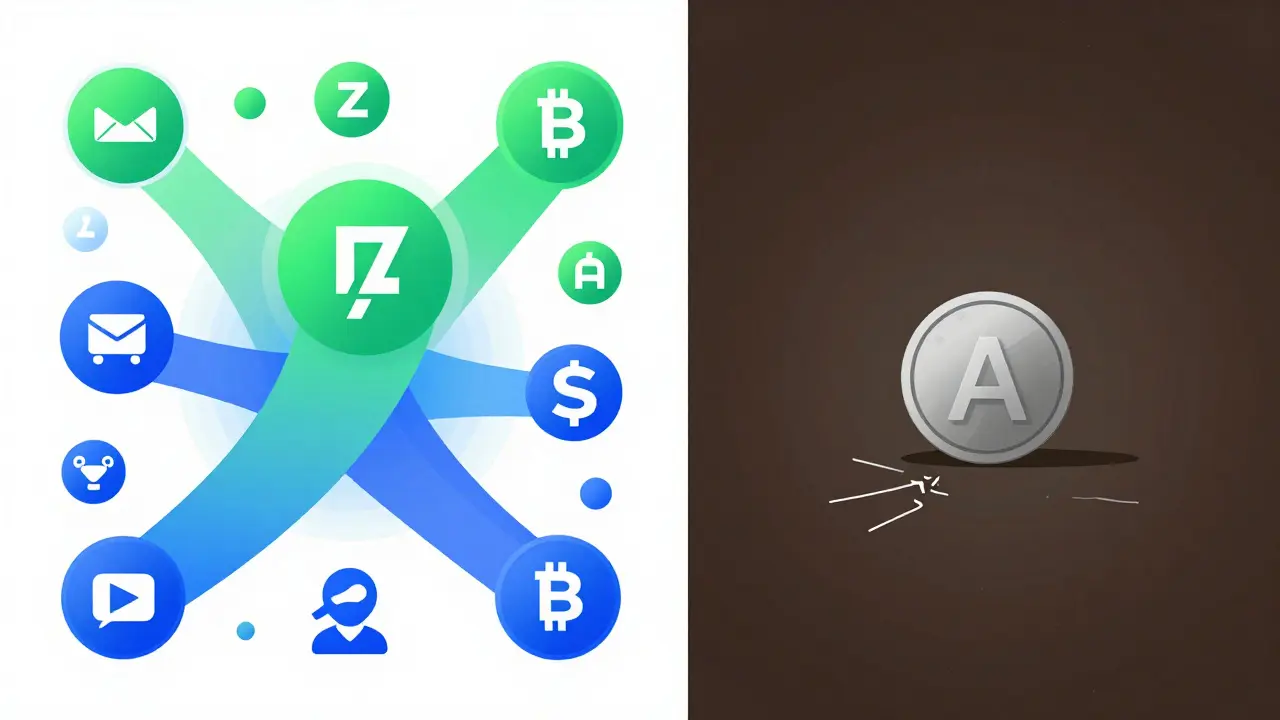
Technically, yes. You can download the Android wallet, sync it to the blockchain, and hold your coins. The wallet supports mobile staking, which is a nice feature if you believe the price will go up. But here is the catch: how do you get your money out?
If you hold ALIAS, you are essentially holding a collectible item rather than a liquid asset. Selling it requires navigating obscure decentralized exchanges or peer-to-peer deals, both of which carry high risks of fraud or unfavorable pricing. The lack of merchant acceptance means you cannot spend it anywhere. There are no gift cards, no payment processors, and no services that accept ALIAS.
Furthermore, the wallet experience is far from polished. Users have reported synchronization issues and battery drain problems on mobile devices. Without an active development team fixing bugs, these issues persist indefinitely.
Is ALIAS a Scam?
This is a common question for any coin that drops 99% in value. The short answer is: probably not a scam in the traditional sense, but certainly a failure. There is no evidence of a rug pull where developers stole funds and vanished overnight. The code is open-source, and the network still runs. However, the gap between the project’s promises and its delivery is vast.
Some critics argue that the continued existence of the token with minimal utility borders on deceptive, especially when exchanges like LBank describe it as "frequently traded" despite daily volumes under $300. This misrepresentation can lure inexperienced investors into thinking there is activity where there is none. Always verify data across multiple sources like CoinMarketCap, CoinGecko, and direct exchange APIs before trusting any platform’s description.
Who Should Care About ALIAS?
For the average investor, the answer is nobody. If you are looking for exposure to the privacy coin sector, Monero (XMR) remains the king. It has the largest market cap, the highest liquidity, and the strongest developer community. Zcash (ZEC) and Dash (DASH) are also viable alternatives if you want diversified privacy options.
However, ALIAS might interest two specific groups:
- Crypto Archaeologists: Researchers or historians who study the evolution of blockchain technology. ALIAS serves as a case study in how privacy features alone are insufficient without community building and regulatory navigation.
- Speculative Gamblers: Individuals willing to bet tiny amounts on "zombie coins" hoping for a random pump. Remember, this is not investing. It is lottery ticket buying. The odds of ALIAS recovering to its 2018 highs are virtually zero given the current landscape.
Final Thoughts on ALIAS in 2026
ALIAS started with a noble goal: giving people true financial privacy. Its technology-ring signatures, Tor integration, and anonymous staking-is sound. But in the world of cryptocurrency, technology is just the starting line. Success requires adoption, liquidity, and continuous development. ALIAS lost that race years ago.
Today, it exists in a gray area between obsolete and extinct. It is too small to matter in the broader market, too illiquid to trade safely, and too stagnant to innovate. If you encounter ALIAS in your research, treat it as a cautionary tale. It reminds us that in crypto, being first or having good tech isn’t enough. You need a living, breathing ecosystem to survive.
Is ALIAS crypto safe to store?
From a security standpoint, the ALIAS blockchain itself is secure due to its proof-of-stake mechanism and encryption standards. However, "safety" also includes usability and support. Since the development team is largely inactive, any vulnerabilities discovered in the wallet software may never be patched. Additionally, storing assets with no liquidity means you cannot easily exit your position if needed, which poses a financial risk rather than a technical one.
Where can I buy ALIAS in 2026?
Buying ALIAS is difficult. It is listed on very few exchanges, mostly smaller or regional platforms. Major exchanges like Coinbase or Binance do not list it. You may find pairs on obscure decentralized exchanges or niche centralized platforms, but expect high fees and significant slippage. Always check current listings on aggregators like CoinMarketCap before attempting a purchase.
Buying ALIAS is difficult. It is listed on very few exchanges, mostly smaller or regional platforms. Major exchanges like Coinbase or Binance do not list it. You may find pairs on obscure decentralized exchanges or niche centralized platforms, but expect high fees and significant slippage. Always check current listings on aggregators like CoinMarketCap before attempting a purchase.
What is the difference between ALIAS and Monero?
Both are privacy coins, but Monero is the industry leader with billions in market cap and widespread adoption. ALIAS is a micro-cap project with negligible trading volume. Technically, ALIAS integrates Tor directly into the wallet, while Monero users often run Tor separately. Monero has a vibrant, active development community, whereas ALIAS has seen almost no updates since 2019.
Will ALIAS price recover?
It is highly unlikely. For a cryptocurrency to recover from a 99% loss, it needs a catalyst-such as a major partnership, technological breakthrough, or surge in demand. ALIAS has none of these. Its development is stalled, and its user base has evaporated. Historical data shows that coins with such low liquidity and activity rarely make meaningful comebacks.
Is ALIAS legal?
Holding ALIAS is generally legal in most jurisdictions, but using it for transactions may violate local anti-money laundering laws depending on your country. Privacy coins face increased regulatory scrutiny globally. Some countries have banned exchanges from listing privacy coins entirely. Always consult local regulations before engaging with privacy-focused cryptocurrencies.
Tobias Gjerlufsen
21 05 26 / 10:21 AMyou people really think ring signatures are magic shields against the state? its cute. i studied cryptography back when it was actually a science not a marketing buzzword. alias is dead because the devs ran off with the liquidity and left you holding the bag of worthless tokens. stop pretending this has any utility.
Bijan Das
22 05 26 / 15:33 PMlol another zombie coin review. why do we even bother reading these trash posts about coins that dont exist anymore. its like writing a biography for a ghost. save your time and go buy some actual tech stocks or something useful.
Ashley Rodriguez
23 05 26 / 07:21 AMi mean i guess it makes sense that if nobody uses it then the volume drops but i always thought the privacy aspect was really interesting especially with the tor integration built right in which is pretty cool for people who care about anonymity so maybe there is still a niche for it somewhere even if its small
Bridget Coogle
23 05 26 / 18:09 PMits okay to feel disappointed by failed projects. learning from them helps us build better systems later. privacy is important though.
Zara Zaman
24 05 26 / 01:24 AMwhy should american taxpayers care about some obscure crypto project failing overseas. we have real issues here. focus on domestic blockchain innovation instead of digging up dead foreign coins.
Larry Port
24 05 26 / 06:19 AMthe technical stack was sound theoretically. proof of anonymous stake is an elegant solution to energy consumption while maintaining privacy layers. the failure was purely in community adoption and exchange listings. interesting case study in market dynamics versus technological merit.
Jocelyn Garcia
25 05 26 / 04:58 AMtbh the order book depth is just non existent. slippage kills any arbitrage opportunity instantly. its a liquidity trap. typical altcoin death spiral.
Amit Varpe
26 05 26 / 07:23 AMIndian devs could have made this work if they had proper support. Western exchanges killed it. Sad but true :/
Bronwen Butler
27 05 26 / 06:15 AMeveryone says monero is king but its centralized mining pools control it. alias was more decentralized in spirit. you all are sheep following the herd to xmr without questioning the narrative.
Pauline Larocco71
27 05 26 / 13:01 PMit reminds me of early days of internet when so many sites just vanished overnight. feels nostalgic in a sad way tho. hope someone preserves the code for history sake.