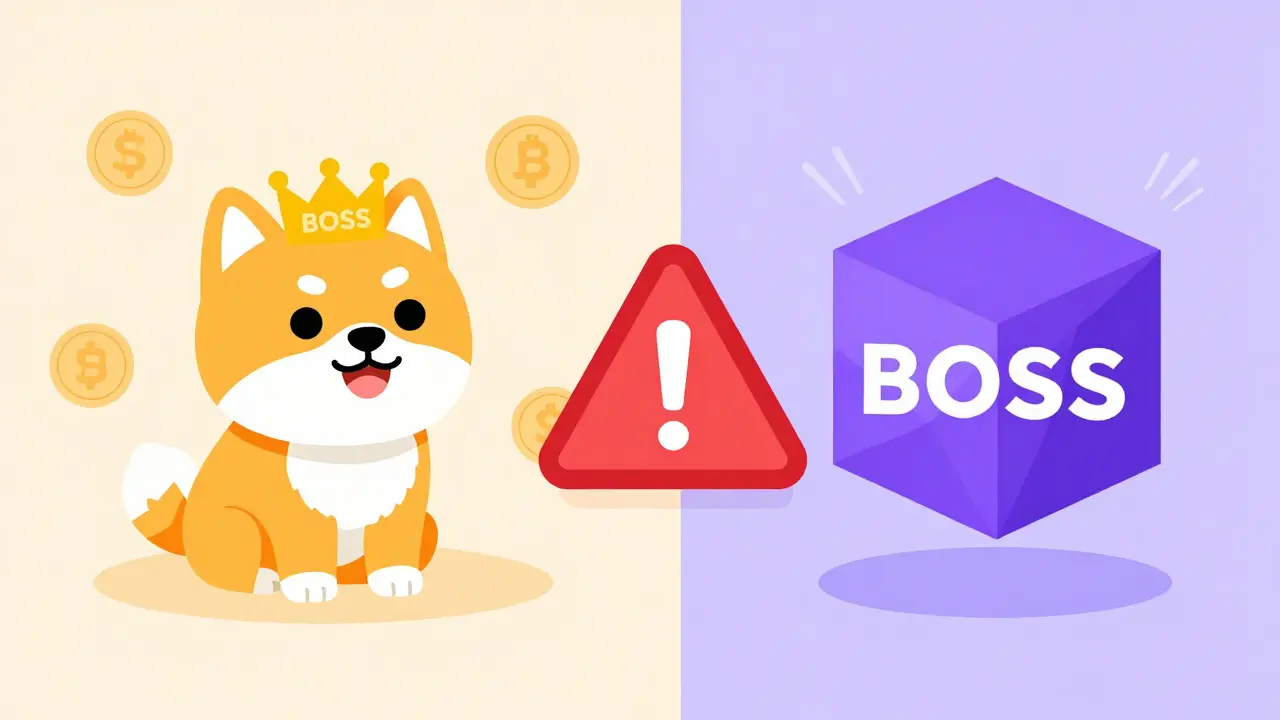
You’ve seen the ticker BOSS flash across your screen. Maybe it was on a price tracker, a social media feed, or a chat group buzzing about the next big thing. But before you click "buy," you need to know exactly what you are looking at. There is more than one cryptocurrency using this name, and mixing them up could cost you real money.
The main asset people refer to as Boss Token (BOSS) is a community-driven project built on the BNB Smart Chain (BSC). It positions itself as a meme coin with a specific ambition: to become the "boss" of dog-themed cryptocurrencies. However, it isn't just a joke coin; it uses complex decentralized finance (DeFi) mechanics like automatic rewards and deflationary burns to keep holders engaged.
Boss Token vs. Solana BOSS: Don’t Mix Them Up
The first rule of trading micro-cap coins is checking the address. The ticker "BOSS" is not unique. If you search for it without care, you might find two completely different projects.
The primary Boss Token we are discussing runs on BNB Smart Chain (formerly Binance Smart Chain). This is an Ethereum-compatible network known for low transaction fees. It is the home of most meme coins that rely on high-frequency trading and automated liquidity pools.
However, there is also a separate "BOSS" coin built on the Solana blockchain. This Solana-based version is a Web3 utility coin focused on speed and scalability. It has different tokenomics, a different team (or lack thereof), and trades in a different ecosystem entirely. Always verify if the contract address starts with a BSC identifier or a Solana seed phrase. For this guide, we focus on the BSC-based Boss Token, which dominates the search results on major aggregators.
How the Tokenomics Work: Rewards, Liquidity, and Burns
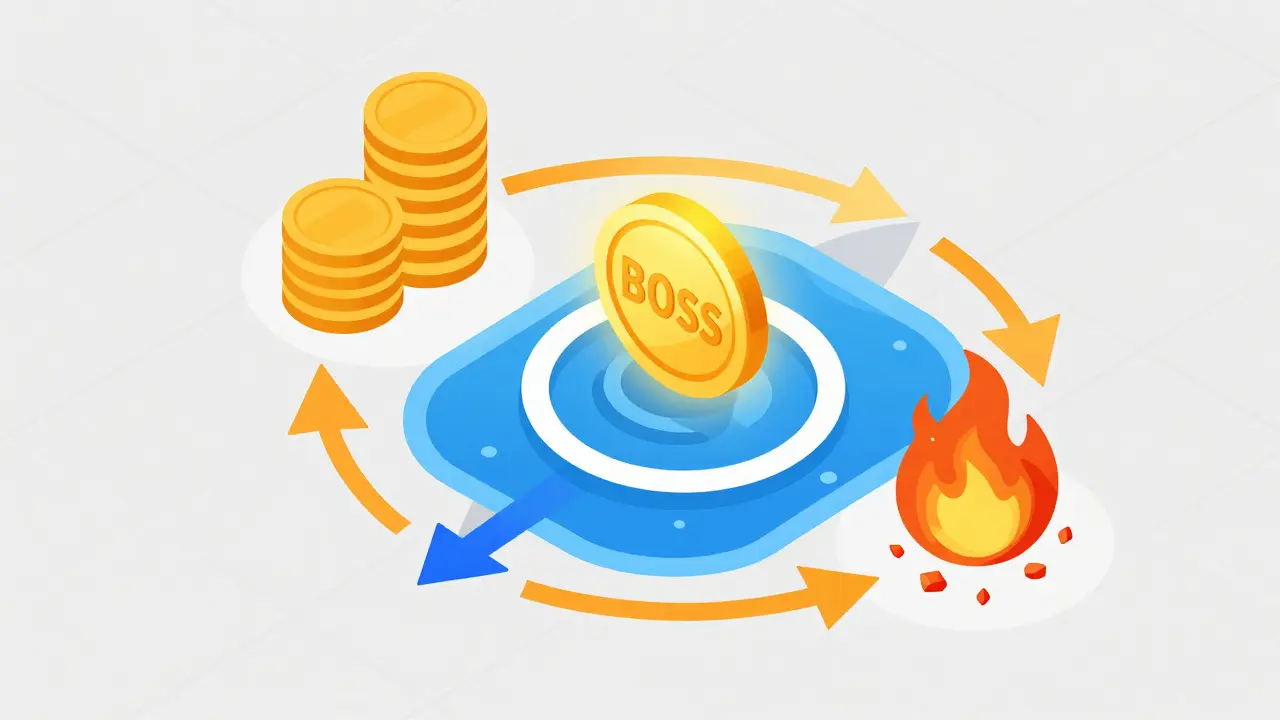
Boss Token doesn't just sit in your wallet; it moves every time someone else trades it. The project follows a popular model called "reflection" or RFI (Reflection Finance-style) tokenomics. Here is what happens behind the scenes during every single buy, sell, or transfer:
- Static Reward Redistribution: A portion of the transaction fee is automatically sent to all existing holders. If you hold BOSS, your balance grows passively as long as others are trading. You don’t need to stake anything; you just hold.
- Liquidity Acquisition: Another part of the fee is added to the liquidity pool on PancakeSwap v2. This helps stabilize the price and ensures there is enough BNB available for other traders to enter or exit positions.
- Deflationary Burning: Some sources indicate a third component where a small percentage of tokens is permanently burned. This reduces the total supply over time, theoretically increasing scarcity.
This system creates a feedback loop. More trading means more rewards for holders and deeper liquidity for traders. However, the exact percentages for these splits are not always publicly fixed in standard documentation, so they can vary based on the smart contract’s current state.
Supply and Market Reality
When you look at the numbers for Boss Token, they can be intimidating because of the sheer volume of digits. The maximum supply is capped at 1 quadrillion (1,000,000,000,000,000) BOSS. That is a lot of zeros.
At launch, the distribution was split according to their "woofpaper" (their informal whitepaper):
- 50% was sent to a burn wallet immediately (500 trillion tokens gone forever).
- 45% went to the community supply.
- 5% was reserved for development and marketing.
Today, the circulating supply hovers around 394 to 397 trillion BOSS. Because the unit price is microscopic-often fractions of a cent like $0.000000002-the market capitalization remains in the micro-cap range, typically between $500,000 and $900,000 USD. This classifies it as a high-risk, speculative asset. Prices can swing wildly based on small volumes of trade.
Where and How to Trade BOSS
You won’t find Boss Token on major centralized exchanges like Coinbase Pro, Kraken, or the main Binance spot market. It is a decentralized asset, meaning you have to interact directly with the blockchain.
The primary venue for trading is PancakeSwap, specifically the v2 router on BNB Smart Chain. To buy it, you generally need:
- A compatible wallet like MetaMask or Trust Wallet configured for BSC.
- BNB (the native currency of the chain) to pay for gas fees and swap for BOSS.
- Access to a DEX interface like PancakeSwap or the Binance Web3 Wallet portal.
Be aware that daily trading volume is often low, sometimes under $1,500. Low liquidity means your large buy orders could slip the price significantly, and selling large amounts might be difficult without crashing the price yourself.

Roadmap and Utility: Is There More Than Memes?
Meme coins usually survive on hype alone, but Boss Token claims to have a broader vision. The project describes ambitions beyond being the "boss of Dogcoins." They mention developing a decentralized application called Boss Track, designed to help users track portfolios across multiple chains, including Ethereum and BSC.
If delivered, this would shift BOSS from a pure speculation vehicle to a utility token powering a DeFi tool. They also hint at integrations with gaming and lending sectors. However, as of mid-2026, concrete updates on these features are sparse. Most information comes from aggregator descriptions rather than verified product launches. Until you see the app live and functional, treat these promises as aspirational rather than guaranteed value drivers.
Risks You Should Know Before Buying
Investing in micro-cap meme tokens carries significant risks that differ from buying Bitcoin or Ethereum.
| Risk Factor | Impact |
|---|---|
| Low Liquidity | Hard to sell large positions without slippage; price volatility is extreme. |
| Anonymous Team | No named founders or audited corporate entity; relies on trust in code. |
| Smart Contract Risk | Complex tax/burn mechanisms can fail or be exploited if bugs exist. |
| Ticker Confusion | Accidental purchase of Solana BOSS instead of BSC BOSS. |
While the project claims a "fair launch" with no presale manipulation, the 5% reserve for development gives the team some control. Additionally, while liquidity is locked in pools to prevent immediate rug pulls, the duration and ownership of those locks should be verified on-chain if possible. Always do your own research (DYOR) and never invest money you cannot afford to lose.
Is Boss Token (BOSS) listed on Coinbase or Binance?
No, Boss Token is not listed on the centralized versions of Coinbase or Binance. You will find price tracking pages for it on these sites, but you cannot buy it directly through their exchange interfaces. You must use a decentralized exchange (DEX) like PancakeSwap via a Web3 wallet.
What is the difference between BSC BOSS and Solana BOSS?
They are completely different projects. BSC BOSS is a meme/DeFi token on the BNB Smart Chain with reflection tokenomics. Solana BOSS is a separate Web3 coin on the Solana blockchain. They do not share liquidity, teams, or roadmaps. Always check the contract address to ensure you are buying the correct one.
Do I earn passive income by holding BOSS?
Yes, through its static reward mechanism. A portion of every transaction fee paid by traders is redistributed to all holders proportionally. Your balance increases automatically as long as you hold the token in a compatible wallet.
What is the maximum supply of Boss Token?
The maximum supply is 1 quadrillion (1,000,000,000,000,000) BOSS. Approximately 50% was burned at launch, leaving a circulating supply of roughly 395 trillion tokens.
Is Boss Token a safe investment?
Like all micro-cap meme coins, it is highly speculative and risky. It lacks centralized exchange listings, has low liquidity, and operates with an anonymous team. Only invest funds you are prepared to lose entirely.
Leave a comments