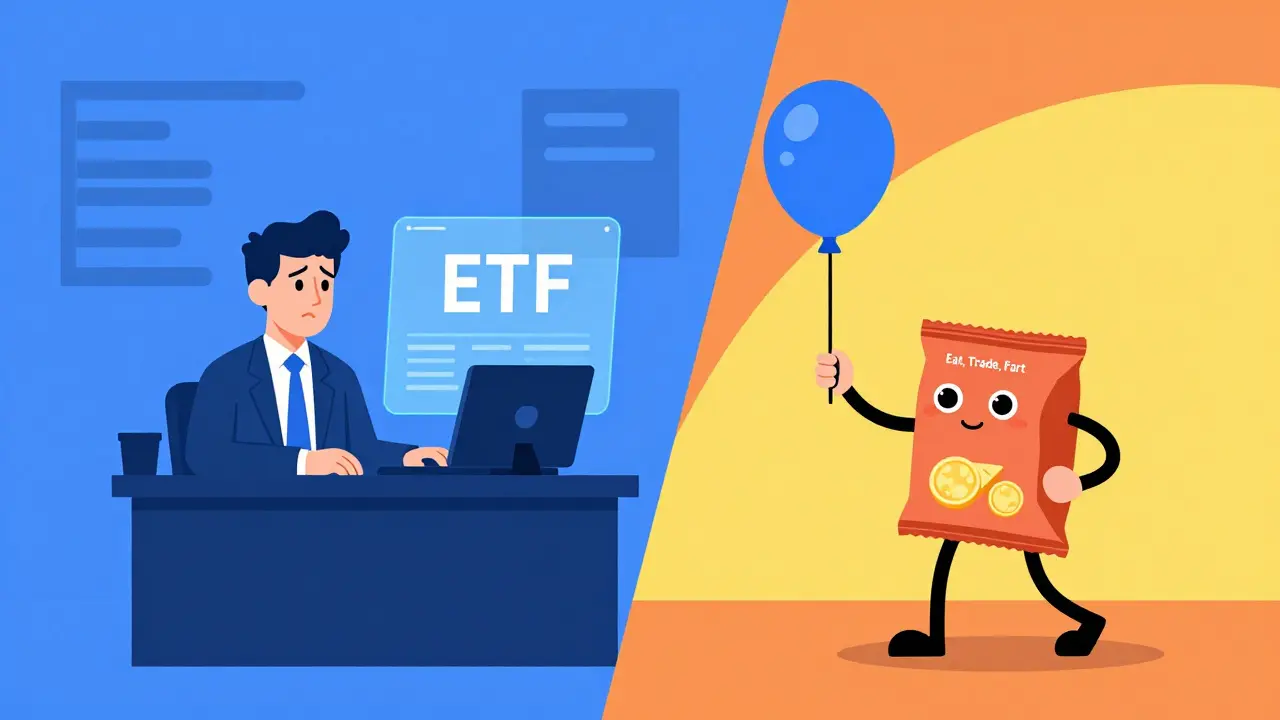
Ever seen a ticker symbol that looks like it belongs in a Wall Street portfolio but turns out to be an internet joke? That’s exactly what you get with Eat, Trade, Fart. Despite sharing the abbreviation **ETF** with traditional Exchange-Traded Funds, this cryptocurrency has absolutely nothing to do with regulated investment vehicles. It is a Solana-based meme coin launched in 2025, built entirely on community humor and speculative trading.
If you are wondering why this token exists or whether it holds any real value, you aren’t alone. The crypto space is flooded with thousands of tokens, many of which rely on viral trends rather than technology. Understanding what lies beneath the funny name helps you decide if this is a harmless curiosity or a financial trap.
The Core Identity: More Meme Than Mechanism
Eat, Trade, Fart (ETF) is a humorous cryptocurrency token operating on the Solana blockchain, designed to unite traders through relatable, light-hearted community culture rather than technical utility. Unlike major cryptocurrencies that solve specific problems-like Bitcoin securing digital ownership or Ethereum enabling smart contracts-ETF serves no functional purpose outside of being traded.
The branding is intentionally crude. The slogan “Eat, Trade, Fart” mimics the famous “Eat, Pray, Love” phrase, replacing spiritual growth with basic human functions and market speculation. This approach taps into a well-worn vein of crypto culture where absurdity drives engagement. Projects like Fartcoin have shown that bodily humor can attract massive attention, especially when paired with AI narratives or viral moments. ETF attempts to ride that same wave, though on a significantly smaller scale.
There is no whitepaper detailing a complex protocol. There is no governance structure where holders vote on future upgrades. Instead, the project’s stated goal is simply to create a community around the shared experience of trading crypto-a process that often involves stress, excitement, and yes, perhaps some relief after a big win or loss. The value proposition is purely social and speculative.
Technical Reality: Running on Solana
While the name is a joke, the underlying technology is real. ETF operates on the Solana network. Solana is known for its high speed and low transaction costs, making it the preferred home for many meme coins. When you trade ETF, you are interacting with a standard fungible token contract on this blockchain.
This means there are no hidden fees or proprietary tech stacks. You don’t need special hardware or software to hold it. Any wallet that supports Solana tokens can store ETF. However, the lack of additional technical features also highlights its simplicity. It does not offer staking rewards, yield farming opportunities, or integration with decentralized finance (DeFi) protocols. It is a static asset whose price moves solely based on supply and demand dynamics in the open market.
Market Metrics: The Illusion of Activity
To understand the risk profile of ETF, you have to look at the numbers. And here is where things get tricky. At first glance, seeing a price listed on major platforms like Coinbase, CoinGecko, or Bybit might suggest legitimacy. But looking closer reveals a different story.
| Metric | Value / Observation | Implication |
|---|---|---|
| Price Range | $0.000018 - $0.000019 USD | Extremely low nominal value; requires buying millions of units to equal small dollar amounts. |
| 24-Hour Volume | $0 - $1.10 USD | Negligible liquidity. A single large trade could crash or spike the price wildly. |
| Market Rank | #3361+ | Deep in the long tail of crypto assets; far from top-tier visibility. |
| Data Consistency | Inconsistent across platforms | Different aggregators show conflicting volumes due to thin order books. |
Notice the volume figures. Less than one dollar in daily trading volume is essentially zero for a financial asset. For context, top meme coins like PEPE or DOGE trade billions of dollars daily. Even mid-tier projects see hundreds of thousands. With ETF, if you tried to sell even $100 worth of tokens, you might struggle to find a buyer at your desired price. This creates extreme slippage, meaning you could end up selling at a much lower price than expected just because there is no one else on the other side of the trade.
The inconsistency in data further complicates matters. One platform might show a 3% increase while another shows zero activity. This happens because each aggregator pulls data from different sources. Some track centralized exchanges, others track decentralized pools. When liquidity is this thin, minor differences in data collection methods lead to wildly varying reports.
How to Buy (and Why You Should Think Twice)
If you are determined to own some ETF, you cannot simply log into a standard bank app and click “buy.” Since it is not listed on major centralized exchanges as a direct fiat pair, you need to use Web3 tools.
- Set up a Solana-compatible wallet: Apps like Phantom, Solflare, or the Binance Web3 Wallet work well. Make sure you secure your seed phrase offline.
- Fund your wallet with SOL: You will need Solana’s native token to pay for transaction fees and to swap for ETF.
- Connect to a DEX Aggregator: Platforms like Jupiter or Raydium allow you to swap SOL for other Solana tokens. Search for the exact contract address of ETF to avoid scams.
- Execute the swap: Enter the amount of SOL you wish to spend. Be prepared for high slippage settings, as the pool is shallow.
Platforms like Binance provide guides on how to use their Web3 wallet interface to access these decentralized exchanges. Tools like 3Commas and CoinCodex also support ETF in their calculators, allowing you to model conversions against USD or ETH. However, these are informational tools-they do not facilitate the trade directly.

Risk Assessment: The Micro-Cap Trap
Investing in ETF carries significant risks that go beyond normal market volatility. Here is what you need to keep in mind:
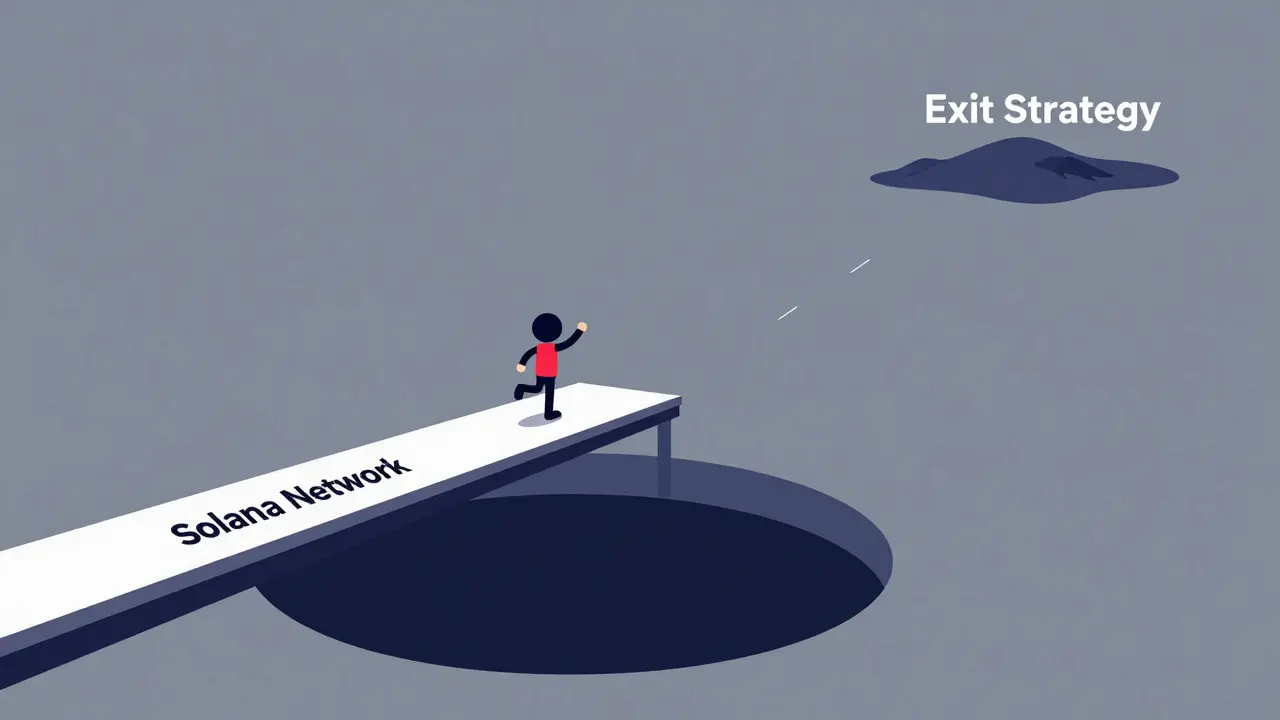
- Liquidity Risk: As mentioned, with less than $2 in daily volume, exiting a position can be difficult. You might hold the token but be unable to sell it without crashing the price.
- Information Asymmetry: There is no known founding team, no public roadmap, and no official website linked in major listings. This anonymity means there is no accountability if something goes wrong.
- No Fundamental Value: Without utility, governance rights, or revenue streams, the price is driven purely by sentiment. If the community loses interest, the price likely goes to zero.
- Scam Potential: In the world of anonymous meme coins, copycat tokens and rug pulls are common. Always verify the contract address carefully before swapping.
Compare this to larger meme coins. While they are also risky, they have established communities, higher liquidity, and more visibility. ETF sits at the extreme fringe. It has not attracted institutional commentary, professional analysis, or significant media coverage. Bloomberg analysts jokingly discussed potential ETFs for bigger meme coins, but Eat, Trade, Fart remains unnoticed by mainstream financial discourse.
Community and Future Outlook
As of June 2026, the community surrounding ETF appears minimal. Trading forums like TradingView show empty chat sections for the asset. Major tracking sites do not link to active Discord servers or Telegram groups in their primary descriptions. This silence suggests a dormant or very small user base.
For a meme coin to survive, it needs constant hype. Memes fade quickly. Without new marketing pushes, celebrity endorsements, or viral moments, interest tends to evaporate. Given that ETF launched in 2025 and has maintained such low activity into 2026, it seems to have failed to capture the lightning-in-a-bottle moment that propels successful meme coins to fame.
The outlook remains highly speculative. Unless a sudden surge in interest occurs-perhaps driven by a broader resurgence of crude-humor memes on Solana-the token is likely to remain a micro-cap curiosity. For most investors, the opportunity cost of tying up capital in an illiquid asset with no upside catalyst is too high.
Is Eat, Trade, Fart (ETF) a legitimate investment?
No, it should not be considered a legitimate investment in the traditional sense. It is a high-risk speculative meme coin with negligible liquidity and no fundamental utility. Treat any money spent on it as entertainment expense that you are fully prepared to lose.
Why is the ticker symbol ETF confusing?
The ticker "ETF" is a deliberate play on words, referencing Exchange-Traded Funds from traditional finance. However, this cryptocurrency is not a fund, is not regulated, and does not track an index. It is a standalone token on the Solana blockchain.
Can I buy ETF with US Dollars directly?
Not directly. You typically need to convert USD to Solana (SOL) first, either through a centralized exchange or a credit card purchase, and then swap SOL for ETF using a decentralized exchange like Jupiter via a Web3 wallet.
Who created the Eat, Trade, Fart token?
The creators remain anonymous. Major tracking platforms do not list specific founders, a development company, or a foundation. This lack of transparency is common for meme coins but increases the risk for buyers.
How does ETF compare to other meme coins like Fartcoin?
ETF is significantly smaller and less liquid than major meme coins like Fartcoin or PEPE. While Fartcoin has reached near-billion-dollar market caps and attracted institutional attention, ETF trades less than $2 in daily volume and ranks over #3300 in market cap, indicating it is a fringe asset with minimal visibility.
Leave a comments