
You want to stake your SUI tokens to earn rewards, but you hate the idea of locking them up for weeks. You also don't want to spend hours researching which validator has the lowest commission or highest uptime. This is exactly the problem Haedal Protocol solves. It’s a liquid staking infrastructure built specifically for the Sui blockchain. Instead of just holding idle assets or losing liquidity to traditional staking locks, Haedal lets you stake your SUI and get back a derivative token called haSUI. This token keeps earning staking rewards while letting you use it in other DeFi apps immediately. If you’ve been wondering what all the hype around HAEDAL is about, this guide breaks down how it works, why it matters, and whether it fits your portfolio strategy as of late 2026.
The Core Concept: Liquid Staking Without the Lock-Up Pain
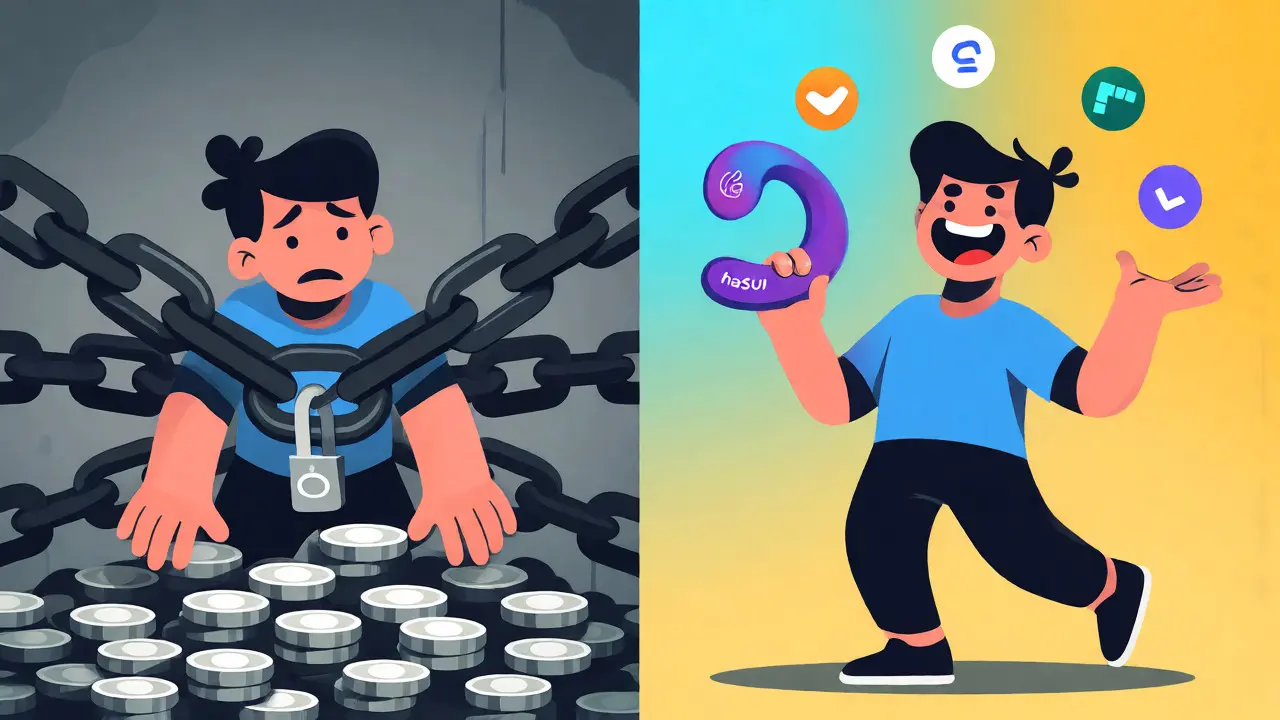
Traditional staking on proof-of-stake networks like Sui requires you to delegate your tokens to validators. The catch? Your tokens are often locked or illiquid during the process. If you need to sell or move those funds quickly, you’re stuck waiting out an unstaking period that can last days or weeks. Haedal Protocol changes this dynamic by introducing a liquid staking model. When you deposit SUI into Haedal, you receive haSUI tokens. These aren’t just receipts; they are active financial instruments. They automatically accrue staking rewards through a rebasing mechanism, meaning their value increases relative to SUI over time. Meanwhile, because haSUI is a standard token on the Sui network, you can trade it, lend it, or provide liquidity in decentralized exchanges without ever breaking your staking position. This dual utility-earning passive income while maintaining capital efficiency-is the primary reason users flock to protocols like Haedal.
How Haedal Protocol Works Under the Hood
At its heart, Haedal acts as an automated asset manager for your staked SUI. You don’t need to pick validators manually unless you really want to. The protocol handles the heavy lifting by delegating your SUI across a dynamically managed set of validators. It optimizes these choices based on performance metrics, reliability scores, and commission rates. This abstraction layer removes the technical complexity that usually deters casual investors from participating in network security.
The system offers two distinct modes. First, there’s Automated Staking, a one-click experience where the protocol selects the best validators for you. Second, Manual Staking allows power users to choose specific validators based on their own criteria, such as higher annual percentage yield (APY) or lower fees. Regardless of the mode, the output is always haSUI. The value of haSUI is determined by a simple formula: total staked SUI divided by the total supply of haSUI. As rewards accumulate, the denominator stays constant while the numerator grows, pushing the price of haSUI up against SUI. This means you don’t see more tokens in your wallet; you see each token become worth more.
Understanding the HAEDAL Token and veHAEDAL Governance
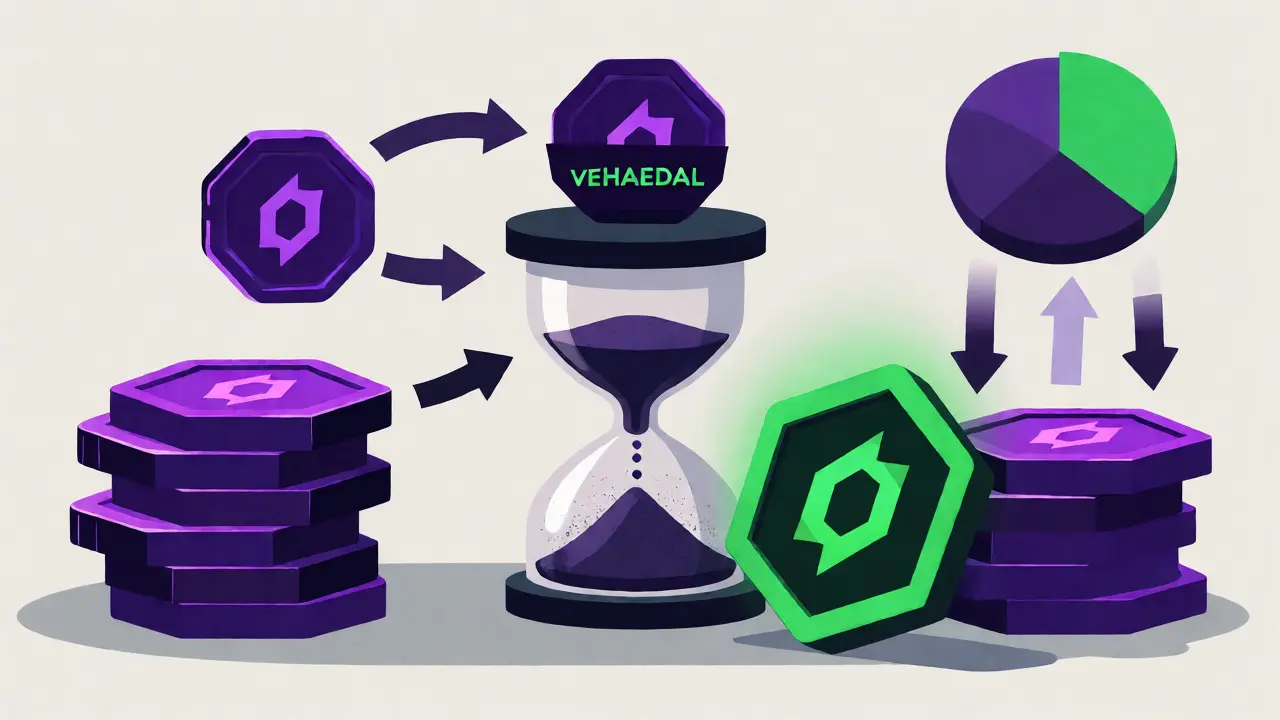
If haSUI is the vehicle for your staked assets, HAEDAL is the fuel for the protocol itself. HAEDAL is the native governance token with a fixed total supply of 1 billion tokens. But holding HAEDAL isn’t just about speculation; it’s about participation. The protocol uses a vote-escrowed model known as veHAEDAL. To participate in governance and earn boosted yields, you lock your HAEDAL tokens for a period ranging from 1 to 52 weeks. The longer you lock, the more veHAEDAL you receive, up to a maximum ratio of 1:1 for a full year lock-up.
This veHAEDAL balance decays linearly over time. Once the lock expires, you get your original HAEDAL back, but your voting power and reward boosts drop to zero until you re-lock. This structure aligns incentives. Long-term holders who believe in the project’s future are rewarded with greater influence over protocol upgrades and a larger share of revenue. Speaking of revenue, half of all protocol earnings-from validator commissions and vault performance-are used to buy HAEDAL from the open market. This buyback-and-distribute model creates a sustainable economic flywheel, directly linking the success of the staking service to the value of the governance token.
Why Choose Haedal Over Other Liquid Staking Solutions?
You might ask, "Why not just use Lido or Rocket Pool?" Those giants dominate Ethereum, but they aren’t native to Sui. Haedal is engineered specifically for Sui’s Move-based architecture and its unique consensus mechanism. This native integration offers several advantages. For one, transaction speeds are faster, and fees are significantly lower compared to Ethereum-based alternatives. More importantly, haSUI integrates seamlessly with the growing suite of DeFi applications on Sui. You can use haSUI in lending markets, liquidity pools, and yield vaults without friction.
However, context matters. If you are looking for multi-chain staking solutions, Haedal’s confinement to the Sui ecosystem might feel limiting. Protocols like Stafi offer cross-chain utility, whereas Haedal doubles down on being the best-in-class solution for Sui specifically. For users already invested in the Sui ecosystem, this specialization is a feature, not a bug. It ensures deep liquidity and tight integration with local dApps, creating network effects that generic multi-chain protocols often struggle to replicate.
Practical Steps: How to Stake SUI via Haedal
Getting started with Haedal doesn’t require a computer science degree. Here’s the typical workflow for a user in New Zealand or anywhere else globally:
- Set Up a Wallet: Install a Sui-compatible wallet like Sui Wallet or Ethos Wallet. Ensure you have some SUI tokens for gas fees and staking.
- Connect to Haedal: Visit the official Haedal Protocol website and connect your wallet.
- Select Staking Mode: Choose between Automated Staking for simplicity or Manual Staking if you have specific validator preferences.
- Deposit SUI: Enter the amount of SUI you wish to stake. Confirm the transaction in your wallet.
- Receive haSUI: After confirmation, your wallet will reflect the new haSUI balance. You can now use these tokens in other DeFi platforms on Sui.
- Manage Rewards: Your haSUI value will increase automatically. No claiming is needed for the underlying staking rewards embedded in the token price.
Note that while haSUI provides immediate liquidity, converting it back to raw SUI involves the standard Sui network unstaking period, which typically takes 21-28 days. Plan your exits accordingly if you anticipate needing immediate access to base-layer SUI.
Risks and Considerations Before Investing
No crypto investment is risk-free. With Haedal, the primary risks are smart contract vulnerabilities, regulatory shifts, and the broader market volatility of SUI itself. Since Haedal holds significant amounts of SUI, any major bug in its code could impact the value of haSUI. Additionally, the protocol’s success is tied to Sui’s adoption trajectory. If Sui struggles to attract developers or users, demand for liquid staking services may stagnate. Competition is also heating up, with other liquid staking providers entering the Sui space. While Haedal currently holds a strong position due to its early mover advantage and robust community, staying informed about competitor developments is crucial.
Furthermore, consider the opportunity cost of locking HAEDAL for veHAEDAL. If the token price spikes during your lock-up period, you cannot sell your principal HAEDAL tokens without forfeiting your veHAEDAL status. This illiquidity is a trade-off for governance power and boosted yields. Assess your personal risk tolerance before committing large sums to long-term locks.
| Feature | Traditional Staking | Haedal Protocol (Liquid Staking) |
|---|---|---|
| Liquidity | Low (Locked during staking/unstaking) | High (haSUI is tradable/usable) |
| Validator Selection | Manual (User responsibility) | Automated or Manual (Protocol optimized) |
| DeFi Utility | None (Tokens are locked) | Full (Use haSUI in lending/LP) |
| Complexity | Moderate (Requires research) | Low (One-click interface) |
| Rewards Accrual | Claimed periodically | Continuous (via token value appreciation) |
Frequently Asked Questions
What is the difference between HAEDAL and haSUI?
HAEDAL is the governance token of the protocol, used for voting and earning revenue shares. haSUI is a liquid staking derivative token received when you stake SUI. haSUI represents your staked SUI and accrues staking rewards, while HAEDAL governs the platform's development and economics.
Can I lose my money in Haedal Protocol?
Yes, like any DeFi protocol, there are risks. Smart contract bugs, slashing events from poor validator performance, or extreme market volatility affecting the price of SUI can impact your returns. However, the protocol uses diversified validator sets to mitigate slashing risks.
How long does it take to unstake SUI from Haedal?
While you can swap haSUI for SUI instantly on DEXs, withdrawing directly from the protocol follows the Sui network's unstaking period, which is typically 21-28 days. Using a DEX swap bypasses this wait but may incur slippage or trading fees.
Is Haedal only for SUI tokens?
Primarily, yes. Haedal focuses on SUI liquid staking. It also supports WAL tokens via haWAL derivatives. Its core innovation and liquidity depth are centered around the SUI asset within the Sui blockchain ecosystem.
What is veHAEDAL and why should I care?
veHAEDAL is vote-escrowed HAEDAL. By locking your HAEDAL tokens for up to 52 weeks, you gain voting power in governance proposals and receive a share of protocol revenues. Longer locks result in more veHAEDAL, offering higher rewards and influence.
Final Thoughts on Haedal’s Place in the Ecosystem
Haedal Protocol isn’t just another yield farm; it’s critical infrastructure for the Sui blockchain. By solving the liquidity trap of traditional staking, it encourages more people to secure the network without sacrificing capital efficiency. For users already active in the Sui DeFi scene, integrating haSUI into your portfolio is a logical step to maximize returns. Just remember to monitor the evolving landscape of Sui competitors and keep an eye on the broader crypto market trends. As Sui continues to scale, protocols that bridge the gap between security and usability, like Haedal, will likely remain central players in the ecosystem.
Leave a comments