
Imagine trying to pay for a coffee in Sydney and settling the bill instantly with a friend in London, without banks taking their cut or waiting days for clearance. That’s the promise behind HowToPay (HTP). It isn’t just another meme coin chasing hype; it’s a utility token built to power a real-world payment ecosystem. But what exactly is this cryptocurrency designed to facilitate fast, low-cost domestic and cross-border transactions? And why should you care about its supply cap or smart contract address?
If you’ve seen HTP pop up on your wallet or heard whispers about Confidia Limited, you might be wondering if it’s worth your attention. This guide breaks down everything you need to know about the HTP token, from its technical roots on the Binance Smart Chain to its practical use cases in point-of-sale systems.
The Core Concept: Powering Cashless Payments
At its heart, HowToPay is a digital asset created to serve as the backbone of a specific financial network. Unlike Bitcoin, which aims to be "digital gold," or Ethereum, which powers endless decentralized applications, HTP has a narrower, more focused job. It exists to make payments easier within the HowToPay ecosystem.
The project is driven by Confidia Limited, an Australian company that has been operating payment services since May 2020. They didn’t start with blockchain; they started with traditional merchant acquiring and POS technology. The introduction of HTP was a strategic move to modernize these existing services. By integrating a cryptocurrency into their hardware and software solutions, Confidia aims to reduce transaction fees and speed up settlement times for both merchants and consumers.
Think of it like airline miles, but instead of getting free flights, you get a medium of exchange that works seamlessly across borders. If you’re a merchant using HowToPay terminals, HTP acts as the settlement asset. If you’re a consumer, you might use it to earn rewards or pay for services within the platform. It’s tightly integrated, meaning its value is tied directly to the adoption and usage of the HowToPay network rather than broader crypto market speculation alone.
Technical Backbone: BEP-20 on Binance Smart Chain
Why did Confidia choose the Binance Smart Chain (BSC)? The answer lies in efficiency. BSC is known for its high throughput and low transaction fees compared to older networks like Ethereum. For a payment system where users might make multiple small transactions daily, high gas fees would kill the user experience. BSC solves this problem.
HTP is a BEP-20 token. If you’re familiar with ERC-20 tokens on Ethereum, BEP-20 is the equivalent standard on BSC. This compatibility is crucial because it means HTP can be stored in any wallet that supports BSC, such as MetaMask or Trust Wallet, and traded on major decentralized exchanges like PancakeSwap or Uniswap V3 on BSC.
| Attribute | Detail |
|---|---|
| Blockchain Network | Binance Smart Chain (BSC) |
| Token Standard | BEP-20 |
| Total Supply Cap | 500,000,000 HTP |
| Smart Contract Address | 0xc9DE725a4Be9ab74b136c29D4731D6beBD7122e8 |
| Anti-Whale Limit | 1% of total supply per address |
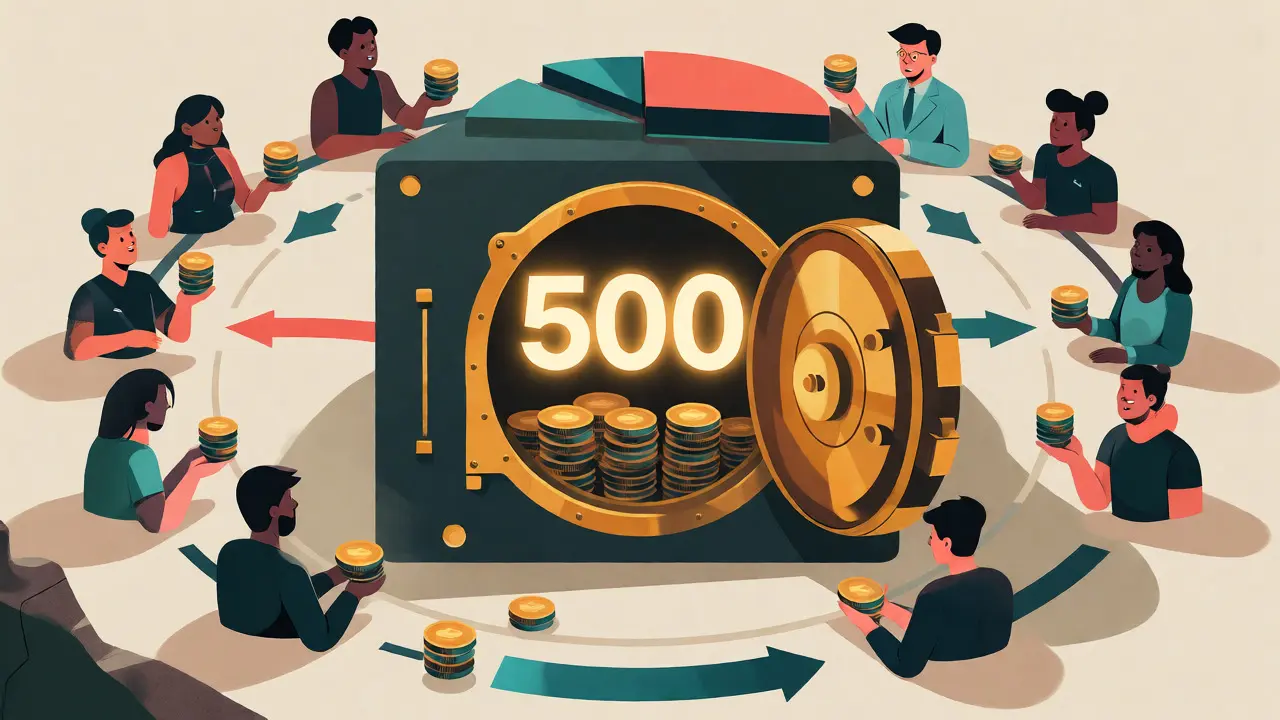
A critical detail for anyone holding HTP is the smart contract update. In October 2024, Confidia announced that all 500 million tokens had been minted. If you joined the project before this date, you needed to add the new contract address to your wallet to see your correct balance. This fixed supply model is designed to create scarcity-no more tokens will ever be created, which theoretically supports price stability if demand rises.
Tokenomics: Scarcity and Distribution
The economics of HTP are structured to prevent market manipulation and ensure steady growth. The most notable feature is the anti-whale limit. No single wallet can hold more than 1% of the total supply. With a cap of 500 million tokens, that means no individual holder can own more than 5 million HTP. This rule helps distribute ownership more evenly and prevents a few large holders from crashing the price by dumping their entire stake at once.
Distribution happened in stages over 24 months, starting with an initial ICO release of 1,000,000 tokens. These were fully vested upon sale, meaning buyers could trade them immediately on platforms like PancakeSwap. This staged approach allowed the team to manage liquidity carefully, avoiding the shock of releasing hundreds of millions of tokens into the market overnight.
However, data on circulating supply varies wildly between tracking sites. Some aggregators report near-zero circulating supply, while others show figures closer to the full minted amount. This discrepancy often happens with micro-cap tokens where not all exchanges report data accurately. Always check the official HowToPay documentation for the most current roadmap milestones regarding when specific tranches become tradable.

Use Cases: Where Can You Actually Use HTP?
Utility is king in crypto. What can you do with HTP today? Currently, its primary role is within the HowToPay ecosystem. Merchants using Confidia’s POS devices accept payments, and HTP facilitates the settlement of these transactions. This reduces reliance on traditional card schemes, which often charge merchants 2-3% per transaction. By using blockchain-based settlement, HowToPay claims to lower these costs significantly.
For consumers, HTP offers incentives. The platform rewards users for participation, whether that’s making purchases or engaging with the community. These rewards are denominated in HTP, creating a loop where usage drives demand for the token. Additionally, early adopters and marketing partners have used HTP to pay for marketing services, indicating a B2B utility layer alongside the consumer-facing payments.
It’s important to manage expectations here. As of mid-2025, HTP is still in the early stages of broad adoption. While it trades on centralized exchanges like Dex-Trade and Bitstorage, and decentralized venues like Uniswap V3, it hasn’t yet achieved the ubiquitous acceptance of major stablecoins. Its value proposition is strongest for those already engaged with the HowToPay merchant network.
Market Performance and Liquidity
Let’s talk numbers. HTP is a micro-cap asset. Price trackers have shown it trading between $0.000129 and $0.0011 USD in recent months. Daily trading volumes fluctuate, sometimes hitting over $100,000 on active days, but often sitting much lower. This thin liquidity means that large buy or sell orders can impact the price more dramatically than they would on larger coins like Bitcoin or Ethereum.
You won’t find HTP listed for spot trading on major giants like Coinbase or Binance main exchange pages, though they may track its price. Instead, activity is concentrated on decentralized exchanges (DEXs) and smaller centralized exchanges. This decentralization aligns with the project’s ethos but requires users to be comfortable with DEX interfaces and managing their own private keys.
Investors should note the volatility inherent in such assets. The lack of extensive third-party audits or independent expert reviews means you are relying largely on Confidia’s transparency. However, the fact that the supply is fully minted and capped provides a clear framework for valuation analysis based on network usage rather than inflationary pressure.
How to Buy and Store HTP
Ready to jump in? Here’s the practical path to owning HTP. First, you need a BNB-compatible wallet. MetaMask and Trust Wallet are popular choices. Ensure you have some BNB in your wallet to cover gas fees for transactions.
- Acquire Base Currency: Buy BNB or BUSD (BEP-20) via a fiat-on-ramp service like Banxa, or transfer from an exchange.
- Connect to a DEX: Go to a supported decentralized exchange like PancakeSwap or Uniswap V3 on BSC.
- Swap Tokens: Connect your wallet and swap BNB/BUSD for HTP. Be sure to paste the correct contract address:
0xc9DE725a4Be9ab74b136c29D4731D6beBD7122e8. - Add Token to Wallet: If your wallet doesn’t automatically detect HTP, manually add the token using the contract address above.
Always double-check the contract address. Scammers often create fake tokens with similar names. Using the official address ensures you’re buying the real HTP token.
Risks and Considerations
No investment is risk-free, especially in the crypto space. For HTP, the primary risks include low liquidity, limited merchant adoption outside the core ecosystem, and competition from established payment solutions like PayPal or Stripe, which are also exploring blockchain integrations.
Furthermore, regulatory environments for cryptocurrencies vary globally. As an Australian-backed project, Confidia operates under specific local laws, but global expansion brings complex compliance challenges. Keep an eye on news regarding regulatory changes in key markets where HowToPay operates.
Finally, remember that HTP’s value is closely tied to the success of the HowToPay business model. If the company struggles to onboard merchants or expand its user base, token demand may stagnate regardless of broader crypto market trends. Do your own research, assess your risk tolerance, and consider consulting a financial advisor before investing.
Is HowToPay (HTP) a good investment?
Whether HTP is a good investment depends on your risk profile and belief in the HowToPay ecosystem. It is a micro-cap utility token with a fixed supply, offering potential upside if merchant adoption grows. However, it carries higher risk due to lower liquidity and less market maturity compared to major cryptocurrencies.
Where can I buy HTP tokens?
You can buy HTP primarily on decentralized exchanges like PancakeSwap and Uniswap V3 (on Binance Smart Chain). It is also listed on some smaller centralized exchanges such as Dex-Trade and Bitstorage. Major exchanges like Coinbase and Binance currently track the price but may not offer direct spot trading pairs.
What is the maximum supply of HTP?
The maximum supply of HowToPay (HTP) is capped at 500,000,000 tokens. All tokens were minted by October 21, 2024, and no further tokens will be created, ensuring a fixed supply model.
Which blockchain does HTP use?
HTP is a BEP-20 token running on the Binance Smart Chain (BSC). This allows for fast transactions and low fees compared to networks like Ethereum.
Can I store HTP in MetaMask?
Yes, you can store HTP in MetaMask. Since it is a BEP-20 token, you simply need to switch your MetaMask network to Binance Smart Chain and add the HTP token using its official contract address.
Alison Cooper
14 09 26 / 15:17 PMThe idea of instant settlement across borders is the holy grail, but let's be real about the adoption curve. Most merchants in Sydney or London are still terrified of crypto volatility and prefer the safety of Visa or Mastercard rails. Until HowToPay can prove that their POS terminals actually reduce overhead by a measurable percentage compared to traditional acquiring fees, this remains a solution looking for a problem. The tech stack on BSC is efficient sure, but efficiency doesn't sell hardware to skeptical small business owners who just want their money in the bank by Friday.
vanessa bulos
15 09 26 / 19:40 PMOh please spare me the corporate jargon.
This reads like a press release written by someone who has never actually tried to buy coffee with a new token. "Utility token"? Give me a break. It’s a micro-cap gamble dressed up in a suit. I looked at the liquidity charts and nearly fell out of my chair. You’re telling me we should care about a coin that trades on exchanges I’ve never heard of while Coinbase ignores it? This is exactly why people get burned. They read a guide like this, think they found the next Bitcoin, and then watch their portfolio evaporate because nobody wants to buy the exit liquidity. It’s pretentious nonsense wrapped in blockchain buzzwords.
emmanuel ivan
17 09 26 / 00:00 AMI appreciate the detailed breakdown here! 🌟
For those unfamiliar with BEP-20 standards, it is essentially the Binance Smart Chain equivalent of Ethereum's ERC-20. This compatibility is crucial for wallet integration. However, one must be cautious with the smart contract address provided. Scammers often create lookalike tokens. Always verify via official documentation before swapping. Also, the anti-whale limit of 1% is a nice touch to prevent market manipulation, though enforcement relies entirely on the contract code which hasn't been audited by major firms like Certik as far as I know. Good luck with your investments! 🚀
Samantha Dalton
18 09 26 / 03:48 AMhonestly the supply cap is the only thing keeping me interested
fixed supply means no inflation diluting the value later on which is huge for long term holders i guess its risky but at least its not printing more coins every day like some other projects do
Sagan Bogda
18 09 26 / 16:59 PMYou guys are missing the point completely. Confidia Limited is Australian. That means strict regulations. Unlike US based meme coins, they have to deal with ASIC. This isn't just another pump and dump scheme run by anonymous devs in a basement. The fact that they started with traditional merchant acquiring gives them a bridge that pure-play crypto companies lack. If you don't understand the difference between a utility token backed by physical infrastructure and a speculative asset, you shouldn't be investing in this space at all. Read the whitepaper again.
Marc Kennedy
20 09 26 / 12:47 PMHey everyone, great discussion! 😎
I think Sagan makes a solid point about the regulatory backing being a differentiator. It adds a layer of trust that many DeFi projects lack. On the flip side, Vanessa, I feel you on the liquidity concerns. It’s definitely thin right now. But remember, early days always look scary until volume picks up. I’m holding a small bag just to support the ecosystem growth. Fingers crossed the merchant onboarding speeds up!
Justine Jones
22 09 26 / 05:33 AMDoes anyone know if the rewards program is active yet?
Would love to see actual user testimonials.
Harmony Davidson
23 09 26 / 07:15 AMWait... wait a minute. Why did they mint ALL 500 million tokens in October 2024??
If everything was minted already, where is the team getting the incentive to keep working? Usually there is a vesting schedule for founders to align interests. If they dumped their share immediately after the ICO phase, that explains the low circulating supply reports on some aggregators. Who holds the keys to the treasury? Is Confidia Limited controlled by a single entity or multiple partners? This smells like centralized control disguised as decentralization. We need to see the multi-sig wallets. Don't let them fool us with "scarcity" narratives when the distribution data is murky.
Bruce Percival
25 09 26 / 06:23 AMHi Harmony,
That's an interesting angle regarding the minting schedule. From what I've gathered from their roadmap, the initial 1 million were fully vested for the ICO, but the rest were released in stages over 24 months. So the team likely still has locked tokens that unlock gradually. This should theoretically keep them motivated to grow the network so their unlocked holdings retain value. It’s not perfect, but it’s better than immediate full circulation.
Sue Long Merrill
25 09 26 / 07:15 AMThe article fails to adequately address the competitive landscape. Stripe and PayPal are not merely exploring blockchain; they are actively integrating stablecoin payments that offer zero volatility risk for merchants. HTP offers price volatility, which is antithetical to payment stability. A merchant does not want to accept a currency that might drop 10% in value during the lunch rush. Unless HowToPay implements an auto-conversion feature to fiat instantly upon receipt, the utility proposition is fundamentally flawed. This oversight renders much of the technical praise irrelevant.
John Failla
25 09 26 / 07:29 AMInvesting in unregulated or lightly regulated crypto assets without understanding the underlying legal framework is morally irresponsible. Many retail investors treat these tokens like lottery tickets rather than equity stakes in a company. If Confidia Limited faces regulatory hurdles in Australia or expands into jurisdictions with stricter KYC/AML laws, the token could become illiquid overnight. People need to stop chasing hype and start respecting the law. Do your due diligence or don't invest at all.
Ryan Abenoja
26 09 26 / 09:51 AMtotally agree with the sentiment above
but hey if you believe in the tech it’s worth a shot right? just don’t bet the rent money lol
Tim Soefje
27 09 26 / 14:03 PMSure, let's ignore the fact that "instant settlement" usually requires off-chain layers that introduce centralization points. Or maybe we should just pretend that DEX slippage doesn't exist for small caps. But go ahead, tell yourself it's decentralized gold. 🙄
Sean Russo
29 09 26 / 04:07 AMI think we need to balance the skepticism with the potential for niche dominance. Not every payment solution needs to compete with Visa globally from day one. If HowToPay captures the cross-border remittance niche for specific corridors, say Australia to Southeast Asia, they can build a sustainable community. The key is education. Users need to understand how to manage private keys and gas fees. It’s a learning curve, but necessary for true financial sovereignty.
Greeshma Umapathi
30 09 26 / 16:41 PMListen to me closely!! 🔥
The energy around utility tokens is shifting. We are moving away from pure speculation towards tangible use cases. HowToPay represents the future of frictionless commerce. Imagine a world where your coffee purchase automatically settles the debt between two parties without intermediaries eating 3% of your hard-earned cash. That is freedom! That is innovation! Do not let the naysayers dampen your spirit. Research, engage, and participate. The revolution will not be televised, but it will be paid for in HTP! Stay bullish! 🚀🚀🚀
Theresa Flores
30 09 26 / 16:55 PMThere is a philosophical depth to this that many overlook. Money is essentially a shared belief system. By introducing a token tied to real-world services, HowToPay attempts to ground abstract digital value in concrete human interaction. It’s not just about speed; it’s about reconnecting economic activity with community participation. The rewards loop creates a sense of belonging among users. In a fragmented global economy, finding a medium of exchange that fosters connection rather than just transaction is a noble pursuit. Even if the price fluctuates, the social fabric woven by such networks has intrinsic worth beyond market cap.