Most people treat their crypto wallets like piggy banks. You put money in, and it just sits there, gathering digital dust while inflation quietly eats away at its purchasing power. But what if your dollar could earn interest automatically, without you having to stake it, lock it up, or constantly monitor a dashboard? That’s the core promise of Origin Dollar, also known as OUSD. It’s a stablecoin designed to generate yield directly in your wallet, turning idle cash into productive assets.
If you’ve been curious about how this works or whether it’s safe enough for your savings, you’re in the right place. We’ll break down exactly what OUSD is, how it generates returns, and why it stands out in a crowded field of stablecoins. No jargon walls, no confusing acronyms-just a clear look at one of the more interesting innovations in decentralized finance.
The Core Concept: A Dollar That Works For You
At its simplest, OUSD is a cryptocurrency token pegged 1:1 to the US Dollar. Unlike Bitcoin or Ethereum, which swing wildly in value, OUSD aims to stay steady at $1.00. But here’s the twist: traditional stablecoins like USDC or USDT don’t pay you anything for holding them. They are essentially IOUs that sit dormant. OUSD changes the game by embedding yield generation into the token itself.
When you hold OUSD in your Ethereum wallet, the protocol automatically deploys your funds into low-risk, blue-chip decentralized finance strategies. You don’t need to click "stake" or approve complex smart contracts every few weeks. The yield accrues automatically and compounds over time. As of late 2026, this mechanism has allowed holders to earn an average annual percentage yield (APY) of around 5.37%. That’s significantly higher than most traditional savings accounts, and it happens passively.
How Does OUSD Generate Yield?
You might be wondering where this money comes from. Is it magic? Not quite. The protocol uses a sophisticated but transparent system of automated strategies. When you mint OUSD, your collateral isn’t just sitting in a vault. It’s actively working in established DeFi protocols.
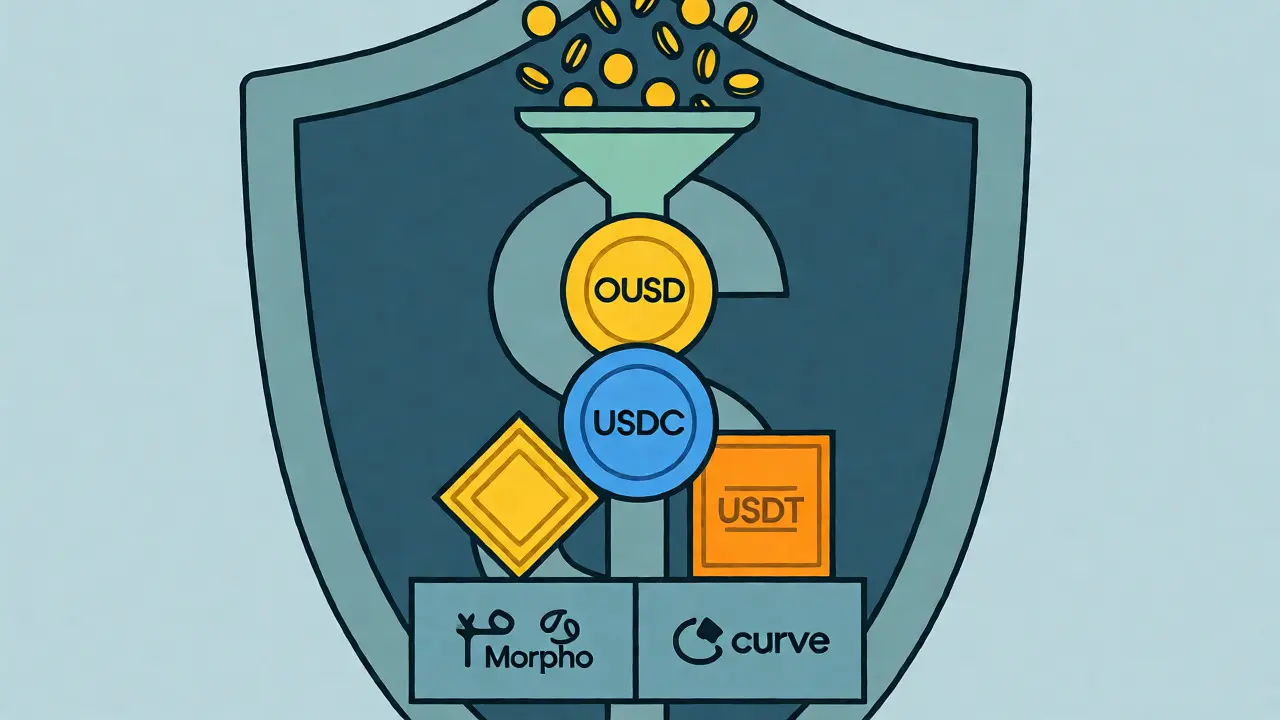
- Morpho: This platform optimizes lending rates, ensuring that funds lent out get competitive returns with managed risk.
- Curve Finance: Known for its efficient liquidity pools, Curve helps provide on-chain liquidity, earning fees from traders swapping stablecoins.
- Pool Booster: This design element enhances efficiency in managing these liquidity pools, squeezing out extra yield without taking on speculative risks.
The key here is "blue-chip." The developers avoid high-risk, experimental farms that might offer 50% APY but carry a high chance of collapse. Instead, they stick to proven, lower-risk venues. This approach prioritizes capital preservation alongside yield, making it suitable for users who want stability first, growth second.
Collateral and Stability: What Backs OUSD?
Stability is the name of the game for any stablecoin. If a coin loses its peg, it fails its primary purpose. OUSD maintains its $1.00 value through a basket of other established stablecoins. Specifically, it is backed by a mix of DAI, USDC, and USDT.
This multi-collateral approach diversifies risk. If one underlying stablecoin faces regulatory trouble or depegs temporarily, OUSD isn’t solely dependent on it. The protocol manages this basket dynamically to maintain the peg. According to recent data, OUSD has maintained a price hovering tightly around $1.00, with minor fluctuations between $0.9974 and $1.00 USD across major exchanges. This tight tracking demonstrates the effectiveness of its arbitrage mechanisms and collateral management.
Governance and Decentralization
Who controls OUSD? It’s not run by a single CEO or a centralized bank. The protocol is governed by the Origin DeFi DAO. Holders of the governance token, OGV, can stake their tokens to gain voting power. This means the community decides on critical upgrades, fee structures, and strategy adjustments.
This decentralized model aligns incentives. Stakers receive a share of the protocol’s fees, so they have a financial reason to keep the system healthy and secure. It removes the need for trust in a central authority, replacing it with code and community consensus. For many crypto enthusiasts, this transparency is a major selling point compared to traditional financial institutions.
Fees and Economic Model
Let’s talk costs. Many investment products charge hefty management fees regardless of performance. OUSD takes a different route. The protocol charges 0% management fees. You only pay when the system performs well. There is a 20% performance fee on the yields generated. If the protocol doesn’t make money, you don’t pay fees. This structure ensures that the team behind OUSD is motivated to optimize returns rather than just collecting rent on your assets.
| Feature | Origin Dollar (OUSD) | Traditional Stablecoins (e.g., USDC) |
|---|---|---|
| Yield Generation | Automatic, in-wallet | None (unless staked elsewhere) |
| Management Fee | 0% | Varies / None |
| Performance Fee | 20% on profits | N/A |
| Backing | Basket of DAI, USDC, USDT | Cash / Equivalents |
| Complexity | Low (set and forget) | Low (but zero yield) |

Security and Risks
No financial product is risk-free, and OUSD is no exception. While it avoids speculative positions, it still operates in the volatile world of DeFi. The main risks include smart contract bugs, potential depegging of the underlying collateral coins, and general market volatility affecting the broader Ethereum network.
To mitigate these, the protocol undergoes regular security audits and runs bug bounty programs. These measures help identify vulnerabilities before hackers can exploit them. Additionally, because all operations are on-chain, anyone can verify the reserves and strategies in real-time. This transparency builds trust, but it’s crucial to remember that "audited" doesn’t mean "unhackable." Always do your own research and never invest more than you can afford to lose.
How to Get Started with OUSD
Getting your hands on OUSD is relatively straightforward if you’re already comfortable with Ethereum-based transactions. You can buy it on major exchanges like Kraken, though availability varies by region and platform. Some platforms may list it as non-tradable initially, requiring you to mint it directly via the Origin Protocol website using USDC or other supported stablecoins.
Once you have OUSD in your wallet, you’re done. You don’t need to take further action to earn yield. Just keep it in your Ethereum-compatible wallet, such as MetaMask or Rabby, and watch your balance grow slowly over time. Remember, gas fees on Ethereum can add up during times of network congestion, so timing your transactions wisely can save you money.
Is Origin Dollar safe to use?
Origin Dollar employs several safety measures, including backing by a basket of established stablecoins (DAI, USDC, USDT), regular security audits, and bug bounty programs. However, like all DeFi protocols, it carries inherent risks related to smart contract vulnerabilities and market volatility. It is generally considered safer than high-yield speculative farms but riskier than holding cash in a bank.
Do I need to stake my OUSD to earn interest?
No, you do not need to stake OUSD. The yield generation is automatic and occurs directly within your wallet. The protocol deploys the underlying funds into yield-generating strategies on-chain, and the returns are distributed to token holders without requiring any manual staking actions.
What is the current APY for OUSD?
As of mid-2026, the trailing 30-day average Annual Percentage Yield (APY) for OUSD is approximately 5.37%. This rate fluctuates based on the performance of the underlying DeFi strategies used by the protocol, such as Morpho and Curve Finance.
Can I redeem OUSD for US Dollars?
Yes, OUSD is fully redeemable. Since it is backed 1:1 by a basket of stablecoins, you can typically swap OUSD back into USDC, DAI, or USDT on decentralized exchanges or centralized platforms that support these pairs. From there, you can convert to fiat currency depending on your exchange options.
Which blockchains support OUSD?
Currently, Origin Dollar operates exclusively on the Ethereum blockchain. This means you need an Ethereum-compatible wallet to store and interact with OUSD. Future expansions to other networks may occur, but as of now, Ethereum is the sole home for the protocol.
Leave a comments