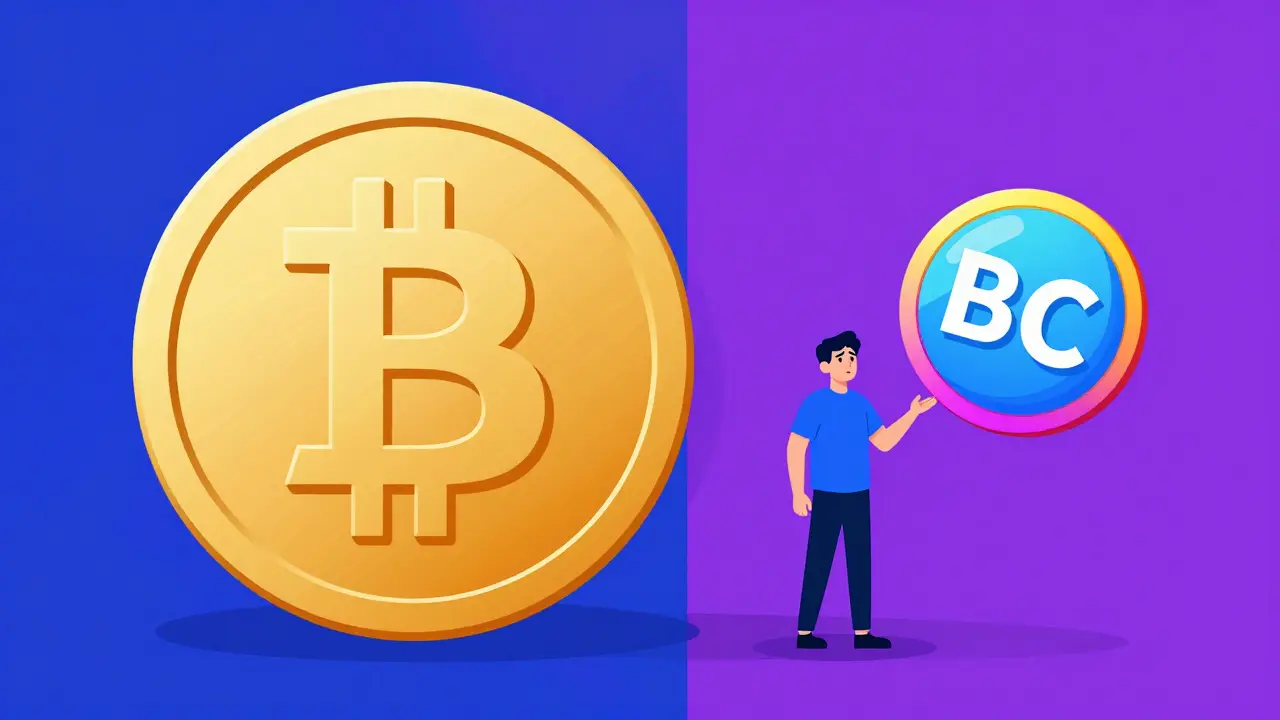
If you've been browsing crypto forums and stumbled across something called Original Bitcoin (BC), you might be feeling a bit confused. You're probably thinking, "Wait, isn't Bitcoin's ticker BTC?" You're absolutely right. There is a massive difference between the world-famous digital gold we all know and this specific token called BC. One is a global financial revolution; the other is a speculative meme coin riding on a different network entirely.
The danger here is simple: naming. By calling itself "Original Bitcoin," the BC token creates a psychological bridge to the legitimacy of the real thing. For a seasoned trader, this is a red flag. For a beginner or someone's elderly relative, it can be a costly mistake. Before you put a single cent into this, you need to understand exactly what this token is, where it lives, and why it is not the "original" version of anything.
The Reality Check: BC vs. BTC
Let's get the definitions straight. Bitcoin is the first decentralized cryptocurrency, launched in 2009 by Satoshi Nakamoto to enable peer-to-peer electronic cash without a central authority. It uses the ticker BTC and runs on its own independent blockchain.
On the flip side, Old Bitcoin (BC) is a community-driven meme coin launched between 2023 and 2024 that operates on the Solana blockchain. It does not have its own network; it's simply a token (an SPL token) living on someone else's infrastructure. While its creators claim it embodies the "original vision" of Bitcoin, it shares almost nothing with the actual technical architecture of BTC.
| Feature | Bitcoin (BTC) | Old Bitcoin (BC) |
|---|---|---|
| Blockchain | Native (Bitcoin Network) | Solana |
| Consensus Mechanism | Proof-of-Work (Mining) | Proof-of-History |
| Max Supply | 21 Million | 1 Billion |
| Transaction Speed | ~7 TPS (Slow) | Up to 65,000 TPS (Very Fast) |
| Market Cap (approx) | ~$578 Billion (Nov '23) | ~$1.2 Million (Nov '23) |
| Regulatory Status | Classified as Commodity | Uncertain/Potential Security |
How it Works (and Why it's Different)
To understand BC, you have to understand the Solana ecosystem. Unlike Bitcoin, which requires massive amounts of electricity and specialized hardware (ASICs) to secure the network, BC leverages Solana's high-speed architecture. This means sending BC tokens costs less than a penny and happens almost instantly-usually in under 800 milliseconds.
The project claims fairness by revoking its "mint authority." In plain English, this means the developers burned the keys that would allow them to create more tokens out of thin air. This is a common move in the meme coin world to prove that the project isn't a "rug pull" (where devs dump new tokens on investors). However, while the supply is fixed at 1 billion, the utility is virtually non-existent. There is no global payment network or store-of-value prestige here; it's primarily a vehicle for speculation.
Compare this to the security model of the real Bitcoin. BTC has a decade-long track record of resisting 51% attacks and is backed by thousands of independent nodes globally. BC, however, inherits Solana's security. While Solana is fast, it has historically suffered from network outages, including several significant periods of downtime in 2022. If the Solana network goes down, your BC tokens are effectively frozen.
The "Original Vision" Argument
The marketing for Old Bitcoin (BC) focuses heavily on "restoring the early openness and fairness" of the 2009 era. This is a clever emotional hook, but technically, it's a contradiction. The original vision of Bitcoin was centered on monetary sovereignty-the idea that you don't need a bank or a third-party provider to hold your money.
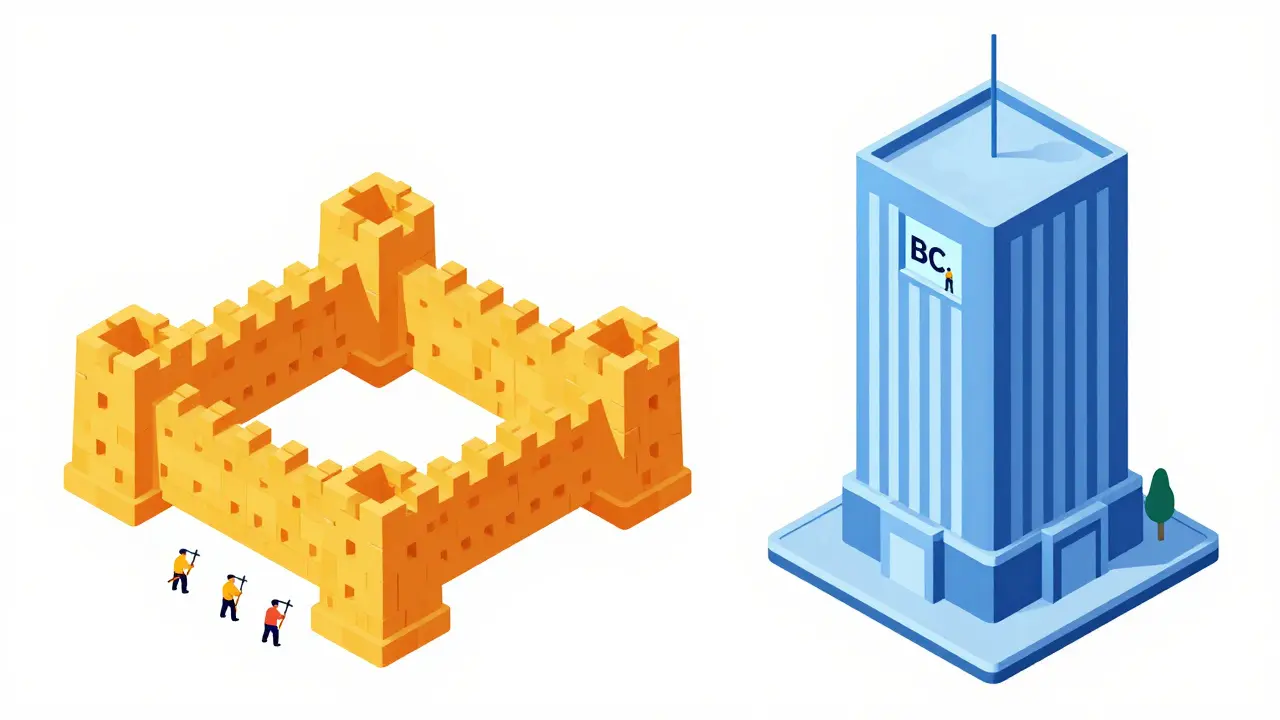
By running on Solana, BC is essentially a tenant in someone else's building. It relies on a specific set of validators and a specific corporate-led infrastructure. Experts like Dr. Garrick Hileman have pointed out that decentralization isn't just about how tokens are distributed; it's about the method of securing the network. Proof-of-Work (Bitcoin's method) is far more decentralized and censorship-resistant than the Proof-of-Sake/History models used by Solana-based tokens.
The Risks: Speculation vs. Investment
When you look at the numbers, the risk profile of BC is astronomical compared to BTC. Bitcoin is often called "digital gold" and is now held by institutional giants like BlackRock through spot ETFs. It's a macro-asset. Old Bitcoin (BC) is a meme coin. According to data from Messari, meme coins with no real utility have a failure rate of around 92% within 18 months of launch.
There are two types of people interacting with BC right now:
- The Flippers: These are traders who don't care about the "vision." They see a price pump on a decentralized exchange like Raydium, buy in, and hope to sell to someone else for a quick profit.
- The Confused: These are retail investors who see the word "Original Bitcoin" and assume they've found a cheaper, better version of the real thing. This is where the real danger lies.
For example, some users on Reddit have reported making a few hundred dollars during short-term pumps. But other stories are heartbreaking-people losing thousands of dollars because they mistakenly thought BC was an official derivative or a "new version" of BTC.
Practical Steps: How to Avoid the Trap
If you are looking to get into crypto, always check the ticker and the blockchain. If a coin claims to be "Bitcoin" but uses a ticker other than BTC, or tells you to use a Phantom Wallet (which is for Solana) instead of a Bitcoin-compatible wallet, it is not Bitcoin.
The onboarding process for BC is faster because Solana's wallets are very user-friendly. You can set up a Phantom wallet in five minutes and swap SOL for BC. However, this speed comes with a trade-off. You'll encounter more "transaction failed" errors due to network congestion, and you are operating in a high-volatility environment where a single tweet can crash the price by 90%.
Is Original Bitcoin (BC) the same as Bitcoin (BTC)?
No. They are entirely different. Bitcoin (BTC) is the original cryptocurrency with its own blockchain. Original Bitcoin (BC) is a meme coin created years later that runs on the Solana blockchain. It has no official connection to Satoshi Nakamoto or the Bitcoin network.
Is BC a safe investment?
It is highly speculative. Like most meme coins, it lacks fundamental utility and relies on community hype. While some people make quick profits from "flipping," most meme coins eventually lose their value. It should be treated as a gamble, not a long-term investment.
Why does it use the Solana network instead of its own?
Building a new blockchain from scratch is incredibly difficult and expensive. By using Solana, the creators of BC can take advantage of extremely fast transaction speeds and near-zero fees without needing to recruit thousands of miners to secure the network.
How do I tell if a Bitcoin-related coin is a scam?
Check the ticker (real Bitcoin is always BTC), the blockchain (BTC has its own), and the market cap. If a coin claims to be a "better" or "original" version of Bitcoin but has a tiny market cap and lives on a different chain, it's likely a marketing-driven derivative.
What happens if the Solana network crashes?
Since BC tokens exist as entries on the Solana ledger, if the Solana network experiences an outage, you cannot move, sell, or trade your BC tokens until the network is back online.
Next Steps for Investors
Depending on who you are, your approach to this token should change:
- The Beginner: Avoid BC. Stick to established assets like BTC or ETH until you understand the difference between a "Coin" (with its own chain) and a "Token" (which lives on another chain).
- The Degenerate Trader: If you're okay with losing 100% of your money for a chance at a 10x return, use a Solana wallet like Phantom and keep a close eye on Raydium's liquidity pools.
- The Long-term Holder: If you want "digital gold" and monetary sovereignty, ignore the BC ticker and stick to the original BTC.
Iestyn Lloyd
26 04 26 / 15:37 PMThe distinction between a native coin and an SPL token is a fundamental concept that many newcomers overlook. It is essentially the difference between owning the land and renting a room in a skyscraper.
Rain Richardsson
27 04 26 / 13:58 PMMakes sense. Glad this is out there.
debra hoskins
28 04 26 / 22:08 PMImagine thinking a token on a different chain is the original anything. Absolute malarkey. The whole naming scheme is a total farce designed to fleece the gullible.
Amanda Macy
28 04 26 / 23:08 PMThe irony is that the pursuit of the original vision often leads people away from the very decentralization that defined the 2009 era. We trade security for speed and call it progress.
Chloe Fletcher
29 04 26 / 04:26 AMStay safe everyone! 🚀 Always double check those tickers before hitting buy! 💎🙌
Lex Harley
29 04 26 / 13:05 PMThe slippage on Raydium can be brutal if the liquidity pool is too shallow. Just a heads up for those trying to arb this stuff, the MEV bots will eat your face if you aren't careful with your tx settings.
Arun Prabhu
30 04 26 / 12:54 PMSuch pedestrian analysis. It's painfully obvious that any asset utilizing the Solana virtual machine is merely a derivative play. The sheer audacity to call it Original Bitcoin is a grotesque joke played on the intellectually bankrupt.
Michael Repak
1 05 26 / 09:55 AMTotally agree with the points made here!!! Great breakdown!!!
Livvy Cooper
3 05 26 / 07:15 AMWho cares? It's all just gambling anyway. Why act like any of this is actually a smart way to save money.
Kara Spadone
4 05 26 / 12:55 PMSome people just can't see the energy shift here. If you're attracting these kinds of coins, you're manifesting scarcity, not abundance :) 🌀
VIVEK SINGH
5 05 26 / 15:50 PMOh sure, because believing a Solana token is the 'original' version of a PoW coin is a totally rational way to invest. Pure genius. Truly a masterclass in financial literacy.
April D Thompson
7 05 26 / 13:26 PMThis is the absolute tragedy of the modern age! We have the tools for liberation in our pockets, yet we are lured by the siren song of a fake ticker! It is a cosmic joke on our collective intelligence!
Arti Jain
9 05 26 / 05:54 AMRidiculous nonsense. Pure scam.
Pramendra Singh
10 05 26 / 22:31 PMIt's a good reminder for us to be patient and learn the basics before diving in. There is always hope for those who study first.
Tony Phan
11 05 26 / 19:43 PMI just saw a 50x pump on a different SOL coin and now I'm feeling the FOMO hard. Who cares if it's a rug if you get out in time? The volatility is where the money is!
Harvey Alford
13 05 26 / 04:17 AMI lost $2k on this. Help.
Mitali Rajvanshi
15 05 26 / 02:20 AMJust keep a calm head and stick to the assets you understand. Slow and steady wins the race.
Jehan ZA
16 05 26 / 05:05 AMThe technical breakdown provided in the table is most helpful for clarifying the disparity in market capitalization and consensus mechanisms.
Ralph Espinosa
17 05 26 / 16:06 PMThe point about the mint authority is crucial!!! If they didn't burn the keys, it's a guaranteed rug!!!
Veronica Bago
18 05 26 / 10:05 AMThanks for the warning, I'll stick to my BTC.