
Have you ever wondered if your trading bot could actually think for itself? That’s the promise behind RIFT AI, a cryptocurrency project that launched in early 2025 with the ambitious goal of creating a decentralized marketplace for artificial intelligence agents. If you’ve seen the ticker symbol RIFT pop up on your screen, you’re likely trying to figure out if this is just another hype-driven meme coin or a legitimate tool for the future of automated trading.
The short answer is complicated. RIFT positions itself as the "Shopify App Store for AI Agents," allowing users to buy, sell, and deploy modular AI skills on the blockchain. However, beneath the flashy marketing lies a micro-cap asset with thin liquidity, confusing data across tracking platforms, and significant price volatility. Before you swap your stablecoins for RIFT, it helps to understand exactly what the project does, how its token works, and where it stands in the market as of August 2026.
The Core Concept: A Marketplace for AI Skills
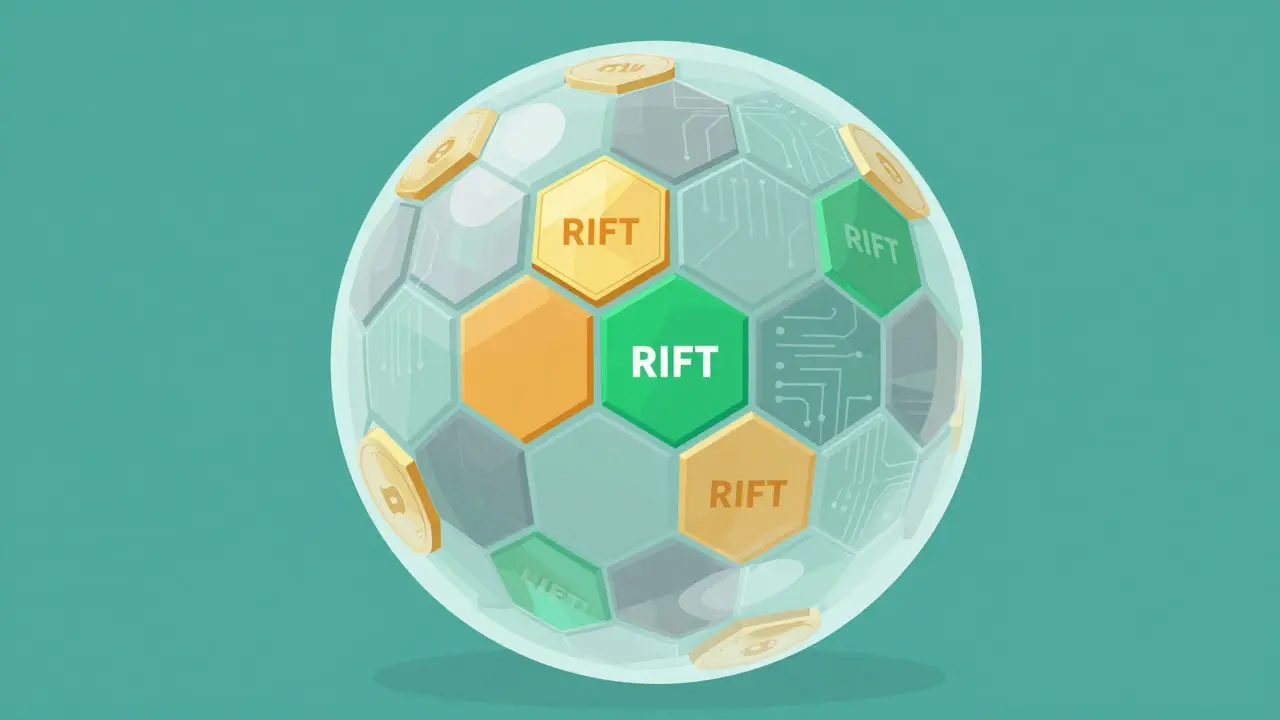
Most crypto projects talk about AI integration vaguely. RIFT AI tries to be specific. The platform is designed around the idea of modularity. Instead of one giant, monolithic AI brain, the ecosystem consists of smaller, specialized modules. Think of these modules like apps you install on your phone. One module might specialize in validating blockchain nodes, while another focuses on generating and selling NFT art through custom storefronts.
Developers create these modules and list them on the RIFT marketplace. End-users-whether they are traders, creators, or node operators-can then assign these modules to their own AI agents with just a few clicks. This low-code approach aims to make advanced AI accessible without requiring deep programming knowledge. The vision is to let anyone compose a bespoke digital worker tailored to their exact needs.
This model relies heavily on the Solana blockchain. Unlike some competitors that start on Ethereum and migrate later, RIFT launched directly on Solana in January 2025. This choice prioritizes speed and low transaction costs, which are critical when an AI agent might need to execute hundreds of small trades or data validations per minute. The native currency for all transactions within this ecosystem is the RIFT token.
Tokenomics: How the RIFT Coin Works
Understanding the economics of the token is crucial because it dictates demand. The RIFT token serves several distinct purposes:
- Payment for Services: Users spend RIFT to access AI modules and compute resources.
- Governance: Holders can vote on platform upgrades and new feature integrations.
- Staking: Participants can stake tokens to secure the network or earn rewards from the ecosystem’s revenue share.
- Base Trading Pair: All AI modules trade against RIFT, making it the central unit of account. If a developer wants to sell a new trading algorithm, it must be priced in RIFT.
The maximum supply is fixed at 1 billion RIFT tokens. There is no inflation mechanism, meaning no new tokens will ever be minted. At launch, only 20% of the supply (200 million tokens) was circulating. The remaining 800 million were locked for staking rewards, team allocations, and ecosystem incentives. This structure is designed to prevent immediate dumping by early insiders, though the release schedule for those locked tokens remains a key metric to watch.
Price Performance and Market Data Confusion
If you look up RIFT on different tracking sites, you’ll notice something unsettling: the numbers don’t match. This is common for micro-cap coins but particularly pronounced here. As of early August 2026, the price hovers in the sub-cent range, typically between $0.0018 and $0.0032.
| Platform | Price (USD) | Circulating Supply | Market Cap Estimate |
|---|---|---|---|
| CoinGecko | $0.001965 | Data varies | ~$2.0 Million |
| CoinMarketCap | $0.001944 | Data varies | ~$2.0 Million |
| InstantFunding | $0.001841 | 264.91 Million | ~$487,000 |
| CoinStats (Historical) | $0.02966 (Feb 2025) | 999.99 Million | ~$29.6 Million |
The discrepancy in circulating supply figures is stark. Some sources report nearly 1 billion tokens in circulation, while others cite around 265 million. This confusion makes calculating the true fully diluted valuation difficult. Furthermore, the price has dropped significantly from its early 2025 highs. In February 2025, RIFT briefly touched nearly $0.03 with a market cap approaching $30 million. By mid-2026, it had corrected over 90%, settling into a much quieter, lower-volume existence.
Liquidity and Trading Risks
Low price doesn’t always mean high risk, but low liquidity definitely does. RIFT is primarily traded on decentralized exchanges (DEXs) built on Solana, such as Raydium and Meteora. On average days, the 24-hour trading volume can be as low as $50 to $500. While there have been spikes-such as a $165,000 day in early 2025-these are exceptions rather than the rule.
Why does this matter to you? Slippage. If you try to buy or sell a large amount of RIFT, say $5,000 worth, you might move the price significantly because the order books are thin. You could end up paying much more than the listed price to buy, or receiving far less when you sell. For casual investors looking to park a small amount of capital, this is manageable. For anyone attempting serious position sizing, the lack of depth is a major hurdle.
Additionally, RIFT ranks outside the top 2,000 cryptocurrencies by market cap on most aggregators. It is not listed on major centralized exchanges like Binance or Coinbase for spot trading. This limits accessibility for beginners who prefer the simplicity of buying directly from a regulated exchange interface.
How to Buy RIFT AI Tokens
Since RIFT lives on the Solana network, you cannot buy it with a credit card on a traditional stock brokerage app. Here is the step-by-step process for acquiring RIFT as of 2026:
- Get a Solana Wallet: Download a wallet like Phantom or Solflare. These are user-friendly and support mobile devices.
- Fund Your Wallet: Buy SOL (Solana) on a major exchange like Coinbase or Kraken and transfer it to your wallet address.
- Connect to a DEX: Navigate to Raydium or Meteora. Connect your wallet to the platform.
- Swap for RIFT: Find the RIFT/SOL trading pair. Paste the official contract address (
jUpa2aDCzvdR9EF4fqDXmuyMUkonPTohphABLmRkRFj) to ensure you are getting the real token and not a scam copycat. - Execute the Trade: Set your slippage tolerance appropriately (often 1-3% for volatile assets) and confirm the swap.
Always double-check the contract address. Because RIFT is a newer project, fake tokens with similar names often appear on DEXs to trick inexperienced users.

The Mobile App and Future Roadmap
Beyond the token, RIFT AI promotes a mobile application designed to help users "trade any market 24/7." The app integrates AI-driven signals and automation tools intended to improve investment outcomes compared to manual trading. The tagline suggests ambitions to connect users to multiple asset classes, potentially including forex and traditional crypto markets, not just Solana-native assets.
Early documentation mentioned plans to migrate to a dedicated, AI-focused blockchain chain. However, as of August 2026, the project remains firmly rooted on Solana. There has been no public announcement of a successful migration or a live mainnet for a separate chain. This suggests the team is focusing on building utility within the existing Solana ecosystem rather than managing the complex engineering challenge of launching a new layer-one blockchain.
Is RIFT AI a Good Investment?
That depends entirely on your risk tolerance. RIFT is not a blue-chip asset. It is a speculative bet on the convergence of AI agents and decentralized finance. The technology concept-a modular marketplace for AI skills-is innovative and addresses a real need for accessible automation. However, adoption metrics remain low. Daily volumes are minimal, and community engagement appears niche compared to larger AI-themed tokens.
If you believe that AI agents will become standard tools for retail traders and that RIFT can capture a meaningful share of that market, the current sub-cent price offers asymmetric upside potential. But if you are looking for stability or proven traction, RIFT currently lacks the institutional backing, liquidity depth, and user base to qualify as a safe harbor. Treat any capital allocated to RIFT as high-risk venture money-you should be prepared to lose it entirely if the project fails to gain further traction.
What blockchain is RIFT AI built on?
RIFT AI operates on the Solana blockchain. Although early descriptions sometimes mentioned Ethereum, the token launched on Solana in January 2025 and continues to trade via Solana-based decentralized exchanges like Raydium and Meteora.
What is the maximum supply of RIFT tokens?
The maximum supply of RIFT is fixed at 1,000,000,000 (1 billion) tokens. There is no inflation, meaning no new tokens will be created after this cap is reached.
Why do different websites show different prices for RIFT?
Discrepancies arise due to inconsistent reporting of circulating supply and limited liquidity. Some trackers estimate nearly 1 billion tokens in circulation, while others cite around 265 million. Since Market Cap = Price x Circulating Supply, these variations cause wide swings in reported value and ranking across platforms like CoinGecko, CoinMarketCap, and InstantFunding.
Can I buy RIFT on Coinbase or Binance?
As of August 2026, RIFT is not listed on major centralized exchanges like Coinbase or Binance for direct fiat purchasing. You must use a Solana-compatible wallet and swap SOL for RIFT on decentralized exchanges (DEXs) such as Raydium or Meteora.
What does the "Shopify for AI Agents" analogy mean?
This analogy refers to the platform's modular design. Just as Shopify merchants install various apps to add features to their stores, RIFT users can install specific AI modules (like trading bots or NFT generators) onto their personal AI agents. Developers create and sell these modules, and users pay with RIFT tokens to activate them.
Is RIFT AI a scam?
There are no widespread reports labeling RIFT AI as a fraudulent scheme, but it is a high-risk micro-cap asset. The primary risks are technical failure, lack of adoption, and extreme price volatility due to low liquidity. Always verify the contract address before buying to avoid counterfeit tokens.
Leave a comments