
Imagine finding a shiny new toy in a sandbox that just opened. You rush to play with it, only to realize the plastic is thin and the instructions are missing. That’s roughly the story of RocketSwap. It was one of the first protocols to hit Base, Coinbase’s Ethereum Layer-2 network, promising speed and low fees. But if you’re looking at its native token, RCKT, today, you need to know more than just the hype. This article breaks down what RocketSwap actually is, why its security history matters, and whether this micro-cap asset has any real future.
The Core Concept: A Uniswap Clone on Base
RocketSwap is a decentralized exchange (DEX) and DeFi protocol built specifically for the Base network. Think of it as an automated market maker (AMM). Instead of matching buyers and sellers like a traditional stock exchange, it uses liquidity pools. You swap one token for another against a pool of assets, paying a small fee to the people who provided those assets.
The project launched in mid-2023, right when Base went public. Its main selling point? Being early. The team claimed it was the "first protocol to trade on Base and automatically provide liquidity." While that sounds impressive, it’s largely a marketing claim. Technically, RocketSwap runs on a Uniswap-v2 style design. If you’ve used Uniswap, you’ll find the interface familiar. Users can swap tokens, farm yields, stake their coins, and even use a launchpad for new projects.
The ecosystem isn’t limited to just swapping. The documentation lists several features:
- Yield Farming: Earn rewards by locking up your tokens.
- Staking: Stake RCKT to earn more RCKT.
- Launchpad: A platform for new tokens to raise funds using ETH and RCKT.
- NFTs: Non-fungible tokens integrated into the platform.
Who Is Behind RocketSwap?
Here’s where things get murky. Unlike major exchanges like Binance or Coinbase, RocketSwap doesn’t have a famous CEO or a publicly verified founding team. The official docs say it was "community initiated" and aims to become community-owned via a DAO (Decentralized Autonomous Organization).
In reality, no individual founder has been independently verified. There’s no registered corporate entity backing it. When you invest in a project without a known team, you’re betting entirely on the code and the community. For RocketSwap, that bet became risky very quickly.
The Tokenomics: Confusing Supply Numbers
If you try to look up RCKT stats, you’ll see different numbers depending on which website you check. This is a red flag for serious investors. Let’s clear up the confusion based on the official contract data versus tracker reports.
The official Base Mainnet contract (0x6653dD4B92a0e5Bf8ae570A98906d9D6fD2eEc09) states a total supply of 100,000,000 RCKT. However, 98,000,000 of those were sent to a "black-hole" address, meaning they are effectively burned and gone forever. This leaves approximately 2,000,000 tokens in circulation. But wait-there’s also a deployment on opBNB (another Layer-2 network) with its own separate supply of 2,000,000 RCKT.
| Metric | Official Docs / Contract | Tracker Reports (Varied) |
|---|---|---|
| Network | Base Mainnet & opBNB | Often conflated or outdated |
| Total Supply (Base) | 100,000,000 (98M burned) | ~2,000,000 circulating |
| Max Supply | Not clearly defined post-burn | ~99,030,000 reported |
| Price | N/A (Market driven) | $0.004 - $0.02 range |
| Liquidity | Low | $0 - $250k reported |
Why does this matter? Because price is meaningless without liquidity. If a tracker says the price is $0.02 but there’s zero volume, you can’t actually sell your tokens at that price. You’d crash the market trying to exit. As of late 2026, RCKT remains extremely illiquid. Some trackers show $0 daily volume. Others show tiny amounts. Always verify the specific contract address and network before trusting a price feed.
The Security Breach That Changed Everything
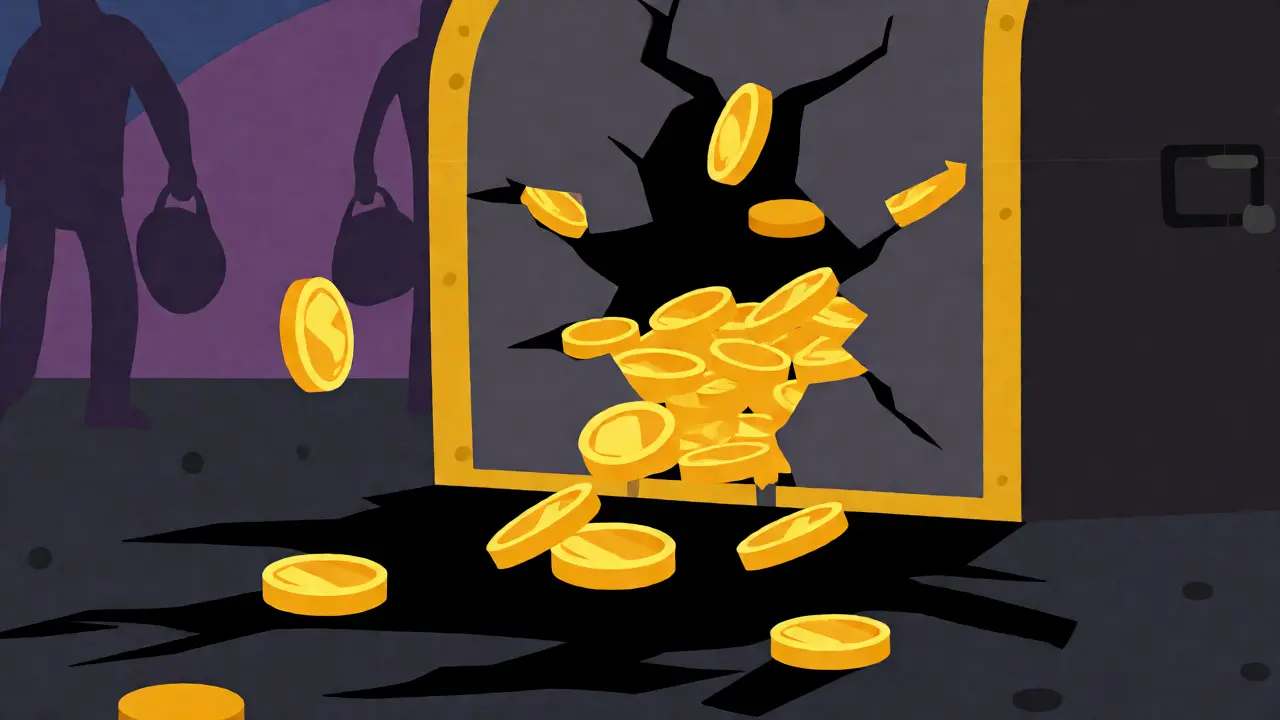
You can’t talk about RocketSwap without mentioning August 14, 2023. This date marks a major security incident that severely damaged user trust. Hackers drained approximately 472 ETH from the farming contracts. At the time, that was worth around $865,000.
How did it happen? The project blamed a brute-force attack on a server holding private keys. In simpler terms, the keys to the kingdom weren’t stored securely enough. Once the hackers got the keys, they didn’t just steal the money; they created chaos. They minted a fake token called "LoveRCKT," dumped it, and crashed the price. Then, they laundered the stolen ETH through bridges and exchanges like Tornado Cash and Binance.
This wasn’t the first scare. Just days earlier, in early August, users lost about $69,000 to scammers impersonating KuCoin representatives. Two security failures in one week? That’s a pattern, not an accident. It suggests weak operational controls and poor key management practices.
RocketSwap responded with an emergency plan: deploy new contracts, open-source the code, and reduce token emissions. They asked the hacker to return the funds. Did they? Mostly no. The loss was permanent for most users. The incident highlighted a critical lesson for DeFi beginners: smart contracts are only as secure as the humans managing them.
Is RocketSwap Still Active in 2026?
Fast forward to October 2026. Is anyone actually using RocketSwap? The answer is complicated. On paper, the protocol exists. The website is live. The contracts are deployed. But activity levels tell a different story.
Compared to competitors like Aerodrome Finance, which dominates the Base ecosystem, RocketSwap is a ghost town. Aerodrome offers better liquidity, more integrations, and a stronger security track record. Uniswap, available on multiple chains including Base, remains the gold standard for reliability.
RocketSwap’s current status is best described as "zombie-like." It hasn’t officially died, but it’s barely breathing. Development cadence is unclear. There’s no active, visible roadmap. The DAO structure mentioned in the docs hasn’t shown strong evidence of functioning governance. Most holders are likely sitting on losses or waiting for a miracle.
If you’re looking for yield farms, check the Total Value Locked (TVL). DefiLlama shows some TVL, but it’s inconsistent. High TVL with low trading volume often means locked-up capital that isn’t moving. It’s dead weight.

Pros and Cons of Holding RCKT
Should you buy RCKT? Here’s a balanced view based on current data.
Pros:
- Early Mover Advantage: One of the first DEXs on Base.
- Simplicity: Easy-to-use AMM interface.
- Burn Mechanism: 98% of the original supply was burned, theoretically reducing dilution.
Cons:
- Security History: Major exploit ($865k loss) and scam incidents.
- Illiquidity: Hard to buy or sell large amounts without slippage.
- Unknown Team: No verified founders or corporate backing.
- Data Inconsistency: Price and supply figures vary wildly across platforms.
- Strong Competition: Aerodrome and Uniswap offer safer, more liquid alternatives.
How to Use RocketSwap (If You Must)
If you’re still curious and want to test the waters, here’s how to interact with it safely. Remember, this is high-risk territory.
- Get ETH on Base: Bridge ETH from Ethereum Mainnet to Base using the official bridge or a wallet like MetaMask.
- Connect Your Wallet: Go to the RocketSwap website. Connect your EVM-compatible wallet (MetaMask, Rabby, etc.).
- Verify the Contract: Double-check the RCKT contract address. Don’t just click the first search result. Scams love copycat tokens.
- Select the Pool: Choose the correct Base network pool. Avoid opBNB unless you specifically want that deployment.
- Check Liquidity: Look at the pool size. If it’s tiny, your swap will have high price impact.
- Approve and Swap: Approve the transaction, then execute the swap. Keep an eye on gas fees, though they should be low on Base.
For farmers, remember that impermanent loss applies. If the price of RCKT drops relative to ETH, your value in the pool decreases compared to just holding the tokens. Plus, you face smart contract risk again. Even after the fix, audits are crucial. The project links to audit reports, but verifying the auditor’s reputation and date is essential.
The Verdict: Speculative Micro-Cap
RocketSwap is a cautionary tale wrapped in a DeFi protocol. It had the right idea at the right time-launching on Base when everyone was excited about cheap transactions. But execution failed. Security lapses and poor communication eroded trust. Today, RCKT is a speculative micro-cap asset. It’s not a blue-chip cryptocurrency like Bitcoin or Ethereum. It’s not even a solid mid-cap like Solana.
Think of it as a lottery ticket. If the community revives it, adds real utility, and fixes its reputation, it could see gains. But given the competition from Aerodrome and the lingering stigma from the hack, that seems unlikely. For most investors, there are safer ways to gain exposure to the Base ecosystem.
Is RocketSwap safe to use now?
It carries significant risk. While new contracts were deployed after the 2023 hack, the project lacks a verified team and consistent development updates. Smart contract risk remains, and the previous security breach raises concerns about operational maturity. Only invest what you can afford to lose.
What is the total supply of RCKT?
The official Base contract lists 100 million total supply, but 98 million were burned, leaving ~2 million in circulation. Note that opBNB has a separate deployment. Always check the specific network contract address for accurate supply data.
Why do price trackers show different values for RCKT?
Because liquidity is extremely low. Different trackers may pull data from different pools, use stale metadata, or fail to account for the burn. With near-zero trading volume, prices are easily manipulated or simply inaccurate reflections of real-world executability.
Did RocketSwap compensate victims of the hack?
There is no public evidence that all affected users were fully compensated. The project released a recovery plan involving new contracts and emission changes, but the stolen ETH (~$865k) was largely moved through mixers and exchanges, making recovery difficult.
Is RocketSwap better than Aerodrome on Base?
Currently, yes, Aerodrome is generally considered superior. It has higher liquidity, better security reputation, stronger ecosystem integration, and more active development. RocketSwap struggles to compete on these fronts.
Leave a comments