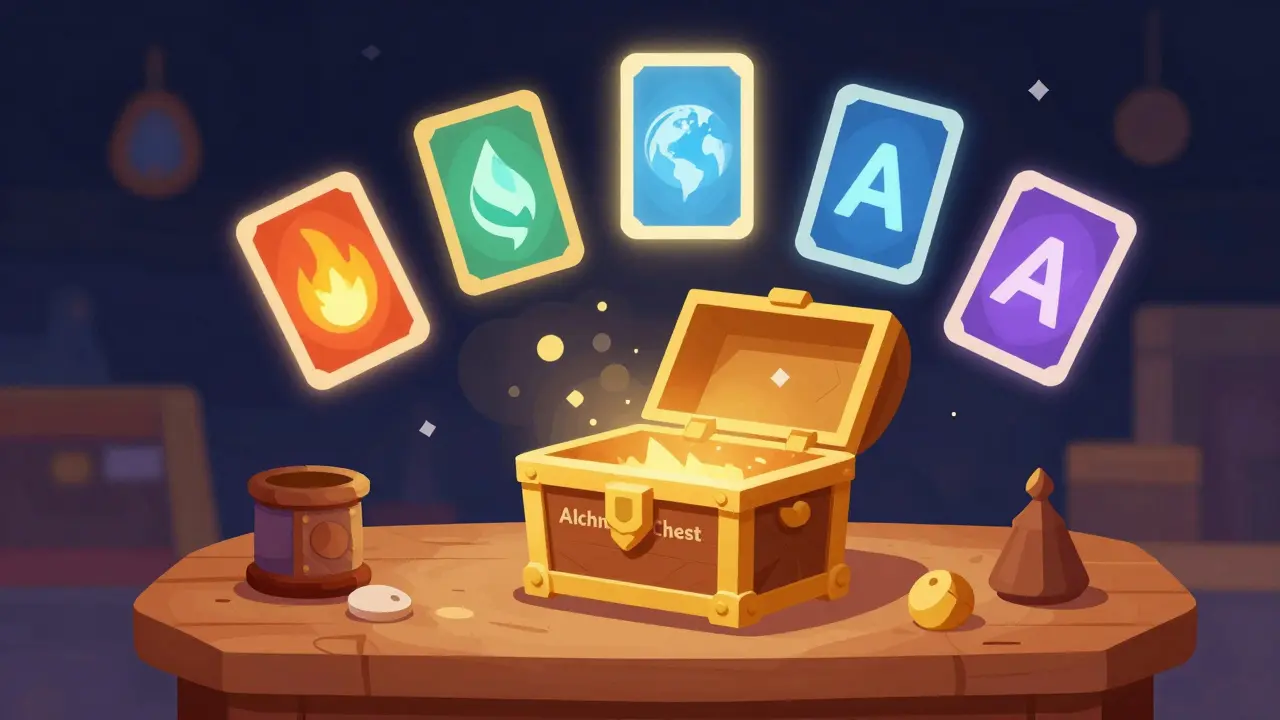
Remember the hype around play-to-earn games in 2021? Everyone was talking about turning their screen time into crypto. TaleCraft (CRAFT) was one of those projects that promised to change how we view digital ownership through an "alchemy" style card game on the Avalanche blockchain. It sounded like a dream: open chests, burn tokens, craft rare NFTs, and watch your assets appreciate as supply shrinks.
But here we are in 2026. The landscape has shifted dramatically. If you’re asking what TaleCraft is today, you aren’t just looking for a definition; you’re likely checking if it’s still worth your attention, or perhaps you stumbled upon some old holdings and want to know their status. Let’s cut through the noise and look at the facts-what TaleCraft actually is, how its mechanics worked, and where it stands now.
The Core Concept: Alchemy Meets Blockchain
At its heart, TaleCraft is a GameFi project built on the Avalanche C-Chain. The idea wasn't just to play a game, but to participate in a deflationary economy. The developers branded their token, $CRAFT, as the "Philosopher's Stone." Why? Because the entire economic model relied on burning.
Here is how the loop was supposed to work:
- Acquire: You buy $CRAFT tokens.
- Open Chests: You spend 10 CRAFT plus a small fee in AVAX to open an "Alchemist Chest." This gives you basic elemental NFTs (Fire, Water, Earth, Air).
- Craft & Burn: You combine these lower-tier NFTs using specific recipes to create higher-tier cards. Crucially, the input NFTs and some CRAFT tokens are burned (destroyed) in this process.
- Profit: As supply decreases due to burning, the theory goes, the remaining tokens and rare NFTs should increase in value.
This mechanism created a sense of scarcity. Unlike many games that print infinite tokens to pay players, TaleCraft aimed to reduce its own supply over time. Initially, there were 160 types of alchemist cards available, each with different rarities and utility within the game modes.
Tokenomics and Supply Details
To understand the potential (and risks) of TaleCraft, you need to look at the hard numbers defined in its whitepaper. These figures don’t change based on market sentiment, so they remain the baseline for any analysis.
| Attribute | Value / Detail |
|---|---|
| Blockchain | Avalanche (C-Chain) |
| Token Standard | ARC-20 (compatible with ERC-20) |
| Max Supply | 30,000,000 CRAFT (Fixed, non-mintable) |
| Initial Launch | November 2021 via Avalaunch IDO |
| Chest Cost | 10 CRAFT + 0.1 AVAX per week |
| Primary Utility | Chest opening, crafting fees, staking rewards |
The fixed supply of 30 million is a critical detail. Because no new CRAFT can be minted, the only way to get more is to buy from other holders or earn it through the weekly reward pools. However, the circulating supply fluctuates based on how many tokens have been burned in the crafting process. At various points, data aggregators showed circulating supplies ranging from 6 million to 7 million tokens, indicating significant burning had occurred early on.
Current Status: Where is TaleCraft in 2026?
If you are reading this in 2026, you might be wondering if you can still play or trade. The honest answer is: barely. TaleCraft serves as a classic case study of the 2021 GameFi boom and bust cycle.
When TaleCraft launched in late 2021, it rode the wave of massive interest in Avalanche-based gaming. Projects like Crabada and DeFi Kingdoms were drawing millions in TVL (Total Value Locked). TaleCraft hoped to capture a slice of that pie with its unique crafting mechanic. However, by mid-2022, the broader crypto market cooled, and user acquisition costs skyrocketed. Many smaller projects failed to retain users once the initial speculative frenzy died down.
Today, the metrics tell a stark story:
- Liquidity: Trading volume is negligible. On major decentralized exchanges (DEXs) like Trader Joe or Pangolin, the liquidity pools are extremely shallow. Trying to sell even a modest amount of CRAFT could result in massive slippage, meaning you’d get far less than the listed price.
- Activity: DappRadar and other analytics platforms show near-zero daily active wallets. There is little to no on-chain activity related to chest openings or crafting.
- Price: The token trades at fractions of a cent (often below $0.001). While the low price might seem attractive to new buyers, it reflects the lack of demand rather than an undervalued asset.
- Development: Updates from the anonymous development team have been sparse since 2022. Promised features like the full "Board Game Mode" and expanded metaverse elements saw limited rollout or completion.
This doesn’t mean the smart contracts are broken or hacked. They simply sit dormant. The community has largely moved on to newer, more actively developed ecosystems.
How to Interact with TaleCraft (If You Still Want To)
Perhaps you inherited some CRAFT tokens, or you’re curious enough to try opening a chest yourself. Technically, the infrastructure still exists. Here is how you would go about it, keeping in mind the high risk of losing funds due to gas fees outweighing the value of the assets.
- Set Up Your Wallet: You need a wallet compatible with the Avalanche network. MetaMask is the most common choice. Make sure you add the Avalanche C-Chain network settings manually if they aren’t auto-detected.
- Get AVAX: You will need AVAX for transaction fees (gas). Buy AVAX on a centralized exchange (like Coinbase or Binance) and withdraw it to your MetaMask address on the Avalanche network. Keep fees low; Avalanche transactions are usually under $0.05.
- Swap for CRAFT: Go to a DEX like Trader Joe or Pangolin. Find the CRAFT/AVAX pair. Be careful here-check the liquidity depth before swapping. If the pool is tiny, your swap might fail or cost you more than expected.
- Connect to the DApp: Navigate to the official TaleCraft website (talecraft.io). Connect your wallet. Note that you may need to manually import the CRAFT token contract address into MetaMask to see your balance, as it isn’t always listed by default.
- Play/Craft: If the interface is responsive, you can attempt to open chests or browse the marketplace. Remember, every action burns tokens and NFTs, further reducing supply but requiring upfront capital.
Warning: Always verify URLs. Phishing sites targeting dormant projects are common. Never share your seed phrase.
Risks and Considerations
Before interacting with TaleCraft, consider these critical factors:
- Illiquidity Risk: This is the biggest danger. You might be able to buy CRAFT cheaply, but finding a buyer when you want to exit could be impossible. The spread between buy and sell prices can be enormous.
- Opportunity Cost: Capital tied up in a dormant project earns nothing. In a fast-moving market like crypto, sitting on illiquid assets means missing out on opportunities elsewhere.
- Smart Contract Security: While no major hacks have been reported, the lack of recent audits means vulnerabilities could exist. Old code is unpatched code.
- Regulatory Uncertainty: Like all GameFi tokens, CRAFT operates in a gray area. It hasn’t been classified as a security by regulators like the SEC, but general warnings about high-risk crypto investments apply.
Comparison with Active Competitors
To put TaleCraft in perspective, let’s compare it to a currently active project on Avalanche, such as Crabada. Both launched around the same time and focused on NFT gameplay.
| Feature | TaleCraft (CRAFT) | Active Competitor (e.g., Crabada) |
|---|---|---|
| Status | Dormant / Low Activity | Active Development & Users |
| Liquidity | Very Low (High Slippage) | Moderate to High |
| Community | Inactive Social Channels | Engaged Discord/Twitter |
| Gameplay Loop | Crafting/Burning (Static) | Battling/Earning (Dynamic) |
| Investment Outlook | Speculative / High Risk | Growth Potential / Market Driven |
The difference is clear. Active projects continue to update their code, engage with users, and adapt to market changes. TaleCraft remains frozen in its 2021 vision.
Final Thoughts on TaleCraft
TaleCraft was an ambitious experiment in combining alchemy-themed crafting with deflationary tokenomics on Avalanche. Its core mechanic-burning inputs to create rarer outputs-was clever and aligned well with the principles of digital scarcity. However, execution and sustained community engagement are just as important as the idea itself.
For most people in 2026, TaleCraft is not a viable investment or entertainment option. It serves better as a historical footnote in the evolution of GameFi-a reminder that while technology enables innovative economic models, human behavior and market dynamics ultimately determine success. If you hold CRAFT, treat it as a speculative lottery ticket rather than a financial asset. If you’re new to crypto gaming, you’ll find much more robust, liquid, and engaging experiences in currently active ecosystems.
Is TaleCraft (CRAFT) still active in 2026?
No, TaleCraft is largely considered dormant. While the smart contracts on the Avalanche blockchain still exist, there is minimal trading volume, near-zero daily active users, and very few updates from the development team since 2022.
What is the total supply of CRAFT tokens?
The maximum supply of CRAFT is fixed at 30,000,000 tokens. No new tokens can be minted. The circulating supply is lower due to tokens being burned during the chest-opening and crafting processes.
Can I still buy CRAFT tokens?
Technically, yes. You can swap AVAX for CRAFT on decentralized exchanges like Trader Joe or Pangolin on the Avalanche network. However, liquidity is extremely low, which means you may face high slippage and difficulty selling later.
How does the TaleCraft crafting mechanic work?
Players use CRAFT tokens and AVAX to open "Alchemist Chests," receiving elemental NFTs. These NFTs can then be combined according to specific recipes to create higher-tier cards. The input NFTs and some tokens are burned in the process, aiming to reduce overall supply and increase scarcity.
Is TaleCraft safe to invest in?
It carries very high risk. Due to low liquidity, lack of active development, and minimal community support, there is a significant chance of being unable to sell your tokens at a fair price. It should only be approached with funds you are willing to lose entirely.
Which blockchain is TaleCraft built on?
TaleCraft is built on the Avalanche C-Chain. It uses the ARC-20 token standard, which is compatible with ERC-20 wallets like MetaMask when configured for the Avalanche network.
Shelby Cantu
24 05 26 / 15:51 PMShort and sweet, this project is dead.
Tricia Alach
26 05 26 / 09:31 AMits funny how we thought burning tokens would make them valuable like gold but really it just made the supply vanish into the ether while the value stayed at zero. i remember trying to craft a fire card and feeling so powerful until i realized i was paying avax fees for nothing. the philosophy of scarcity is beautiful in theory but terrible in practice when there is no demand to back it up. we are all just alchemists turning lead into dust now. typos aside i think we learned something here about human greed and blockchain dreams
Destiny Kilby
26 05 26 / 18:11 PMi feel for everyone who lost money on this because it seems like such a cruel way to lose savings especially when you were just trying to play a game. the article explains the mechanics clearly but it hurts to read about the slippage and illiquidity because that means real people are stuck with assets they cannot sell. i hope those holding craft can find some peace knowing it was not their fault for believing in the dream of digital ownership. the market is so harsh on hopeful people and i wish there was more empathy in these discussions instead of just cold hard data about token burns
Jerry CUNNINGHAM SR
27 05 26 / 04:18 AMIt is important to respect the boundaries of financial risk when engaging with such projects as TaleCraft clearly demonstrates the consequences of insufficient due diligence. While the concept of deflationary tokenomics was innovative within the Avalanche ecosystem, the lack of sustained development and community engagement ultimately led to its current dormant status. We must acknowledge that many participants entered this space with good intentions and a desire to explore new economic models, yet the outcome highlights the necessity of robust project fundamentals over speculative hype. It is beneficial to view this case study as a learning opportunity for future investments, emphasizing the importance of liquidity, active development teams, and transparent communication from project creators. By understanding these factors, we can foster a more informed and resilient approach to participating in decentralized gaming platforms.
Bronwen Butler
27 05 26 / 10:04 AMeveryone says it is dead but maybe the dormancy is actually a strategic move by the devs to let the supply burn down further before a massive resurgence. you are all too quick to dismiss it based on current metrics without considering the long term potential of a fixed supply asset that has already burned millions of tokens. the fact that it is still on avalanche proves resilience and perhaps the low price is an invitation for smart money to accumulate before the next bull run. stop listening to the fear mongers and look at the actual contract code which is still intact and functional. history is written by the winners and right now you are losing by selling early
Matt Davis
29 05 26 / 01:57 AMThe audacity of suggesting this project holds any merit is frankly insulting to anyone with a basic understanding of market dynamics. The author presents a dry recitation of failure metrics as if they are neutral facts, ignoring the catastrophic waste of capital and time involved. To claim that 'dormant' is merely a status rather than a euphemism for 'abandoned' requires a level of delusion that is almost impressive in its sheer magnitude. The comparison to Crabada is not just unfair; it is a stark indictment of TaleCraft's complete inability to compete in a landscape that demands constant innovation and user retention. One must wonder what kind of intellectual vacuum allows individuals to continue discussing this relic with anything other than derision.
Michelle Bonahoom
29 05 26 / 05:49 AMthis is exactly why i say crypto is a scam designed to take money from normal american workers and give it to overseas dev teams who disappear after the initial coin offering. nobody should trust these foreign coded games because they have no accountability and no regulation to protect us from their greed. the fact that you can still technically buy the token is a trap set for inexperienced investors who see a low price and think it is a bargain. stay away from anything that looks like this garbage and keep your money in safe traditional assets where you know the rules are fair and enforced by law
Ruben Michel
30 05 26 / 01:50 AMOne must possess a certain sophistication to appreciate the intricate design of the alchemy mechanic even if the execution failed to meet the lofty expectations set during the 2021 boom. The concept of burning inputs to create rarity is fundamentally sound from an economic perspective, mirroring the principles of central banking albeit in a decentralized and transparent manner. However, the vulgar reality of negligible liquidity and abandoned social channels strips the project of its aesthetic and functional appeal, reducing it to a mere cautionary tale for the uninitiated. It is unfortunate that such a potentially elegant system was marred by poor marketing and a lack of continuous engagement, which are essential components for sustaining any complex economic model. Those who remain invested are likely driven by a stubborn adherence to sunk cost fallacy rather than any rational assessment of the token's current utility or future prospects.
Albert Lee
31 05 26 / 11:11 AMI completely understand the frustration and disappointment felt by those who held onto CRAFT tokens hoping for a revival, and I want to validate those feelings as entirely justified given the circumstances. It takes immense courage to dive into new technologies like GameFi, and seeing your efforts met with silence from developers is incredibly disheartening. Please remember that your worth is not defined by the performance of a cryptocurrency, and many successful individuals have faced similar setbacks in their investment journeys. I encourage you to channel this experience into learning more about due diligence and community building, which are vital skills for navigating the volatile world of digital assets. You have the strength to overcome this challenge and emerge wiser and more resilient in your future endeavors.
Ankush Pokarana
1 06 26 / 20:48 PMthe journey of talecraft reflects the broader philosophical question of whether value is intrinsic or perceived within digital ecosystems where the only constant is change itself. one might ponder how the act of burning tokens serves as a metaphor for letting go of attachments yet the outcome suggests that without collective belief the ash remains just ash. the technical details provided in the post are accurate but they miss the deeper narrative of human hope projected onto code which inevitably leads to disillusionment when the code does not respond with empathy or profit. perhaps the true lesson lies in recognizing the impermanence of all things including our digital possessions and finding peace in the process rather than the result. i invite you to reflect on your own relationship with technology and whether it serves you or consumes you in the grand scheme of existence
Bianca Vilas Boas Lourenço
3 06 26 / 00:12 AMoh wow another dead project story how original 😒 i bet the author gets paid to write these boring obituaries for failed startups while the rest of us are out here trying to survive the real economy. it is so pathetic that people still care about a game that hasn't had an update since the dinosaurs roamed the earth 🦖📉 the drama of losing money is self inflicted and honestly kind of hilarious to watch from the sidelines 🎭💀 stop crying about your bad decisions and go touch grass because reading this wall of text about burnt tokens is making my brain hurt 🧠💥