
Imagine buying a coin called "VolatilityX" because you heard it uses AI to predict the stock market. You check your wallet, but the price doesn't match what your friend sees. Why? Because there isn't just one VolatilityX. There are at least three different tokens sharing the exact same ticker symbol: **VOLTX**. If you are looking into this project in mid-2026, you need to know which version you are holding before you lose money to a simple mix-up.
VolatilityX started as a concept for an AI-driven financial data platform that provides market intelligence through social media feeds and short-video apps. The idea was attractive: get unbiased, fact-based analysis directly where you scroll. However, the reality on the blockchain is messy. The original analytics-focused token has seen its value drop by over 97% from its peak in early 2025. Meanwhile, derivative versions of the token exist on other blockchains like Base and Binance Smart Chain, creating a confusing web for new investors.
The Identity Crisis: Three Tokens, One Name
The biggest risk with VOLTX right now is not just market volatility-it's identity confusion. When you search for "VolatilityX" on any major tracker, you might be looking at completely different assets. Let's break down the three main entities currently using this name.
| Token Version | Blockchain | Total Supply | Primary Use Case |
|---|---|---|---|
| VolatilityX (Original) | Unknown/EVM | 1.00 Billion | AI Market Analytics & Data Access |
| VolatilityX by Virtuals | Base Blockchain | 6.7 Billion | General Value Transfer / NFT Ecosystem |
| VolatilityX (BSC) | Binance Smart Chain | 100 Million | Decentralized App Interactions |
The original VolatilityX, tracked by sites like CryptoRank and CoinMarketCap, is the one associated with the AI agent narrative. It has a maximum supply of 1 billion tokens, with 800 million currently circulating. This is the token that hit an all-time high (ATH) of $0.0199 in January 2025. As of mid-2026, it trades significantly lower, often hovering between $0.0001 and $0.0005 depending on the exchange.
Then there is "VolatilityX by Virtuals" on the Base blockchain. This is a separate contract entirely. It has a massive supply of 6.7 billion tokens and is compatible with ERC-20, ERC-721, and ERC-1155 standards. This suggests it might be used for NFTs or gaming assets rather than just buying access to AI tools. Its price is often near zero due to low liquidity.
Finally, the Binance Smart Chain (BSC) version exists as a BEP-20 token with only 100 million in supply. While smaller in quantity, it operates on a different network with different fees and security considerations. Mixing these up is easy if you just copy-paste a ticker symbol without checking the contract address.
The Promise vs. Reality of the AI Agent
So, what does the original VolatilityX actually do? The pitch is strong. The project claims to deploy autonomous AI agents that deliver stock market analysis directly into platforms you already use, like social feeds or TikTok-style video apps. Instead of digging through complex charts, the AI supposedly gives you clear, fact-based insights.
In theory, this solves a real problem: information overload. Retail traders are drowning in data. An AI filter that highlights key trends could be valuable. However, the execution details are sparse. There are no public API specifications, no detailed whitepapers explaining the machine learning models used, and no independent audits of the AI's accuracy. Most of the information available comes from marketing blurbs on listing sites like CoinMarketCap.
Without transparency on how the AI works, it's hard to verify if the token holds actual utility. Is holding VOLTX required to use the service? Or can anyone sign up for free? Currently, the link between owning the token and accessing the AI features remains vague. This lack of clarity is common in micro-cap projects but dangerous for investors expecting tangible product usage.

Price History and Market Performance
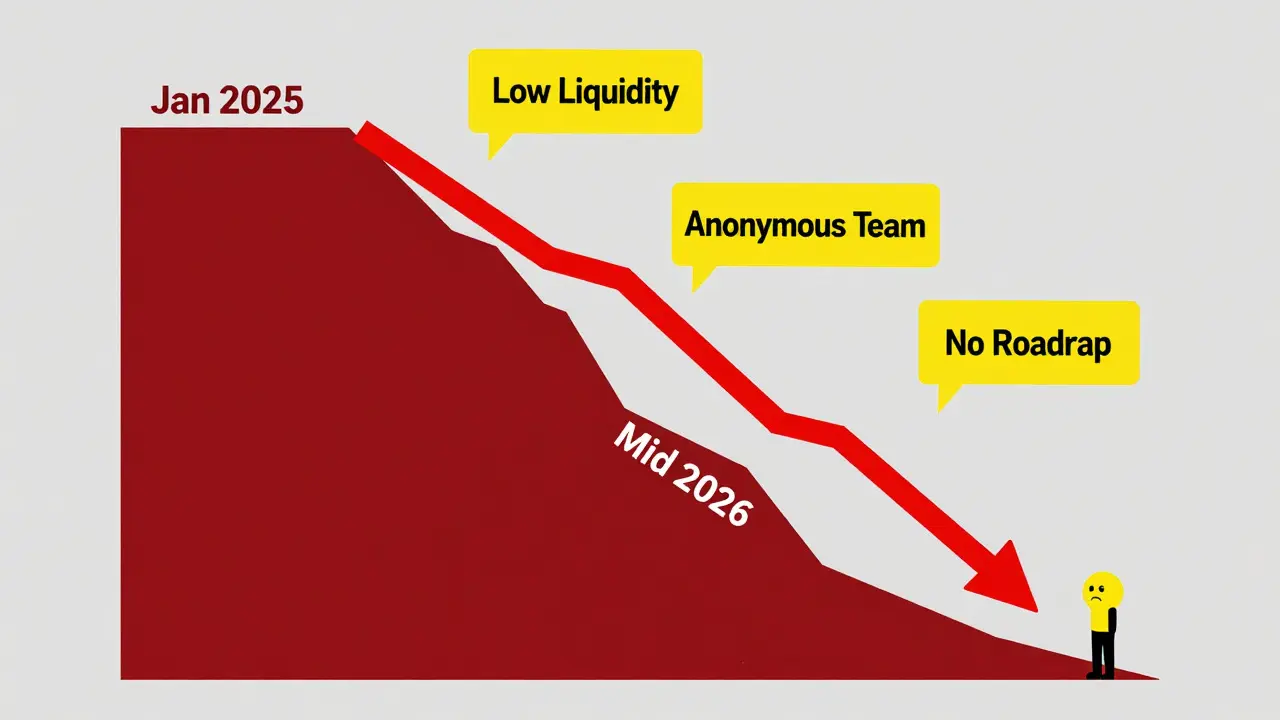
If you bought VOLTX at its peak, you are likely feeling the pain. The token reached its highest recorded price of $0.0199 on January 6, 2025. Since then, it has suffered a massive drawdown. By mid-2026, prices across various exchanges show values ranging from $0.00011 to $0.0005. That represents a loss of roughly 97% to 98% from the top.
Why did it crash? Several factors contribute:
- Micro-Cap Status: With a market capitalization fluctuating between $100,000 and $370,000, VOLTX is tiny compared to the broader crypto market. Small caps are highly susceptible to sell-offs when hype fades.
- Thin Liquidity: Daily trading volumes are often low, sometimes under $1,000 on some trackers. This means large sales can crash the price instantly, and buying back in can spike it artificially (a phenomenon known as slippage).
- Competition: The AI crypto sector became crowded in 2025 and 2026. Larger, better-funded projects with clearer roadmaps attracted most of the investor attention, leaving smaller tokens like VOLTX behind.
Interestingly, you might see sudden spikes in price reports. For instance, Binance once listed a 218% daily increase for VOLTX. In thin markets, a few thousand dollars in volume can create wild percentage swings that don't reflect genuine demand. These spikes are often traps for late buyers.
How to Buy (and Where to Be Careful)
If you still want to buy VOLTX, you need to know where to look. Because it is not widely listed on major centralized exchanges (CEXs) with deep order books, most trading happens on decentralized exchanges (DEXs).
- For the Original Token: Check aggregators like 3Commas or specific listings on Bitget. Ensure the contract address matches the one cited by reputable trackers like CryptoRank. The circulating supply should be around 800 million.
- For the Base Version: You will need a wallet compatible with Ethereum networks (like MetaMask) and ETH bridged to Base. Trade on Uniswap v3. Watch out for the 6.7 billion supply figure-this is the "Virtuals" variant.
- For the BSC Version: Use a wallet set up for Binance Smart Chain. Trade on PancakeSwap v2. Verify the contract address ends in ...E06 to ensure you have the correct 100 million supply token.
Always double-check the contract address. Copying the wrong one is the fastest way to end up with a worthless token that looks exactly like the real thing on your screen.
Risks and Red Flags
Before investing more, consider these critical risks associated with VolatilityX in 2026:
- No Clear Team: Public listings do not provide names of founders, incorporation details, or a clear organizational structure. Anonymous teams are higher risk because accountability is low.
- Lack of Roadmap: There are no published dates for future feature releases, AI upgrades, or governance plans. The project appears stagnant since its 2025 launch.
- Data Discrepancies: Different exchanges report vastly different prices and volumes for the same ticker. This indicates fragmented liquidity and potential data feed errors.
- Regulatory Uncertainty: As an AI-driven financial tool, it may face scrutiny regarding securities laws, especially if the token promises returns based on the efforts of others (the AI team).
The absence of expert reviews, academic papers, or GitHub repositories linked to the project makes it difficult to assess technical merit. You are betting on a brand name rather than a verified technology stack.
Conclusion: Proceed with Extreme Caution
VolatilityX (VOLTX) is a fascinating case study in how branding can outpace substance. The idea of AI agents delivering financial insights is timely and useful. But the current state of the token is fragmented, illiquid, and heavily discounted from its highs. If you are looking for a stable investment, this is not it. If you are a speculator willing to gamble on a comeback, ensure you know exactly which of the three VOLTX tokens you are buying. Check the contract address, check the supply, and never invest more than you can afford to lose entirely.
Is VolatilityX (VOLTX) a scam?
There is no definitive proof that VolatilityX is a scam, but it exhibits many red flags common in high-risk micro-cap projects. These include anonymous founders, multiple conflicting token contracts, and a 97% drop in value from its peak. The lack of transparent technical documentation and user reviews makes it difficult to verify legitimacy. Treat it as a highly speculative asset rather than a secure investment.
Which blockchain is the real VolatilityX on?
The original VolatilityX associated with the AI analytics platform is primarily tracked on general aggregators and does not explicitly specify a single chain in all listings, though it behaves like an EVM-compatible token. However, there are distinct versions on the Base blockchain (VolatilityX by Virtuals) and Binance Smart Chain (BSC). Always verify the contract address against the source you trust, such as CryptoRank or CoinMarketCap, to ensure you are interacting with the intended asset.
What is the total supply of VOLTX?
The total supply depends on which version you hold. The original VolatilityX has a maximum supply of 1.00 billion tokens. The Base blockchain version (by Virtuals) has a supply of 6.7 billion tokens. The Binance Smart Chain version has a supply of 100 million tokens. Confusing these supplies is a common error for new investors.
Can I buy VOLTX on Coinbase or Binance?
While price trackers on Coinbase and Binance may list VOLTX for reference, direct spot trading pairs are limited or non-existent on these major centralized exchanges. Most trading occurs on decentralized exchanges like Uniswap (for Base) or PancakeSwap (for BSC), or through smaller aggregators. Always check the specific exchange interface for active trading pairs before attempting a purchase.
What is the purpose of the VolatilityX token?
The stated purpose of the original VolatilityX token is to provide access to an AI-driven platform for financial data and analysis. It aims to deliver unbiased market intelligence through digital channels. However, the exact mechanism for using the token to access these services is not clearly documented, leading to questions about its practical utility beyond speculation.
Leave a comments