
Remember the hype around "decentralized internet" projects a few years back? You probably saw headlines about earning crypto just by sharing your Wi-Fi. Wicrypt was one of those ambitious attempts to let everyday people monetize their bandwidth. The project promised a dual reward system through its NFT and Device Drop airdrop, combining physical hardware with digital collectibles. But if you are looking for details on this specific drop today, you might be surprised to find that the landscape has changed drastically since its launch in late 2021.
Let's cut through the noise. The "NFT & Device Drop" wasn't just a simple giveaway of tokens. It was a strategic move to bootstrap a network of physical routers. Users who participated often had to engage with the ecosystem early to secure these rewards. However, as we stand here in November 2026, the reality of Wicrypt is quite different from the initial promises. This article breaks down what the airdrop actually entailed, how the WNT token functioned, and where the project stands now.
What Was the Wicrypt Airdrop?
To understand the airdrop, you first need to grasp the core concept. Wicrypt built a peer-to-peer wireless network. Instead of paying a traditional ISP exclusively, users could buy a specialized router, connect it to their existing internet, and sell excess bandwidth to neighbors or other network participants. In return, they earned WNT tokens.
The "Device Drop" referred to the distribution of these physical hardware units. Early adopters didn't just get tokens; they got the actual equipment needed to mine WNT. The NFT component served as a proof of participation or ownership rights within the ecosystem, potentially offering governance privileges or reduced fees. This hybrid model-hardware plus digital assets-was designed to create a sticky user base. You couldn't just dump the tokens and leave; you had to keep the device online to earn more.
The primary token distribution, however, happened via a Token Generation Event (TGE) rather than a standalone free-for-all airdrop. The TGE concluded in December 2021. Participants in the earlier private funding rounds and IDO (Initial DEX Offering) on Cardano’s OccamRazer platform received their allocations based on vesting schedules. Some tokens unlocked linearly over two months, while others were locked for up to 36 months. This structure aimed to prevent immediate sell-offs, but it also meant that many early supporters had their capital tied up for years.
How Did the Hardware Work?
You might wonder, "Is this just a fancy router?" Not exactly. The Wicrypt device was an ARM-based processor unit with dual-band Wi-Fi (2.4GHz and 5GHz) and gigabit Ethernet ports. It acted as both a standard home router and a blockchain node.
- Setup: Users connected the device to their main modem. The software handled the split between local traffic and shared bandwidth.
- Earnings: Rewards depended on uptime, bandwidth shared, and demand in your specific geographic area.
- Maintenance: Unlike cloud mining, this required physical presence. If the power went out or the Wi-Fi dropped, earnings stopped.
Early reports from Lagos, Nigeria-one of Wicrypt's key markets-suggested that a well-placed device could earn around $3.50 daily. That sounds great, right? But real-world data tells a different story. Community feedback highlighted frequent reboots and overheating issues, especially in tropical climates. One user reported losing nearly 40% of potential earnings due to technical glitches requiring manual resets. For many, the hassle outweighed the profit.
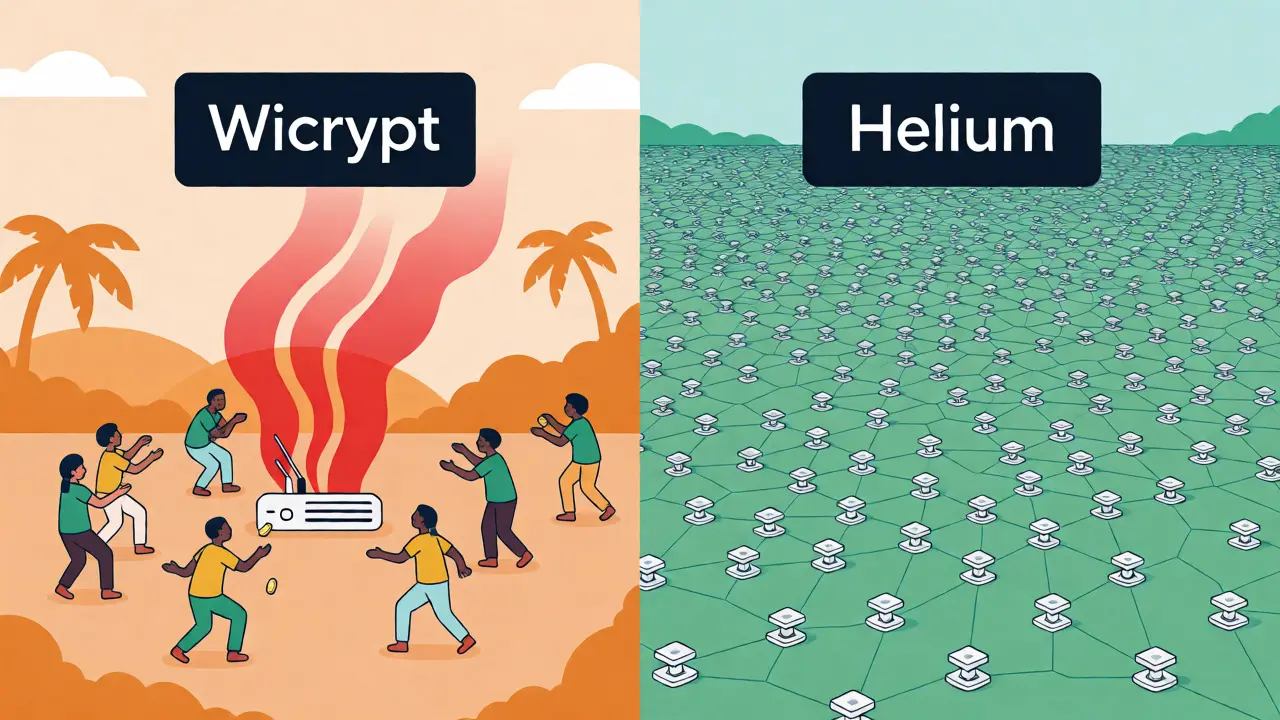
Wicrypt vs. Helium: Why Scale Matters
It is impossible to discuss Wicrypt without mentioning Helium. Both projects aim to decentralize connectivity, but they targeted different technologies. Helium focused on LoRaWAN for IoT devices, deploying over 500,000 hotspots globally by 2021. Wicrypt stuck to Wi-Fi, which offers higher speeds but shorter range and higher energy costs.
| Feature | Wicrypt (WNT) | Helium (HNT) |
|---|---|---|
| Network Type | Wi-Fi (High Speed) | LoRaWAN (Low Power, Long Range) |
| Primary Use Case | Internet Bandwidth Sharing | IoT Sensor Data Transmission |
| Hardware Cost (Launch) | ~$99 USD | ~$300-$500 USD |
| Global Hotspots (2021) | ~1,200 (Estimated) | 500,000+ |
| Token Utility | Payment for Bandwidth | Reward for Coverage/Data |
Wicrypt raised $1.5 million in private funding, a modest sum compared to the hundreds of millions flowing into competitors like Helium. This funding gap showed in marketing and community growth. While Helium became a household name in crypto circles, Wicrypt remained niche, primarily active in African markets where traditional internet infrastructure was expensive or unreliable.
Current Status: Is WNT Still Alive?
Here is the hard truth. As of 2025, the WNT token is no longer actively traded on major centralized exchanges. CoinGecko lists it as delisted, with the last significant trading activity occurring in Q2 2022 on decentralized exchanges. The GitHub repository shows minimal development commits after March 2022. This stagnation suggests that the team either pivoted away from public development or ceased operations entirely.
The community reflects this decline too. The official Telegram group, which boasted 8,500 members in late 2021, dwindled to roughly 1,200 active members by October 2025. Most of the remaining chatter consists of users asking if their devices still work or if there will ever be another update. The "NFT" aspect largely faded into obscurity, with secondary markets for these digital assets becoming illiquid.
If you held onto WNT tokens hoping for a moonshot, you likely faced significant losses. The 36-month vesting schedule meant that when many tokens finally unlocked, the market sentiment had already shifted against small-cap DePIN (Decentralized Physical Infrastructure Network) projects. Analysts at Delphi Digital noted in 2024 that over 70% of similar hardware-dependent blockchain projects failed to sustain operations beyond 18 months. Wicrypt fits this pattern perfectly.
Lessons for Future Airdrops
So, what can we learn from the Wicrypt experience? First, hardware-dependent airdrops carry unique risks. Unlike software protocols, you cannot simply fork the code and fix bugs remotely. If the device fails physically, the network suffers. Second, liquidity matters. An airdrop is only valuable if you can sell the asset. When exchanges delist a token, exit opportunities vanish.
For investors eyeing new DePIN projects, look for transparent device deployment numbers. Wicrypt struggled because it never publicly confirmed exact adoption rates, leading to skepticism. Always check the developer activity on GitHub. If the last commit was three years ago, treat the project as dormant regardless of its marketing claims.
Was the Wicrypt airdrop free?
Not entirely. While some promotional drops occurred, the primary distribution involved purchasing tokens during the IDO or buying the physical hardware device. The "airdrop" often referred to bonus tokens granted to early hardware buyers or community participants, not a completely free giveaway for everyone.
Can I still use my Wicrypt device?
Technically, yes, it functions as a standard Wi-Fi router. However, the blockchain integration and WNT earning capabilities have significantly degraded or stopped due to lack of server maintenance and exchange support. You likely won't earn meaningful crypto rewards anymore.
Where can I sell my WNT tokens?
Major exchanges like Binance or Coinbase do not list WNT. Your best bet is decentralized exchanges (DEXs) on networks where the token was originally issued, such as Cardano or Ethereum bridges, though liquidity is extremely low and slippage may be high.
Did Wicrypt succeed in Nigeria?
It gained traction initially due to high internet costs, but widespread adoption stalled. Regulatory hurdles and competition from cheaper mobile data plans limited its long-term success. It remains a niche player rather than a mainstream solution.
Are there better alternatives to Wicrypt now?
Yes. Projects like Helium (now focusing on 5G), Grass, and various newer DePIN startups offer more active communities and better liquidity. They also benefit from lessons learned by predecessors like Wicrypt regarding hardware reliability and tokenomics.
The Wicrypt journey serves as a cautionary tale for the crypto space. Innovation is exciting, but sustainability requires more than just a clever whitepaper and a shiny device. If you are holding legacy WNT assets, consider whether the effort to liquidate them is worth the current value. For newcomers, keep an eye on projects with transparent development logs and robust exchange listings before committing capital.
Leave a comments