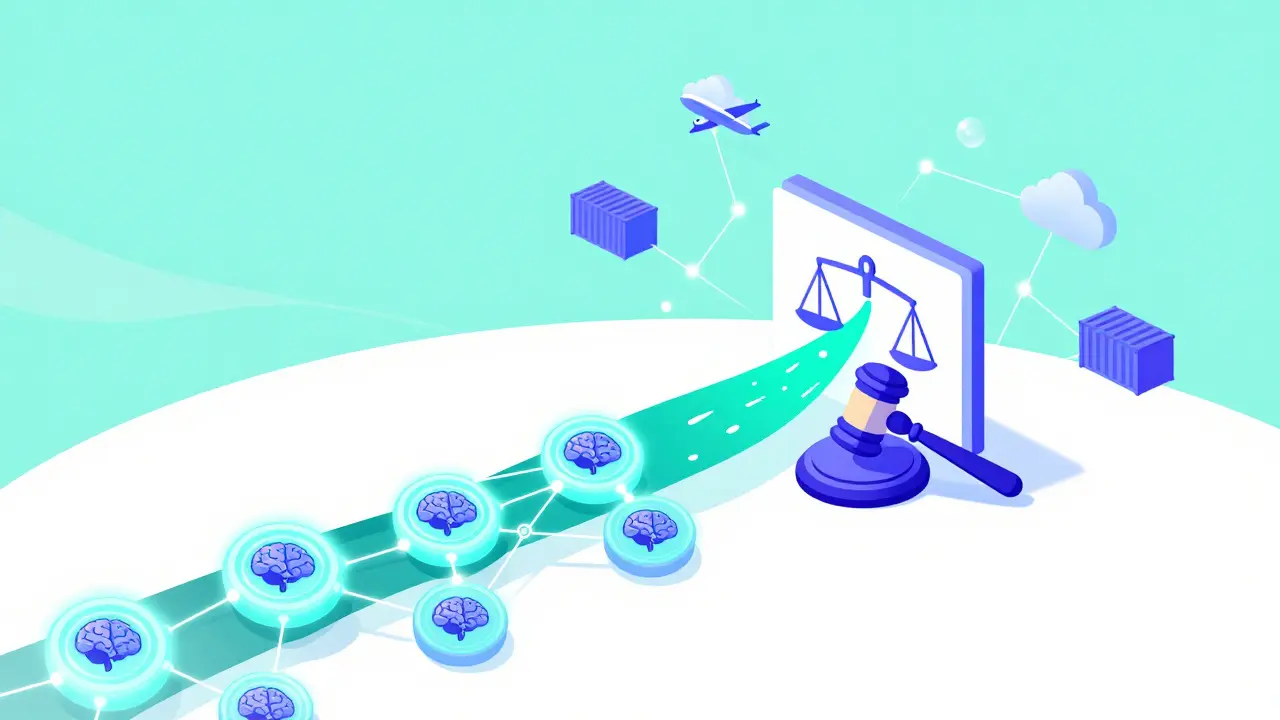
AI-powered smart contracts aren’t just a buzzword-they’re rewriting how agreements happen on the blockchain. Forget the old "if this, then that" logic. Today’s smart contracts don’t just follow rules. They learn from data, spot patterns, and make decisions in real time-like a lawyer who’s read every contract ever signed and can predict what’s coming next.
What Makes AI-Powered Smart Contracts Different?
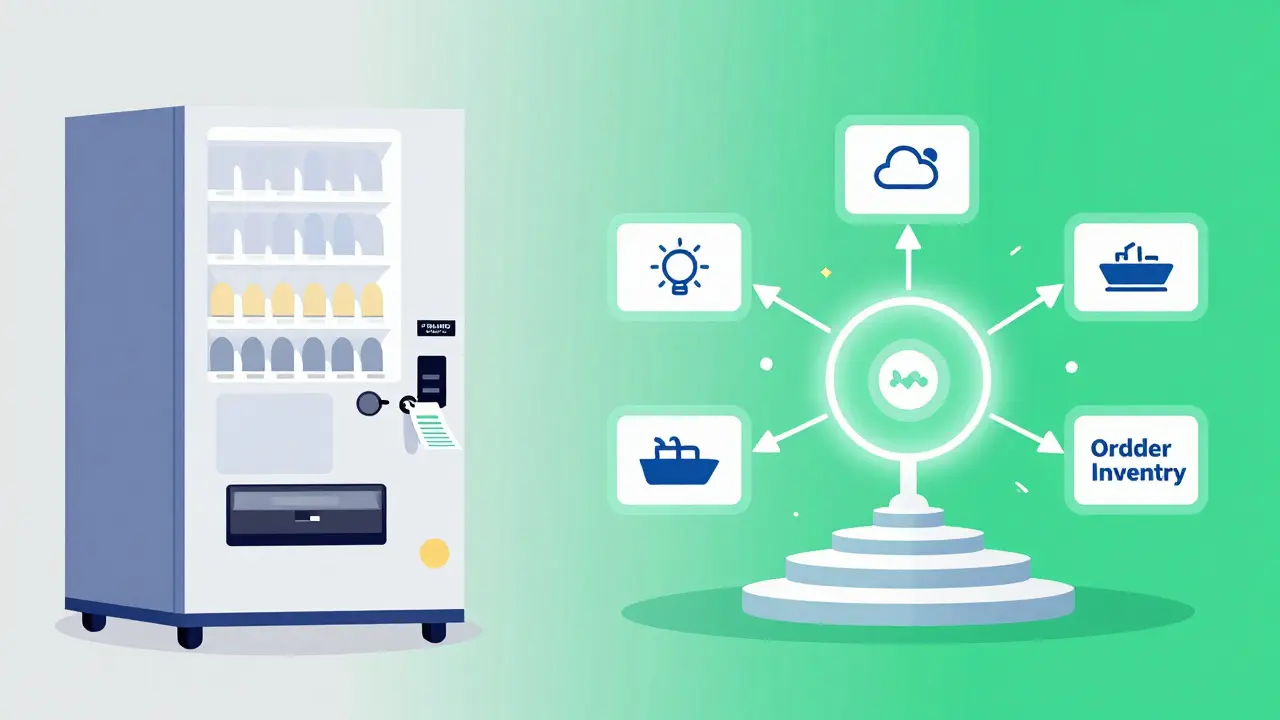
Traditional smart contracts are like vending machines. You put in the right input-say, proof of delivery-and you get the right output-payment released. Simple. Reliable. But rigid. They can’t adapt. If the weather delays a shipment, or a supplier goes bankrupt, or market prices swing overnight, they just sit there, waiting for the exact condition they were coded for. AI-powered smart contracts are different. They use machine learning models trained on thousands of past transactions. They don’t just react. They anticipate. In insurance, they can look at flight delay data, passenger counts, and historical claims patterns to automatically approve compensation-within minutes. In supply chains, they reroute shipments based on port congestion, fuel prices, and storm forecasts. They’re not programmed to handle every scenario. They’re trained to figure it out. According to Komodo Platform’s March 2025 analysis, these contracts improve prediction accuracy by 15-22% after processing just 10,000+ transactions. They cut execution errors by 37% after six months. And in AXA’s pilot, they reduced flight delay claim processing from 14 days to 47 minutes-with 99.2% accuracy.How They Work: The Tech Behind the Magic
An AI-powered smart contract isn’t one thing. It’s a system. At its core, it still runs on blockchain platforms like Ethereum, using Solidity to define the contract’s structure. But it’s layered with AI tools: TensorFlow or PyTorch models that analyze data, and middleware like Fetch.AI’s agent framework that lets AI agents act independently on the network. These contracts connect to oracles-data bridges that pull in real-world info. Weather reports. Stock prices. Customs delays. Without oracles, they’re blind. With them, they become dynamic. Chainlink’s new AI oracle network, launched in January 2025, cuts gas costs by 35% by running heavy AI computations off-chain, then only recording the final decision on the blockchain. The learning process is key. The AI doesn’t start smart. It starts with data. At least 5,000 historical transactions are needed for basic functionality. More data? Better decisions. At 50,000+, accuracy climbs steadily. Unilever’s supply chain team spent six months just calibrating their model before hitting 90% reliability.Where They’re Making a Real Difference
You won’t find AI smart contracts in simple peer-to-peer payments. But in complex, multi-variable environments? They’re already saving millions.- Insurance: AXA’s AI contract for flight delays automatically checks flight status, weather, and passenger tickets. No forms. No calls. Just payout. 99.2% accuracy.
- Supply Chain: Maersk’s 2024 pilot used AI contracts to reroute cargo ships based on real-time port congestion, fuel costs, and weather. Result? 22.4% lower logistics costs.
- Finance: Banks are testing AI contracts to auto-adjust loan terms when a borrower’s credit risk shifts-based on spending patterns, job changes, or market trends.
- Manufacturing: Contracts between suppliers and factories now auto-reorder parts when inventory dips below predicted demand thresholds, not fixed levels.
The Downside: Cost, Complexity, and Risk
AI smart contracts aren’t magic. They’re expensive. On Ethereum, gas fees average 0.045 ETH per execution-three times higher than traditional contracts at 0.015 ETH. That adds up fast in high-volume systems. Setup is brutal. You need:- A blockchain developer (Solidity)
- Two AI specialists (TensorFlow/PyTorch)
- A domain expert (insurance rules, logistics rules, etc.)
AI vs. Traditional Smart Contracts vs. CLM Systems
| Feature | Traditional Smart Contracts | AI-Powered Smart Contracts | AI CLM Systems (e.g., Sirion) |
|---|---|---|---|
| Logic Type | Fixed if-then rules | Adaptive, learning-based | Human-in-the-loop workflows |
| Best For | Simple, binary transactions | Complex, multi-variable scenarios | Contract negotiation, review, approval |
| Execution Speed | 0.2 seconds (Ethereum) | 40-65% faster on complex logic | Hours to days (manual steps) |
| Immutability | High | High | Low (editable records) |
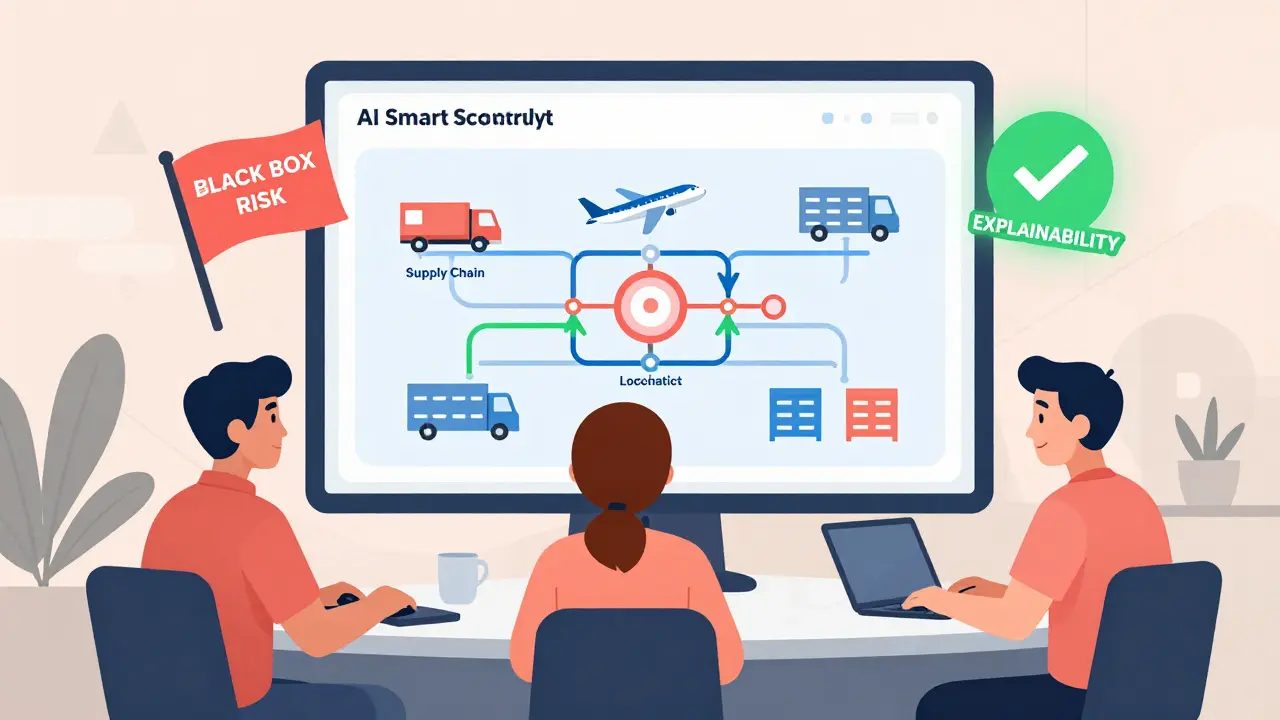
| Explainability | Full transparency | Low (black box risk) | High (human audits) |
| Cost per Execution | 0.015 ETH | 0.045 ETH | Not applicable (cloud-based) |
What’s Next? The Road Ahead
The market is exploding. Deloitte and Gartner estimate AI-enhanced blockchain solutions hit $8.7 billion in 2024-with AI smart contracts making up $5.4 billion of that. By 2028, it could hit $26.4 billion. New developments are tackling the biggest hurdles:- Ethereum’s Shanghai upgrade (March 2025) cut gas costs for complex AI logic by 28%.
- Chainlink’s AI oracle network now provides verified, off-chain AI processing.
- NVIDIA’s Blockchain AI Inference Engine, launched in May 2025, offers dedicated hardware to speed up AI execution on chains.
- ISO/IEC JTC 1 started work on standard 23091-7 in February 2025 to certify AI contract explainability.
Should You Use Them?
If you’re running a simple payment system? Stick with traditional smart contracts. They’re cheaper, faster, and foolproof. But if you’re managing:- Supply chains with dozens of moving parts
- Insurance policies with dynamic risk factors
- Loan agreements tied to real-time economic data
- Manufacturing workflows with unpredictable delays
Are AI-powered smart contracts secure?
Yes, but differently. The blockchain layer remains as secure as any traditional smart contract-immutable and tamper-proof. But the AI layer introduces new risks. If the training data is poisoned, or the oracle feeds false information, the contract can make bad decisions. That’s why systems like Chainlink’s decentralized oracle network and explainability frameworks are critical. Security now means securing both the code and the data.
Can AI smart contracts be legally enforced?
In many jurisdictions, yes-if they meet legal requirements for electronic contracts. The EU’s MiCA framework (effective January 2025) explicitly recognizes AI-powered smart contracts as legally binding, provided they include mechanisms to explain decisions. In the U.S., states like Arizona and Tennessee have passed laws recognizing blockchain contracts. The challenge isn’t legality-it’s proving how the AI reached its decision when disputes arise.
Do I need to be a coder to use AI smart contracts?
Not to use them-but to build them, absolutely. Businesses can buy or license AI contract solutions from platforms like Fetch.AI or Sirion. But if you want to customize one, you need a team with blockchain development skills (Solidity), machine learning expertise (TensorFlow/PyTorch), and deep knowledge of your industry’s rules. There’s no low-code tool yet that handles complex AI logic on-chain.
How much data do I need to train an AI smart contract?
Minimum 5,000 historical transactions for basic functionality. But performance improves with more data. At 10,000+, accuracy jumps 15-22%. For enterprise use cases like insurance or logistics, 30,000-50,000+ records are ideal. Poor data quality can reduce accuracy by up to 40%. Clean, consistent, labeled data is non-negotiable.
What industries are adopting AI smart contracts fastest?
Financial services lead with 41% of implementations, followed by supply chain and logistics at 29%, and insurance at 18%. Manufacturing and healthcare are catching up. These industries all share one thing: complex, multi-variable agreements where delays cost millions. AI smart contracts solve real pain points there.
Will AI smart contracts replace lawyers?
No. They replace repetitive, rule-based tasks-like verifying delivery proof or triggering payments. But they can’t negotiate terms, interpret ambiguous language, or handle disputes. Lawyers are still needed to draft the rules the AI follows, review exceptions, and represent clients when things go wrong. AI smart contracts are tools, not replacements.
Sean Kerr
16 12 25 / 01:48 AMthis is wild lol i just used an ai contract to get my amazon refund when my package was late and it paid me $12 in 20 mins no cap 😍👏
Terrance Alan
17 12 25 / 10:25 AMPeople act like this is some revolutionary breakthrough but its just code with extra steps and if you think its ethical to let machines decide who gets paid and who doesnt without human oversight then youve been drinking the blockchain koolaid too long
Sally Valdez
19 12 25 / 05:06 AMUSA invented this tech and now europe is trying to regulate it into oblivion because they cant build anything themselves. Let us innovate or get left behind. China is already ahead and they dont care about your explainability nonsense
George Cheetham
19 12 25 / 13:38 PMThere's something beautiful about machines learning to be fairer than humans ever were. Imagine a world where your insurance claim isn't denied because of a typo in a form but because the system truly understands your situation. That's not automation. That's evolution.
Sue Bumgarner
21 12 25 / 03:17 AMYou people dont even understand how this works. The data has to be clean or the AI just spits out garbage. I worked at a bank that tried this and they used dirty data from 2018 and the system started approving loans to people who were dead. Like actual corpses. It was a disaster. You cant just slap ML on blockchain and call it innovation
Emma Sherwood
21 12 25 / 07:16 AMIn India we have millions of small farmers who cant access credit because they dont have formal paperwork. Imagine an AI contract that reads satellite images of their fields, weather patterns, and harvest history to give them loans automatically. This isnt just tech. Its justice.
Kelsey Stephens
21 12 25 / 10:03 AMI really appreciate how this post breaks down both the promise and the pitfalls. Its easy to get swept up in the hype but the part about legal liability and black box decisions? That’s the real conversation we need to be having. Not just how fast it runs but who bears the cost when it fails.
Tom Joyner
22 12 25 / 06:08 AMThe notion that this is somehow more efficient than human judgment is laughable. You're outsourcing moral reasoning to a model trained on historical bias. The 99.2% accuracy claim is meaningless if the 0.8% error is someone's life savings.
Cheyenne Cotter
23 12 25 / 08:42 AMIve been using AI contracts for my freelance gigs on Ethereum and theyve cut my invoicing time by 80%. No more chasing clients for payments. The system auto-releases funds when milestones are verified by oracles. Its like having a robot accountant who never sleeps.
Shruti Sinha
23 12 25 / 10:41 AMThe real challenge isn't the technology. It's getting organizations to trust it. My company tried to implement this for supply chain and the legal team refused because they couldn't 'explain' it to auditors. We ended up keeping a human in the loop anyway. The tech works. The culture doesn't.
Elvis Lam
25 12 25 / 02:02 AMYou're all missing the point. The real game-changer is off-chain AI computation with on-chain verification. Chainlink's new oracle network means you get the power of AI without drowning in gas fees. This isn't just better contracts. It's the first scalable AI blockchain architecture.
Jonny Cena
25 12 25 / 14:22 PMIf you're worried about black boxes, start with explainable AI frameworks like LIME or SHAP. They're not perfect but they give you breadcrumbs to follow. And don't forget: humans still design the training data. The bias isn't in the machine. It's in the people who fed it.
Mark Cook
26 12 25 / 08:09 AMNah this is just a fancy way for big corp to avoid paying humans. Next thing you know the AI will decide who gets fired too. 😏
Greg Knapp
26 12 25 / 20:18 PMI tried one of these contracts last year and it auto paid out to someone who never even delivered the goods because the weather oracle said it was late but the package was sitting in a warehouse for 3 weeks and no one noticed until the money was gone
Sammy Tam
27 12 25 / 02:27 AMThis is the future and its glittering. Imagine your car insurance adjusting your premium in real time based on your driving behavior, traffic patterns, and even local crime stats. No more annual renewals. Just pure adaptive fairness. We're not just changing contracts. We're redefining trust.
Heather Turnbow
27 12 25 / 02:58 AMThe regulatory landscape remains fragmented. While the EU's MiCA framework mandates explainability, the U.S. lacks a unified standard. This creates compliance fragmentation that increases operational risk. Organizations must invest in audit trails and model documentation to mitigate legal exposure. The technology is mature; the governance is not.