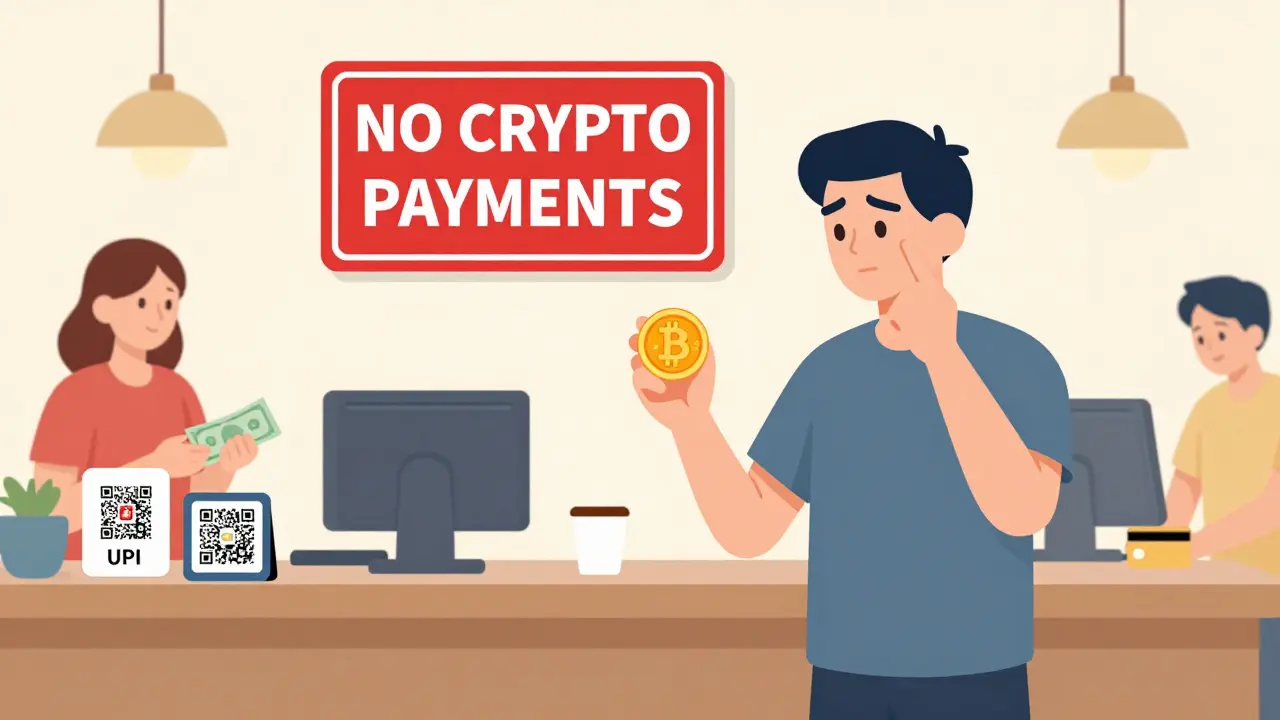
Can you pay for your coffee with Bitcoin in India? What about using Ethereum to buy groceries online? The short answer is no-and it’s not because the government banned crypto entirely. It’s because they made a very specific choice: you can own crypto, but you can’t spend it like money.
What’s Actually Illegal About Crypto Payments in India
In India, using cryptocurrencies like Bitcoin, Ethereum, or Solana to pay for goods or services is explicitly prohibited. This isn’t a gray area-it’s written into the rules. The government doesn’t want private digital currencies replacing the Indian Rupee (INR) in everyday transactions. Even if a shop owner says they’ll accept Dogecoin, doing so puts both you and them at legal risk. The law treats crypto not as currency, but as a Virtual Digital Asset (VDA). That classification matters. It means crypto is treated like stocks or gold-something you buy, hold, or sell for profit. But you can’t use it to settle debts or pay for services. That’s the line the government drew. This rule applies to everyone: individuals, businesses, online marketplaces, freelancers, even crypto ATMs. If you’re a freelancer and you invoice a client in USDT, then get paid in USDT, that’s a violation-even if you immediately convert it to INR. The payment method itself is illegal.What You Can Still Do With Crypto in India
Here’s where things get confusing for many people. If you can’t use crypto to pay for things, why does everyone still trade it? Because trading and holding are still legal-under strict conditions. You can buy Bitcoin on WazirX, CoinSwitch, or ZebPay. You can sell it. You can hold it in a wallet. You can even trade on international platforms like Binance or Bybit-as long as they’re registered with FIU-IND, India’s financial intelligence unit. The key distinction is simple: Investment is allowed. Payment is not. If you buy Bitcoin hoping its value goes up, you’re fine. If you try to use that Bitcoin to buy a laptop from Flipkart, you’re breaking the law. This split approach is rare globally. Most countries either fully ban crypto or let it function as money. India chose a third path: treat it like a high-risk asset class, not a currency.How the Tax System Forces Compliance
The Indian government didn’t just ban crypto payments-they made it expensive and complicated to ignore the rules. Since 2022, every crypto trade is taxed at 30%, with no deductions allowed. That means if you bought Bitcoin for ₹5 lakh and sold it for ₹8 lakh, you owe ₹90,000 in tax-no matter if you lost money on other trades. On top of that, there’s a 1% Tax Deducted at Source (TDS) on every transaction over ₹50,000. So if you sell ₹1 lakh worth of Ethereum, ₹1,000 gets taken out before you even see the money. And if you pay platform fees in INR? Those are now subject to 18% GST. You must report all crypto activity in your income tax return using Schedule VDA. If you don’t, your return can be rejected. The Income Tax Department has cross-checked bank statements with exchange data. Thousands of people have received notices for undeclared crypto gains-even if they didn’t cash out. The tax system isn’t just about revenue. It’s a surveillance tool. Every trade leaves a paper trail. The government wants to know who owns what, when they bought it, and how much they made. No anonymity. No loopholes.
Why the Government Fears Crypto as Payment
So why ban payments but allow trading? The Reserve Bank of India (RBI) has been clear: crypto undermines monetary control. If millions start paying for rent or groceries in Bitcoin, the central bank loses its grip on interest rates, inflation, and currency stability. There’s also fear of illicit activity. Crypto’s pseudonymous nature makes it attractive for money laundering. That’s why FIU-IND has fined Binance ₹18.8 crore and Bybit ₹9.27 crore for failing to report suspicious transactions. Both platforms had to register under India’s Anti-Money Laundering laws to keep operating. The government’s solution? The Digital Rupee. The RBI launched its own central bank digital currency (CBDC) in late 2022. Unlike Bitcoin, the Digital Rupee is legal tender. It’s backed by the RBI, traceable, and designed to replace cash-not compete with it. The goal is simple: give people the speed and convenience of crypto without the risks. No volatility. No tax evasion. No offshore exchanges. Just a digital version of the rupee, controlled by the state.What Happens If You Try to Use Crypto to Pay for Something?
If you try to pay a vendor in crypto, the worst-case scenario isn’t jail-it’s tax trouble. The transaction itself isn’t criminal, but it triggers red flags. If the vendor deposits the crypto proceeds into a bank account, the bank will report it under PMLA rules. The Income Tax Department will see an unexplained income source. You’ll likely get a notice asking: “Where did this money come from?” If you can’t prove it was from legal crypto trading (and you didn’t report it), you could face penalties, interest, or even a tax reassessment. Businesses that accept crypto payments risk having their bank accounts frozen. Banks in India still operate under RBI guidelines that discourage crypto-related activity. Even if a platform is registered with FIU-IND, banks can refuse to serve businesses that deal in crypto payments. The risk isn’t just legal-it’s financial. Crypto prices swing wildly. A shop owner who accepts 0.1 BTC for a ₹50,000 product might wake up to find that same 0.1 BTC is now worth ₹42,000. They’re stuck with the loss. And they can’t claim it as a tax deduction.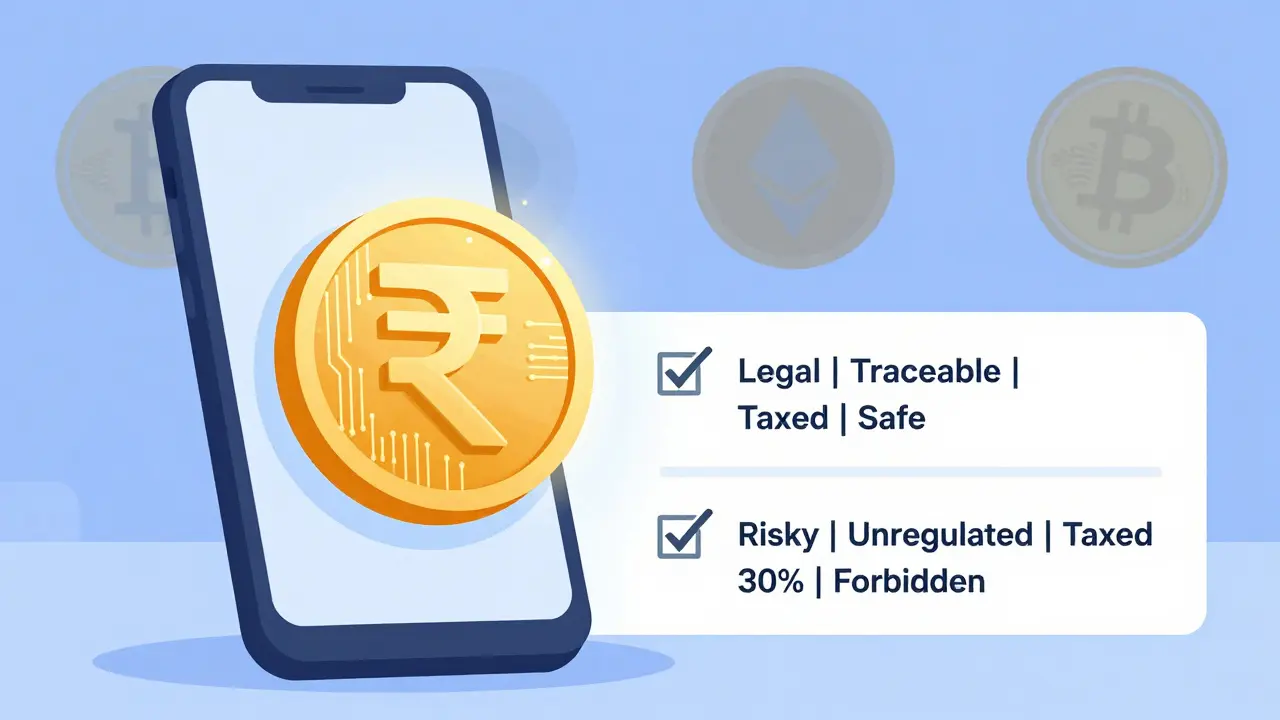
How People Are Working Around the Rules
Despite the ban, people still find ways to use crypto for payments. Some use peer-to-peer (P2P) platforms to convert crypto to INR instantly, then pay via UPI. Others use crypto debit cards that auto-convert holdings to rupees at checkout. These aren’t legal, but they’re common. A growing number of freelancers invoice clients in crypto, then convert the funds to INR within hours. They treat it as a foreign currency transaction, not a payment method. It’s a loophole-but one that could get them audited. The crypto community in India is large-over 15 million users-and it’s adapting. People keep detailed records. They use tax software. They avoid public crypto payments. They know the rules aren’t perfect, but they’re enforceable.The Future: Will Crypto Payments Ever Be Legal?
Don’t expect a change anytime soon. The government’s position hasn’t shifted since 2022. The Finance Ministry has drafted a bill to ban private cryptocurrencies-but it hasn’t been tabled in Parliament. That doesn’t mean it’s dead. It means they’re waiting for the right moment. The Digital Rupee is expanding. By 2026, it’s expected to be used for government payments, subsidies, and even retail transactions. If it works well, it’ll make private crypto payments even less relevant. Experts believe India will stick with its current model: crypto as a speculative asset, not a currency. The tax regime will stay. The ban on payments will stay. The crackdown on unregistered exchanges will intensify. The real question isn’t whether crypto payments will be allowed-it’s whether anyone will still want to use them. With the Digital Rupee offering instant, secure, state-backed digital payments, why risk fines, taxes, and volatility?What You Should Do in 2026
If you’re in India and you own crypto:- Don’t use it to pay for anything. Even if the seller says it’s okay.
- Keep full records of every buy, sell, and transfer. Include dates, amounts, and platform names.
- Report all gains in Schedule VDA of your ITR. Don’t wait for a notice.
- Use only FIU-IND registered exchanges. Avoid unregistered platforms.
- Understand that losses can’t offset gains. Every profit is taxed at 30%.
- Consider the Digital Rupee as your real digital payment tool-it’s legal, safe, and growing fast.
Can I use Bitcoin to pay for online services in India?
No. Using Bitcoin or any other cryptocurrency to pay for goods or services in India is explicitly prohibited by law. Even if a website or service accepts it, doing so violates the government’s rules on Virtual Digital Assets. You can buy and sell crypto legally, but you cannot use it as payment.
Is it legal to hold cryptocurrency in India?
Yes. Holding cryptocurrency is completely legal in India. You can buy, sell, and store Bitcoin, Ethereum, and other digital assets through registered exchanges like WazirX, CoinSwitch, or FIU-IND-compliant international platforms. The government treats crypto as a Virtual Digital Asset, not as currency, so owning it is permitted under current tax and regulatory rules.
What happens if I don’t report my crypto gains?
If you don’t report crypto gains in your income tax return using Schedule VDA, you risk receiving a notice from the Income Tax Department. Your return may be invalidated, penalties up to 200% of the tax due can be imposed, and interest will accrue on unpaid taxes. The department cross-checks bank transactions with exchange data, so undeclared gains are easily detected.
Are crypto-to-crypto trades taxed in India?
Yes. Every crypto-to-crypto trade is treated as a taxable event. If you swap Bitcoin for Ethereum, the IRS treats it as selling Bitcoin and buying Ethereum. You must calculate the fair market value in INR at the time of the trade and pay 30% tax on any gain. TDS of 1% also applies if the transaction value exceeds ₹50,000.
Can Indian banks block my account for crypto activity?
Yes. While banks can’t ban crypto trading outright, they can freeze or close accounts linked to crypto payments or suspicious activity. The RBI still discourages banks from facilitating crypto-related transactions. If you frequently transfer money to unregistered exchanges or make large deposits from P2P crypto sales, your bank may flag your account under PMLA rules.
Is the Digital Rupee the same as cryptocurrency?
No. The Digital Rupee is India’s central bank digital currency (CBDC), issued and backed by the Reserve Bank of India. Unlike Bitcoin or Ethereum, it’s legal tender, traceable, and not decentralized. It’s designed to replace cash, not compete with crypto. While crypto is a speculative asset, the Digital Rupee is a government-controlled digital version of the Indian Rupee.
Do I have to pay GST on crypto trading fees?
Yes. Since July 2025, an 18% Goods and Services Tax (GST) applies to platform fees charged by Indian crypto exchanges. This includes fees for buying, selling, or transferring crypto. The fee is paid in INR and is separate from the 30% income tax on gains. You cannot deduct this GST from your taxable crypto profits.
Can I use Binance or Bybit in India?
Yes-but only if they’re registered with FIU-IND. Both Binance and Bybit were fined in 2023 for non-compliance but have since completed registration under India’s Anti-Money Laundering laws. You can use them legally if you complete KYC and comply with reporting requirements. Unregistered platforms remain illegal and risky.
Paul Johnson
11 01 26 / 10:05 AMbro why even care about crypto payments when u can just use UPI its faster and free lol
Sarbjit Nahl
12 01 26 / 01:01 AMThe government's stance is not about control it is about preserving the integrity of monetary policy. Crypto as payment introduces untraceable value flows that destabilize macroeconomic equilibrium. The VDA classification is a legal necessity not a restriction.
Meenakshi Singh
13 01 26 / 20:19 PMI tried paying for chai with ETH once 😅 the guy just stared at me like I asked him to pay me in glitter. Then he said "beta yeh kya kar raha hai?" and took cash instead. 🤡
Michael Richardson
14 01 26 / 13:33 PMIndia thinks it's special because it bans crypto payments but lets you gamble on it. Meanwhile the US lets you buy Bitcoin with your credit card. Who's really progressive?
Krista Hoefle
14 01 26 / 16:57 PM30% tax on crypto gains? Wow. So the state just taxed my dreams. Next they'll tax hope. And oxygen. 💀
Kelley Ramsey
15 01 26 / 14:30 PMI really appreciate how this post breaks down the difference between holding and spending crypto-it’s such a crucial distinction that so many people miss! The tax rules are harsh, yes, but at least they’re clear. Keep sharing thoughtful content like this!
Sabbra Ziro
16 01 26 / 23:56 PMI think it's beautiful that India is building its own digital currency instead of letting private entities control the future of money. The Digital Rupee could empower millions who don't have bank accounts-this isn't about control, it's about inclusion.
Natalie Kershaw
17 01 26 / 23:26 PMHonestly if you're using crypto for payments you're already playing with fire. The 1% TDS + 30% tax + 18% GST is a triple whammy. Why not just use the Digital Rupee? It's faster, cheaper, and won't get your account frozen. Stop fighting the system-build on it.
Kip Metcalf
18 01 26 / 05:27 AMI don't get why people are mad. If you want to spend crypto go to Thailand or El Salvador. India has its own rules. Just trade it. Don't try to use it like cash. Simple.
Jacob Clark
19 01 26 / 15:00 PMLet me just say this: the fact that the RBI fined Binance ₹18.8 crore and Bybit ₹9.27 crore... that's not just enforcement-that's a message. A message that says: 'We are watching. We are recording. We are not playing.' And if you think you're anonymous? You're not. Not even close. The system is built to catch you. Every trade. Every transfer. Every second. Don't test it.
Emily Hipps
20 01 26 / 06:24 AMYou know what? This whole system is actually kind of empowering. Yes, the rules are strict-but they’re clear. You know exactly where you stand. No gray zones. No shady exchanges. If you play by the rules, you’re safe. And if you’re smart? You use the Digital Rupee and skip all the stress. You’ve got options. Use them wisely. 💪