Before January 2024, if you wanted to invest in Bitcoin or Ethereum through a traditional brokerage account, you were stuck buying the actual coins-or dealing with risky, unregulated products. That changed forever when the SEC approved the first spot Bitcoin ETFs on January 10, 2024. Six months later, Ethereum ETFs followed. These weren’t just new products. They were a full reset of how Wall Street views crypto.
Why the SEC Finally Said Yes
The SEC had rejected over 13 Bitcoin ETF applications since 2013. The turning point wasn’t a change in policy-it was a court ruling. In August 2023, the D.C. Circuit Court told the SEC it had been inconsistent. It approved Bitcoin futures ETFs but kept blocking spot ones, even though both tracked the same asset. The court called it arbitrary. That forced the SEC’s hand. By January 2024, six Bitcoin ETFs launched, led by BlackRock’s IBIT. Within a week, it hit $4.6 billion in assets. Investors didn’t just buy Bitcoin. They bought Bitcoin ETF shares the same way they buy Apple or Tesla stock. No wallets. No private keys. No risk of losing access to your crypto because you forgot a passphrase. Then came Ethereum. On July 23, 2024, the SEC approved 11 spot Ethereum ETFs. That was bigger than Bitcoin’s launch. Bitcoin is digital gold. Ethereum is a platform. It runs smart contracts, decentralized apps, DeFi protocols. The SEC approving an Ethereum ETF meant they were no longer treating all crypto the same. Ethereum got its own category: a legitimate, investable asset class.The Cash-Only Phase: A Temporary Fix
The first Bitcoin and Ethereum ETFs didn’t work like gold ETFs. They used a cash-only model. When you bought shares, you paid cash. When you sold, you got cash back. The ETF provider had to buy or sell actual Bitcoin or Ether on the open market to match the flow. That created problems. First, it was expensive. Every time an authorized participant (AP) had to trade crypto to balance the ETF, they paid fees and slippage. Second, it created tax headaches. Selling crypto to fund ETF creation triggered capital gains. That meant ETFs were less tax-efficient than they could be. By mid-2025, the market had grown to over $70 billion across both Bitcoin and Ethereum ETFs. But the cash-only system was holding it back. That’s why the SEC’s next move mattered more than the initial approvals.In-Kind Processing: The Real Game Changer
On July 29, 2025, the SEC approved in-kind creation and redemption for crypto ETFs. That meant APs could now swap actual Bitcoin or Ether for ETF shares-no cash needed. This is how gold ETFs like GLD have worked since 2004. If you hold a ton of gold, you don’t sell it to get into a gold ETF. You deliver the metal and get shares. Same here. The impact was immediate. By October 2025, BlackRock had processed over $3 billion in Bitcoin conversions using in-kind swaps. Whales and institutions stopped selling their coins. Instead, they moved them into ETFs without triggering taxes. It was a quiet revolution. Grayscale’s Ethereum ETF (ETHE) saw 47% more in-kind inflows in Q3 2025 than in Q2. Bitwise and Galaxy Digital reported 63% growth. The SEC estimated this cut annual operational costs by 0.15-0.25%. For a $100 billion market, that’s $150-250 million saved every year.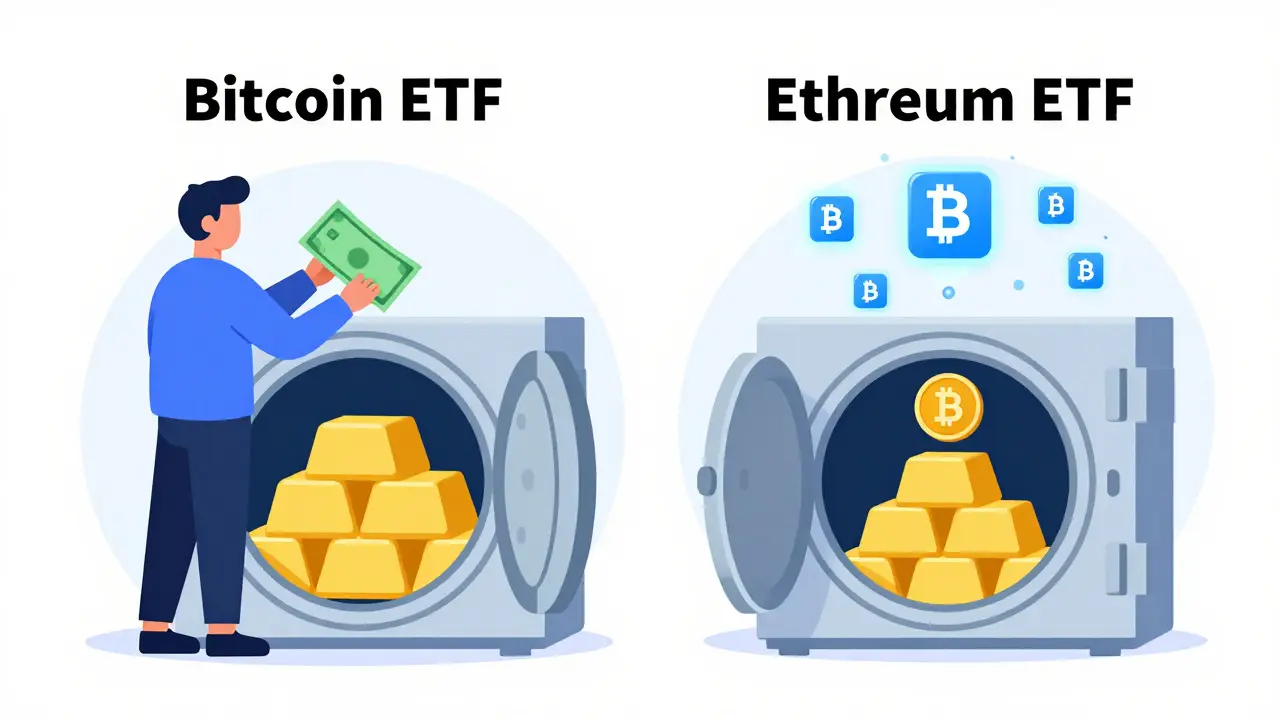
Bitcoin vs. Ethereum ETFs: Not the Same
Don’t treat them like twins. They’re different animals. Bitcoin ETFs are simple. They hold Bitcoin. No staking. No rewards. Just price tracking. All 11 Bitcoin ETFs use the same structure. Fees range from 0.00% (Fidelity’s FBTC) to 0.90% (Grayscale’s GBTC). Most sit around 0.25%. Ethereum ETFs? More complex. Ethereum runs on proof-of-stake. That means holding ETH earns rewards. The SEC allowed ETF providers to stake their ETH and pass rewards to investors. But not all did. Only five of the 11 Ethereum ETFs chose to stake. Grayscale’s ETHE staked 4.2% of its 3.1 million ETH holdings. That generated $127 million in quarterly rewards. Other providers skipped it, fearing regulatory gray areas. The SEC hasn’t clarified if staking rewards count as income or capital gains. Fees for Ethereum ETFs are higher. Average is 0.35%. Grayscale’s ETHE charges 1.50%-a legacy of its old trust structure. VanEck’s EETH charges just 0.15%. Investors are voting with their wallets. EETH has grown faster than ETHE since July 2024.Market Data: Who’s Winning?
As of September 30, 2025:- Bitcoin ETFs: $54.3 billion in assets under management
- Ethereum ETFs: $18.7 billion in assets under management

What This Means for You
If you’re an individual investor, you now have three real options:- Buy Bitcoin or Ethereum directly-full control, full responsibility.
- Buy a Bitcoin ETF-easy, taxable, no wallet needed.
- Buy an Ethereum ETF-same as above, but you might earn staking rewards.
What’s Next?
The SEC’s October 2025 orders didn’t just open the door for Bitcoin and Ethereum. They opened it for everything else. The language says “a host of crypto asset ETPs.” That means Solana, Cardano, even XRP could be next. Hong Kong already launched its first Solana ETF in October 2025, charging 0.99% fees. Singapore and the EU are expected to follow by mid-2026. The UK lifted its ban on crypto ETNs in October 2025, letting retail investors hold Bitcoin and Ether in tax-free ISAs. Institutional adoption is accelerating. Fidelity’s FETH ETF hit $842 million in trading volume in a single day. 78% of institutional investors now prefer ETFs over direct crypto for estate planning and collateralization. But risks remain. Harvard Law’s John Coates warned that staking could threaten Ethereum’s security if too much ETH gets locked in ETFs. The SEC hasn’t defined what “sufficient custody” means for staking rewards. That’s the next legal battle.Final Thoughts
The approval of Bitcoin and Ethereum ETFs wasn’t just a regulatory win. It was a cultural shift. Crypto moved from fringe speculation to mainstream finance. The SEC didn’t endorse crypto. It just admitted it’s here to stay. The market is no longer about whether crypto belongs in portfolios. It’s about which ETFs you choose, how much you pay, and whether you want staking rewards. The rules are clearer. The tools are better. The door is open. If you’ve been waiting to get into crypto, you don’t need to wait anymore. But you do need to pay attention-to fees, to structure, and to what’s really inside the ETF.Are Bitcoin and Ethereum ETFs the same as buying crypto directly?
No. When you buy a Bitcoin or Ethereum ETF, you’re buying shares in a fund that holds the crypto. You don’t own the actual coins. You can’t send them to a wallet or use them for transactions. But you also don’t need to manage private keys or worry about exchange security. It’s like owning shares in a gold ETF instead of holding a gold bar.
Why do Ethereum ETFs have higher fees than Bitcoin ETFs?
Ethereum ETFs are newer and more complex. Some charge higher fees because they offer staking rewards, which require extra infrastructure. Grayscale’s ETHE charges 1.50% because it was originally a trust with higher expenses and only recently converted to an ETF. VanEck’s EETH charges 0.15% because it was built from the ground up as a low-cost ETF. Fees reflect operational costs, not just the asset.
Can I lose money in a Bitcoin or Ethereum ETF?
Yes. ETFs track the price of Bitcoin or Ethereum. If the price drops, your ETF shares drop too. The ETF structure doesn’t protect you from market volatility. It just makes it easier to buy and hold. You still face the same risks as holding crypto directly-just without the technical risks like losing your private key.
Do I pay taxes on Ethereum ETF staking rewards?
It’s unclear. The IRS hasn’t officially ruled on whether staking rewards from ETFs are taxable as income or capital gains. Most tax professionals treat them as ordinary income when received, similar to dividends. But because the SEC hasn’t clarified the regulatory status of staking, the tax treatment remains in flux. Always consult a tax advisor.
Will more cryptocurrencies get ETFs soon?
Yes. The SEC’s October 2025 approval explicitly allows for “a host of crypto asset ETPs.” Solana already got its ETF in Hong Kong. XRP, Cardano, and others are under review. The SEC isn’t saying yes to all crypto-just those that meet their criteria for market maturity, custody, and transparency. Bitcoin and Ethereum cleared the bar. Others will follow if they do the same.
Is it safe to invest in crypto ETFs now?
They’re safer than buying crypto on an unregulated exchange, but not risk-free. The ETFs are regulated, held by major custodians like Coinbase or Fidelity, and subject to SEC oversight. But the underlying assets-Bitcoin and Ethereum-are still volatile. They can drop 30% in a week. Only invest what you can afford to lose. And choose low-fee ETFs with strong liquidity.
Next steps: Compare ETF expense ratios on YCharts or ETF Database. Check which providers offer in-kind conversions. If you’re holding crypto in a wallet, consider moving a small portion into an ETF to test the waters. Don’t go all in-but don’t wait for perfection. The market’s already moved.
Freddy Wiryadi
28 01 26 / 19:03 PMHonestly? This is the moment crypto stopped being a weird internet thing and started being real money. I bought IBIT last week and just let it sit. No more panic-selling because I forgot my seed phrase 😅
Brianne Hurley
29 01 26 / 14:32 PMUgh. So now we're just replacing one form of gambling with another, but with more paperwork? I mean, sure, you don't have to worry about losing your keys... but you're still betting on a digital ghost that's controlled by a handful of devs and miners. And don't get me started on staking rewards-total regulatory gray zone.
christal Rodriguez
29 01 26 / 17:18 PMETFs don't change the volatility.
Tressie Trezza
31 01 26 / 10:18 AMI switched from holding ETH in a wallet to EETH last month. The fees are insane low, and I don't have to stress about gas prices or Metamask updates. Honestly? It's like upgrading from a flip phone to a smartphone. Still a phone, just way less annoying.
Calvin Tucker
31 01 26 / 23:40 PMThe SEC’s in-kind approval is the most significant regulatory development since the 2017 ICO boom. It aligns crypto ETFs with the structural integrity of traditional asset-backed securities, thereby mitigating counterparty risk and reducing systemic friction in liquidity provision.
Rob Duber
1 02 26 / 07:40 AMI just watched my $20K in ETHE turn into $18K in two weeks and I'm screaming into a pillow. But hey-at least I didn't lose it to some sketchy exchange that got hacked. Still feels like watching your house burn down while wearing a tuxedo. 🤡
Gary Gately
1 02 26 / 22:57 PMidk why ppl r so mad about fees? like yeah 1.5% sucks but if you dont wanna manage keys then u pay. its like paying for a safe deposit box. and the staking rewards? that's free money. why complain?
Joshua Clark
2 02 26 / 23:56 PMI think people are missing the bigger picture here-this isn’t just about convenience or fees, it’s about legitimacy. The fact that institutional investors are now moving billions into these ETFs through in-kind swaps means that crypto is no longer a speculative sideshow. It’s becoming part of the core infrastructure of finance, like bonds or commodities. And that shift, subtle as it may seem, will ripple through everything-pension funds, endowments, even retirement accounts. The SEC didn’t just approve ETFs-they acknowledged that digital assets are here to stay, and the market structure had to evolve to accommodate them. The real revolution isn’t the product-it’s the mindset.
Katie Teresi
3 02 26 / 15:07 PMAmerican investors are getting soft. In Europe, we’ve had crypto ETNs for years. You want real innovation? Look at Switzerland’s regulated crypto funds. Not this watered-down Wall Street version with 0.25% fees and no real ownership. You’re not investing-you’re renting.
Moray Wallace
3 02 26 / 16:14 PMI appreciate the clarity in this breakdown. The distinction between Bitcoin as digital gold and Ethereum as a platform is critical. I’ve been holding ETH since 2018, and seeing it treated as a separate asset class feels like validation.
Dahlia Nurcahya
4 02 26 / 20:04 PMIf you're new to this, start small. Put 5% of your portfolio into a low-fee ETF like FBTC or EETH. Learn how it feels to hold it without managing keys. Then decide if you want to go deeper. No rush. The market isn't going anywhere.
William Hanson
5 02 26 / 17:59 PMYou people are delusional. This is just Wall Street’s way of sucking the soul out of crypto. They took the rebellion, put it in a suit, and started charging fees. The whole point was decentralization. Now you’re trusting BlackRock to hold your ‘Bitcoin’. Pathetic.
Lori Quarles
7 02 26 / 12:23 PMI moved my entire crypto stash into ETFs last month. My mom asked if I was crazy. I said, ‘Mom, I’m not crazy-I’m just finally using the tools the system gave me.’ And guess what? She opened her first IRA last week. We’re talking about real change, not just crypto bros yelling into the void.
Jeremy Dayde
8 02 26 / 09:27 AMI’ve been holding Bitcoin since 2016 and I still remember when you had to mine it on your laptop and explain to your friends why you were wasting electricity. Now my cousin who works at a bank just bought IBIT through her 401(k) and didn’t even ask me what it was. That’s wild. The culture shift is real. I’m not mad. I’m just… amazed. It’s like watching your kid grow up and become a doctor while you’re still wearing the same hoodie.
Steven Dilla
8 02 26 / 12:01 PMIn-kind swaps are the real MVP here. I moved 12 BTC into IBIT last week and didn’t pay a single cent in capital gains. Like… that’s basically a tax loophole with a SEC stamp. 🙌 And now my wallet’s empty but my portfolio’s still growing. Crypto’s not dead-it just got a corporate makeover.
Meenal Sharma
8 02 26 / 20:48 PMThe institutionalization of cryptocurrency represents a profound epistemological rupture in the ontological framework of monetary sovereignty. The state, through the SEC, has co-opted decentralized value systems and reconstituted them as tradable financial instruments under the auspices of neoliberal governance. This is not progress-it is the commodification of resistance. The blockchain was meant to liberate. Now it merely lubricates the machine.