
The race for the future of money isn’t about which coin has the biggest community or the flashiest whitepaper. It’s about who can deliver fast, secure, and trusted digital payments at scale. Right now, that race is between CBDCs and private cryptocurrencies - and governments are pulling ahead.
CBDCs Are No Longer Experiments
In 2023, only 114 countries were looking into digital currencies issued by their central banks. By early 2025, that number jumped to 134 - covering 98% of global GDP. This isn’t a trend. It’s a global shift. From the Bahamas to Brazil, from Japan to Nigeria, central banks are no longer asking if they should build a digital currency. They’re asking how fast they can launch it.
Eighty-one central banks are still in the exploration phase, but 69 have moved into active development or pilot testing. That means real code, real user testing, and real infrastructure being built. Four countries have fully launched their CBDCs - the Sand Dollar in the Bahamas, the eNaira in Nigeria, the Jamaican JAM-DEX, and Zimbabwe’s ZiG. But if you count countries with full public rollout and nationwide usage, the number climbs to 11. That’s not a handful anymore. It’s a wave.
Why CBDCs Beat Private Crypto in Cross-Border Payments
Private cryptocurrencies promised to make international transfers cheap and fast. But in practice, they’re messy. You need a wallet, an exchange, a bridge, and often a third-party service to convert to local currency. Fees pile up. Settlements take hours. And regulators still don’t know how to handle them.
CBDCs are solving this differently. Twenty-nine countries are working together on cross-border CBDC projects. The mBridge project - led by the BIS, China, Hong Kong, Thailand, and the UAE - has already processed $59 billion in cross-border transactions in 2025. That’s up 45% from last year. Project Dunbar in Australia, Singapore, and Malaysia is testing shared settlement platforms. These aren’t theoretical. They’re live.
Unlike Bitcoin or Ethereum, CBDCs are built to talk to each other. They follow the same rules, use shared standards, and integrate with existing banking systems. That’s why 17 bilateral agreements now exist between nations to make CBDC flows smooth and legal. Private crypto? Still stuck in a patchwork of bans, unclear rules, and inconsistent compliance.
Regulation Isn’t a Bug - It’s a Feature
One of the biggest complaints about CBDCs is that they’re too controlled. Governments can track every transaction. That’s true. But here’s the twist: that’s exactly why businesses and banks prefer them.
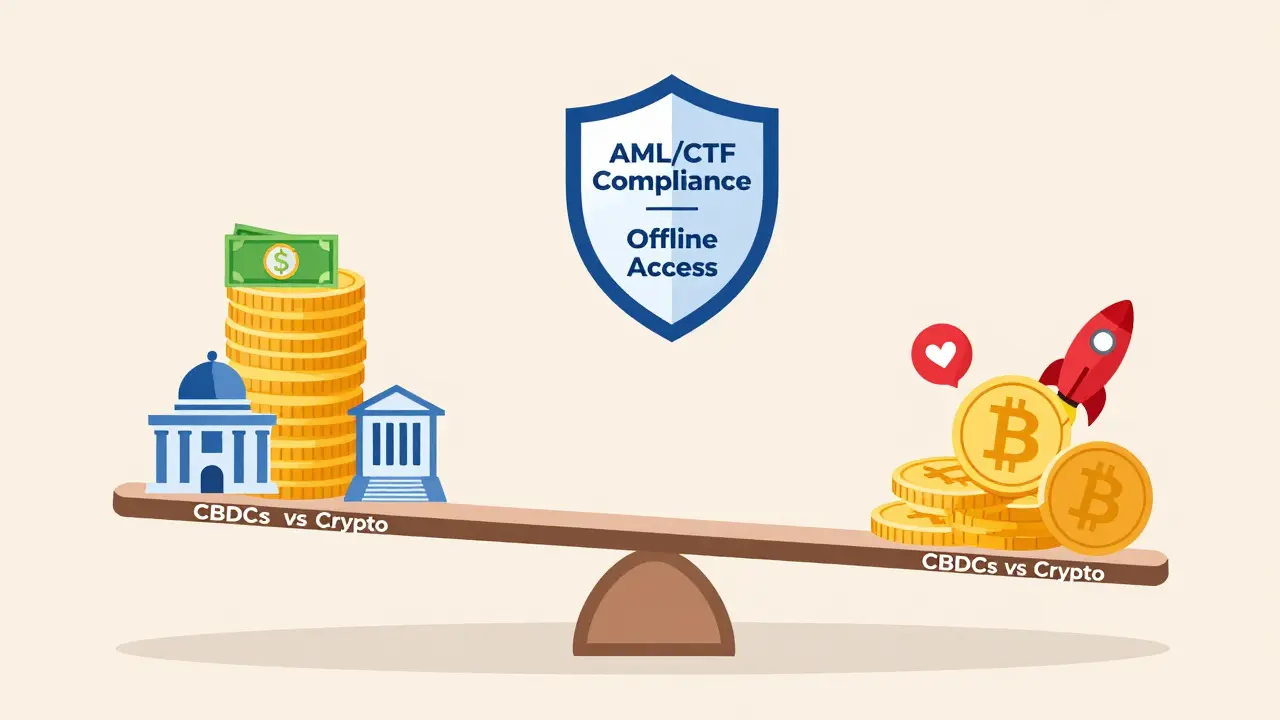
Over 48% of countries running CBDC pilots have aligned their anti-money laundering (AML) and counter-terrorism financing (CTF) rules with digital currency flows. That means banks can onboard customers faster. Compliance teams don’t need to guess if a payment is clean. They know. And 38% of cross-border CBDC projects are testing blockchain-based digital identity systems to verify users instantly.
Compare that to private crypto. Most exchanges still don’t know who their users are. The U.S. Treasury flagged over 1,200 crypto-related money laundering cases in 2024. Regulators are tightening rules - and pushing users toward platforms that play by the rules. CBDCs don’t fight regulation. They bake it in.
Technical Design: CBDCs Are Built for Real Life
Bitcoin was designed to be decentralized. CBDCs are designed to be useful.
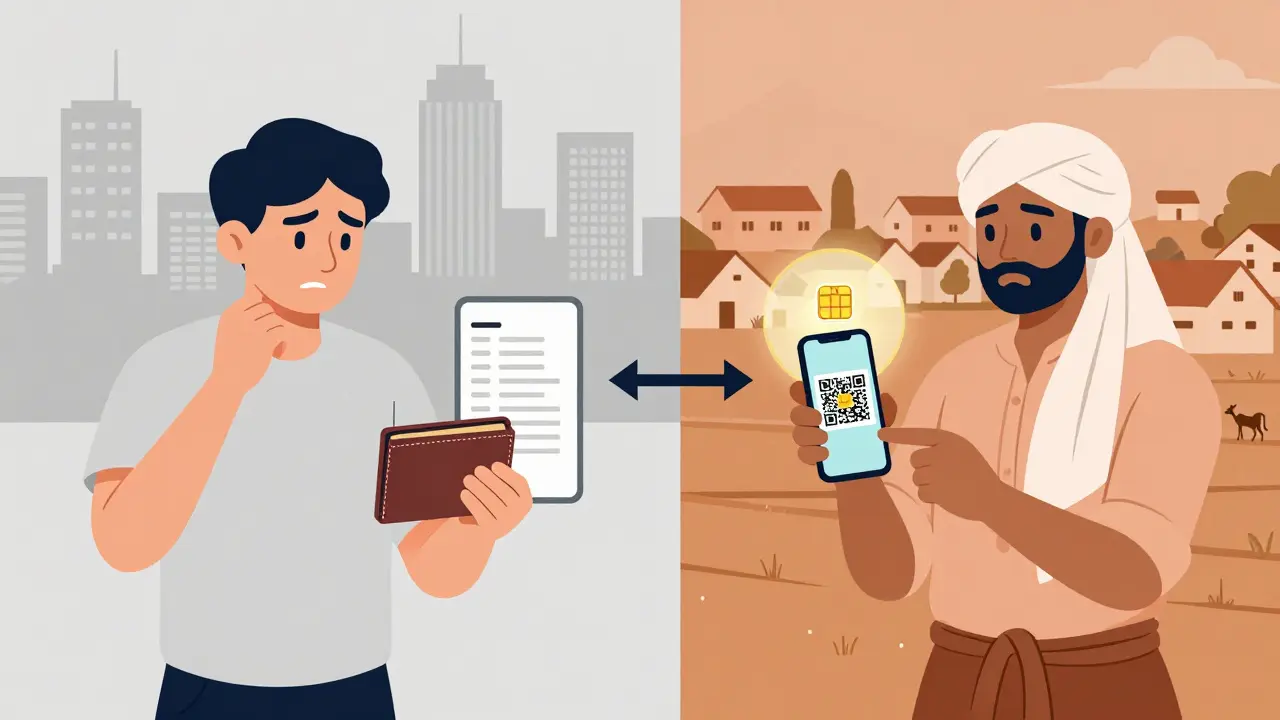
The Reserve Bank of India expanded its digital rupee (e₹) in 2025 to include offline payments. You don’t need internet. Just a phone and a chip. Farmers in rural Bihar can now receive subsidies without a data plan. Retailers in Jaipur accept payments even in areas with no signal.
The Bank of Japan spent two years running pilot programs with real users - not developers, not bankers, but ordinary citizens. They tested UIs. They watched how people used the app. They fixed bugs. They added features like automatic savings buckets and spending limits for teens. This isn’t tech for tech’s sake. It’s tech for people.
Private crypto wallets? Still clunky. You need seed phrases. You risk losing money if you mis-type an address. No customer service. No refunds. No way to reverse a mistake. CBDCs have all that - because they’re built by institutions that answer to the public.
The Big Fear: Bank Runs and Financial Stability
There’s one major risk no one talks about enough: what happens if everyone dumps their bank deposits into CBDCs?
Imagine a sudden economic shock - a recession, a currency crisis, a war. People panic. They want cash. But if cash is gone, and CBDCs are the only digital option, millions might rush to convert their bank savings into CBDCs. That’s a bank run - but faster, bigger, and harder to stop.
The IMF warned in October 2024 that this could drain banks of liquidity. Banks lend money. If they lose deposits, they can’t lend. Credit freezes. The economy slows. That’s why countries like Canada and Sweden are designing CBDCs with limits: you can only hold $5,000 in CBDCs per person. No interest. No rewards. Just a safe place to store small amounts.
Private crypto doesn’t have this problem - because it doesn’t touch banks. But that’s also its weakness. If your bank fails, you’re covered by insurance. If your crypto exchange collapses? You’re on your own.
Security: Who’s Really Safer?
Private crypto fans say blockchain is unbreakable. But look at the facts. In 2024, over $3.2 billion was stolen from crypto platforms. DeFi protocols got hacked. Exchanges got breached. Wallets got drained.
CBDCs? They’re not built on public blockchains. They’re built on secure, centralized infrastructure - with layers of encryption, real-time fraud detection, and government-backed recovery systems. Over 100 central banks now treat CBDC cybersecurity as a national priority. They’re hiring top cyber teams, running red-team exercises, and testing against state-level attacks.
Is it perfect? No. A CBDC system with 1.4 billion users is a massive target. But it’s designed by institutions that have spent decades securing financial systems. Crypto? Built by hobbyists, often with open-source code and no accountability.
Why Private Crypto Still Has a Shot
Don’t get me wrong - private crypto isn’t dead. It still wins in three areas:
- Censorship resistance: If your government freezes your account, you can still move crypto. CBDCs? They can be paused.
- Decentralized governance: Bitcoin’s rules are set by code, not politicians. CBDCs? Always under central bank control.
- Independence from monetary policy: If your country prints too much money, crypto can act as a hedge. CBDCs? They’re tied to the national currency.
But here’s the catch: these are niche benefits. Most people don’t care about censorship resistance. They care about paying rent on time, sending money to family, or buying groceries without a 5% fee. For those use cases, CBDCs are winning.
The Future: Coexistence, Not Replacement
CBDCs won’t kill Bitcoin. And Bitcoin won’t kill the digital dollar. But they’ll carve out different roles.
CBDCs will be the backbone of everyday payments - salaries, taxes, subsidies, cross-border trade. They’ll be the digital version of cash: reliable, regulated, and backed by the state.
Private crypto will stay in the shadows - used for speculative trading, borderless remittances in unstable regions, and as a hedge against hyperinflation. It won’t be the main system. But it won’t disappear.
The real question isn’t which one wins. It’s whether your country can build a CBDC that’s simple, secure, and fast enough to make people want to use it. So far, the data says: yes, they can.
Are CBDCs the same as Bitcoin or Ethereum?
No. CBDCs are digital versions of your national currency - issued and controlled by your central bank. Bitcoin and Ethereum are private cryptocurrencies created by decentralized networks. CBDCs are legal tender. Crypto is not. CBDCs can be tracked. Most crypto transactions are pseudonymous. CBDCs are designed for everyday use. Crypto is often used for speculation or bypassing regulations.
Can I use CBDCs without a bank account?
Yes - that’s one of their biggest goals. Countries like India and Nigeria built CBDCs to reach unbanked populations. You can use a basic smartphone app with offline capabilities, even without a bank account. Some systems allow payments via QR codes or digital tokens stored on a chip. The idea is to make money accessible, not just digital.
Will CBDCs replace cash?
Not immediately - and not everywhere. Many countries are keeping cash alive for now, especially in rural areas or among older populations. But over time, as digital payments become the norm, cash use will decline. CBDCs are designed to be the digital successor to cash, not to eliminate it overnight.
Why do governments care so much about CBDCs?
Three reasons: control, efficiency, and security. CBDCs give governments better control over monetary policy, reduce the cost of payments, and improve financial inclusion. They also make it harder for criminals to move money anonymously. For countries with weak banking systems, CBDCs can be a lifeline.
Is my privacy at risk with a CBDC?
It depends on the design. Some CBDCs offer full traceability - every transaction is recorded. Others use privacy-preserving tech, like zero-knowledge proofs, to hide small transactions while still catching fraud. The key difference from crypto: CBDCs are regulated, so privacy rules are set by law - not by a blockchain protocol that can change overnight.
Cordany Harper
22 03 26 / 19:00 PMHonestly, I never thought I'd say this, but CBDCs are starting to make sense. I used to be all in on crypto, but after seeing how many people struggle with wallets and seed phrases, I get it now. It's not about ideology-it's about whether your grandma can pay for groceries without losing her money. The offline feature in India? Genius. That’s real inclusion.
Annette Gilbert
22 03 26 / 19:51 PMOh wow, so now we're just trading one surveillance state for another? Congrats, central banks-you turned money into a loyalty card with a blockchain-shaped sticker.
DarShawn Owens
23 03 26 / 23:36 PMI’ve been using the eNaira app for a few months now. No drama. No gas fees. My aunt in Lagos got her pension on time for the first time ever. That’s not hype-that’s life-changing. People keep talking about ‘control’ like it’s a bad thing. What’s worse? Being controlled… or being ignored by the system?
vu phung
24 03 26 / 02:20 AMThe architectural asymmetry here is fascinating. Private crypto operates on a permissionless, trust-minimized stack-while CBDCs leverage a permissioned, trust-anchored infrastructure with embedded compliance layers. The latter isn’t just more scalable-it’s inherently more resilient to systemic friction. Think of it as Web2 meets financial rails. The UX? Way smoother. The compliance? Automated. The adoption curve? Exponential.
Lorna Gornik
25 03 26 / 02:01 AMi mean... the offline thing in india? 🤯 like, my cousin in rural odisha just got paid via cbdc and didn't need data. no joke. that's the future. also, why are we still arguing about decentralization like it's 2017? lol 🙃
Ananya Sharma
25 03 26 / 04:16 AMCBDCs are not about control. They're about access. In India, millions have never held a bank card. Now they have a phone app that works without internet. That's not surveillance. That's dignity.
JOHN NGEH
25 03 26 / 19:32 PMI’ve been skeptical, but the mBridge data is hard to ignore. $59 billion in cross-border flows? That’s not a pilot-it’s a new global standard. And the fact that it’s interoperable with existing banking systems? That’s the real win. Crypto’s fragmentation just doesn’t scale.
Joshua T Berglan
26 03 26 / 08:15 AMY’all are missing the point. CBDCs aren’t trying to replace crypto. They’re trying to replace cash. And honestly? Cash is outdated. I haven’t used paper money in 3 years. My kid’s allowance goes straight to her CBDC wallet. No arguing, no losing it. Just clean, simple, safe. We’re not losing freedom-we’re upgrading infrastructure.
Kevin Da silva
27 03 26 / 09:56 AMThe bank run risk is real but overblown. Limits exist for a reason. Canada’s $5k cap? Smart. People don’t want to hoard digital cash. They want to spend it. The real threat is if banks don’t adapt. Not CBDCs.
Kayla Thompson
28 03 26 / 15:32 PMOh so now we're just gonna hand over our financial autonomy to some bureaucrat in a suit who thinks 'trust' is a feature? Cute. Meanwhile, I'm still holding my BTC because I don't trust anyone with my money-not even my government.
Kevion Daley
30 03 26 / 02:37 AMThe fact that you're calling CBDCs 'secure' while ignoring the attack surface of a centralized 1.4B-user system is peak cognitive dissonance. Crypto may be messy, but at least your keys are yours. With CBDCs? You're one hack away from being frozen out of your own life.
Jeannie LaCroix
1 04 26 / 00:23 AMI work in fintech. I’ve seen the internal docs. CBDCs aren’t built for the people. They’re built for surveillance. The ‘privacy-preserving tech’? It’s a marketing slide. The backdoor? Always there. They’re not fixing finance-they’re weaponizing it. And the worst part? People are okay with it because it’s ‘convenient’.
Domenic Dawson
2 04 26 / 07:57 AMI used to think crypto was the future. Then I tried to send $50 to my sister in Nigeria. Took 3 days. 3 different apps. Two failed. One got flagged. CBDC? She got it in 12 minutes. No questions. No fees. Just… done. I’m not mad. I’m just impressed.
Sam Harajly
4 04 26 / 01:57 AMThe biggest advantage of CBDCs isn’t speed or security-it’s predictability. You know the rules. You know who’s in charge. You know what happens if something goes wrong. Crypto? You’re gambling on code and community consensus. That’s not innovation. That’s chaos dressed up as rebellion.
namrata singh
5 04 26 / 05:04 AMi think the real story is how cbdc is helping small farmers in india. no more middlemen. no more delays. money goes straight. that's not control. that's justice.
Jackie Crusenberry
5 04 26 / 08:28 AMSo... we're just gonna let the government track every coffee purchase? Cool. I'll just keep my cash under the mattress. Or my crypto. Whatever.
Cordany Harper
6 04 26 / 04:15 AMI see your point about surveillance, Annette. But let’s not pretend private crypto is a privacy utopia. Every exchange you use knows who you are. Every wallet you connect to a DEX leaks metadata. CBDCs at least have legal limits on data use. Crypto? Your data gets sold to advertisers, then exploited by hackers. The system’s broken either way-but CBDCs have a path to fix it.